
SidePak AM520
Personal Aerosol Monitor
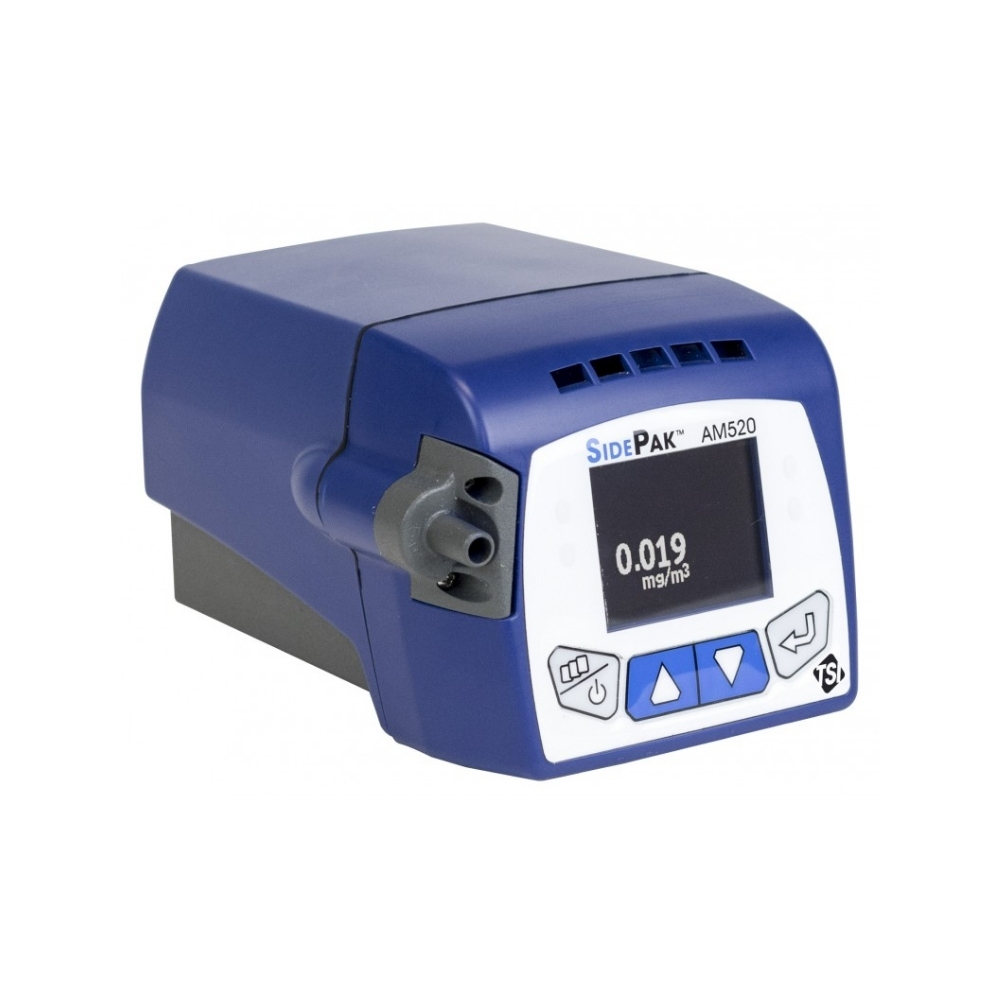
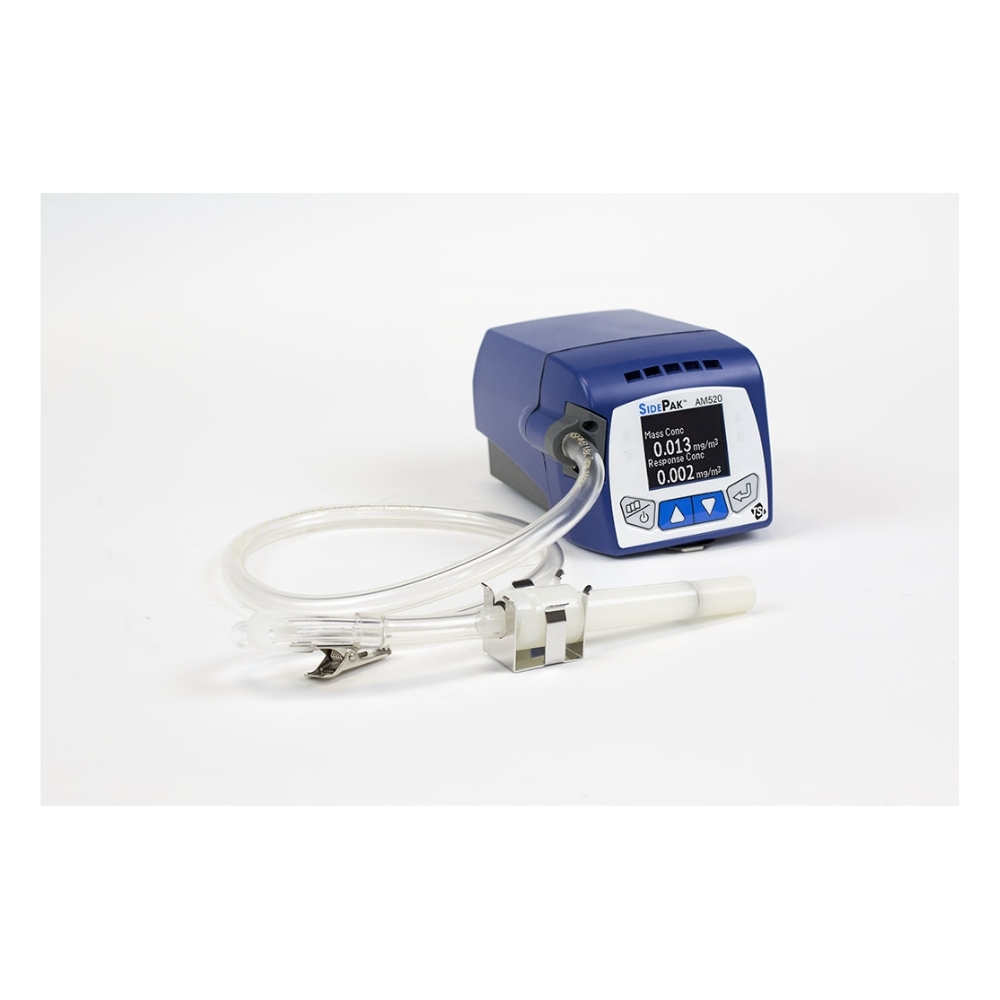
The TSI SidePak AM520 is a personal aerosol monitor that measures dust, fumes, mists, smoke and fog in the worker’s breathing zone in real time, rather than on a filter sent away for analysis. It’s a light scattering laser photometer that displays mass concentration as it happens, from 0.001 to 100 mg/m³. Interchangeable inlet conditioners set the size fraction, from PM10 to respirable and 0.8 micron diesel particulate, and the battery runs for more than 20 hours.
KEY BENEFITS
- Real time mass concentration in the breathing zone, not a result days later
- User defined calibration factors, so readings can be matched to the specific dust on site
- Interchangeable inlet conditioners set the size fraction from PM10 down to 0.8 micron DPM
- Measures from 0.001 to 100 milligrams per cubic metre
- More than 20 hours of battery run time, covering a full shift on one charge
+ more in the Description tab below
Real Time Changes What the Measurement Is For
Traditional respirable dust measurement clips a filter to a worker, runs it for a shift, and sends it away for gravimetric analysis. The result arrives days later as one number for the whole shift.
That number tells you whether the shift averaged above the limit. It tells you nothing about what caused it. By then, the task has been repeated, and any control decision is based on a guess about which part of the day produced the exposure.
The SidePak AM520 measures continuously and displays as it goes, so the record is a trace rather than an average. It shows which task, which part of the shift and which location produced the dust, which is the information a control decision actually needs.
It also warns the person wearing it. A 95 dBA audible alarm, a blinking red LED and a flashing red display mean an exposure can be acted on during the shift, rather than reported after it. Alarms can be set as general or STEL alarms, with levels from 0.001 to 999 mg/m³.
Calibrating for the Dust You’re Measuring
The AM520 is a photometer. It works out mass from scattered light, and the relationship between the two depends on the particle size, shape and density of the dust being measured.
It’s factory calibrated against the respirable fraction of ISO 12103-1 A1 test dust. For accurate readings on a particular site’s dust, TSI’s manual sets out how to develop a photometric calibration factor: run the AM520 side by side with a gravimetric sampler, compare the results, and enter the new factor into the instrument. TSI provides application notes for doing this for respirable silica and for diesel particulate matter.
Up to five user defined calibration factors can be stored, with labels, so the instrument can be switched between materials and sites. That’s the point worth understanding rather than glossing over: the AM520 is accurate when the calibration factor is right for the dust, and misleading when it isn’t.
Inlet Conditioners Set What You’re Measuring
The size fraction the AM520 reports is set by the inlet fitted, not by the electronics.
| Fraction | Inlet | Application |
|---|---|---|
| PM10 | Impactor | Inhalable and general ambient dust |
| PM4, respirable | 4 micron Dorr-Oliver cyclone | The fraction reaching the deep lung, which exposure standards are written against |
| PM5, China respirable | Impactor | Where that standard applies |
| PM2.5 | Impactor | Fine particulate, including combustion sources |
| PM1 | Impactor | Very fine particulate |
| 0.8 micron | DPM impactor, with Dorr-Oliver cyclone upstream | Diesel particulate matter |
Changing the inlet changes the instrument’s job. One unit can cover respirable dust monitoring one day and diesel particulate in a workshop the next.
The flow rate is user adjustable up to 1.8 L/min, and the cyclones need it set to 1.7 L/min to give the correct cut point.
How It Measures
A 650 nm laser diode is directed at the aerosol stream drawn through the instrument. Light scattered by the particles is collected at 90 degrees to the beam, and the intensity of that scattered light is a function of the particle concentration.
That gives a range from 0.001 to 100 mg/m³, across particle sizes from 0.1 to 10 microns, with a minimum resolution of 0.0001 mg/m³.
Personal Monitoring, Not Area Monitoring
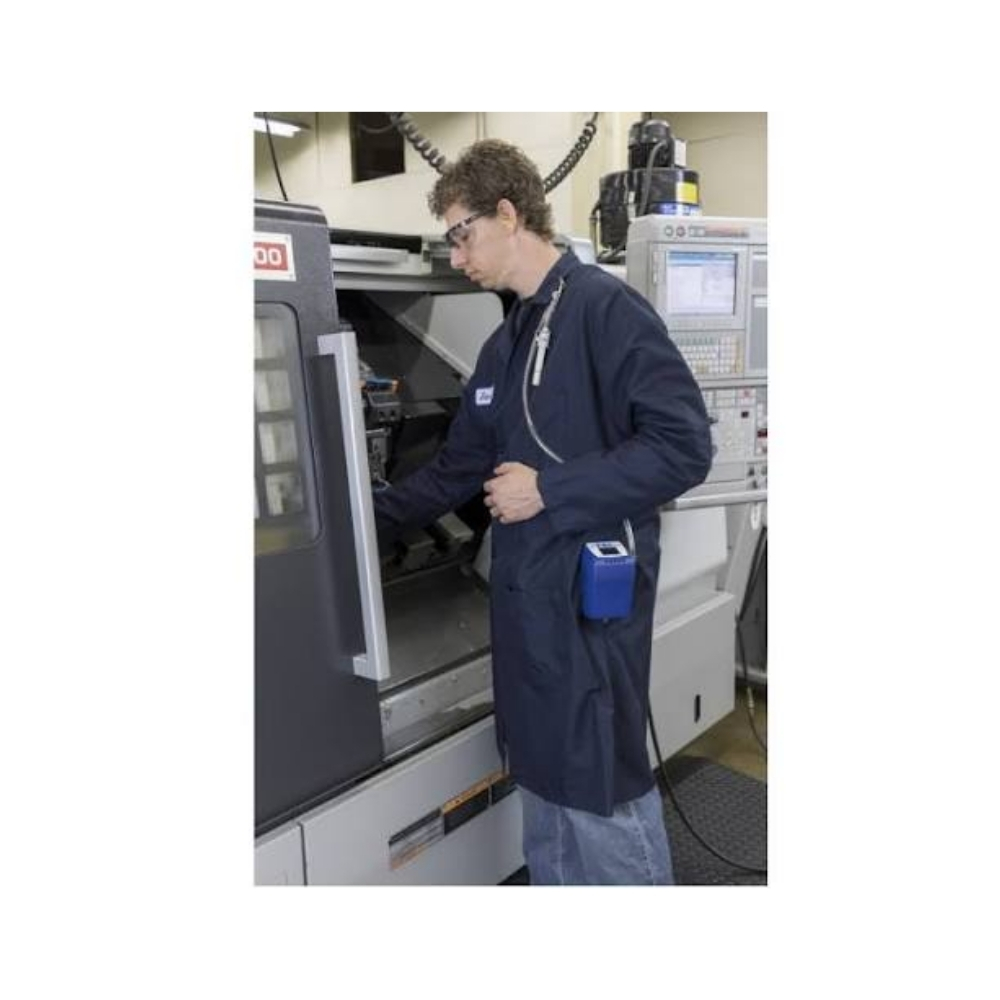
The AM520 is designed to be worn on a person for a shift. It’s rated IP54, protected from limited dust and water spray, and works from 0 to +50°C.
For continuous unattended monitoring at a boundary or fence line, area monitoring is the better fit, and AQMesh is one option. Used together, they answer different halves of the same question: personal monitoring shows what one worker breathed, and area monitoring shows what the space contained and where it came from.
Data and Software
The AM520 logs about 80,000 data points (55 days at one reading a minute), with logging intervals from 1 second to 30 minutes. It’s operated by push buttons, or programmed through TSI’s TrakPro v5 software over USB.
Where It’s Used
Mining. Foundries. Construction sites. Chemical plants. Refineries and petrochemical plant. Power and utilities. Transportation. Aerospace. Maritime. Confined space work where dust is the hazard. General industry and occupational hygiene surveys.
Benefits
- Real time mass concentration in the breathing zone, not a result days later
- User defined calibration factors, so readings can be matched to the specific dust on site
- Interchangeable inlet conditioners set the size fraction from PM10 down to 0.8 micron DPM
- Measures from 0.001 to 100 milligrams per cubic metre
- More than 20 hours of battery run time, covering a full shift on one charge
- Audible alarm at 95 dB with visible red LEDs, so the wearer is warned rather than only recorded
- Logs about 80,000 data points, so an exposure can be matched to the task that caused it
- Worn on the person rather than fixed to an area
- Compact at 620 g, with a colour OLED display
- Adjustable flow rate up to 1.8 L/min, set to suit the inlet fitted
Instrument type
Personal aerosol monitor, single channel light scattering laser photometer
Measurement
Real time aerosol mass concentration in the worker's breathing zone
Mass concentration range
0.001 to 100 mg/m³
Particle size range
0.1 to 10 micron
Size fractions
PM10, PM5 (China respirable), PM2.5 and PM1 by impactor. PM4 respirable by 4 micron Dorr-Oliver cyclone. 0.8 micron DPM by impactor with Dorr-Oliver cyclone
Inlets
Cyclones and impactors
Flow rate
User adjustable, 0 to 1.8 L/min. 1.7 L/min when using cyclones
Alarms
General and STEL alarms. 95 dBA audible horn, blinking red LED, flashing red display. Programmable from 0.001 to 999 mg/m³
Data logging
About 80,000 data points (55 days at once per minute). Logging intervals 1 second to 30 minutes
Battery
5,400 mAh Li-ion, more than 20 hours at 1.7 L/min with PM2.5 impactor
Battery charge time
Approximately 4 hours
IP rating
IP54
Sensor
90° light scattering, 650 nm laser diode. Minimum resolution 0.0001 mg/m³
Calibration
Factory calibrated against the respirable fraction of ISO 12103-1 A1 test dust. Up to 5 user defined calibration factors (0.1 to 10.0)
Weight and dimensions
620 g with battery. 129 x 94 x 78.4 mm
Display
Colour OLED, 160 x 128
Operating conditions
0 to +50°C. 0 to 95% RH, non condensing
Communications and software
USB. TrakPro v5 software
Approvals
EN 61326-1, IEC 61010-1, IEC 60825-1
- Aviation & Transportation
- Chemical Manufacturing
- Confined Space & Compliance
- Energy (Oil & Gas)
- Food & Beverage
- Landfill & Remediation
- Marine & Maritime
- Mining & Minerals
- Power Generation & BESS
- Technology & Semiconductor
- Water & Wastewater
A filter gives one number for a whole shift, days later. The AM520 measures continuously, so the record shows which task and which part of the day produced the exposure.
It measures respirable dust using the 4 micron cyclone. For an accurate silica related reading, a photometric calibration factor is developed for the specific dust on site, by running the AM520 alongside a gravimetric sampler. TSI provides an application note on doing this for respirable silica.
By changing the inlet. Impactors cover PM10, PM5, PM2.5 and PM1. The 4 micron Dorr-Oliver cyclone covers respirable PM4, and the DPM impactor covers 0.8 micron diesel particulate.
More than 20 hours at 1.7 L/min with the PM2.5 impactor, with about four hours to charge.
It's designed as a personal monitor worn for a shift, and is rated IP54. For continuous unattended outdoor monitoring, area monitoring equipment is the better fit.
Not the standard AM520. There is a certified variant, the AM520i, so talk to us if the work is in a classified area.
Trusted by









Contact Us
Can’t find what you’re looking for? Our team is happy to help.