
Functional Testing For Optical Flame Detectors
A flame detector’s built in test tells you the detector can see. It does not tell you anything happens when it does.
That distinction is the reason flame simulators exist, and it catches out more sites than it should. The automatic self test in a modern optical flame detector checks window cleanliness, optical integrity and internal electronics, and it runs continuously or at short intervals without anyone doing anything. What it deliberately does not do is activate the alarm outputs. So a detector can pass its own test daily for a year while something downstream has failed. A relay contact gone. A cable damaged during other work. A panel input isolated and never restored. A suppression release disconnected for maintenance and forgotten.
A flame simulator produces a signal the detector accepts as a real fire, which drives the entire chain. The detector alarms, the relay operates, the panel receives it, the notification devices activate and, if you choose, the suppression system releases. That is the only way to know the system does what the design says it does.
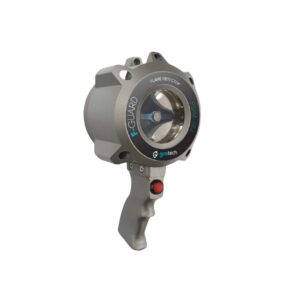
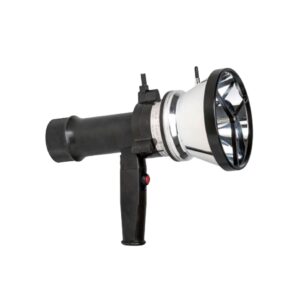
Gastech supplies two ranges. The Spectrex FS1100, FS1200, FS1300 and FS1400 are long range simulators approved to ATEX and IECEx for Zones 1, 2, 21 and 22. They run on rechargeable lithium ion batteries delivering at least fifty tests between charges. The F-Guard FLS FSIM range covers testing at shorter distances with three models matched to detector type, one for IR3, one for IR3-H2 and one for UV/IR.
Matching the simulator to the detector matters. A simulator produces a specific spectral signature, and a detector tuned to hydrogen will not respond to a source built for hydrocarbon flames. Buying the wrong one produces a failed test on a detector that is working perfectly. That wastes a day and undermines confidence in the system.
One practical point on suppression. Where the detector is linked to deluge or gas release, that output must be disabled at the panel before testing unless you intend it to fire. Simulators are frequently used to prove suppression release deliberately, which is a valid and worthwhile test, but it needs to be a decision rather than a discovery.
Flame simulators are also available through our hire fleet, which suits most operations better than owning one. Commissioning and periodic testing come round once or twice a year, and a simulator that sits in a store for eleven months still needs its battery maintained and its own condition verified.
Trusted by









Contact Us
Can’t find what you’re looking for? Our team is happy to help.