
Open Path Gas Detectors for Wide Area and Perimeter Monitoring
A point detector waits for gas to reach it. An open path detector watches a line of sight and picks up a cloud the moment it crosses the beam. That difference decides where each belongs. Point detection protects a known leak source such as a flange, a compressor seal or a pump. Open path detection covers the space in between, along a pipe rack, across a tank bund, around a compressor house or down a fence line. One open path detector can do the work of five to twenty point detectors placed in a straight line, which is why the installed cost per metre of coverage is so much lower.
Readings work differently too, and it catches people out. An open path detector reports in LEL metres rather than percent LEL, because it measures the total quantity of gas along the beam rather than the concentration at one spot. A small dense cloud and a large thin one can give the same reading. That is not a limitation, it is the point. What matters on a large site is whether gas is present in the area, not the exact concentration at a single coordinate.
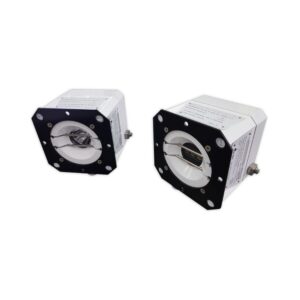
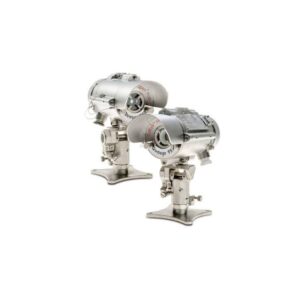
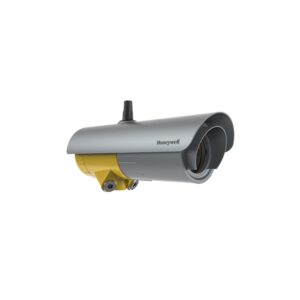
Gastech supplies two open path technologies, and they solve the problem in different ways. The Honeywell Searchline family uses infrared with a patented double band pass filter that compensates for fog and rain, so it holds accuracy through weather that blinds simpler detectors. The Spectrex SafEye family uses a xenon flash source with spectral fingerprint analysis by Differential Optical Absorption Spectroscopy, and keeps working through beam obscuration of up to 90 percent, which is why it became the preferred choice on offshore platforms and FPSOs.
Choosing between them comes down to path length and target gas. The Searchline Excel Plus is a medium range detector for combustible hydrocarbons, with Bluetooth setup, a high visibility LED status ring and no routine calibration. The Searchline Excel Edge is built for long range perimeter and fence line monitoring. The SafEye Quasar 900 covers combustible hydrocarbons from 7 to 200 metres in three models, in a stainless steel ATEX and IECEx enclosure with a built in event recorder holding the last hundred events. For toxic gas the SafEye Quasar 950 detects hydrogen sulphide and the Quasar 960 detects ammonia.
False alarms matter more here than with point detection, because an open path beam crosses a lot of ground. Both families are designed for it, staying immune to sunlight, flare stacks, arc welding and lightning, and both tolerate partial blockage, misalignment and vibration without reporting gas that is not there.
Path length, mounting geometry, gas selection and how the detectors report back all need working through together. Gastech engineering does that with you, and supports the installed system from WA, NSW and QLD.
Trusted by









Contact Us
Can’t find what you’re looking for? Our team is happy to help.