
Vehicle Mounted Gas Detection for Crews Entering Unknown Atmospheres
Fixed gas detection protects a place. Portable detection protects a person. Neither covers the situation in between, which is a crew arriving somewhere in a vehicle without knowing what is in the air.
That gap matters because the decision to stay in the cab or get out is made in the first few seconds, and the gases that cause harm are rarely the ones anyone can smell. Nitrogen dioxide from blasting and diesel exhaust is dangerous well below the level at which it becomes obvious. Carbon monoxide gives no warning at all. Methane and oxygen deficiency give none either. A detector clipped to a shirt alarms after somebody has opened the door and breathed, which is the wrong side of the decision.
Vehicle mounting is a genuine engineering problem rather than a bracket and a cable. A detector on a truck lives with constant vibration, shock loading, dust, washdown, a supply voltage that moves with the alternator, and a display that has to be readable in a cab in direct sunlight. Sensors also have to sit where they sample the outside air rather than the underside of the bodywork. Instruments built for a wall do not survive it.
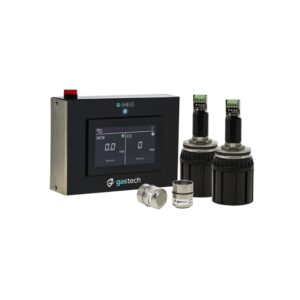
The G-Shield Fire is Gastech’s own answer, and it was the first vehicle mounted gas detector of its kind. A sensor platform threads directly onto the vehicle, secured against vibration, and reports to a bright full colour display mounted inside the cabin so occupants see real time ambient conditions. It runs on a 9 to 30 volt DC supply, which suits the range of vehicle electrical systems in a mixed fleet, and an optional display enclosure adds integrated audible and visual alarms. Installation was designed to be straightforward enough for a fleet workshop rather than a specialist.
Flexibility comes from G-Pods, the intelligent single sensor cartridges the system uses. An onboard circuit gives a universal interface across different target gases and different sensor technologies, so one platform covers oxygen, carbon monoxide, nitrogen dioxide, methane and ammonia depending on what the vehicle needs to know. G-Pods arrive calibrated before dispatch, so a sensor change is a swap rather than a workshop visit.
The same modular thinking extends past vehicles. Gastech has fitted G-Pods to robotic platforms for post blast re-entry monitoring in underground mining, where a droid carries detection into an atmosphere nobody should enter yet and reports back by WiFi, Bluetooth or 4 to 20 mA. Mobile gas detection is broader than cabs and getting broader.
Gastech designs and builds this equipment in Australia, which means the people who engineered it are the people who answer the phone. Service, calibration and support run from WA, NSW and QLD.
Trusted by









Contact Us
Can’t find what you’re looking for? Our team is happy to help.