
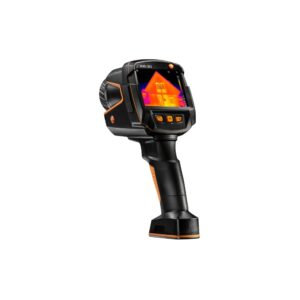
Thermal Imaging Cameras For Electrical, Solar And Mechanical Inspection
Gas detection tells you something has happened. Thermal imaging tells you something is about to.
That is why these sit alongside the rest of the range rather than apart from it. Almost anything failing electrically or mechanically gets hot before it stops working, and it gets hot long before it produces smoke, flame or gas. A loose terminal in a switchboard runs warm for months before it arcs. A bearing heats up before it seizes. A cell in a battery bank runs hotter than its neighbours before anything goes wrong with it. In each case the heat is visible with the right camera and invisible without one.
Electrical inspection is the most common application, and it is the one where the return is easiest to demonstrate. Loose or corroded connections, overloaded circuits and unbalanced phases all produce heat at the fault. A survey across a switchboard, a motor control centre or a distribution board under load finds them without shutting anything down or opening anything up. That is both faster and considerably safer than the alternative.
Solar is the fastest growing application in Australia and the least well served. Photovoltaic systems fail through physical damage, electrical faults, degradation over time, manufacturing defects and accumulated dirt, and most of that is invisible to the eye. Thermal imaging reveals cracks, delamination, water ingress and hot spots at a stage where a panel can be repaired or replaced rather than left to damage the rest of the string. On a solar farm or a large rooftop array, a scan is the only practical way to inspect at that scale.
Mechanical and process work covers the rest. Bearings, motors, couplings, belt drives and gearboxes running hot ahead of failure. Steam traps and valves passing when they should be shut. Refractory and furnace lining with a hot spot developing. Insulation gaps and thermal bridging in a building envelope. Blocked coils and duct losses in an HVAC system.
Battery installations are worth calling out separately, because they connect directly to work we already do. Cell imbalance and a hot cell in a battery bank are early indicators of a developing problem, well ahead of the off-gassing that lithium-ion gas detection is watching for. Thermal imaging and gas detection cover the same risk at different stages.
Resolution is the specification that decides everything else, and it matters more than it appears. Detector resolution runs from 160 by 120 pixels through 320 by 240 to 640 by 480, which is a sixteen fold difference in pixel count between the ends of that range. The reason it matters is not image quality. A hot spot smaller than the camera’s spot size at that distance gets averaged with its cooler surroundings, so it reads cooler than it actually is. Under-resolving a target does not produce a blurry picture of a fault, it produces a wrong temperature and a fault that looks acceptable.
So the selection question is how small the target is and how far away you have to stand. A terminal at arm’s length in a switchboard is straightforward. A busbar behind a barrier, a panel on a roof or a connection at height needs the pixels to resolve it properly.
Gastech supplies the Testo range across those resolutions. Our Technical Consultants will work through the targets you need to inspect and the distances involved before recommending a camera, from WA, NSW and QLD.
Trusted by









Contact Us
Can’t find what you’re looking for? Our team is happy to help.