
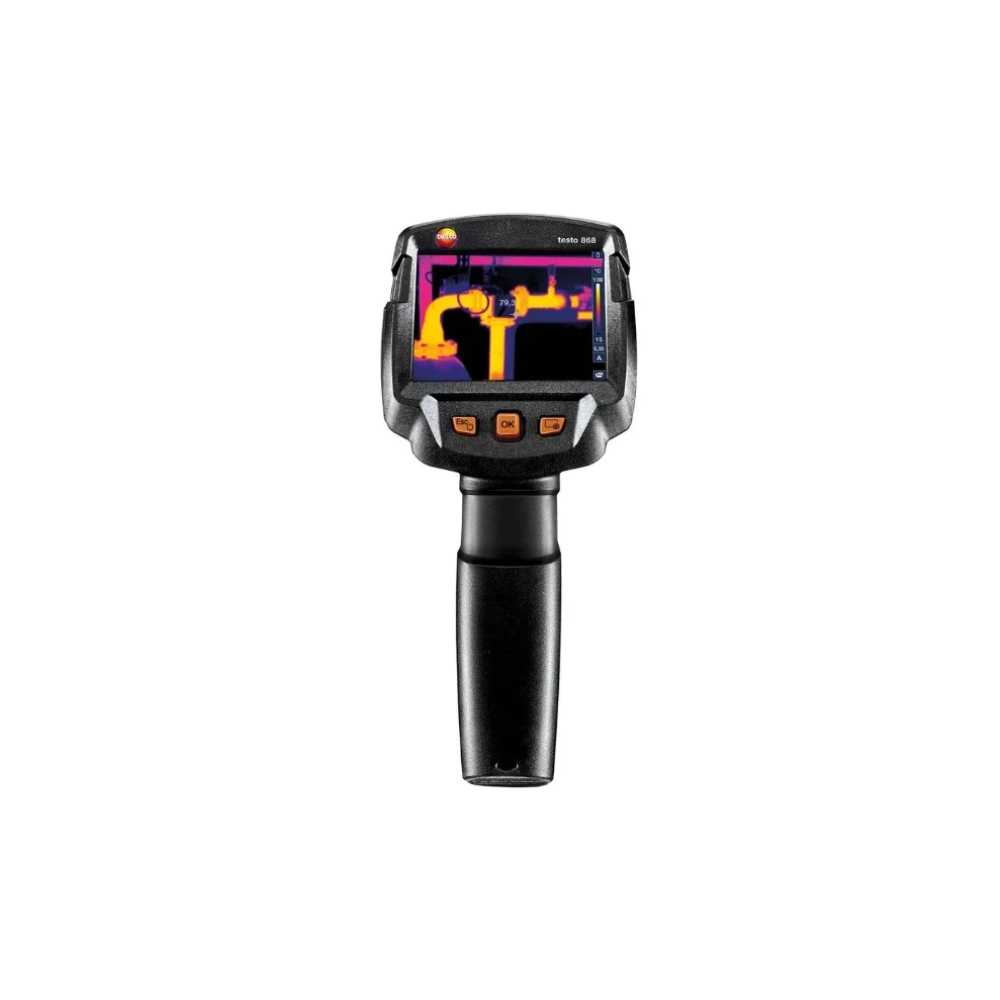
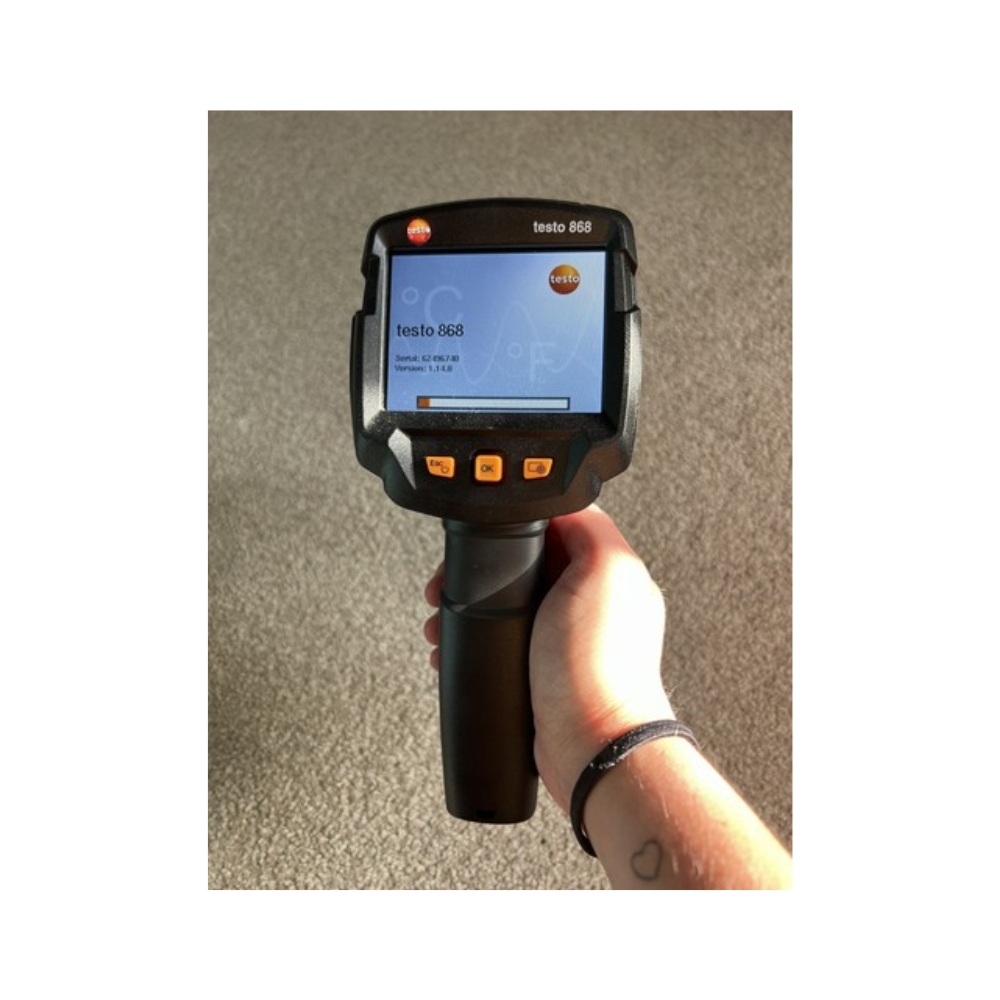
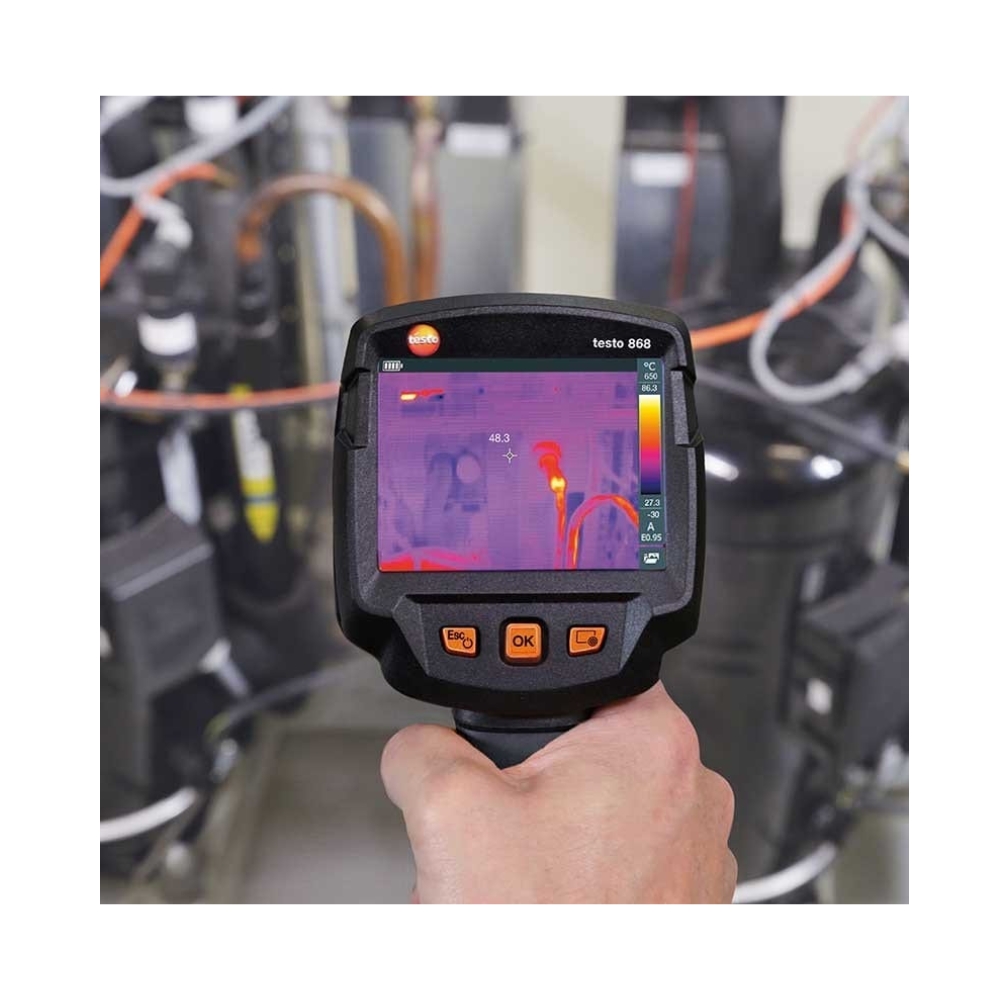
testo 868
Thermal Imaging Camera
The Testo 868 is where thermal imaging stops being indicative and starts being defensible. Three assist functions deal with the three things that make thermal images wrong: emissivity, scale and standing too far away. It reads from minus 30 to plus 650 degrees Celsius, resolves temperature differences of 0.08 degrees, and produces the report on site through the Thermography App.
KEY BENEFITS
- IFOV warner displays the measurement spot size, so you know what you're actually measuring
- ScaleAssist adjusts the colour scale for objectively comparable building thermography images
- ε-Assist and three supplied markers set emissivity and reflected temperature automatically
- Measures from minus 30 to plus 650 degrees Celsius, covering electrical through to process
- Accuracy of ±2 degrees or 2 percent of reading, whichever is greater
+ more in the Description tab below
Three Things That Make Thermal Images Wrong
It’s worth understanding these first, because the assist functions on this camera exist to deal with them, and they’re what separate it from a basic imager.
Emissivity is the biggest. A surface radiates heat according to its emissivity, and a shiny or reflective surface radiates far less than a dull one at the same temperature. Point a camera at a polished busbar, and it reads cold, because it’s reflecting the room rather than emitting its own heat. Set the emissivity wrong, and the temperature is wrong, sometimes by tens of degrees.
Scale is the one people rarely think about. A thermal image looks alarming or unremarkable depending entirely on the temperature range the colours are spread across. Two people imaging the same building with different scales produce images that look nothing alike, and can’t be compared.
Distance is the quiet one. A target smaller than the camera’s measurement spot at that distance gets averaged with its cooler surroundings, so it reads cooler than it is. That doesn’t produce a blurry image. It produces a fault that looks acceptable.
The Assist Functions
IFOV warner deals with distance. It displays the measurement spot size on the image, so you can see whether the target fills it, and move closer if it doesn’t. For electrical surveys, where a small hot terminal can be understated from too far away, that’s a valuable check.
testo ScaleAssist deals with scale in building thermography. It adjusts the colour distribution of the scale to the inside and outside temperature of the building, and the difference between them. That gives objectively comparable thermal images, so the thermal behaviour of a building isn’t misread.
testo ε-Assist deals with emissivity. Stick one of the supplied markers on the surface, and the camera automatically recognises the emissivity and determines the reflected temperature, rather than the operator looking up a table and estimating. Three markers come with the camera, and packs of ten are available.
Between them, those three turn a picture into a measurement.
Temperature Range Is the Practical Step Up
The testo 868 measures from -30 to +650°C, across two ranges: -30 to +100°C and 0 to +650°C, with manual or automatic switching. That’s a much wider span than a basic imager, and the top end is what opens up applications.
Electrical faults sit comfortably in the low hundreds. Process equipment, steam systems, furnace and kiln surfaces, refractory and exhaust components run far higher. A camera topping out at 350°C can’t look at any of it.
Accuracy is ±2°C or ±2% of reading, whichever is greater, which is where a report against an absolute threshold becomes defensible rather than just indicative.
SuperResolution
The detector is 160 x 120, which is 19,200 measuring points. testo SuperResolution lifts the image to 320 x 240, which is 76,800, and improves the geometric resolution from 3.4 to 2.1 mrad.
That’s a real improvement in image detail, but it isn’t the same as having a native 320 x 240 detector. For the static targets thermography usually involves, such as a switchboard, a panel, a bearing or a wall, it works well.
A Camera, Not a Phone Accessory
This is the honest difference from the testo 860i, and it isn’t simply a matter of one being better.
The 860i has a higher native detector resolution, at 256 x 192, and better thermal sensitivity. What it doesn’t have is its own screen, its own digital camera, the assist functions, or the 868’s wider range and accuracy: ±3°C against ±2°C on the 868. Both have fixed focus lenses.
So the 860i is a phone accessory for finding things, and the 868 is a standalone instrument for documenting them. A maintenance technician wanting a thermal view in the van is well served by the 860i. Someone producing a survey report that a client, an insurer or an auditor will read needs the 868.
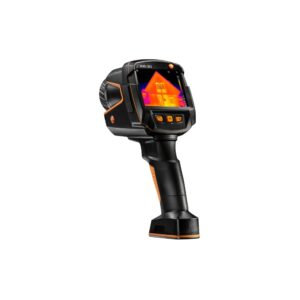
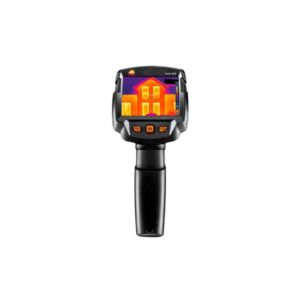
The 868 has a 3.5 inch display. The free testo Thermography App also turns a phone or tablet into a second display and a remote control, and testo IRSoft software handles analysis on a PC.
Reporting Is Half the Job
A thermal survey is as much about documentation as measurement, since the deliverable is a report with images, temperatures and conclusions.
The Thermography App creates and sends compact reports on site, and saves them online, which removes the evening spent matching photos to notes. The integrated 5 MP digital camera captures a real image alongside each thermal one, so the report shows what was being looked at as well as how hot it was.
Automatic hot and cold spot detection finds the extremes in each image without the operator hunting for them, which matters on a survey with a hundred measurement points. Images are stored in the 2.8 GB internal memory, and can be exported in common formats including .jpg, .png, .csv and .xls.
Built for Daily Use
The lithium ion battery runs for about 4 hours, and can be swapped on site, so a spare keeps a long survey going. The camera is rated IP54, weighs 510 grams, and operates from -15 to +50°C.
Where It’s Used
Electrical inspection of switchboards, distribution boards and motor control centres. Solar PV array inspection. Mechanical condition monitoring on bearings, motors and drives. Building envelope and insulation assessment. Damp and thermal bridging investigation. HVAC plant and ductwork. Steam systems and trap surveys. Process plant and pipework. Refractory and furnace surfaces. Preventative maintenance programmes. Annual electrical thermography surveys.
Benefits
- IFOV warner displays the measurement spot size, so you know what you're actually measuring
- ScaleAssist adjusts the colour scale for objectively comparable building thermography images
- ε-Assist and three supplied markers set emissivity and reflected temperature automatically
- Measures from minus 30 to plus 650 degrees Celsius, covering electrical through to process
- Accuracy of ±2 degrees or 2 percent of reading, whichever is greater
- Resolves temperature differences of 0.08 degrees Celsius
- SuperResolution lifts the image to 320 by 240, four times the native pixel count
- Integrated 5 MP digital camera captures a real image alongside the thermal one
- Automatic hot and cold spot recognition finds the extremes without hunting
- Reports written, saved and emailed on site through the Thermography App
Instrument type
Handheld thermal imaging camera
Infrared resolution
160 x 120 pixels, 19,200 measuring points
SuperResolution
320 x 240 pixels, 76,800 measuring points
Thermal sensitivity, NETD
Less than 0.08°C (80 mK)
Measuring range
-30 to +650°C. Range 1: -30 to +100°C. Range 2: 0 to +650°C. Manual or automatic switching
Accuracy
±2 °C or ±2 percent of reading, whichever is greater
Minimum focus distance
Less than 0.5 m. Fixed focus
Digital camera
Integrated, 5 MP
Measurement assist
IFOV warner (displays measurement spot size), testo ScaleAssist, testo ε-Assist with 3 markers supplied
Analysis
Centre point measurement, hot and cold spot detection, delta T
Connectivity
WiFi to the Testo Thermography App
App functions
Second display, remote control, on site report creation and sending, online saving
PC software
IRSoft, supplied free
Battery
Lithium ion, swappable on site. About 4 hours. Optional charging station and spare battery
Field of view
31° x 23°
Geometric resolution (IFOV)
3.4 mrad. 2.1 mrad with SuperResolution
Frame rate
9 Hz
Spectral range
7.5 to 14 µm
Display
3.5 inch TFT, 320 x 240
Memory and file formats
2.8 GB internal. Stores .bmt and .jpg. Exports .bmp, .jpg, .png, .csv, .xls
Video streaming
Via USB, or via WiFi with the Thermography App
Emissivity
0.01 to 1, manual or automatic with ε-Assist
Weight and dimensions
510 g. 219 x 96 x 95 mm
Protection and operating conditions
IP54. -15 to +50°C. 20 to 80% RH, non condensing
- Aviation & Transportation
- Carpark & HVAC
- Chemical Manufacturing
- Energy (Oil & Gas)
- Food & Beverage
- Landfill & Remediation
- Medical & Healthcare
- Mining & Minerals
- Power Generation & BESS
- Technology & Semiconductor
- Water & Wastewater
It displays the measurement spot size on the image, so you can see whether the target fills it. A target smaller than the spot reads cooler than it actually is, so without it, a serious fault can look acceptable.
In building thermography, it adjusts the colour scale to the inside and outside temperatures and the difference between them. That makes thermal images objectively comparable, so a building's thermal behaviour isn't misread.
Because a shiny surface radiates far less heat than a dull one at the same temperature, so it reads cold. Setting emissivity wrong gives a wrong temperature, sometimes by tens of degrees.
No. It lifts the image from 160 x 120 to 320 x 240 and improves the geometric resolution, which is a real improvement in detail, but it isn't the same as a native 320 x 240 detector.
The 860i has a higher native detector resolution and better thermal sensitivity, and uses a phone as its display. The 868 is a standalone camera with its own screen and 5 MP digital camera, better accuracy, a much wider temperature range, and the assist functions. Both have fixed focus. One finds things, the other documents them.
Up to 650 degrees Celsius, which covers process equipment, steam systems and furnace surfaces as well as electrical work.
Trusted by









Contact Us
Can’t find what you’re looking for? Our team is happy to help.