
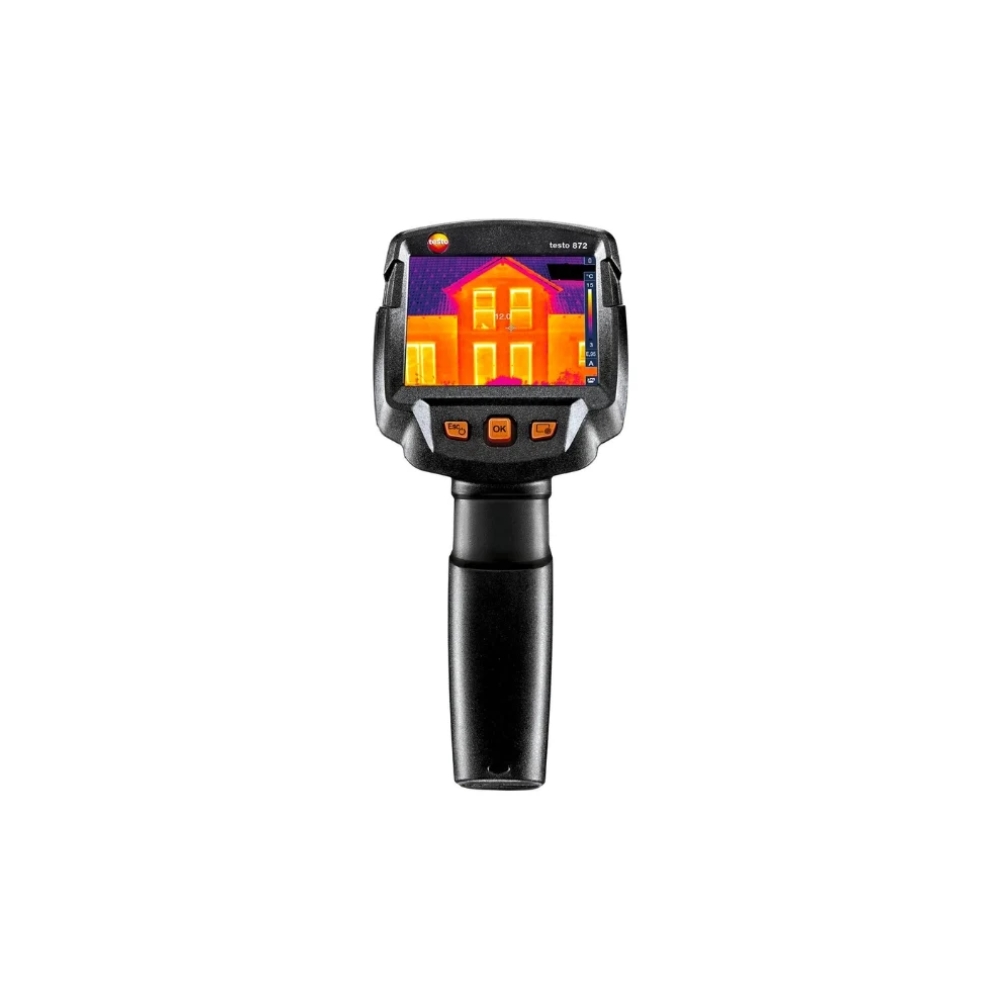
testo 872
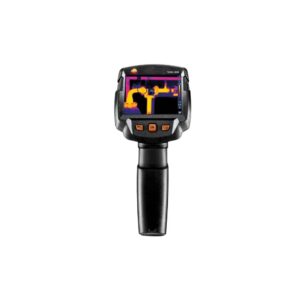
Industrial Thermal Imager
The Testo 872 is where thermal imaging becomes a survey instrument rather than an inspection one. A 320 by 240 detector gives 76,800 measuring points, rising to 307,200 with SuperResolution, which is four times the 868 and enough to resolve a small target from a safe distance. An integrated laser marker appears as a measuring point inside the thermal image, and Bluetooth pulls readings from a clamp meter and a thermohygrometer straight into the report.
KEY BENEFITS
- 320 by 240 detector giving 76,800 measuring points, four times the 868
- SuperResolution lifts the image to 640 by 480, or 307,200 points
- Geometric resolution of 2.3 milliradians, improving to 1.3 with SuperResolution
- Laser marker appears as a measuring point inside the thermal image, not just on the wall
- Bluetooth pulls clamp meter current and humidity readings into the same documentation
+ more in the Description tab below
The Laser You Can Actually See
This is the feature that solves a problem anyone who has done thermography will recognise, and it’s the clearest reason to choose the 872 over the 868.
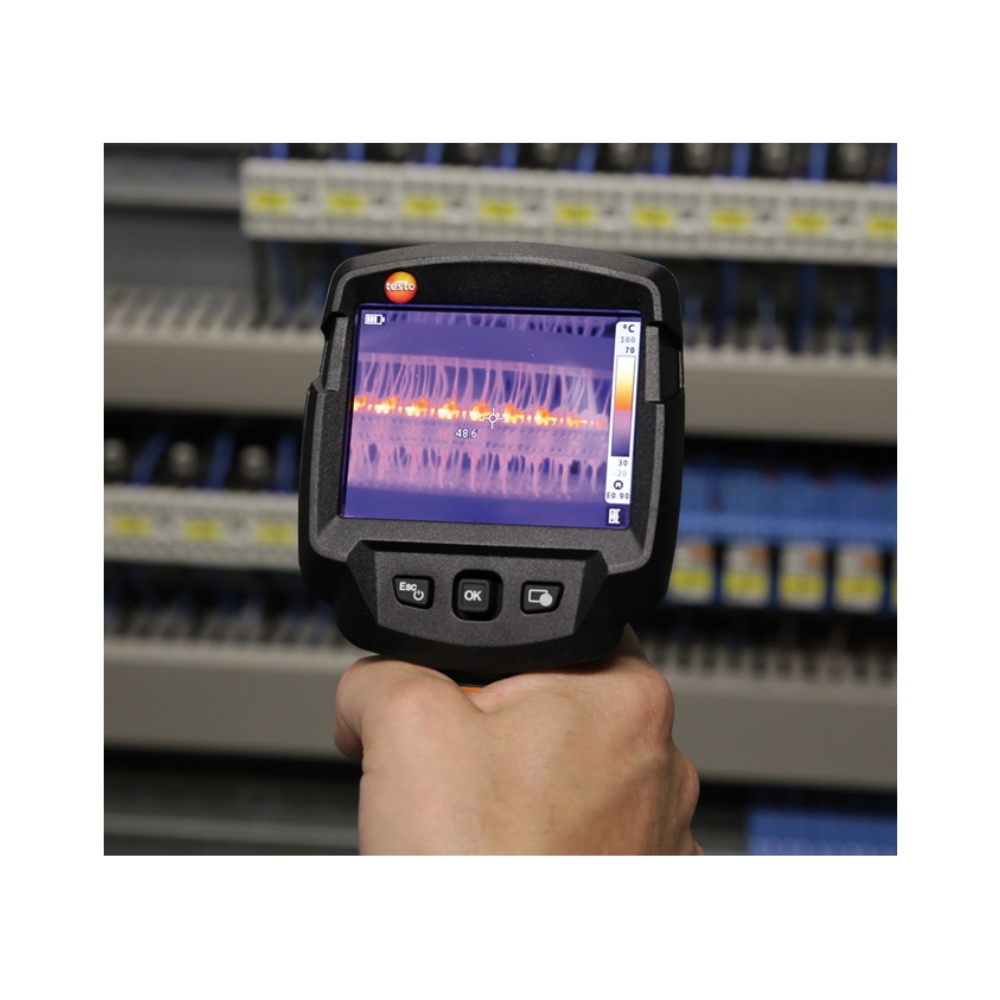
A laser pointer on a thermal camera has an obvious flaw. The laser is visible light and the image is infrared, so the dot appears on the wall but not in the picture you’re looking at. On a switchboard full of identical terminals, or a solar array of identical panels, knowing which one the camera is actually reading becomes guesswork.
The 872 has an integrated laser marker that’s also precisely visible as a measuring point in the thermal image. The dot appears in the picture, at the spot being measured, which removes the doubt.
On a report, that matters twice over. The technician knows which component they measured, and the reader of the report knows it too.
Four Times the Pixels, and What That Buys
The detector is 320 x 240, which is 76,800 measuring points against the 868’s 19,200. testo SuperResolution lifts it to 640 x 480, or 307,200.
The number that matters is geometric resolution, because it answers how far away you can stand. At 2.3 milliradians, one pixel covers 2.3 millimetres at one metre, and 23 millimetres at ten. With SuperResolution, at 1.3 milliradians, that drops to 13 millimetres at ten metres.
Since a reliable temperature needs the target to cover several pixels, the practical figure is roughly a 70 millimetre target at ten metres natively, or 40 millimetres with SuperResolution. The testo 860i, at 3.3 milliradians, needs about 100 millimetres at the same distance.
That difference is the reason to buy this camera rather than a cheaper one. A terminal behind a barrier, a connection at height or a panel on a roof seen from the ground all become measurable, rather than approximate.
The field of view is 42° x 30°, with 2x and 4x digital zoom. The lens is fixed focus.
It Collects the Other Readings Too
This is the capability that separates a picture from a report, and the one most people miss when comparing cameras.
Bluetooth connects the 872 to a testo 770-3 clamp meter and a testo 605i thermohygrometer, both available separately, and brings their readings wirelessly into the same thermal image record.
For electrical work, that closes a gap. A hot connection at 20 amps and a hot connection at 200 amps are entirely different findings, and a thermal image alone can’t tell them apart. Capturing the load current alongside the temperature turns an observation into an assessment. Current, voltage or power can also be entered by hand in electrical mode.
For building thermography, it does the same job differently. Surface temperature on its own doesn’t establish condensation or mould risk. Air temperature and humidity are needed too, and the 605i supplies both directly, with mould risk areas shown using a traffic light system. Humidity values can also be entered manually.
For solar PV inspection, solar mode lets you enter the solar radiation value with each image.
The Three Assist Functions
Three things make thermal images wrong, and all three are invisible in the finished picture.
Emissivity decides how much heat a surface radiates. A shiny busbar reads cold because it reflects the room rather than emitting its own heat, and a wrong emissivity setting gives a wrong temperature, sometimes by tens of degrees. testo ε-Assist automatically recognises the emissivity and determines the reflected temperature, using the three markers supplied.
Scale decides how alarming an image looks. In building thermography, testo ScaleAssist adjusts the colour scale to the inside and outside temperatures and the difference between them, so thermal images are objectively comparable.
Distance decides whether the reading is real. A target smaller than the measurement spot at that distance gets averaged with its surroundings, and reads cooler than it is. The IFOV warner shows the measurement spot size on the thermal image, so the operator knows when to move closer.
Automatic hot and cold spot recognition finds the extremes in each image without hunting, and area measurement gives the minimum and maximum across a selected region. That matters on a survey with a hundred measurement points.
Accuracy and Range
The 872 measures from -30 to +650°C, across two ranges (-30 to +100°C and 0 to +650°C), with manual or automatic switching. Accuracy is ±2°C or ±2% of reading, whichever is greater, and thermal sensitivity is under 0.05°C.
Reading and Reporting
The camera has its own 3.5 inch TFT display, showing either the infrared image or the real image from the integrated 5 MP digital camera. Ten colour palettes are available, including iron, rainbow, cold-hot, grey and iron HT.
The free testo Thermography App turns a phone or tablet into a second display and a remote control, and creates, sends and saves compact reports on site. testo IRSoft handles deeper analysis on a PC.
Images are stored in 2.8 GB of internal memory and can be exported in common formats, including .jpg, .png, .csv and .xls. The lithium ion battery runs for about 4 hours, and can be swapped on site.
Where It Sits in the Range
The testo 860i has no screen and uses a phone, with fixed focus and ±3°C accuracy. It finds things.
The testo 868 is a standalone camera at 160 x 120, and documents things within its range.
The 872 has four times the detector resolution of the 868, adds the laser marker and the Bluetooth instrument integration, and improves thermal sensitivity to under 0.05°C. For a contractor whose deliverable is a survey report, or anyone working at a distance, this is the tier.
Above it, the testo 883 adds an interchangeable lens system.
Where It’s Used
Electrical thermography surveys on switchboards, distribution boards and motor control centres. Solar PV array inspection. Industrial and mechanical maintenance. Bearing, motor and drive condition monitoring. Building thermography, thermal bridging and insulation assessment. Mould and condensation risk investigation. Steam systems and trap surveys. Process plant and refractory. Structural defect detection. Annual preventative maintenance programmes. Contract thermography services.
Benefits
- 320 by 240 detector giving 76,800 measuring points, four times the 868
- SuperResolution lifts the image to 640 by 480, or 307,200 points
- Geometric resolution of 2.3 milliradians, improving to 1.3 with SuperResolution
- Laser marker appears as a measuring point inside the thermal image, not just on the wall
- Bluetooth pulls clamp meter current and humidity readings into the same documentation
- Reads from -30 to +650°C, accurate to ±2°C or ±2% of reading
- Resolves temperature differences below 0.05 degrees Celsius
- IFOV warner, ScaleAssist and ε-Assist help avoid the three common sources of error
- Integrated 5 MP digital camera captures a real image alongside each thermal image
- Solar, humidity and electrical modes for PV, mould risk and electrical surveys
Instrument type
Handheld industrial thermal imaging camera
Infrared resolution
320 x 240 pixels, 76,800 measuring points
SuperResolution
640 x 480 pixels, 307,200 measuring points
Geometric resolution, IFOV
2.3 mrad, improving to 1.3 mrad with SuperResolution
Thermal sensitivity, NETD
Below 0.05 °C, under 50 mK
Measuring range
-30 to +650°C. Range 1: -30 to +100°C. Range 2: 0 to +650°C. Manual or automatic switching
Field of view
42 x 30 degrees
Spectral range
7.5 to 14 micron
Image refresh rate
9 Hz
Focus
Fixed focus. Minimum focusing distance under 0.5 m
Laser marker
Integrated, laser class 2, also visible as a measuring point in the thermal image
Digital camera
Integrated, 5 MP, minimum focusing distance 0.5 m
Display
3.5 inch (89 mm) TFT, QVGA (320 x 240)
Digital zoom
2x and 4x
Display options
Infrared image or real image
Colour palettes
Ten: iron, rainbow, rainbow HC, cold-hot, blue-red, grey, inverted grey, sepia, Testo, iron HT
Measurement assist
IFOV warner (shows measurement spot size), testo ScaleAssist, testo ε-Assist (emissivity and reflected temperature) with 3 markers supplied
Analysis
Centre point measurement, hot and cold spot recognition, delta T, area measurement (min and max)
Connectivity
WiFi and Bluetooth
Instrument integration
Testo 770-3 clamp meter and Testo 605i thermohygrometer, both supplied separately
App functions
On site report writing, online saving, email, second display, remote control
PC software
IRSoft
Battery
Lithium ion, exchangeable on site. About 4 hours. Optional charging station and spare battery
Accuracy
±2°C or ±2% of reading, whichever is greater
Measurement modes
Humidity mode (manual or with testo 605i), solar mode (manual solar radiation input), electrical mode (manual or with testo 770-3)
Memory and file formats
2.8 GB internal. Stores .bmt and .jpg. Exports .bmp, .jpg, .png, .csv, .xls
Video streaming
Via USB, or via WiFi with the Thermography App
Emissivity
0.01 to 1, manual or automatic with ε-Assist
Weight and dimensions
510 g. 219 x 96 x 95 mm
Protection and operating conditions
IP54. -15 to +50°C. 20 to 80% RH, non condensing
- Aviation & Transportation
- Carpark & HVAC
- Chemical Manufacturing
- Energy (Oil & Gas)
- Food & Beverage
- Landfill & Remediation
- Medical & Healthcare
- Mining & Minerals
- Power Generation & BESS
- Technology & Semiconductor
- Water & Wastewater
It shows the measurement spot as a point inside the thermal image rather than only as a dot on the wall. On a board of identical terminals, that removes any doubt about which component was measured.
Four times the detector resolution, 76,800 measuring points against 19,200, and a geometric resolution of 2.3 milliradians against 3.4 on the 868. It also adds the laser marker, better thermal sensitivity and Bluetooth instrument integration.
One pixel covers 23 millimetres at ten metres, or 13 with SuperResolution. Since a reliable temperature needs several pixels on the target, that means roughly a 70 millimetre target at ten metres, or 40 with SuperResolution.
It pulls readings from a Testo 770-3 clamp meter or a Testo 605i thermohygrometer into the same record. Load current alongside temperature for electrical work, or humidity alongside surface temperature for dew point and mould assessment.
No, the testo 872 is fixed focus. For an interchangeable lens system, the testo 883 is the model.
They address the three things that make thermal images wrong. ε-Assist sets emissivity and reflected temperature automatically. ScaleAssist adjusts the scale in building thermography so images compare. The IFOV warner shows the measurement spot size, so you know when to move closer.
Trusted by









Contact Us
Can’t find what you’re looking for? Our team is happy to help.