
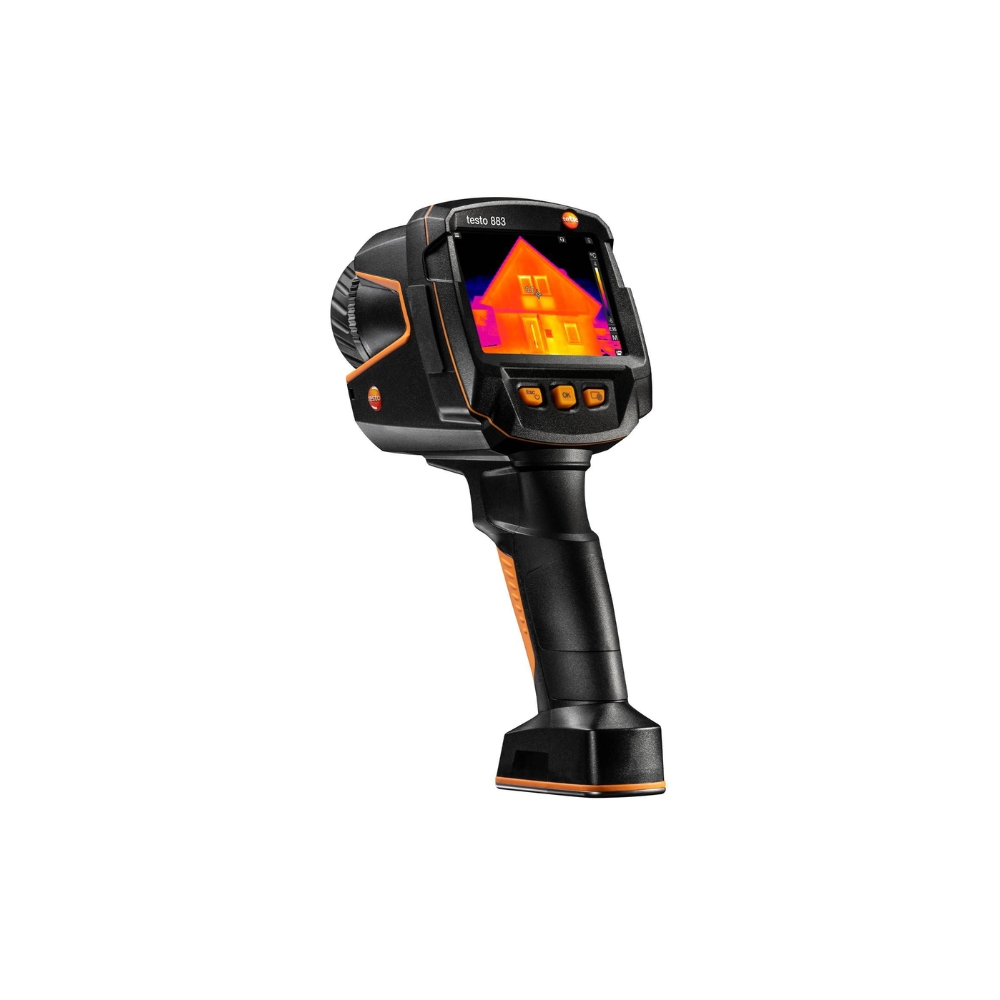
testo 883
Thermal Imager with Interchangeable Lenses
The testo 883 is the first camera in the Testo range with manual focus and interchangeable lenses, and both are measurement features, not just image quality ones. An out of focus thermal image doesn’t just look soft, it reads the wrong temperature. A telephoto lens doesn’t just magnify, it shrinks the measurement spot, so a small target at a distance can be measured properly. testo SiteRecognition then assigns each image to the right measurement location automatically.
KEY BENEFITS
- Manual focus with sharp images from under 10 cm, because an unfocused thermal image reads the wrong temperature
- Standard 30° x 23° lens, plus an optional 12° x 9° telephoto lens for distant targets
- Telephoto lens cuts the measurement spot from 1.7 to 0.7 milliradians
- Thermal sensitivity under 40 mK, so small temperature differences show clearly
- testo SiteRecognition reads QR code markers and files each image against the right measurement location
+ more in the Description tab below
Focus Is a Measurement Feature, Not Just an Image One
This is one of the most misunderstood things about thermal imaging, and it’s the reason this camera exists.
An out of focus photograph looks soft. An out of focus thermal image is worse than soft, because the energy from the target is spread across more pixels than it should be. Each of those pixels sees part of the target mixed with part of its cooler surroundings, so the peak temperature reads lower than it really is.
A fixed focus camera is sharp within a range, and less accurate outside it. That’s acceptable for spot checks. It isn’t acceptable when the output is a survey report with temperatures a client will act on.
The testo 883 has manual focus, with sharp images from under 10 centimetres using the standard lens. That puts the operator in control of the accuracy of the reading, rather than hoping the target falls in the sharp zone.
The Lens Decides How Far You Can Stand
The other cameras in the range have one fixed lens. The testo 883 takes two, and the difference at a distance is substantial.
| Lens | Field of view | Geometric resolution | Suited to |
|---|---|---|---|
| Standard (supplied) | 30° x 23° | 1.7 mrad (1.3 mrad with SuperResolution) | General industrial, electrical and building work |
| Telephoto (in the kit, or separately) | 12° x 9° | 0.7 mrad | Distant targets, outdoor work, elevated plant, solar arrays |
Why this matters comes back to spot size. A narrower field of view spreads the same 320 x 240 pixels across less of the scene, so each pixel covers a smaller area of the target.
On the standard lens, one pixel covers about 17 millimetres at ten metres. On the telephoto, it’s about 7 millimetres, less than half. A target that needs you within three metres on the testo 860i can be measured from more than ten metres with the telephoto lens fitted. For solar arrays, high level electrical work, elevated pipework and anything behind a barrier, that’s the difference between measuring it and estimating it.
Lenses can be changed while the camera is running, and it detects which lens is fitted. Each lens is adjusted to its own camera, and the serial number on the lens must match the camera, so a telephoto lens bought later needs to be ordered for your specific unit.
SiteRecognition Changes the Job, Not Just the Camera
This is the feature most likely to justify the price.
On a survey with two hundred measurement points, taking the images isn’t the hard part. Filing them is. Matching hundreds of thermal and visual images to the right switchboard, panel and asset is hours of desk work afterwards, and it’s where mistakes happen.
testo SiteRecognition removes that. QR code markers are created in testo IRSoft and placed at each measuring location. The camera reads the marker with its built in digital camera, and the images are automatically assigned to that measurement location.
That turns thermography from a one off task into a programme that can be run annually, compared year on year, and handed between technicians without the record falling apart. It pays off most when you take a lot of images of similar measurement objects, such as switchboards.
Building Work
testo ScaleAssist automatically sets the optimum thermal image scale, which makes construction defects and thermal bridges easier to assess, and keeps images comparable even when ambient conditions change.
For mould and condensation risk, humidity mode uses surface temperature from the camera, with ambient temperature and humidity from a testo 605i thermohygrometer sent over Bluetooth, or entered by hand. A dedicated humidity palette shows the results.
testo ε-Assist automatically recognises emissivity and determines the reflected temperature, using Testo’s ε-markers, so readings on different surfaces are corrected properly.
Load Current in the Image
The same Bluetooth link carries testo 770-3 clamp meter readings into the thermal image, or current, voltage and power can be entered by hand.
On a switchboard survey, that closes the gap between an observation and an assessment. A connection at 60°C drawing 20 amps and the same connection at 60°C drawing 200 amps are entirely different findings, and the thermal image alone can’t tell them apart. Recording the load alongside the temperature is what makes the conclusion defensible.
For solar PV inspection, solar mode lets you enter the solar radiation value with each image.
Analysis and Reporting
On the camera, up to five individual measuring points can be placed in an image, alongside hot and cold spot detection, delta T, area measurement (min and max), alarms and isotherms. Voice notes can be recorded with each image through a Bluetooth headset. A laser marker helps identify the target.
testo IRSoft, a free download, handles in depth analysis on a PC and produces professional reports. The testo Thermography App turns a phone or tablet into a second display and remote control, and creates and sends compact reports on site.
Two Versions
The testo 883 comes with the 30° x 23° standard lens. The testo 883 kit adds the 12° x 9° telephoto lens, a spare battery and a battery charging station.
If distance work is part of the job at all, the kit is the better buy, because the telephoto lens is the capability that sets this camera apart from the rest of the range.
Where It’s Used
Contract thermography services. Annual electrical survey programmes. Solar PV array inspection. Building energy consultancy and thermal performance assessment. Mould and condensation risk investigation. Facility and asset management programmes. Industrial and mechanical maintenance. Elevated and hard to reach plant. Quality assurance and production monitoring. Insurance and dispute investigation, where the report has to hold up.
Benefits
- Manual focus with sharp images from under 10 cm, because an unfocused thermal image reads the wrong temperature
- Standard 30° x 23° lens, plus an optional 12° x 9° telephoto lens for distant targets
- Telephoto lens cuts the measurement spot from 1.7 to 0.7 milliradians
- Thermal sensitivity under 40 mK, so small temperature differences show clearly
- testo SiteRecognition reads QR code markers and files each image against the right measurement location
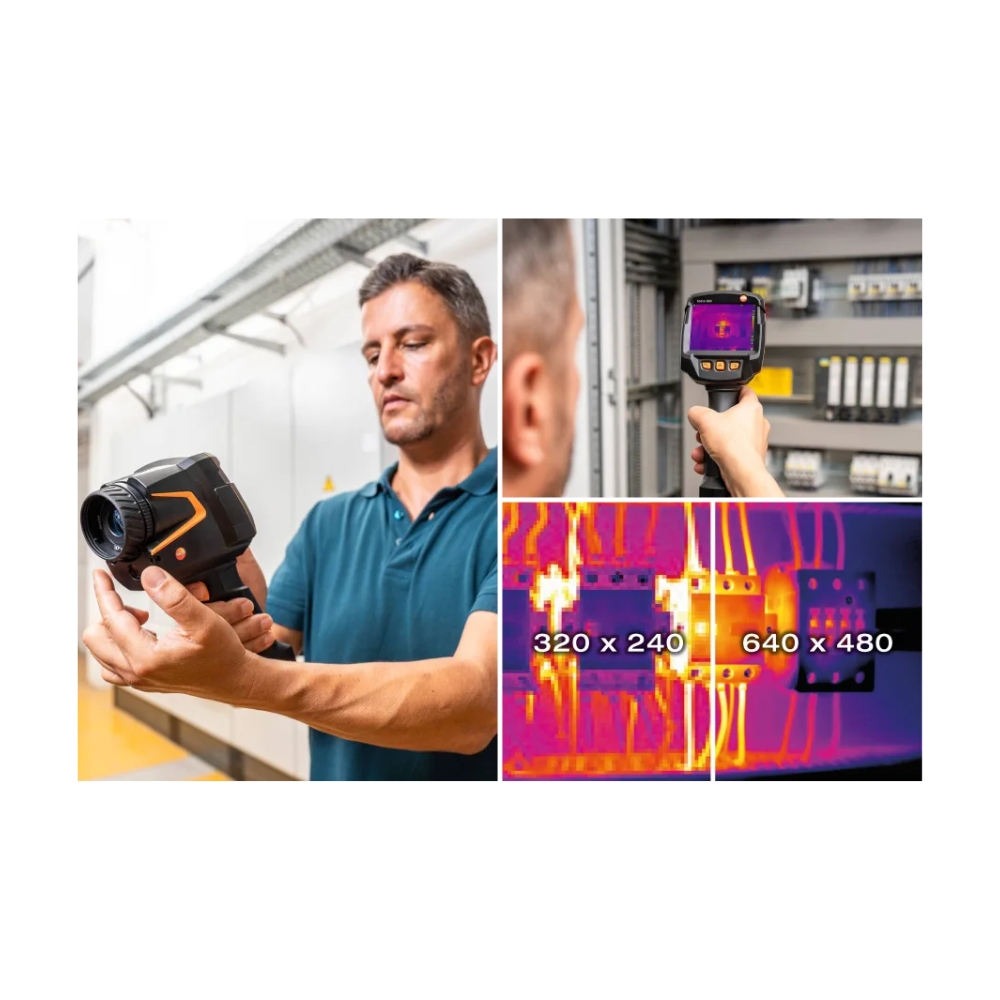
- 320 x 240 infrared resolution, or 640 x 480 with SuperResolution
- Bluetooth brings clamp meter and humidity readings into the thermal image
- Capacitive touch display, with voice notes recorded through a Bluetooth headset
- Fast charging battery, swappable on site, runs at least 5 hours
- Accurate to ±2°C or ±2% of reading, from -30 to +650°C
Instrument type
Handheld thermal imaging camera with interchangeable lenses
Versions
testo 883 (standard lens). testo 883 kit (standard and telephoto lens, spare battery, charging station)
Infrared resolution
320 x 240 pixels (76,800 measuring points)
SuperResolution
640 x 480 pixels (307,200 measuring points), 1.3 mrad
Thermal sensitivity, NETD
Under 40 mK
Lenses
Standard 30° x 23°. Telephoto 12° x 9° (optional, matched to the camera)
Geometric resolution (IFOV)
1.7 mrad (standard lens). 0.7 mrad (telephoto lens)
Frame rate
9 Hz outside the EU (27 Hz inside the EU)
Spectral range
7.5 to 14 µm
Measuring range
-30 to +650°C
Accuracy
±2°C or ±2% of reading, whichever is greater
Emissivity
0.01 to 1, manual, or automatic with testo ε-Assist
Display
3.5 inch capacitive touch display, 320 x 240
Digital camera
3 MP, minimum focusing distance under 0.4 m
Digital zoom
2x and 4x
Laser marker
Laser class 2, 635 nm
Analysis
Up to 5 individual measuring points, hot and cold spot detection, delta T, area measurement (min and max), alarms, isotherm
Assist functions
testo SiteRecognition, testo ScaleAssist, IFOV warner, testo ε-Assist
Measurement modes
Humidity mode (manual or with testo 605i), solar mode, electrical mode (manual or with testo 770-3)
Colour palettes
Iron, rainbow, rainbow HC, cold-hot, blue-red, grey, inverted grey, sepia, Testo, iron HT, humidity
Connectivity
WiFi (Thermography App), Bluetooth (headset, testo 605i, testo 770-3), USB-C
Voice annotation
Via Bluetooth headset
Memory and file formats
2.8 GB internal. Stores .bmt and .jpg. Exports .bmp, .jpg, .png, .csv, .xls
Video streaming
Via USB, or via WiFi with the Thermography App
Battery
Fast charging Li-ion, changeable on site. At least 5 hours
Operating conditions
-15 to +50°C. 20 to 80% RH, non condensing
Protection
IP54
Weight and dimensions
827 g. 171 x 95 x 236 mm
Software
testo IRSoft (free download), testo Thermography App
- Aviation & Transportation
- Carpark & HVAC
- Chemical Manufacturing
- Energy (Oil & Gas)
- Food & Beverage
- Landfill & Remediation
- Medical & Healthcare
- Mining & Minerals
- Power Generation & BESS
- Technology & Semiconductor
- Water & Wastewater
Because an out of focus thermal image reads the wrong temperature. The energy from the target spreads across more pixels than it should, each mixing target with surroundings, so the peak reads lower than it really is.
A 30° x 23° standard lens, supplied with the camera, and a 12° x 9° telephoto lens for distant work, included in the testo 883 kit. Lenses are matched to the individual camera.
More than twice as far. One pixel covers about 7 millimetres at ten metres on the telephoto, against about 17 millimetres on the standard lens.
QR code markers, created in testo IRSoft, are placed at each measuring location. The camera reads the marker and automatically assigns the images to that location, so there's no manual filing afterwards.
If any of your work is at a distance, take the kit. It adds the telephoto lens, a spare battery and a charging station.
Yes. Humidity mode uses surface temperature from the camera, with ambient temperature and humidity from a testo 605i thermohygrometer over Bluetooth, or entered by hand.
Trusted by









Contact Us
Can’t find what you’re looking for? Our team is happy to help.