
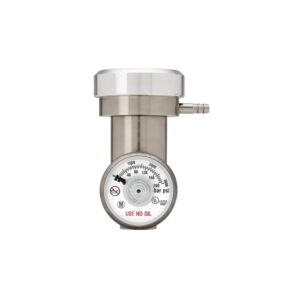
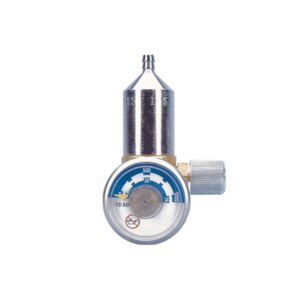
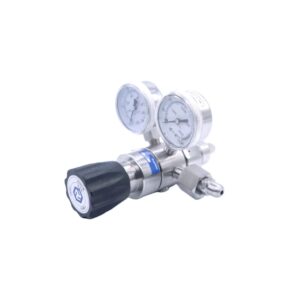
Fixed Flow, Demand Flow And High Purity Regulators
The regulator is the part of a calibration nobody thinks about until the result looks wrong. It is also the commonest reason a calibration fails for reasons unconnected to the instrument.
Two things decide which one you need. How the instrument draws its sample, and how reactive the gas is.
The first determines the flow type. A diffusion instrument relies on gas reaching the sensor by itself, so it needs gas delivered to the calibration cap at a steady rate the manufacturer has specified. A 700 Series fixed flow regulator does that, preset and flow checked at the factory so it arrives ready. Common rates are 0.5, 1 and 1.5 litres per minute, and they can be preset anywhere from 0.2 up to 6.
Worth knowing that more flow is not better. The rate is specified by the instrument manufacturer, and exceeding it floods the sensor and wastes gas while delivering nothing useful. Falling short gives a slow or incomplete response that reads as a sensor problem.
An instrument with a pump is a different situation entirely, and this is where most mistakes happen. The pump is trying to draw its own sample. So a fixed flow regulator either supplies less than the pump wants, which starves it and reads low, or more than it wants, which pressurises the sensor and reads high. Both look like instrument faults and neither is.
A 2000 Series demand flow regulator solves it by working on negative pressure. It supplies gas only as the pump draws it, at whatever rate the pump demands, so the instrument sets the flow rather than the regulator. If your detector has a pump, this is the regulator, and no fixed flow alternative will do the job properly.
The second question is the gas, and it is the same adsorption problem that governs cylinder shelf life. Reactive gases attack and adhere to the wetted surfaces they pass through. So the body material decides both how long the regulator lasts and how much of the gas arrives at the instrument.
Nickel plated brass suits non-reactive gases along with hydrogen sulphide and sulphur dioxide, and covers most everyday work. A hybrid aluminium and stainless steel body handles more reactive gases. Fully stainless steel is the answer for the most reactive, and it is what a chlorine, ammonia or hydrogen chloride mixture needs. Putting a brass regulator on a reactive cylinder consumes the gas you paid for before it reaches the sensor.
For low concentration reactive gases and high purity mixtures, the R Series covers the demanding end. A single stage version suits low flow requirements and a dual stage version gives more consistent pressure and flow, with nickel plated brass or stainless steel bodies. Compact stainless steel diaphragm regulators in the 1700 range cover adjustable flow or pressure output, preset at the factory to a specified figure.
Cylinder connection matters as much as flow. The regulator thread has to match the cylinder, and cylinder sizes across the 2AL, 8AL, 6D, 7EOC, 7HP and 5E range do not all take the same fitting.
Send us the instrument model, the gases it is fitted with and the cylinder size, and our Technical Consultants will confirm the regulator, from WA, NSW and QLD.
Trusted by









Contact Us
Can’t find what you’re looking for? Our team is happy to help.