
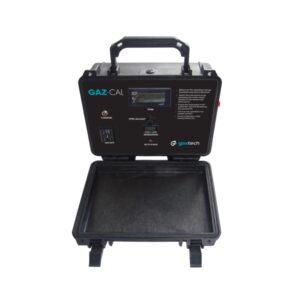
Calibration Gas Generators For Reactive Gases
Some gases are difficult and in a few cases close to impossible to supply reliably in a cylinder, because the gas reacts with the cylinder wall or with other components in the mixture. Chlorine is the obvious example. A chlorine calibration mixture typically carries a shelf life of around six months, and low concentrations are difficult to keep stable at all.
That creates a problem for anybody who calibrates chlorine detection infrequently, which is most water treatment and industrial operations. The cylinder degrades whether it is used or not, so a site testing twice a year is buying gas and discarding most of it.
A generator inverts that. Instead of storing gas, it makes it on demand from a solid state electrochemical cell, and the cell is only consumed while the unit is switched on. Switch it off and the cell stops. Life is therefore governed by how much you use it rather than how long you have owned it.
The difference in output is substantial. A small 58 litre cylinder typically yields somewhere between five and ten calibrations. A GazCal generator cell holds 500 parts per million hours at 0.5 litres per minute, which is a hundred hours of continuous use at 5 ppm and at least four hundred individual calibrations. The unit itself commonly runs five to ten years, often without a cell change, needing only an annual recertification.
Concentration flexibility is the second advantage and it matters more for chlorine than for most gases. A cylinder delivers one concentration. The GazCal is adjustable from 0.5 to 20 parts per million in steps of 0.1, so a single unit covers low level alarm verification and full scale checks. Low concentrations of 1 and 2 ppm are reliably produced, which is exactly where cylinder stability is poorest and where chlorine alarm thresholds sit.
It also works as a surrogate. Depending on the sensor manufacturer’s guidance, chlorine from the generator cross calibrates chlorine dioxide, ozone, fluorine, phosgene and hydrogen fluoride equipment, all gases where a cylinder is an even poorer container than it is for chlorine.
One honest limitation. The GazCal is certified to produce chlorine within 10 percent of nominal, where a cylinder mixture at 5 ppm and above is certified to 5 percent. So a fresh cylinder is the more accurate source. A six month old cylinder is not, and that is the comparison that matters in practice.
The practical benefits follow from having no cylinder at all. Nothing to transport as dangerous goods, nothing to store, nothing to dispose of, and nothing that expires in the back of a vehicle. On a remote site or a water treatment plant with a handful of chlorine detectors, that removes most of the logistics.
Our Technical Consultants will work through your detectors, the concentrations you need and how often you test, from WA, NSW and QLD.
Trusted by









Contact Us
Can’t find what you’re looking for? Our team is happy to help.