
Indoor Air Quality And Ventilation Measurement
Ventilation used to be verified against a table. Professional practice has moved on, and the instruments here are the reason.
Air change rate has always been the central concept in building ventilation. Replacing the air is the simplest and most effective way to stop pollutants, gases, particles, bacteria and viruses accumulating in an occupied space. What has changed is how you establish whether it is happening. Air change rate was previously measured against generic values set by regulation for different venue types and activities. Practitioners now treat carbon dioxide concentration as the primary measure, with air change rate as a target derived from it rather than a rule to comply with.
The reason is worth understanding, because it is frequently misread. At indoor air quality levels, carbon dioxide is not the hazard. It is the proxy. People exhale it continuously, so the difference between indoor and outdoor carbon dioxide is a direct measure of how much of the air in a room has been breathed and not yet replaced. If carbon dioxide is accumulating, so is everything else. That makes it the most reliable and effective single indicator of indoor air quality available, which is why it has displaced the lookup table.
That also means both measurements are needed. Indoor carbon dioxide on its own tells you a number. Indoor carbon dioxide measured against the outdoor concentration tells you how the ventilation is performing, and outdoor background levels are not what they were when the original tables were written.
Calculating the air change rate a space actually requires depends on five variables. Target carbon dioxide concentration, outdoor carbon dioxide concentration, room volume, occupant numbers and what those occupants are doing. Five variables is why a table cannot answer it.
Verifying a system in the field runs as a four step check. Measure the incoming air flow. Measure the outgoing air flow. Check the overpressure inside the space. Check the carbon dioxide level. If carbon dioxide is climbing while the fan is running, the fan is not achieving what the design assumed. Taken together the four readings tell you where the problem is rather than only that there is one.
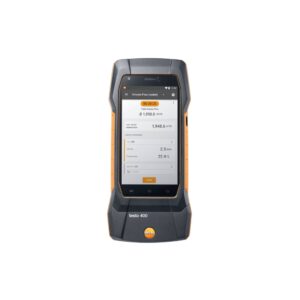
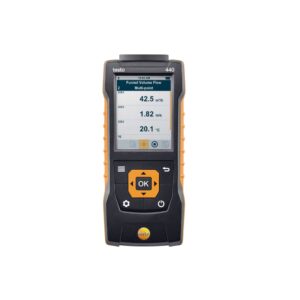
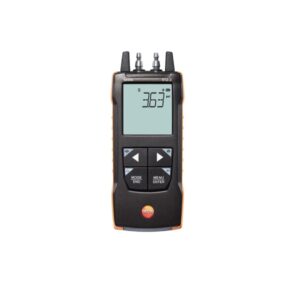
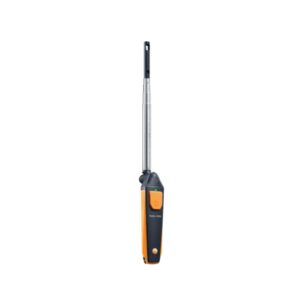
Each step needs a different measurement, which is why these are multifunction instruments rather than single parameter meters. The Testo 440 and Testo 400 both take interchangeable probes covering air velocity, volume flow, carbon dioxide, temperature and humidity, so one instrument handles the whole check rather than requiring four. The Testo 512-2 covers differential pressure, which is the overpressure step and the measurement that confirms air is moving in the intended direction.
Where the requirement is continuous rather than a periodic check, fixed carbon dioxide detection tied to ventilation control does the job, and AQMesh pods cover longer term area monitoring.
The applications run wider than office buildings. Schools and lecture theatres, where occupant density is high and variable. Hospitals and aged care. Gyms and leisure centres. Commercial kitchens. Cinemas and function rooms. Laboratories and clean rooms, where pressure differential matters as much as air change. Underground carparks and plant rooms. Commissioning and defect investigation on any mechanically ventilated building.
Our Technical Consultants will work through which parameters your assessment has to demonstrate and which probes that needs, from WA, NSW and QLD.
Trusted by









Contact Us
Can’t find what you’re looking for? Our team is happy to help.