
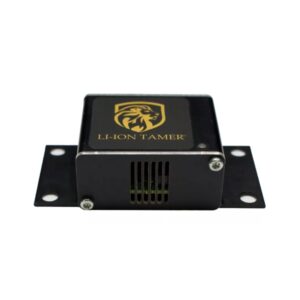
Gas Detection for Battery Energy Storage Systems
Battery energy storage has stopped being an emerging technology in Australia. It stabilises the grid, backs renewable projects, powers electric vehicle charging and keeps data centres running. The hazard that gets underestimated alongside that growth is not fire. It is gas.
Large scale fire tests on lithium-ion batteries have measured significant releases of hydrogen fluoride as cells fail, enough to be dangerous to anyone nearby. A battery failure is a toxic gas release event, not simply a fire to be put out. Many of the gases involved are odourless and colourless, and some, such as carbon dioxide and electrolyte solvent vapours, are heavier than air, so they collect in trenches, low points and corners without a conventional fire alarm registering anything at all.
Two different battery technologies produce two different problems, and they need different answers. Lead acid battery rooms serving uninterruptible power supplies generate hydrogen during charging, through electrolysis of the electrolyte. That is a flammable accumulation problem, solved with hydrogen detection tied to the room’s exhaust ventilation, and the Sensepoint XCL covers it. Lithium-ion storage is a different failure mode entirely. Before a cell enters thermal runaway it vents electrolyte solvent vapour, and that off-gas event is the only warning that arrives while the outcome is still open.
The Li-ion Tamer detects that off-gas. Honeywell states it typically gives between 2 and 30 minutes of warning before thermal runaway, and that the result holds across different cell manufacturers, chemistries and form factors when tested using the UL 9540A recommended failure method. Smoke, heat and flame detection all trigger after runaway has begun, at which point the reaction sustains itself. Off-gas detection is what allows a rack to be isolated, cooling to be increased or ventilation to be started while that still changes the outcome.
Detection alone is not a design. Gastech has engineered BESS room detection using FM approved sensors for ethylene, carbon monoxide and other relevant gases, tied into alarm protocols specified by the customer. Controller choice matters as much as sensor choice, because what a BESS operator needs is constant visibility of what the air is doing, not a notification once a threshold has already been crossed. Flame detection has its place and can see fires the eye cannot, including lithium and hydrogen fires, but it is not a substitute for gas monitoring.
Requirements depend on installation size, enclosure type, location and the authority having jurisdiction. In Australia battery installations sit under AS/NZS 5139, with NFPA 855 and UL 9540A the standards most often referenced internationally. Gastech engineering works through what applies to your installation, and supports the system from WA, NSW and QLD.
Trusted by









Contact Us
Can’t find what you’re looking for? Our team is happy to help.