
Calibration Gas Cylinders, High Volume Supply And Permeation
Calibration gas is what brings a sensor back inside tolerance, and it is the only item in the catalogue with an expiry date that matters more than the purchase price.
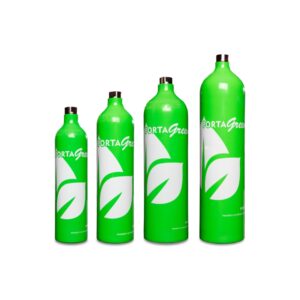
Gastech supplies gas from PortaGas and Air Liquide, the two largest calibration gas manufacturers in the world, under the PortaGreen and CALGAZ brands. Both are traceable to national measurement standards, and between them they cover close to any mixture a detector fleet requires.
There are four ways to get gas to an instrument, and which suits depends almost entirely on how much you use and how reactive the gas is.
Disposable cylinders are the common answer and they run from 34 through 58, 100, 103 and 116 litres. One thing worth understanding about that rating. The litre figure describes the nominal gas volume. The more accurate measure of what is actually in the cylinder is the fill pressure, which on a disposable runs between roughly 34 and 69 bar. Two cylinders of the same nominal volume are not necessarily the same purchase.
Disposables cannot be refilled by the user, so what happens at the end matters. Air Liquide cylinders are recycled by Gastech at no charge. PortaGas cylinders go back to the manufacturer through the Strip and Ship programme, arriving with their own packing tube and prepaid postage, so an empty goes in the post at no cost. Both remove a dangerous goods disposal problem that otherwise sits in a store room.
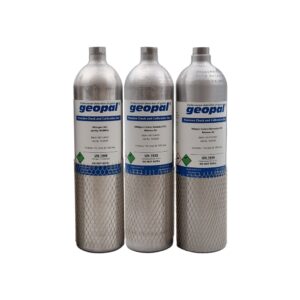
High volume cylinders are the answer once a fleet is large enough that disposables get consumed well before they expire. Higher fill pressures and larger volumes drop the cost per litre substantially, and a small rental applies on the cylinder which is usually recovered quickly.
The crossover point is worth calculating rather than guessing, and there is a gas consumption calculator for it. Put in the gas and the monthly usage and it indicates whether a larger cylinder would cost less. If you are ordering disposables regularly rather than replacing expired ones, the answer is probably yes.
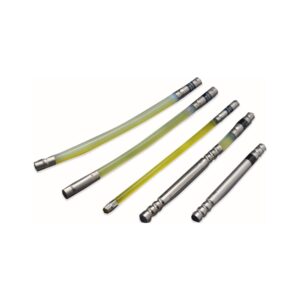
Permeation tubes cover a narrow case that neither of the above handles. Where the gas is exotic with a short shelf life, chlorine being the obvious example, it is supplied in liquid form in a permeation tube. Heating that tube in a permeation oven releases it. At a controlled flow rate that produces a highly accurate concentration. It is a specialised method requiring training and it is not a general purpose answer, but for high volume work on difficult gases it is the accurate one.
Gas generators cover the same difficult gases at lower volume. A GazCal makes chlorine on demand from an electrochemical cell, so nothing expires while it sits unused.
Shelf life is what decides the sensible order quantity, and it varies far more than most people expect. Stable mixtures of methane, carbon monoxide, carbon dioxide and oxygen typically hold two to three years. Reactive gases degrade against the cylinder wall, so hydrogen sulphide is commonly around twelve months and some single reactive gases are shorter.
Ordering the largest cylinder for the best unit price therefore backfires if you cannot use it in time. Our Technical Consultants will work through the gases, the fleet size and the testing frequency, from WA, NSW and QLD.
Trusted by









Contact Us
Can’t find what you’re looking for? Our team is happy to help.