
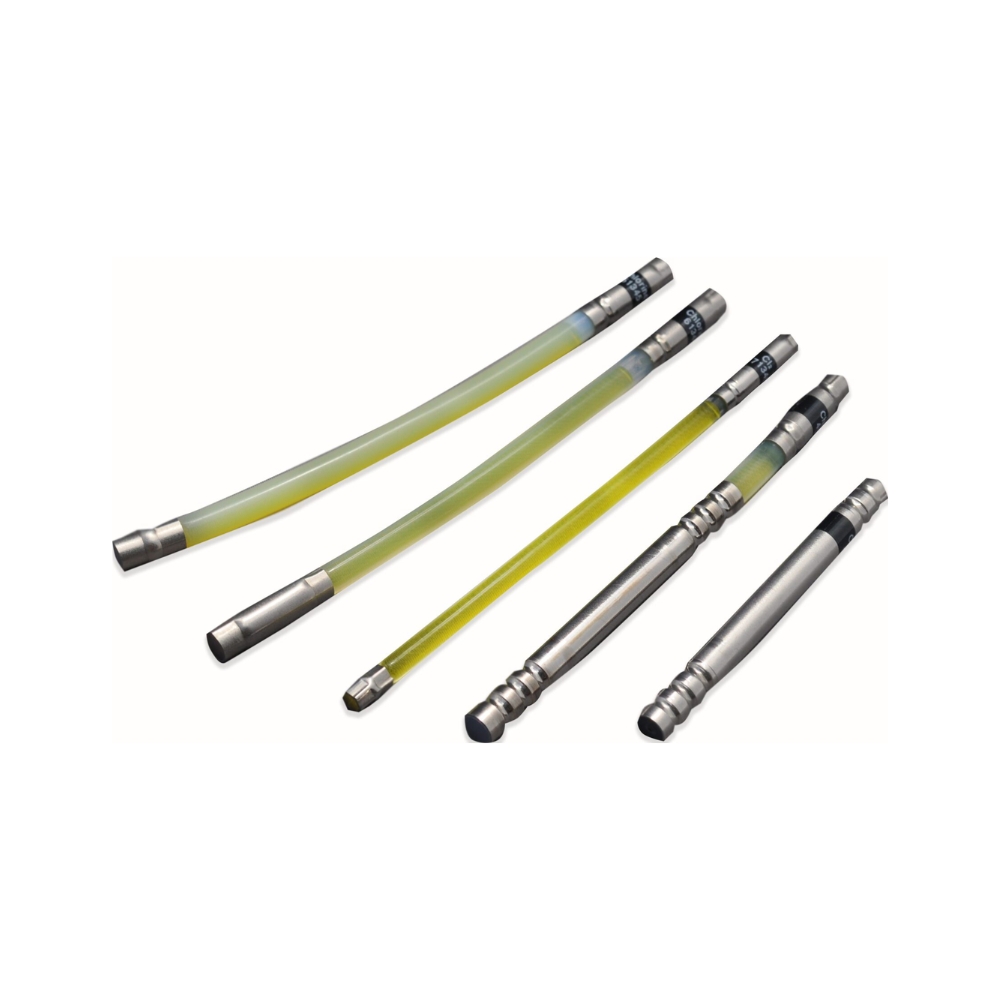
Permeation Tubes
Some gases cannot be held reliably in a cylinder at all. Permeation tubes hold the substance in liquid form and release it as gas when heated in a permeation oven, which at a controlled flow rate produces a highly accurate concentration. It suits high volume work on exotic gases with short shelf lives, and it is a specialised method requiring training.
KEY BENEFITS
- Produces accurate concentrations of gases that will not keep in a cylinder
- Substance held as a liquid, so there is no cylinder shelf life to manage
- Concentration set by oven temperature and carrier flow rate
- Suits high volume testing of exotic gases such as chlorine
- Highly accurate where cylinder stability at low concentration is poor
+ more in the Description tab below
Chlorine is the example that explains the method. In a cylinder it reacts with the wall, so the concentration drifts and the shelf life is short, and low concentrations are difficult to keep stable at all. Those are exactly the concentrations chlorine detection needs to be calibrated at.
A permeation tube holds the substance as a liquid inside a permeable membrane. Heating it in a permeation oven causes gas to permeate out at a rate determined by the temperature. A controlled carrier flow then dilutes it to the required concentration. The output is continuous and highly accurate, and nothing degrades while the tube sits unheated.
This is a specialised method rather than a general purpose one. It requires a permeation oven, a controlled flow source and an operator who has been trained on it, which puts it in laboratories and high volume calibration facilities rather than in a van.
For the same difficult gases at lower volume and without the training requirement, a gas generator is usually the better answer.
Talk to us about whether permeation suits your application before specifying it.
Benefits
- Produces accurate concentrations of gases that will not keep in a cylinder
- Substance held as a liquid, so there is no cylinder shelf life to manage
- Concentration set by oven temperature and carrier flow rate
- Suits high volume testing of exotic gases such as chlorine
- Highly accurate where cylinder stability at low concentration is poor
- Aviation & Transportation
- Carpark & HVAC
- Chemical Manufacturing
- Confined Space & Compliance
- Energy (Oil & Gas)
- Food & Beverage
- Landfill & Remediation
- Marine & Maritime
- Medical & Healthcare
- Mining & Minerals
- Power Generation & BESS
- Technology & Semiconductor
- Water & Wastewater
Gases that cannot be supplied reliably in a cylinder because they react with it, chlorine being the common example, particularly at the low concentrations detection equipment needs.
By the oven temperature, which governs the permeation rate, and by the carrier flow rate that dilutes it.
No. It requires a permeation oven, a controlled flow source and trained operation, so it belongs in a laboratory or a dedicated calibration facility. For field work on the same gases, a gas generator is the practical answer.
Trusted by









Contact Us
Can’t find what you’re looking for? Our team is happy to help.