
testo 400
Universal IAQ Instrument
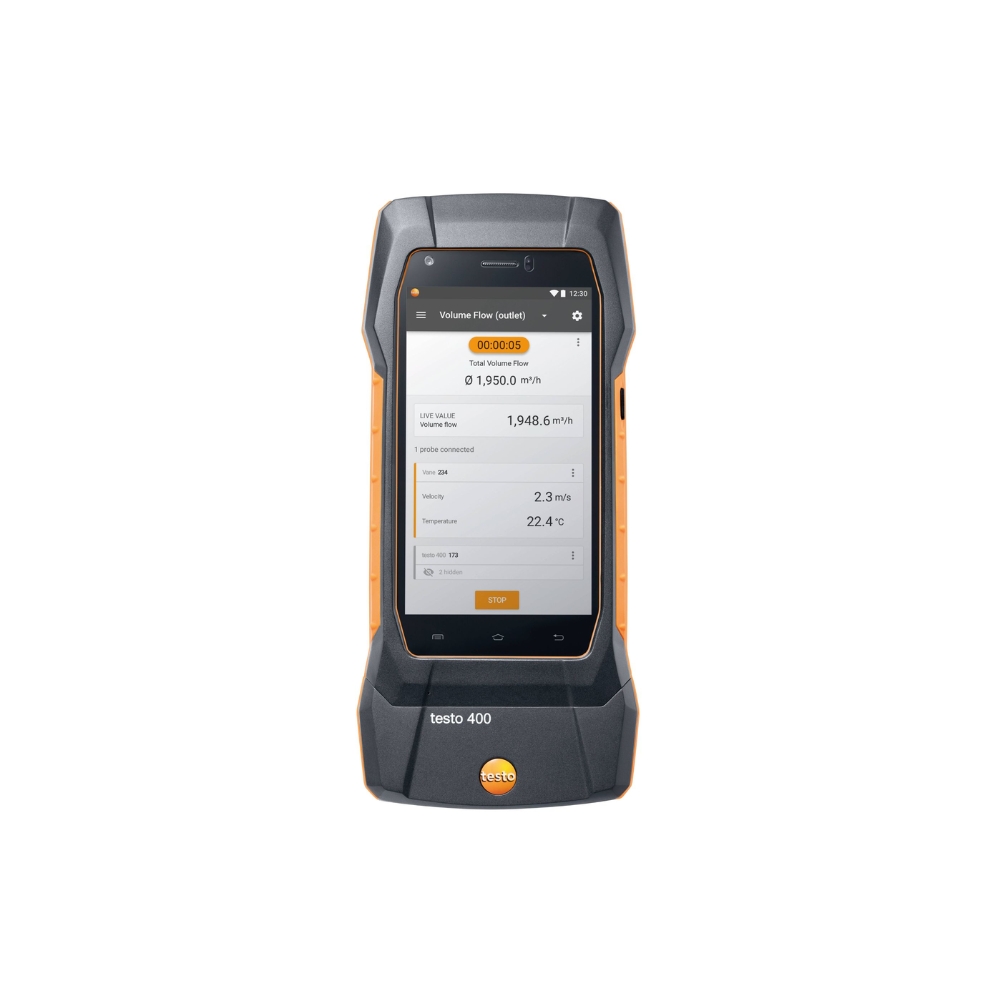
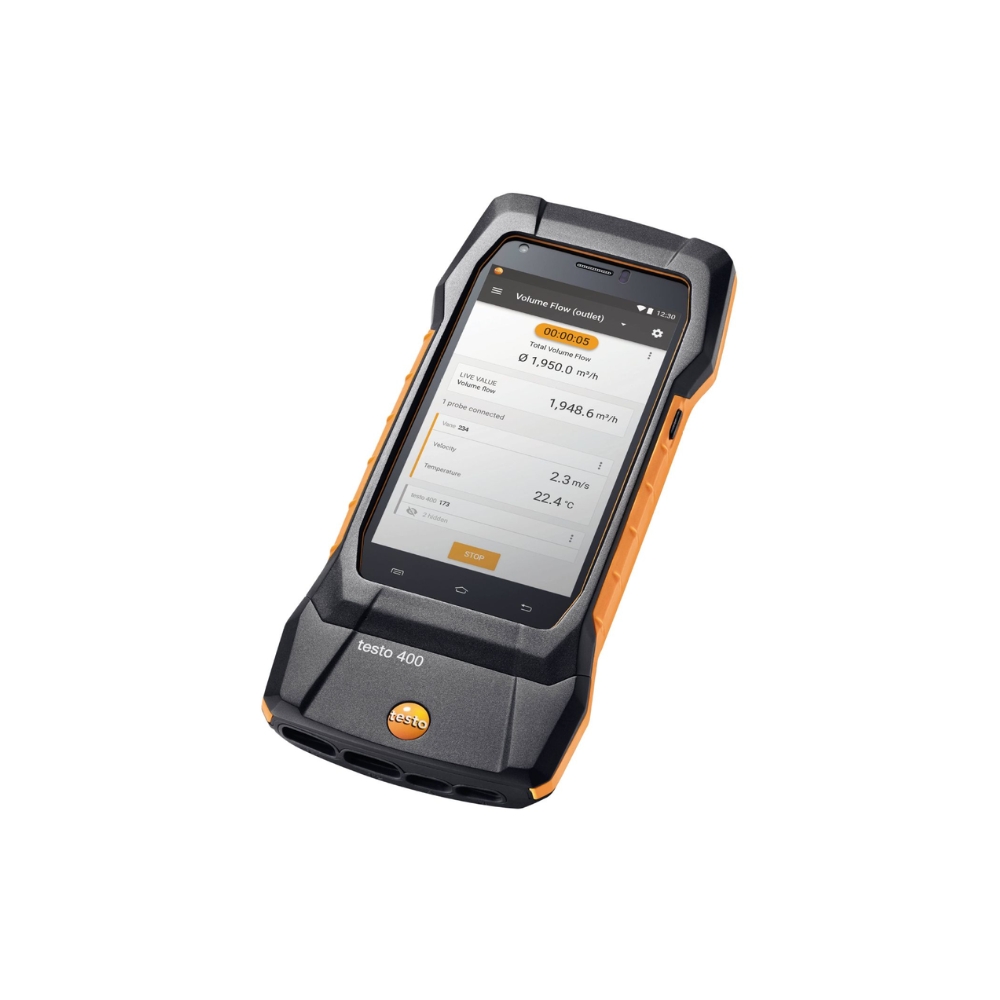
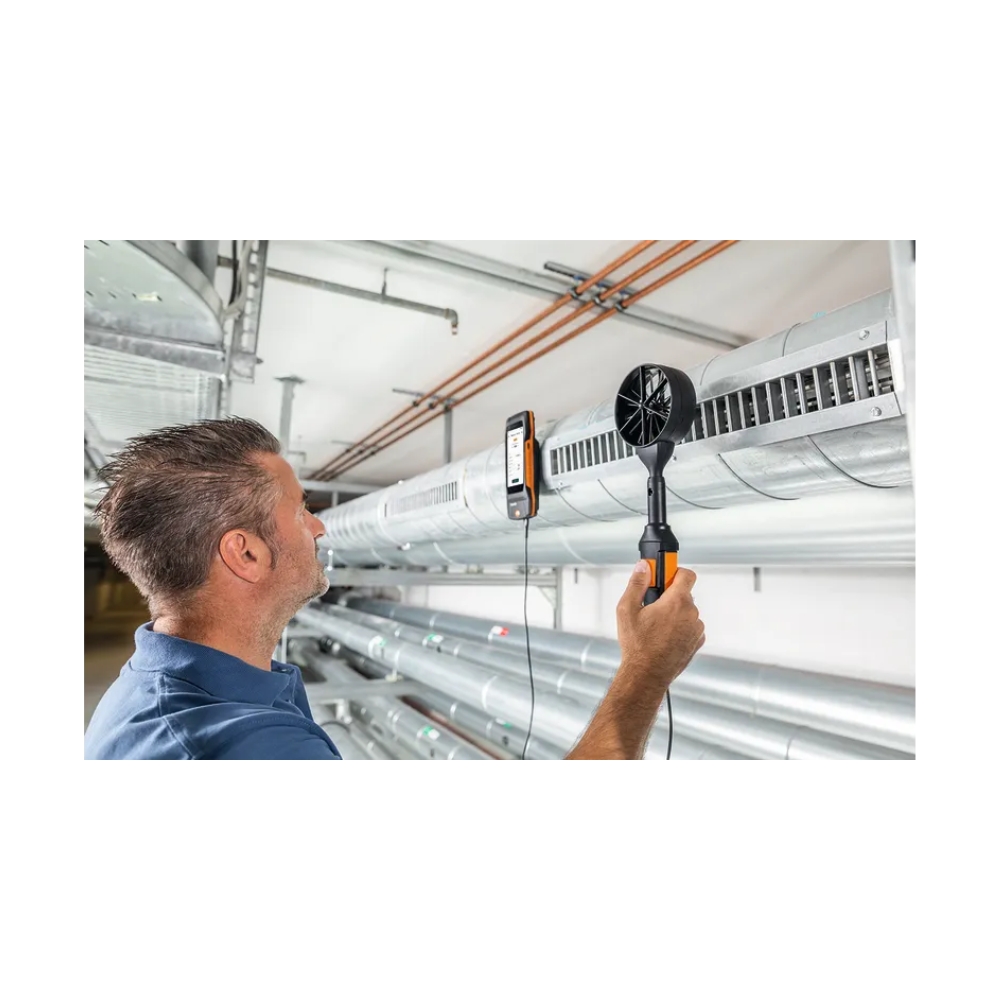
The Testo 400 is built for people who have to produce a report at the end of the job, not just a reading. It takes eight probes at once and runs measurement programmes that follow the recognised methods, rather than leaving the technician to work them out. Documentation is generated on site, complete with photos, comments and your logo. It measures airflow, temperature, humidity, pressure, illuminance, radiant heat, turbulence, carbon dioxide and carbon monoxide.
KEY BENEFITS
- Eight probes connected at once, across cable, Bluetooth and thermocouple inputs
- Measurement programmes follow EN ISO 12599, EN ISO 7730, EN ISO 7243 and their ASHRAE equivalents
- Duct traverse grids calculated for rectangular and circular ducts automatically
- Thermal comfort assessed properly, including PMV, PPD, turbulence and draught rate
- Heat stress measurement using wet bulb globe temperature
+ more in the Description tab below
Eight Probes, Not Three
The testo 400 takes considerably more inputs than a handheld multifunction meter, and that’s what defines it.
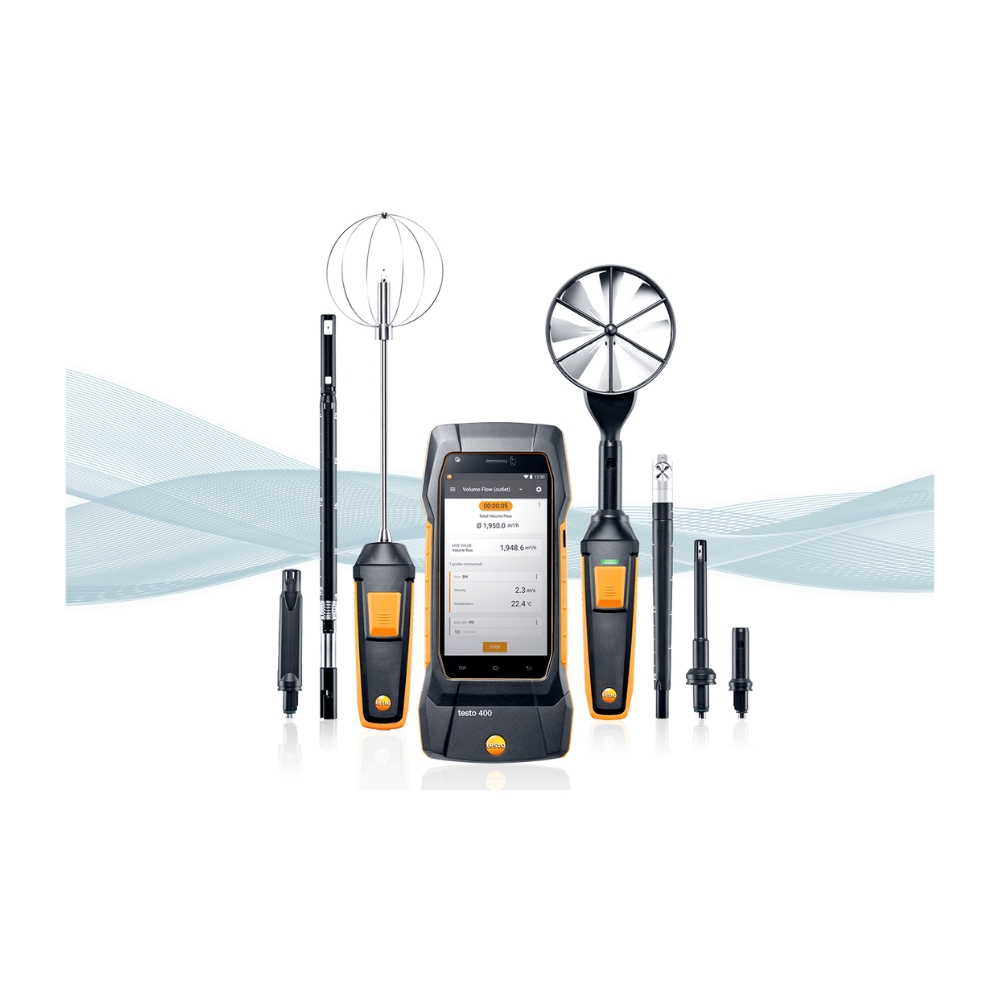
It connects two cable probes on the Testo Universal Connector, four Bluetooth probes, and two Type K thermocouple probes. That’s eight measurements at once, enough to characterise a space properly rather than sampling it in pieces. Bluetooth also connects testo Smart Probes and the testo 420 volume flow hood.
That matters on a commissioning or thermal comfort job, where the parameters interact. Air velocity, temperature, radiant heat, humidity and turbulence together decide whether an occupant is comfortable, and no single one answers the question. Measuring them at the same moment in the same place is the way to get a valid result.
Probe heads can be swapped without restarting the instrument, which on a multi point survey is the difference between a smooth job and a stop start one.
The Measurement Programmes Are the Point
This is what separates the testo 400 from an instrument that simply displays numbers.
Doing a ventilation or comfort assessment correctly means following a defined method: how many points to measure across a duct, where they go, how to average them, and what to calculate from the result. Get the method wrong, and the numbers are worthless however accurate the instrument is.
The testo 400 has those methods built in as measurement programmes:
| Programme | Standard |
|---|---|
| HVAC duct grid measurement | EN ISO 12599 and ASHRAE 111 |
| Thermal comfort (PMV and PPD) | EN ISO 7730 and ASHRAE 55 |
| Draught and degree of turbulence | EN ISO 7730 and ASHRAE 55 |
| Wet bulb globe temperature (WBGT) | DIN 33403 and EN ISO 7243 |
| Normal effective temperature (NET) | DIN 33403 |
Duct traverse grids are calculated for you, so the instrument tells you where to put the probe. Readings are evaluated using a traffic light system, so an out of specification result is obvious at the point of measurement, not at the desk afterwards.
In Australia, AS 1668.2 governs the mechanical ventilation design these measurements check, and the international methods above are widely used for the measurement itself.
Thermal Comfort Is a Calculation, Not an Opinion
This is worth drawing out, because it’s the capability most likely to solve a problem someone has been arguing about for months.
Complaints about a space being too hot, too cold or draughty are usually treated as subjective, but they aren’t. Thermal comfort depends on six factors: air temperature, radiant temperature, air velocity, humidity, clothing insulation and activity level. Combined, they give the predicted mean vote, a number on a seven point scale from cold to hot, and the predicted percentage dissatisfied, which estimates how many occupants will be unhappy.
Draught rate works the same way. Moving air at a given speed feels draughty at one temperature and pleasant at another, and turbulent air feels worse than smooth air at the same speed.
So an open plan floor with a running complaint can be measured, and the result compared against a requirement. That turns an argument between a facilities manager and an occupant into an assessment with a recommendation.
Probes Calibrate Separately From the Instrument
This is a practical detail that changes how a fleet is managed.
On many instruments, calibration means the instrument and its probes go away together, and the whole kit is out of service. The testo 400 uses an intelligent calibration concept, where probes and probe heads are calibrated independently of the instrument.
So a single probe can go for calibration while the instrument and the other probes keep working. For a business running one instrument, that’s the difference between losing a week and losing a probe.
An adjustment function across up to six measuring points supports zero error display where high precision is needed.
Pressure Built In
Both a differential pressure sensor and an absolute pressure sensor are built in. The differential pressure sensor is high precision and location independent, so its accuracy doesn’t depend on how the instrument is held. It measures from -100 to +200 hPa, with 0.001 hPa resolution.
Differential pressure confirms air is moving in the intended direction, not simply moving, which matters for cleanrooms, isolation rooms, switchrooms and paint booths. Absolute pressure feeds the volume flow calculations, since air density changes with barometric pressure.
Documentation on Site
This is why the instrument suits a consultant or contractor, not only a technician.
Customer and measuring point data is managed on the instrument itself. A measurement is completed with full documentation, including photos from the built in camera, comments and your own logo, and emailed over WiFi before leaving the site. Further analysis runs in Testo’s DataControl PC software.
The value isn’t just convenience. The report goes out while the job is fresh and the client is still there, rather than sitting in a pile of notes to be written up on a Friday.
Long Term Measurement Without Losing the Instrument
An optional IAQ data logger runs long term measurements on its own.
That covers the case where indoor air quality has to be tracked over days rather than sampled once, which is often what a genuine complaint needs. The logger stays in the space while the testo 400 goes out on other work.
Where It Sits Against the testo 440
Both are multifunction airflow and IAQ instruments, and the choice is about the deliverable rather than the measurement.
The testo 440 takes three probes and covers most HVAC commissioning, fault finding and IAQ work. For a technician taking readings, it’s the right instrument.
The testo 400 takes eight probes, and adds the standards based measurement programmes, illuminance and radiant heat, thermal comfort and heat stress calculations, and on site report generation. If the output is a formal assessment against a method, rather than a reading, this is the tier.
Where It’s Used
HVAC commissioning, testing and balancing. Ventilation checks against AS 1668.2. Thermal comfort assessment and complaint investigation. Indoor air quality surveys in offices, schools and healthcare. Heat stress assessment in workshops, foundries and outdoor work. Cleanroom and laboratory checks. Isolation and negative pressure rooms. Data centre airflow. Commercial kitchen ventilation. Building tuning and energy optimisation. Occupational hygiene assessments that need documented results.
Benefits
- Eight probes connected at once, across cable, Bluetooth and thermocouple inputs
- Measurement programmes follow EN ISO 12599, EN ISO 7730, EN ISO 7243 and their ASHRAE equivalents
- Duct traverse grids calculated for rectangular and circular ducts automatically
- Thermal comfort assessed properly, including PMV, PPD, turbulence and draught rate
- Heat stress measurement using wet bulb globe temperature
- Probe heads swap mid measurement without restarting the instrument
- Probes calibrate independently of the instrument, so one probe going away does not stop the job
- Integrated differential pressure and absolute pressure sensors
- Reports produced on site, with photos from the built in camera, comments and your logo, then emailed over WiFi
- Optional IAQ data logger runs a long term measurement while the instrument works elsewhere
Instrument type
Universal indoor air quality and airflow measuring instrument
Display
5.0 inch HD touch display, 1280 x 720 pixels
Simultaneous probe connections
Two cable probes on the Testo universal connector, four Bluetooth probes, two Type K thermocouple probes
Measured parameters
Airflow velocity, volume flow, temperature, humidity, differential pressure, absolute pressure, illuminance, radiant heat, turbulence, carbon dioxide, carbon monoxide
Integrated sensors
Differential pressure, high precision and location independent: -100 to +200 hPa, ±(0.3 Pa + 1% of reading) up to 25 hPa, resolution 0.001 hPa. Absolute pressure: 700 to 1,100 hPa, ±3 hPa
Measurement programmes
HVAC grid measurement (EN ISO 12599, ASHRAE 111). PMV/PPD (EN ISO 7730, ASHRAE 55). Draught and degree of turbulence (EN ISO 7730, ASHRAE 55). WBGT (DIN 33403, EN ISO 7243). NET (DIN 33403)
Duct traverse
Automatic point distribution for rectangular and circular ducts
Reading evaluation
Traffic light indication against the applicable limits
Probe handling
Probe heads exchangeable during measurement without restarting the instrument
Calibration concept
Probes and probe heads calibrated independently of the instrument
Adjustment
Up to six measuring points for zero error display
Documentation
On instrument customer and measuring point management. Reports with photos, comments and custom logo, emailed over WiFi
Software
Testo DataControl for PC analysis
Long term measurement
Optional IAQ data logger, operating independently of the instrument
Temperature
NTC: -40 to +150°C, ±0.2°C (-25 to +74.9°C). Type K: -200 to +1,370°C, ±(0.3°C + 0.1% of reading)
Interfaces
Bluetooth (probes, testo Smart Probes, testo 420), WiFi, USB
Cameras
Main camera 8.0 MP. Front camera 5.0 MP
Memory
2 GB (about 1,000,000 readings)
Battery
Rechargeable Li-ion, 5,550 mAh. About 10 hours continuous operation
Weight and dimensions
510 g. 210 x 95 x 39 mm
Protection and operating conditions
IP40. Operating temperature -5 to +45°C
Carbon Monoxide
CO
Carbon Dioxide
CO2
- Aviation & Transportation
- Carpark & HVAC
- Chemical Manufacturing
- Energy (Oil & Gas)
- Food & Beverage
- Marine & Maritime
- Medical & Healthcare
- Mining & Minerals
- Power Generation & BESS
- Technology & Semiconductor
- Water & Wastewater
Eight. Two cable probes, four Bluetooth probes and two Type K thermocouple probes, all reading together.
They build the method into the instrument. Duct traverse points are calculated for you, thermal comfort and draught rate are calculated from the measured parameters, and results are evaluated against the applicable limits as you measure.
Yes. It calculates predicted mean vote and predicted percentage dissatisfied from the six factors that determine comfort, which converts a complaint into an assessment.
No. Probes and probe heads are calibrated independently of the instrument, so one probe can be away while the rest of the kit keeps working.
Yes. Customer and measuring point data is held on the instrument, and a completed report including photos, comments and your logo is emailed over WiFi before you leave.
The 440 takes three probes and suits taking readings. The 400 takes eight, adds the built in measurement programmes, illuminance and radiant heat, comfort and heat stress calculations, and on site reporting. Choose on the deliverable rather than the measurement.
Trusted by









Contact Us
Can’t find what you’re looking for? Our team is happy to help.