
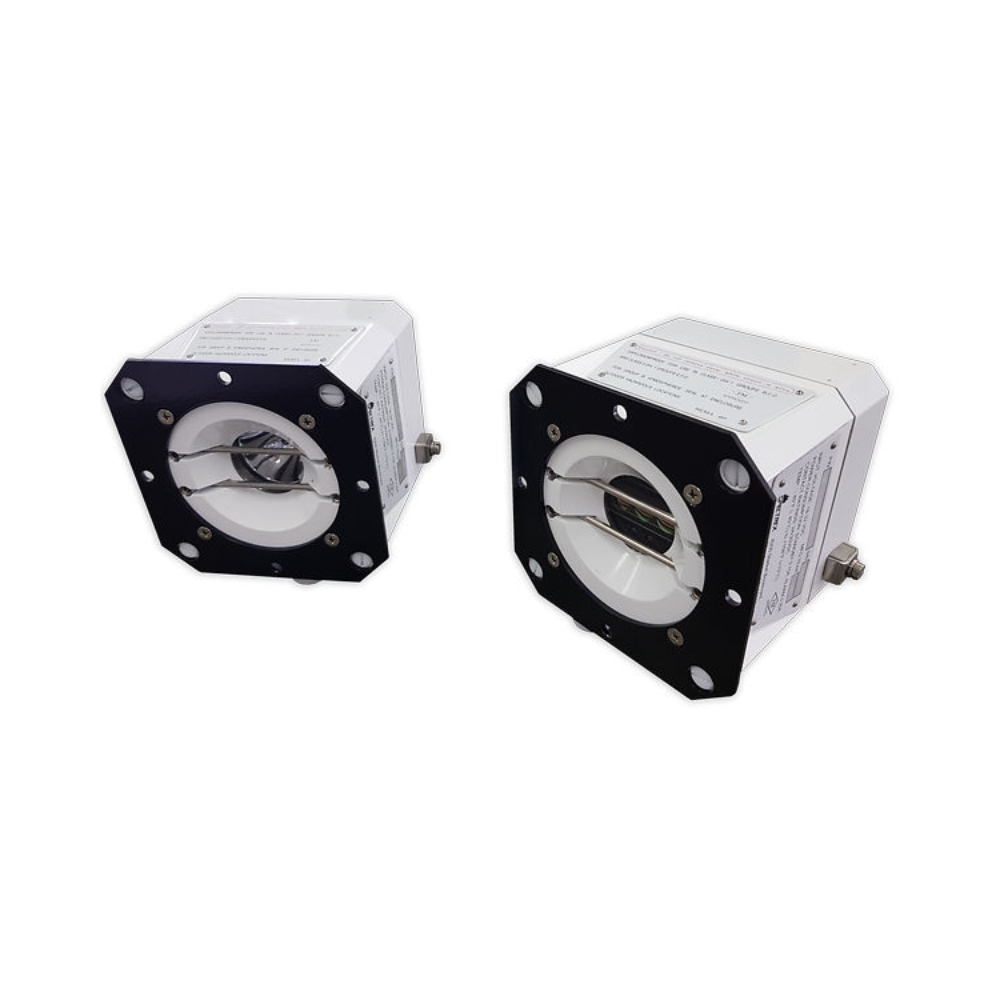
SafEye Duct
Air Duct Open Path Gas Detector
The SafEye Duct by Spectrex sits across an air intake and detects flammable gas being drawn into it. That makes it a different job from site wide open path detection, because a gas cloud entering a turbine intake or a control room HVAC duct becomes an ignition risk or an occupied space hazard rather than an outdoor one. It alarms from 0.5 LEL metres, five times more sensitive than standard open path equipment, and responds in one second on the 200 series. Full scale is matched to inlet width.
KEY BENEFITS
- Protects turbine and HVAC air intakes, so a gas cloud outside does not become a hazard inside
- Alarms from 0.5 LEL metres, five times more sensitive than standard open path equipment
- Responds in one second on the 200 series, five to ten times faster than standard open path
- Up to 50 times faster than a point detector doing the same job
- Two full scale options matched to inlet width, so sensitivity suits the duct rather than a compromise
+ more in the Description tab below
The Hazard Is Not the Cloud, It Is Where the Air Goes
A gas cloud drifting across an open deck is a hazard you manage. The same cloud drawn into a gas turbine air intake is an ignition source inside a machine running at temperature. The same cloud drawn into a control room HVAC intake turns the safe refuge into the exposure.
That is the risk the SafEye Duct addresses. Formation and migration of gas clouds, and their penetration into control rooms, turbine enclosures and other places assumed to be safe, is a substantial risk in its own right, and designers and safety engineers are increasingly required to detect and alarm on it specifically.
Site wide open path detection tells you gas is present somewhere in an area. This tells you gas is entering a duct, which is a different question with a different response.
Why a Point Detector Struggles in a Duct
Air in an intake duct is moving fast. A point detector placed in that stream samples one small volume of a high velocity flow, and a gas front can pass through the duct in less time than the detector needs to respond.
An open path beam crossing the full width of the inlet sees the whole cross section rather than one point in it. Anything passing through the duct passes through the beam.
Spectrex quotes the SafEye Duct as 20 to 50 times faster than a point detector in this duty. Their documentation also notes that point detectors may not be effective at all under the conditions found in an intake, meaning high speed airflow, high temperature, humidity and corrosive gases.
Sensitivity Matched to the Inlet
A duct beam is short, and a short path produces a small LEL metre reading for a given concentration. So duct detection needs far higher sensitivity than a 200 metre site beam.
The SafEye Duct handles this with two full scale options set by inlet width.
| Inlet width | Full scale |
|---|---|
| 0.6 m to 2 m | 1 LEL.m |
| 2 m to 7 m | 2.5 LEL.m |
Alarm sensitivity reaches 0.5 LEL metres, which Spectrex states is five times more sensitive than normal open path equipment. On a narrow inlet that resolves a genuinely small quantity of gas, which is the point, because gas entering a turbine does not need to be a large cloud to matter.
Speed, and Why It Matters More Here
Two series cover different response requirements.
| Series | Response time |
|---|---|
| Series 200 | 1 second |
| Series 300 | 2 seconds |
Both are five to ten times faster than commonly used open path detection. In duct protection, that speed is the difference between shutting an intake damper before the gas reaches the machine and recording that it arrived.
For a gas turbine, a one second response supports an automated intake isolation or trip. For a control room HVAC intake, it supports damper closure and pressurisation before the occupied space is affected.
Built to Ignore Duct Movement
Ducts move. Fans start, airflow loads the structure, plant vibrates, and thermal expansion shifts geometry through the day. A beam detector fixed across a duct has to tolerate all of it without reporting gas.
The optics give a misalignment tolerance of plus or minus 2 degrees in all directions, and the design is specifically protected against false gas readings and alarms caused by partial obscuration and blocking, misalignment, vibration, flexing or tilts.
That list is worth reading twice, because it describes the normal operating condition of an air intake rather than an unusual event.
Automatic Compensation
Each unit is factory calibrated through a temperature cycle across the whole operating range, and a temperature compensating mechanism maintains accuracy as conditions change.
An internal microprocessor runs automatic gain control, which compensates for reduced signal without anybody intervening. So gradual window fouling or a small alignment drift is absorbed rather than becoming a fault call.
The equipment is also not subject to poisoning, unlike catalytic detection, so a duct carrying silicones or sulphur compounds does not degrade it.
Proven Where It Is Hardest
The SafEye Duct is installed in air ducts on FPSOs and offshore rigs for British Petroleum, Shell and ABB Lummus, protecting turbine air intakes among other applications.
That reference list matters for a product like this. Turbine intake protection is a small, conservative market where nobody specifies an unproven detector, and an installed base on major operators’ assets is the qualification that gets a product onto a bid list.
Networking and Outputs
Standard outputs are 4 to 20 mA, or RS-485 which allows up to 64 detectors to be networked to a central monitoring or PC system.
The network connection also carries diagnostics, local and remote, which on an offshore installation means a detector can be interrogated without a boat trip or a shutdown.
Where It Is Used
Gas turbine air intakes. Control room and switchroom HVAC intakes. Offshore platforms, oilrigs and FPSOs. Onshore oil and gas terminals. Tank farms and storage depots. Filling stations. Petrochemical and chemical plant. Power generation and turbine halls. Compressor station buildings. Site buildings adjacent to landfill or digester plant where methane could migrate to an intake.
Benefits
- Protects turbine and HVAC air intakes, so a gas cloud outside does not become a hazard inside
- Alarms from 0.5 LEL metres, five times more sensitive than standard open path equipment
- Responds in one second on the 200 series, five to ten times faster than standard open path
- Up to 50 times faster than a point detector doing the same job
- Two full scale options matched to inlet width, so sensitivity suits the duct rather than a compromise
- Misalignment tolerance of plus or minus 2 degrees in all directions, so duct flexing causes no false reading
- Automatic gain control compensates for reduced signal without operator intervention
- Factory calibrated across the whole operating temperature range, with active temperature compensation
- Works in high speed airflow and up to 70 degrees Celsius, where point detectors are ineffective
- Networks up to 64 detectors over RS-485 to a central monitoring system
Detection principle
Open path, mounted across an air intake or duct
Target gases
Flammable hydrocarbon gases
Full scale, 0.6 m to 2 m inlet
1 LEL.m
Full scale, 2 m to 7 m inlet
2.5 LEL.m
Alarm sensitivity
Up to 0.5 LEL.m, five times more sensitive than standard open path equipment
Response time, Series 200
1 second
Response time, Series 300
2 seconds
Comparative speed
Five to ten times faster than commonly used open path. Twenty to fifty times faster than a point detector
Misalignment tolerance
Plus or minus 2 degrees in all directions
False alarm protection
Protected against readings caused by partial obscuration and blocking, misalignment, vibration, flexing and tilts
Calibration
Factory calibrated through a temperature cycle across the whole operating range
Temperature compensation
Active compensating mechanism maintains accuracy through changing and extreme temperatures
Gain control
Internal microprocessor with automatic gain control compensating for low signal
Maximum operating temperature
Up to 70°C
Environmental suitability
High speed airflow, high temperature, humidity and corrosive gases
Poisoning
Not subject to poisoning
Outputs
4 to 20 mA standard, or RS-485
Networking
Up to 64 detectors to a central monitoring or PC system over RS-485
Diagnostics
Local and remote diagnostic tools over the network connection
Approvals held
ATEX, FM, UL and GOST-R certificates
- Aviation & Transportation
- Carpark & HVAC
- Chemical Manufacturing
- Confined Space & Compliance
- Energy (Oil & Gas)
- Landfill & Remediation
- Mining & Minerals
- Power Generation & BESS
- Water & Wastewater
Flammable gas being drawn into an air intake, such as a gas turbine intake or a control room HVAC duct, where a cloud outside becomes an ignition risk or an occupied space hazard inside.
Because intake air moves fast, so a point detector samples one small volume of a high velocity stream. An open path beam crosses the full inlet and sees whatever passes through it.
It alarms from 0.5 LEL metres, which Spectrex states is five times more sensitive than standard open path equipment, with full scale set at 1 or 2.5 LEL metres depending on inlet width.
Response time. The 200 series responds in one second and the 300 series in two.
No, the optics tolerate plus or minus 2 degrees of misalignment in all directions and the design is specifically protected against partial obscuration, vibration, flexing and tilting.
Yes, up to 64 detectors network over RS-485 to a central monitoring or PC system, which also carries local and remote diagnostics.
Trusted by









Contact Us
Can’t find what you’re looking for? Our team is happy to help.