
SafEye Quasar
Open Path Toxic and Flammable Gas Detector
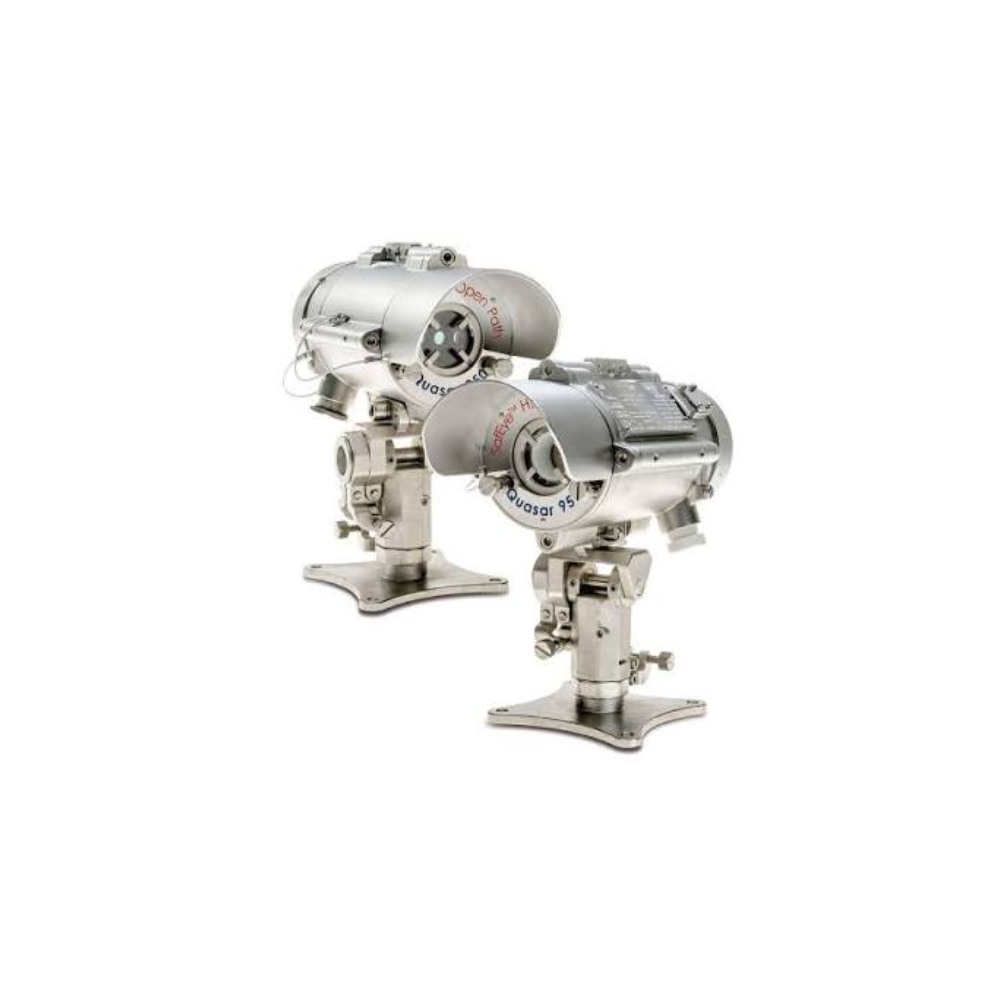
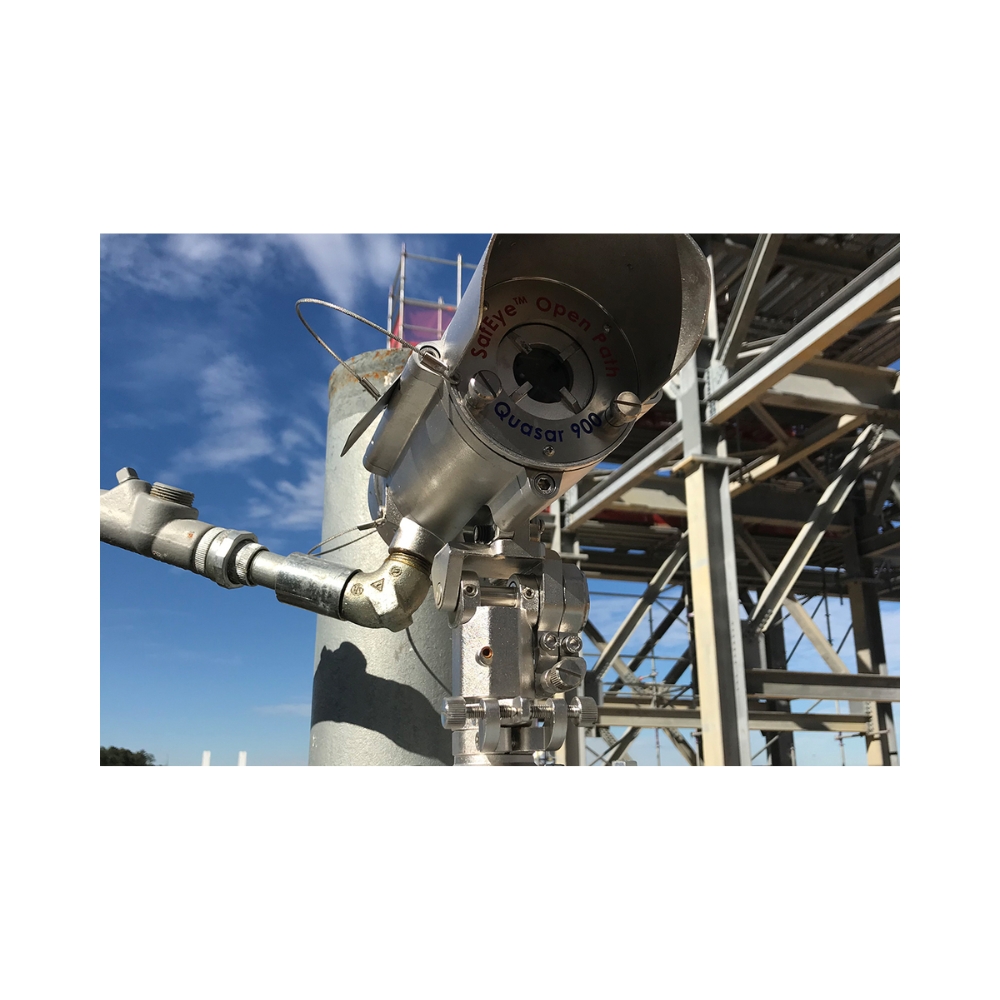
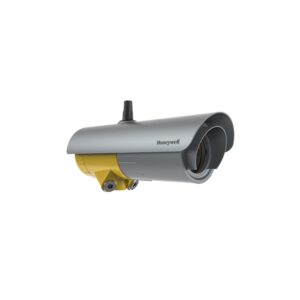
The SafEye Quasar by Spectrex is an open path gas detector family built on the xenon flash lamp design that Spectrex invented. The Quasar 900 detects combustible hydrocarbons, from methane to hexane plus ethylene, across paths of up to 200 metres. The Quasar 950 detects hydrogen sulphide and the Quasar 960 detects ammonia, both across paths of up to 60 metres. Heated optics keep it measuring through fog, rain and snow, and it’s immune to sunlight, flare stacks and arc welding. All three are SIL 2 approved, with 316L stainless steel housings on the 950 and 960.
KEY BENEFITS
- One family covers combustible hydrocarbons, hydrogen sulphide and ammonia
- Xenon flash source, the design Spectrex invented to end the false alarms that plagued early open path detection
- Keeps measuring through heavy beam obscuration from dust, fog, rain and snow
- Heated windows stop condensation, ice and snow degrading the measurement
- Immune to sunlight, flare stacks, arc welding and lightning, so no software masking is needed
+ more in the Description tab below
Three Series, Two Technologies, Three Gas Types
Replace the existing model table with:
| Series | Source | Detects | Path length | Models |
|---|---|---|---|---|
| Quasar 900 | Xenon flash infrared | Combustible hydrocarbons (methane to hexane, and ethylene) | 7 m to 200 m | 901, 902, 903, 904 |
| Quasar 950 | Xenon flash ultraviolet | Hydrogen sulphide | 5 m to 60 m | 951, 952, 953 |
| Quasar 960 | Xenon flash ultraviolet | Ammonia | 5 m to 60 m | 961, 962, 963 |
The gas decides the series, and the path length decides the model. Each model covers a different distance band, so the beam can be matched to the site.
Infrared is used for hydrocarbons because they absorb infrared. Ultraviolet is used for hydrogen sulphide and ammonia because they absorb in the UV band. It’s the same family approach and commissioning method, using a different part of the spectrum.
Spectrex Invented This
This explains why the range behaves the way it does.
Early open path gas detectors were plagued by false alarms. Sunlight, flare stacks, arc welding and lightning all put radiation into the beam, and detectors couldn’t tell that apart from gas.
Spectrex invented the xenon flash lamp design that solved it. The source fires a very powerful signal for a very short time, at set intervals. The receiver only responds to signals of that intensity and speed, and ignores background radiation. It’s a physical solution rather than a software one, which is why the immunity holds.
Performance in All Weathers
An open path beam crossing a site collects whatever’s in the air: dust from a haul road, sea fog, tropical rain, snow, or vibration shifting the alignment. All of it reduces the signal reaching the receiver.
The Quasar’s high power xenon lamp compensates for changing weather, including rain, fog, mist and snow. The optics are thermostatically heated to stop ice and snow building up, and to prevent condensation on the lenses. It operates from -55°C to +65°C.
No Unrevealed Failures
The Quasar 900 is designed so a fault can’t go unnoticed. In normal operation, the output is 4 to 20 mA, depending on the gas concentration. Below 4 mA, it signals a fault (1 mA) or beam blockage (2 mA).
A continuous self test also gives a pre warning (3 mA) when the detector is still working but needs attention, for example when the transmitter or receiver is misaligned, or deposits are building up on the optics. That allows maintenance without downtime. The 950 and 960 have a 3 mA maintenance call too.
An internal data logger on the Quasar 900 keeps a detailed record of the last 100 events.
SIL 2 and Certification
All three series are approved to SIL 2 under IEC 61508 by TÜV. That matters when the detector forms part of a safety instrumented function, rather than sitting alongside one.
Certification also covers ATEX and IECEx, with FM performance testing and DNV approval for the Quasar 900. The 950 and 960 are certified Ex d e ib IIB+H2 T4 Gb, with Ex tb IIIC for dust.
Built for Offshore
The 950 and 960 source and detector housings are 316L stainless steel, with an electropolished finish. The circuit boards are conformal coated and protected against vibration.
That’s aimed at a particular set of conditions: salt air, constant vibration from rotating plant, washdown, and a maintenance regime where getting to a detector is expensive. Electropolished 316L resists pitting corrosion, and conformal coating keeps humidity off the electronics.
For Australian coastal, offshore and North West Shelf work, that’s the difference between a detector that lasts and one that becomes a maintenance item.
One Person Can Commission It
Open path detectors traditionally need two people, one at the source and one at the receiver, with a radio.
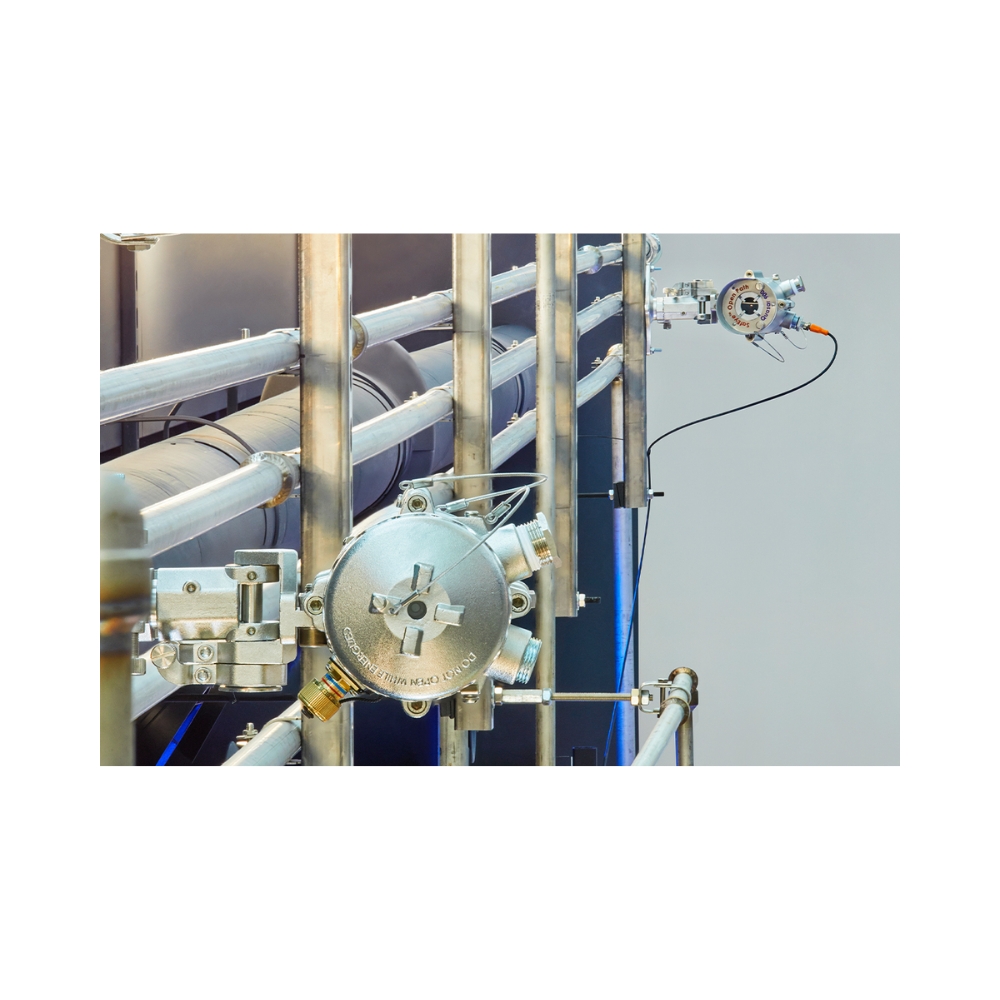
The Quasar can be aligned and commissioned by one person. After a coarse adjustment by eye, a telescope is fitted for fine adjustment to get the strongest signal. An intrinsically safe handheld unit handles diagnostics, calibration and configuration, connecting quickly to the detector or over HART on the mA line.
On the Quasar 900, built in calibration means there’s no need for manual adjustment or test gas. Each detector comes with methane, propane and ethylene calibrations as standard, selectable in the field.
Reading LEL Metres, With a Worked Example
Open path readings for hydrocarbons are in LEL metres, which measures the total gas along the beam rather than the concentration at one point. It takes a moment to get used to, and it changes how alarms are set.
Take a gas cloud at 20% LEL sitting across 7 metres of the beam. The reading is 20% LEL x 7 metres, which gives 1.4 LEL metres. Against a typical low alarm of 1 LEL metre, that alarms comfortably.
Now take the same 20% LEL cloud across only 2 metres. That reads 0.4 LEL metres, and doesn’t reach the alarm. The concentration is the same, but the quantity of gas in the beam isn’t.
That’s why open path detection complements point detection, rather than replacing it. Open path tells you gas is present across an area. Point detectors near likely leak sources tell you where it’s coming from.
Where It’s Used
Refineries and petrochemical plant, offshore platforms and FPSOs, LNG production and storage, gas filling and distribution terminals, gas transport and pipelines, chemical processing plants, wastewater treatment works and digesters (for hydrogen sulphide), ammonia refrigeration engine rooms and cold stores, fertiliser production and storage, and perimeter and boundary monitoring.
Benefits
- One family covers combustible hydrocarbons, hydrogen sulphide and ammonia
- Xenon flash source, the design Spectrex invented to end the false alarms that plagued early open path detection
- Keeps measuring through heavy beam obscuration from dust, fog, rain and snow
- Heated windows stop condensation, ice and snow degrading the measurement
- Immune to sunlight, flare stacks, arc welding and lightning, so no software masking is needed
- Fast response: 3 seconds on the Quasar 900, and 5 seconds or less on the 950 and 960
- SIL 2 approved to IEC 61508, so it can form part of a rated safety function
- 316L electropolished stainless housings with conformal coated boards, built for offshore
- Intrinsically safe handheld unit lets one person install, calibrate and interrogate a beam
- Quasar 900 detects down to 0.15 LEL.m, with methane, propane and ethylene calibrations built in
Quasar 950 and 960
Detection principle
Open path ultraviolet, xenon flash source, spectral fingerprint analysis by DOAS
Gases detected, 950
Hydrogen sulphide
Gases detected, 960
Ammonia
Path length
5 m to 60 m
Model options
950: models 951 (5 to 16 m), 952 (14 to 40 m), 953 (35 to 60 m). 960: models 961, 962 and 963, over the same distances
Speed of response
T90 of 5 seconds or less
Optics
Heated windows to prevent condensation, icing and snow accumulation
Radiation immunity
Immune to sunlight, flare stacks, arc welding and lightning
Power
24 VDC nominal (18 to 32 VDC). Detector and source 250 mA each (300 mA peak)
Operating temperature
-55°C to +65°C
Outputs
0 to 20 mA (sink, source optional), HART, RS485 Modbus. 3 mA maintenance call
Housing
316L stainless steel with electropolished finish
Circuit protection
Conformal coated boards, protected against mechanical vibration
Dimensions, detector and source
267 x 130 x 130 mm
Dimensions, tilt mount
120 x 120 x 158 mm
Weight, detector and source
5 kg
Weight, tilt mount
2 kg
Certification
ATEX and IECEx Ex II 2 GD Ex d e ib [ib Gb] IIB+H2 T4 Gb, Ex tb IIIC T135°C Db IP66. Inmetro. TR CU/EAC. SIL 2 approved by TÜV to IEC 61508
Area classification
Hazardous zones 1 and 2 with IIB plus hydrogen group vapours. Zone 21 for combustible dust
Warranty
3 years
-
-
Quasar 900
Detection principle
Open path infrared, xenon flash source, spectral fingerprint analysis by DOAS
Gases detected
Combustible hydrocarbon gases including methane, ethane, propane, butane and ethylene
Speed of response
3 seconds
Minimum detection level
0.15 LEL.m
Path length
7 m to 200 m
Operating temperature
-55°C to +65°C
Calibration
Built in. Methane, propane and ethylene calibrations as standard, field selectable. No test gas needed
Analogue output
4 to 20 mA normal. 1 mA fault, 2 mA beam blockage, 3 mA pre warning
Model options
Four models: 901 (7 to 20 m), 902 (15 to 40 m), 903 (35 to 200 m), 904 (80 to 200 m)
Diagnostics
Built in event recorder holding a real time record of the last 100 events
Handheld
Fast connection to the handheld unit for prognostic and diagnostic maintenance
Environment
Designed for extremely harsh environments where dust, fog, rain, snow or vibration reduce signal
Housing
Rugged stainless steel, transmitter and receiver both enclosed
Certification
ATEX and IECEx approved. FM and DNV approvals held. SIL 2 approved by TUV
Ethylene (Ethene)
C2H4
Propane
C3H8
Butane
C4H10
Hexane
C6H14
Methane
CH4
Hydrogen Sulphide
H2S
Ammonia
NH3
- Aviation & Transportation
- Chemical Manufacturing
- Confined Space & Compliance
- Energy (Oil & Gas)
- Food & Beverage
- Landfill & Remediation
- Marine & Maritime
- Power Generation & BESS
- Water & Wastewater
The gas. The 900 detects combustible hydrocarbons using infrared, over paths of 7 to 200 metres. The 950 detects hydrogen sulphide and the 960 detects ammonia, both using ultraviolet, over paths of 5 to 60 metres.
Because the xenon flash source fires a high intensity signal for under a millisecond, and the receiver responds only to signals of that intensity and speed, ignoring background radiation.
The high power xenon lamp compensates for rain, fog, mist and snow, and heated optics stop ice, snow and condensation building up. If the beam is blocked, the Quasar 900 signals it (2 mA), and gives a pre warning (3 mA) when the optics or alignment need attention.
Yes, the range is TUV approved against the SIL 2 requirements of IEC 61508, so it can form part of a rated safety instrumented function.
Yes, an intrinsically safe handheld unit combines diagnostics, calibration and interrogation, which removes the need for a second person at the far end.
It is concentration multiplied by path length, so a cloud at 20 percent LEL across 7 metres reads 1.4 LEL metres, while the same concentration across 2 metres reads only 0.4.
Trusted by









Contact Us
Can’t find what you’re looking for? Our team is happy to help.