
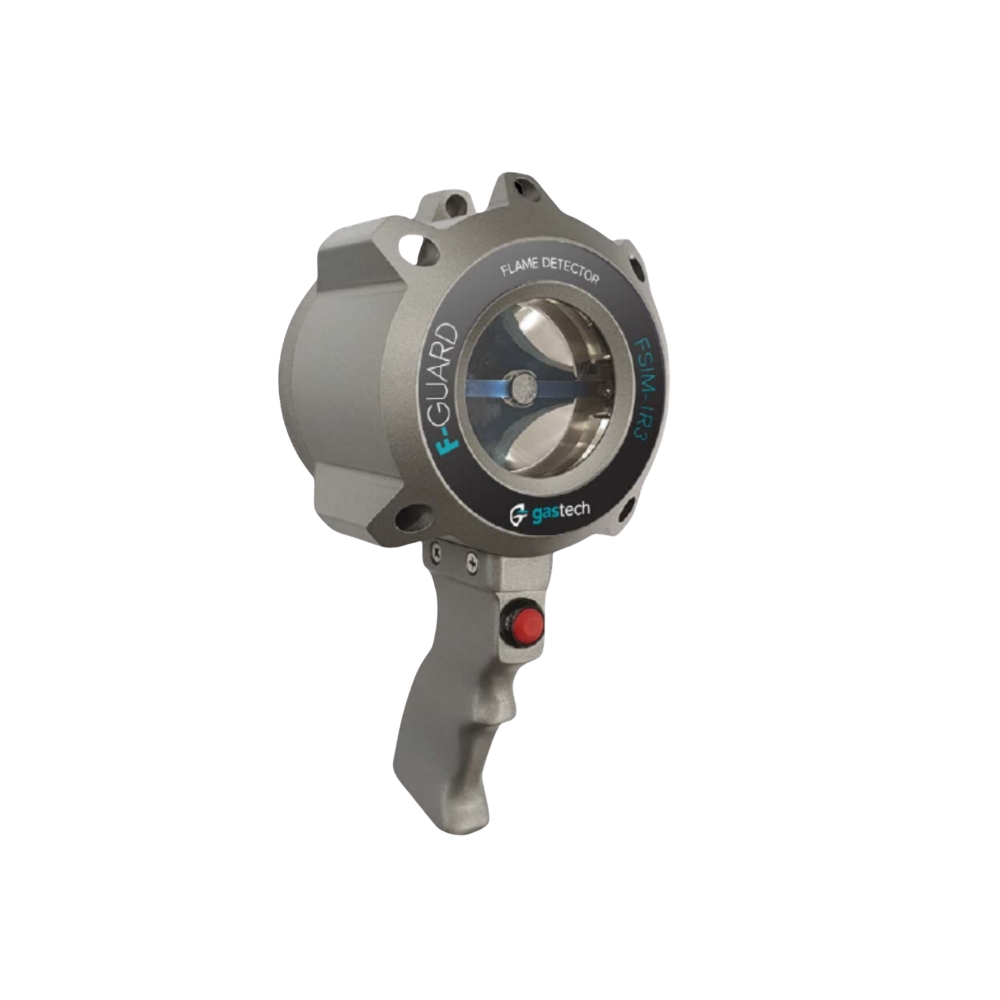
F-Guard Flame Simulators
Portable Flame Detector Testing
F-Guard flame simulators trigger a detector from outside, using a source it accepts as a real fire. That matters because the F-Guard range already has two ways to test itself internally, and neither of them proves the detector can actually see through its window along a clear path. Three models cover the three detector types, testing at up to 7 metres, and each arrives as a complete kit.
KEY BENEFITS
- Provides an entirely external loop test, which no internal test method can
- Proves the optics and the line of sight, not only the electronics and the wiring
- Three models matched to the three F-Guard detector types
- Tests from up to 7 metres with the IR3 and IR3-H2 simulators, and 6.5 metres with the UV/IR
- Alignment markers make positioning fast and repeatable
+ more in the Description tab below
The F-Guard Already Tests Itself Two Ways
It’s worth stating up front, because it changes what the simulator is actually for.
All F-Guard flame detectors run an automatic self test covering their optics, windows, electronics and software. Separately, an F-Guard detector can be put into alarm manually, either through the FGD communicator software, or by short circuiting the Manual BIT terminal to the 24 VDC negative terminal for one second.
That second method is genuinely useful, and often overlooked. A technician with a screwdriver can put the detector into alarm and prove the relay works, the cable is intact, the panel receives the signal and the notification devices activate. For a routine loop check, that’s enough, and it costs nothing.
So the honest question is what a simulator adds.
What Only an External Source Proves
Both internal methods trigger the detector from the inside. They tell you the detector’s electronics work, and that everything downstream of it works. What they can’t tell you is whether the detector can see.
An external simulator produces a signal that has to travel through the air, through the detector’s window and into its sensors. That proves three things nothing else can.
That the optics are clear enough to detect a real fire, not just clean enough to pass a self test. That the line of sight to the protected area is unobstructed. And that the detector is still aimed where the design intended.
Those last two matter more over time than most people expect. Racking gets moved, partitions go up, scaffolding is erected, a new vessel is installed, a pipe run is added. Any of those can put something between the detector and the area it’s watching, and the detector will keep reporting itself healthy throughout. An internal test will pass. A fire wouldn’t be seen.
So the two methods answer different questions. Use the manual BIT for a routine loop check. Use a simulator at commissioning, after any change to the protected area, and for periodic checks that the detector still sees what it’s meant to.
Three Models
| Model | Detector | Maximum testing distance | Activations per charge |
|---|---|---|---|
| FLS FSIM IR3 | F-Guard IR3, including HD and CO2L variants | 7 m | About 1,000 |
| FLS FSIM IR3-H2 | F-Guard IR3-H2, including the HD variant | 7 m | About 1,000 |
| FLS FSIM UV/IR | F-Guard UV/IR, including the HD variant | 6.5 m | About 50 |
Matching the simulator to the detector isn’t optional. A simulator produces a specific spectral signature, and a detector tuned for hydrogen won’t respond to a source built for hydrocarbon flames. The wrong model produces a failed test on a detector that’s working correctly.
Seven Metres, and When That’s Enough
The simulators work at up to 7 metres from the detector (6.5 metres for the UV/IR model), which is shorter than the long range Spectrex units reach.
Testing distance also depends on the detector’s sensitivity setting. At extreme sensitivity, the IR3 and IR3-H2 simulators reach 7 m. At high sensitivity, that drops to 5 m. At medium, 3 m (4 m for the UV/IR). At low, 1 m.
Whether that matters depends on the installation. In a plant room, compressor house, turbine enclosure, workshop or skid, 7 metres reaches most detectors from an accessible position. On a large open process area with detectors mounted high on structure, it won’t, and the Spectrex long range simulators are the right tool.
It’s worth checking against your actual mounting positions and sensitivity settings before ordering, since the whole point is reaching the detector without arranging access equipment.
Designed to Be Used, Not Stored
This is the practical detail that decides whether periodic testing actually happens.
The simulators are inexpensive, lightweight and simple to use. At 1.8 kg, with a modern ergonomic design and alignment markers, they allow accurate, fast and convenient testing. That combination matters, because test equipment that’s heavy, awkward or intimidating gets left in the store, and the testing gets put off.
A 3 colour LED shows the simulator’s status, and the rechargeable lithium battery charges in up to 3 hours. Each kit contains the simulator, a carrying case and strap, a battery charger, the user manual, an Allen key and a tool for removing the rear cover. Nothing else needs sourcing before the first test.
Approved for Hazardous Areas
The simulators are ATEX approved for use in hazardous Zones 1, 2, 21 and 22. They’re certified Ex db ib op is IIC T6 Gb for gas, and Ex tb ib op is IIIC T85°C Db for dust, so they can be taken into the area with the detector without a hot work permit. The LM25 aluminium enclosure is rated IP65 (NEMA 4X) and operates from -20°C to +50°C.
Buy or Hire
For a site with a large installed base and a regular testing programme, owning a simulator makes sense.
For a site with a handful of detectors tested once a year, hiring usually works out better. A simulator sitting in a store for eleven months still needs its battery maintained and its own condition checked, and it earns nothing in the meantime. Gastech supplies these for purchase and through the hire fleet, and our field service team carries out functional testing as part of a service programme, if you’d rather not do it yourselves.
Benefits
- Provides an entirely external loop test, which no internal test method can
- Proves the optics and the line of sight, not only the electronics and the wiring
- Three models matched to the three F-Guard detector types
- Tests from up to 7 metres with the IR3 and IR3-H2 simulators, and 6.5 metres with the UV/IR
- Alignment markers make positioning fast and repeatable
- ATEX approved for use in hazardous Zones 1, 2, 21 and 22
- Lightweight at 1.8 kg, with around 1,000 activations per charge on the IR3 and IR3-H2 models
- Supplied as a complete kit with case, strap, charger, manual and tools
- Complements the F-Guard self test and manual BIT rather than duplicating them
- 3 year warranty, and available to hire as well as purchase
Function
External flame simulator providing an entirely external loop test of F-Guard flame detectors
Models
FLS FSIM IR3, FLS FSIM IR3-H2, FLS FSIM UV/IR
Testing distance
IR3 and IR3-H2: up to 7 m. UV/IR: up to 6.5 m. Distance depends on detector sensitivity setting
Positioning
Ergonomic design with alignment markers
Hazardous area
ATEX approved for Zones 1, 2, 21 and 22. Ex II 2 G Ex db ib op is IIC T6 Gb. Ex II 2 D Ex tb ib op is IIIC T85°C Db. -20°C to +50°C
Power
Rechargeable lithium battery, 3.7 V, over 3,000 mAh. Charging time up to 3 hours. Charger supplied
Kit contents
Simulator, carrying case, carrying strap, battery charger, user manual, Allen key, and a tool for removing the simulator rear cover
Tests
Detector optics, window, line of sight, alarm outputs, wiring, panel and notification
Activations per charge
IR3 and IR3-H2: about 1,000. UV/IR: about 50
Indication
3 colour LED (green, yellow, red)
Size and weight
100 x 100 x 200 mm. 1.8 kg
Enclosure
Painted aluminium LM25. IP65 (NEMA 4X)
Operating temperature
-20°C to +50°C. Humidity up to 99% RH, non condensing
Warranty
3 years
- Food & Beverage
- Aviation & Transportation
- Carpark & HVAC
- Chemical Manufacturing
- Energy (Oil & Gas)
- Landfill & Remediation
- Marine & Maritime
- Mining & Minerals
- Power Generation & BESS
- Technology & Semiconductor
- Water & Wastewater
The manual method triggers the detector internally, so it proves the outputs, wiring and panel. It cannot prove the detector can see through its window along a clear line of sight, which is what an external source tests.
Up to 7 metres with the IR3 and IR3-H2 simulators, and 6.5 metres with the UV/IR, at the detector's extreme sensitivity setting. For detectors mounted higher or further away, the Spectrex long range simulators reach considerably further.
One per detector type. The IR3 simulator for F-Guard IR3 detectors including the HD and CO2L variants, the IR3-H2 simulator for hydrogen detectors, and the UV/IR simulator for UV/IR detectors.
Yes. The simulators are ATEX approved for use in hazardous Zones 1, 2, 21 and 22.
At commissioning, after any change to the protected area that could obstruct the view, and for periodic verification that the detector still sees what it is meant to.
Only if the release is left armed. Disable it at the panel beforehand unless you are deliberately testing the release.
Trusted by









Contact Us
Can’t find what you’re looking for? Our team is happy to help.