
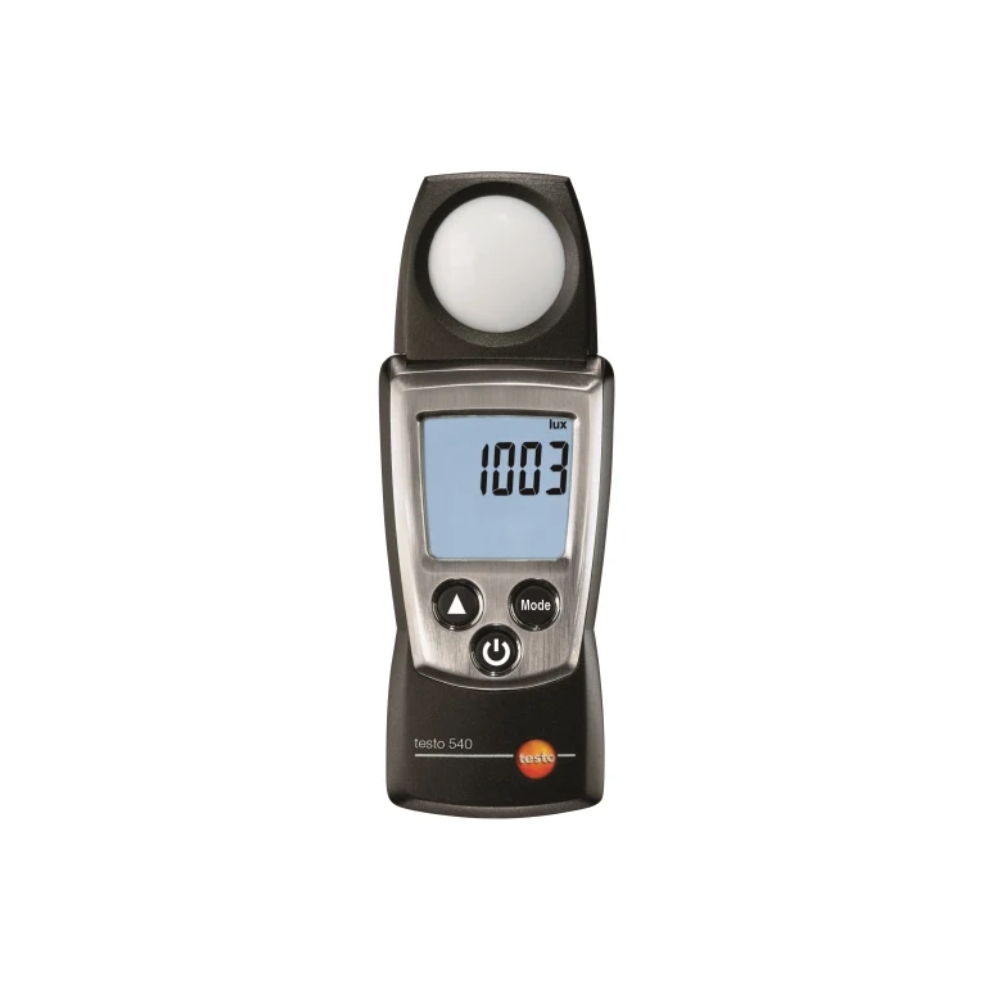
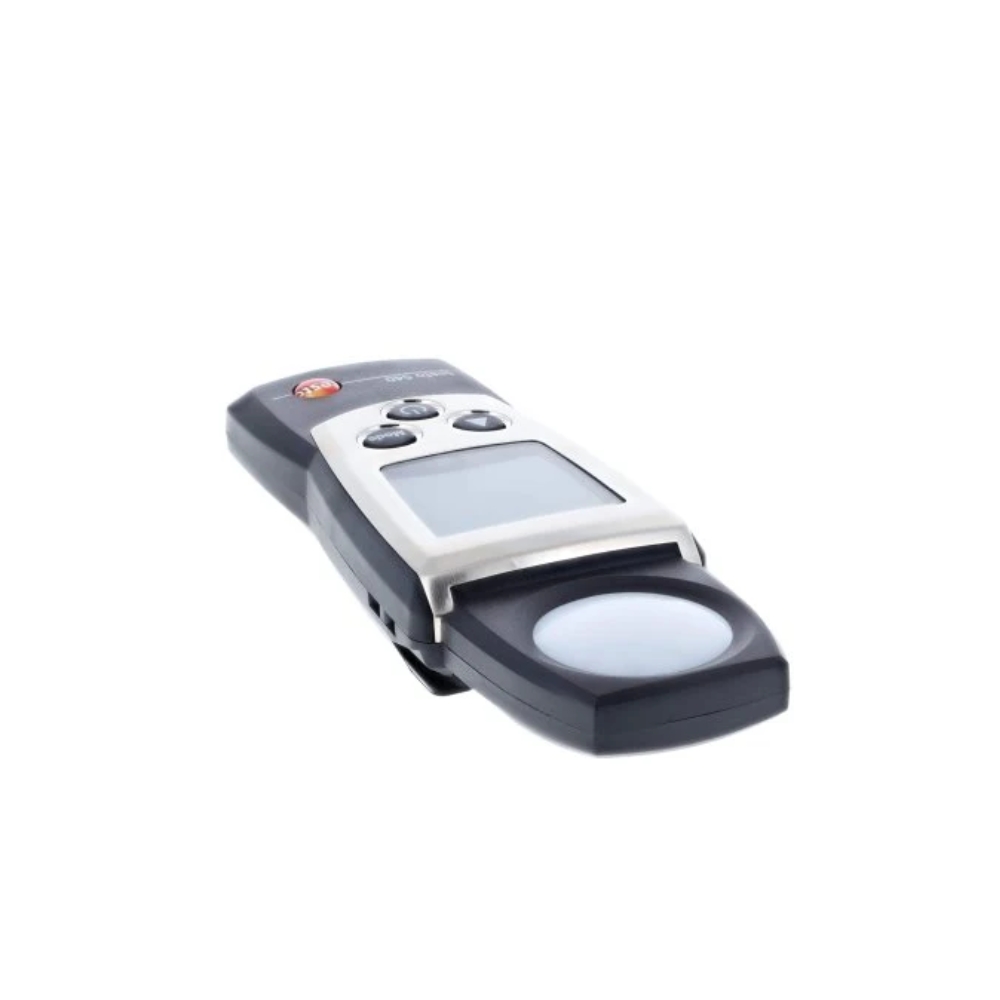
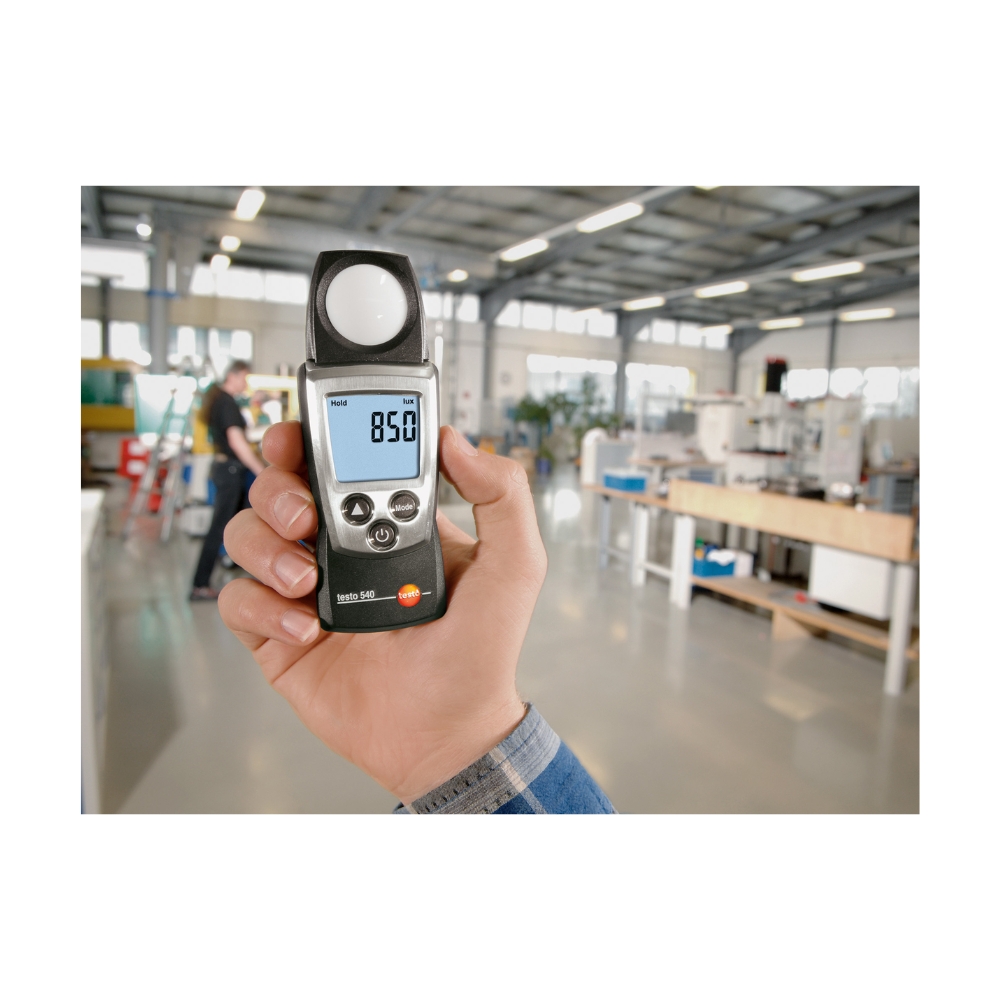
testo 540
Lux Meter
The Testo 540 turns a subjective judgement into a number. Lighting is the one workplace condition usually assessed by asking somebody whether it seems dark enough to be a problem, and a lux meter replaces that with a measurement. The sensor is matched to the spectral sensitivity of the human eye, it reads from 0 to 99,999 Lux in half a second, and it fits in a pocket at 95 grams.
KEY BENEFITS
- Sensor matched to the spectral sensitivity of the human eye, so the reading reflects how a person sees the space
- Measures 0 to 99,999 Lux, from a dim store room through to full daylight
- Reading in half a second, so a survey of a whole floor moves quickly
- Accuracy of ±3 lux or ±3% of reading, whichever is greater, against a Class B reference to DIN 5032 Part 7
- Switches between Lux and foot candles
+ more in the Description tab below
The Hazard Usually Assessed by Opinion
Most workplace hazards get measured. Gas gets a detector, noise gets a meter, dust gets a monitor. Lighting tends to get a look around and an opinion.
That’s a gap, because poor lighting contributes to slips, trips and falls, to errors and quality problems, and to eye strain and fatigue across a shift. It’s also one of the easier things to fix once you know where the problem is.
Australian interior and workplace lighting requirements are set out in the AS 1680 series, with recommended illuminance levels that vary by the task being done rather than by the room. A drawing office and a corridor have different requirements, and the only way to know whether either is being met is to measure at the working plane.
A lux meter turns “it seems a bit dark in here” into a figure that can be compared against a requirement, recorded in an assessment and used to justify a change.
Why the Sensor Has to Match the Eye
This is the technical point that separates a lux meter from a light sensor, and it’s why a phone app isn’t a substitute.
Lux isn’t a measure of radiant power. It’s a unit weighted to how sensitive human vision is at each wavelength. The eye is most responsive to green light around 555 nanometres and falls away sharply towards red and blue, so two light sources giving off identical power can look very different in brightness.
A raw light sensor doesn’t account for that. It responds to wavelengths the eye barely registers, so its reading describes the radiation present, not how bright the space looks to a person standing in it.
The testo 540 uses a silicon photodiode with its response adapted to the spectral sensitivity of the eye. That’s what makes the number a lux value. Accuracy is ±3 lux or ±3% of reading, whichever is greater, against a Class B reference to DIN 5032 Part 7.
The Range, and What It Covers
Zero to 99,999 lux sounds like an odd span until you consider what it has to cover.
A poorly lit store room might sit under 50 lux. An office is typically several hundred. A workshop doing detailed assembly needs considerably more. Direct daylight through a window can reach tens of thousands. One instrument has to handle all of it, which is why the resolution steps down as the range goes up: 1 lux up to 19,999 lux, and 10 lux above that.
The measuring rate is half a second, which matters on a survey. Checking whether a floor meets its requirement means measuring at a grid of points rather than one, and an instrument that takes several seconds to settle turns a twenty minute job into an hour.
Built to Be Carried
At 95 grams including the protective cap and batteries, the testo 540 fits in a shirt pocket. A clip on protective cap, belt holder and wrist strap keep it safe. Two AAA batteries run for about 200 hours without the display light.
The hold function freezes the current reading, which is what you need when the sensor is held at the working plane and the display is facing away from you. Maximum and minimum values are shown at the press of a button, which is useful where lighting is cycling or a survey covers a range of conditions.
The display is illuminated, and units switch between lux and foot candles. It’s supplied with a calibration protocol, and an ISO calibration certificate is available as an option.
Where It Fits
A lux meter is one of the more frequently used instruments in an occupational hygiene kit, because lighting comes up in almost any workplace assessment.
It sits naturally alongside other environmental measurements. On a workshop visit, lighting can be checked on the same trip as other hazards. On an HVAC or building services survey, illuminance is often on the checklist alongside temperature, airflow and carbon dioxide.
Where It’s Used
Offices and commercial buildings. Workshops and fabrication areas. Warehouses and distribution centres. Retail and shopfront lighting. Schools and lecture theatres. Hospitals and aged care. Laboratories. Plant rooms and switchrooms. Carparks and stairwells. Emergency exit routes. Mine site offices and workshops. Occupational hygiene and WHS assessments generally.
Benefits
- Sensor matched to the spectral sensitivity of the human eye, so the reading reflects how a person sees the space
- Measures 0 to 99,999 Lux, from a dim store room through to full daylight
- Reading in half a second, so a survey of a whole floor moves quickly
- Accuracy of ±3 lux or ±3% of reading, whichever is greater, against a Class B reference to DIN 5032 Part 7
- Switches between Lux and foot candles
- Hold function freezes a reading taken where the display cannot be seen
- Minimum and maximum values recalled at a button press
- 200 hours of battery life from two AAA cells
- 95 grams including cap and batteries, with belt holder and wrist strap
- Supplied with a calibration protocol
Instrument type
Pocket sized lux meter
Sensor
Silicon photodiode, response matched to the spectral sensitivity of the human eye
Measuring range
0 to 99,999 Lux. 0 to 9,300 foot candles
Accuracy
±3 lux or ±3% of reading, whichever is greater, against a Class B reference to DIN 5032 Part 7 (at 90° light irradiation)
Resolution
1 lux (0 to 19,999 lux), 10 lux above. 0.1 fc (0 to 1,860 fc), 1 fc above
Measuring rate
0.5 seconds
Units
Lux or foot candles, selectable
Display
Illuminated LCD
Functions
Hold, plus minimum and maximum value recall
Battery
Two AAA alkaline cells
Battery life
Approximately 200 hours without backlight
Operating temperature
0 to 50 °C
Dimensions
133 x 46 x 25 mm including protective cap
Weight
95 g including cap and batteries
Ingress protection
IP40
Warranty
2 years
- Aviation & Transportation
- Carpark & HVAC
- Chemical Manufacturing
- Energy (Oil & Gas)
- Food & Beverage
- Landfill & Remediation
- Medical & Healthcare
- Mining & Minerals
- Power Generation & BESS
- Technology & Semiconductor
- Water & Wastewater
Because lux is a photometrically weighted unit, defined against human vision at each wavelength. A sensor without that weighting reports the radiation present rather than how bright the space appears, and a phone camera sensor is not calibrated for it.
Zero to 99,999 Lux, which covers a dim store room through to direct daylight, with resolution stepping from 1 Lux to 10 Lux above 19,999.
It is the classification under DIN 5032 Part 7 governing how closely the sensor response has to match human vision. Class B suits workplace measurement.
Yes, units switch between Lux and foot candles.
The AS 1680 series covers interior and workplace lighting, with recommended illuminance levels varying by the task being performed rather than by the room.
No. It carries no hazardous area certification. It is suitable for offices, workshops, warehouses and general workplace assessment.
Trusted by









Contact Us
Can’t find what you’re looking for? Our team is happy to help.