
ACG+
Compressed Breathing Air Monitor
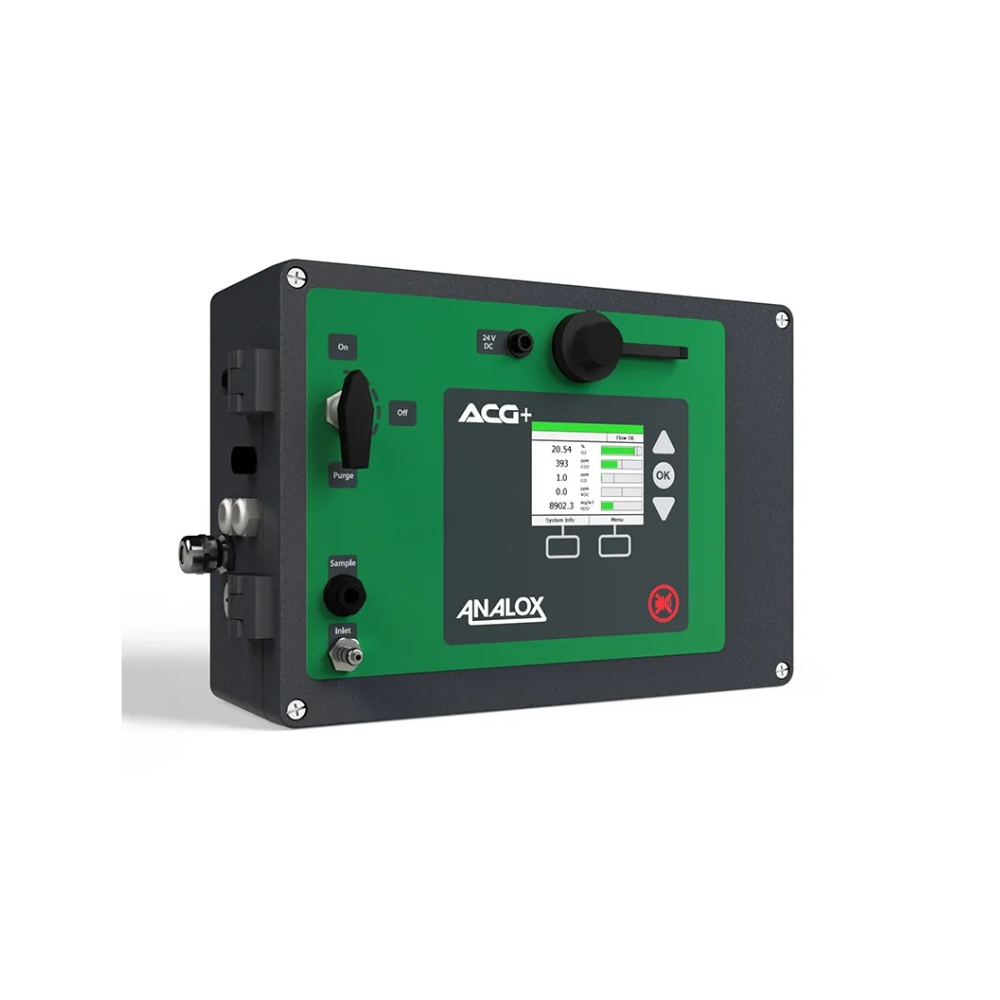
The ACG+ monitors five parameters in compressed breathing air at the same time, continuously, rather than sampling it periodically and hoping nothing changed in between. Oxygen, carbon dioxide, carbon monoxide, volatile organic compounds and dewpoint, with a sample port for oil mist. A common relay can drive a beacon or shut the compressor down, which makes it a control rather than an indication.
KEY BENEFITS
- Five parameters monitored continuously and displayed at the same time
- Relay output can shut the compressor down rather than only sounding an alarm
- Sample port for oil mist checks with colorimetric tubes or an impactor
- Rising water, CO or VOC levels give early warning of filter, temperature or seal problems in the compressor
- Ninety days of data logging, retrieved over USB
+ more in the Description tab below
Five Parameters at Once, Continuously
Compressed breathing air can go wrong in several ways at the same time, and each has a different cause.
The ACG+ continuously monitors oxygen, carbon dioxide, carbon monoxide, volatile organic compounds and water vapour (dew point), and displays them together. A sample port allows oil mist to be checked as well.
All five matter because they point to different problems. Low oxygen or high carbon dioxide points to the intake or the process. Carbon monoxide can point to a combustion source near the intake, such as vehicle exhausts, or overheating in the compressor. VOCs and rising water levels can point to a compressor problem. Measuring one and assuming the others are fine is how contaminated air gets breathed.
Continuous monitoring is the other half. Even new, well sited and well maintained compressors can fail, and contaminants can enter through the intake at any time. A spot check, such as testing with colorimetric tubes at intervals, only tells you the air was acceptable at the moment it was tested.
It Can Shut the Compressor Down
This is what separates the ACG+ from a testing instrument, and it’s the specification worth building the installation around.
Audible and visual alarms are backed by relay outputs. A relay can drive a beacon, or shut the compressor down when an alarm is triggered.
The difference matters. An alarm tells someone there’s a problem and depends on them acting. A shutdown stops the contaminated air source without waiting for a person. On a system supplying breathing apparatus, that’s the difference between an indication and an engineering control.
Early Warning of Compressor Problems
The continuous sensors also say something about the compressor itself.
Analox explains that water vapour is usually what exhausts the desiccant filters first, so rising water levels are a good sign that filters are overdue for replacement or service. Elevated water can also point to high operating temperatures, or seals beginning to fail. Rising VOCs and CO can likewise point to a compressor running hot.
So the monitoring helps diagnose the compressor, as well as protecting the people breathing from it. When these readings rise without an obvious cause, Analox recommends an oil mist check using the sample port. Catching a problem early helps prevent contaminated air being used, and lets the repair be scheduled rather than forced.
The ACG+ doesn’t replace regular preventative maintenance on the compressor, but it gives the maintenance team better information.
Checking for Oil Mist
Oil mist is checked through the sample port, using industry standard colorimetric tubes or a device such as an impactor. That’s a one shot check, not continuous monitoring.
The continuous VOC, CO and water sensors fill that gap. Many of the faults that generate oil mist also produce these contaminants, so a rise in any of them is the prompt to carry out an oil mist test. With mineral oils, the VOC sensor (a 10.6 eV PID) is a reliable way of detecting oil mist. With synthetic oils, it’s an indicator that a fault may have occurred.
Field Replaceable Sensors
The ACG+ uses Analox intelligent sensors: MEC electrochemical sensors for oxygen and CO, an MEC PID sensor for VOCs, and a 5S3 NDIR sensor for CO2. Analox has made the sensors easy to change out.
A proprietary humidifier option prolongs the life of the electrochemical CO and O2 sensors in continuous use.
Portable or Fixed
The same instrument covers both, and the choice changes what it does.
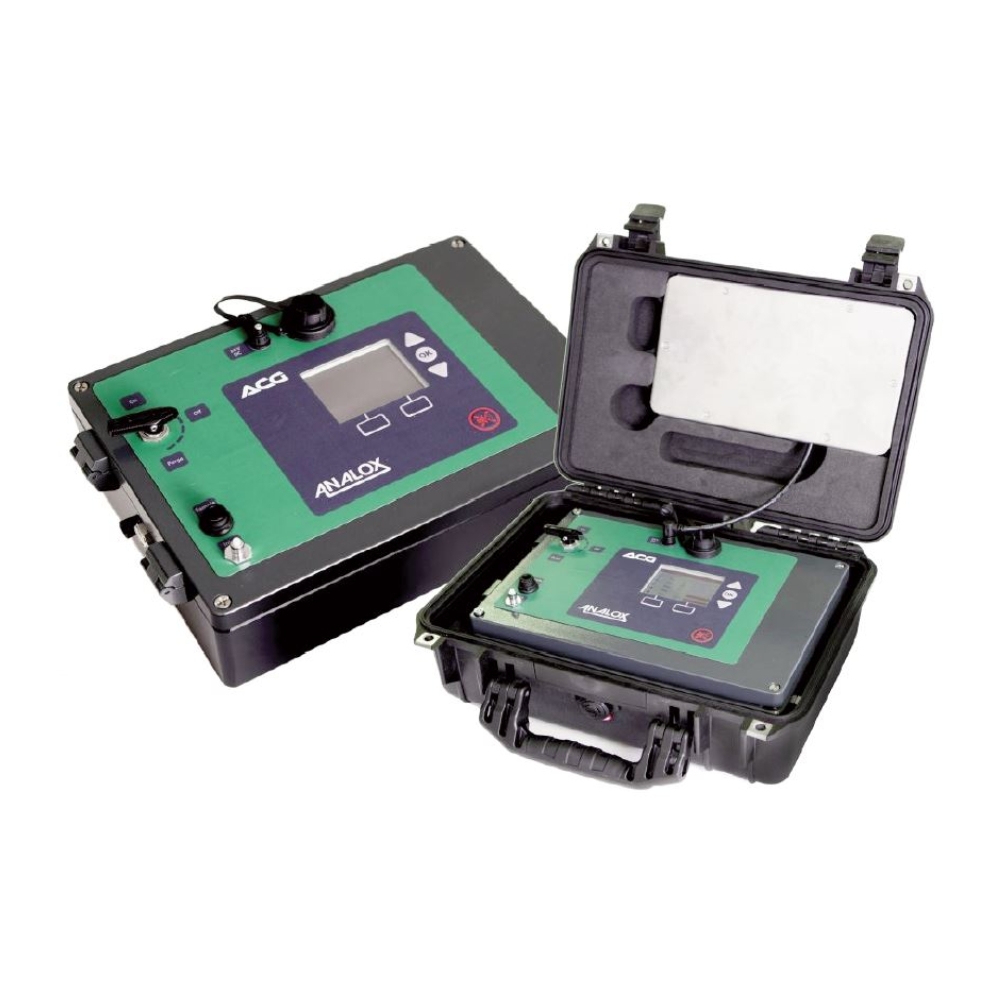
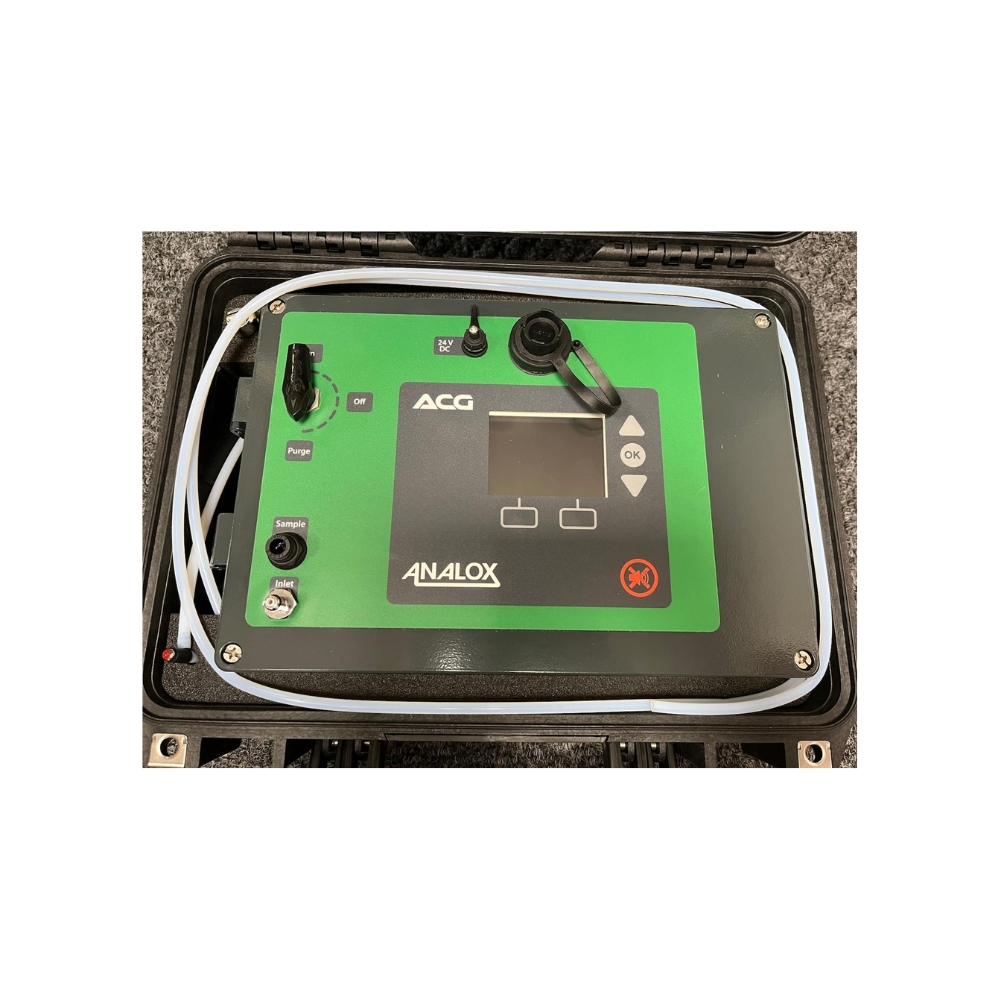
In a robust carry case, the ACG+ is a portable analyser that’s taken to a compressor, connected, and used to check the air. A proprietary dew point sensor lock out system gives fast start up, which suits multi point checking for a business with several compressors, or a service provider checking client systems. Battery options give up to 12 hours of portable use.
In a purpose built housing, it’s a fixed installation monitoring one compressor continuously, with the relay wired to shut the compressor down. That’s the arrangement for a critical system where air is being breathed continuously.
It connects after the compressor and before the end user or cylinder, so contaminants are detected before they reach their destination. Inlet pressure is regulated down to 5 to 10 bar. 90 days of data logging is kept either way, retrieved over USB.
Standards
The ACG+ is certified to BS EN 12021, the European standard for compressed air for breathing apparatus, as well as DEF STAN 68-284 for military vessels, NAVSEA SS521-AK-1-010, the US Navy Dive Manual and BS 8478. That’s worth having where a client specifies an international standard, which is common in marine, defence and diving work.
For Australian work, check the requirements against the standard your client specifies. Our Technical Consultants can help.
One honest limitation: the ACG+ measures the five parameters it measures. Where a risk assessment identifies a hazardous substance producing another harmful gas, additional detection is needed.
Where It’s Used
Breathing air compressor installations. Commercial and offshore diving. Fire and emergency services breathing air. Marine and naval vessels. Confined space entry using airline breathing apparatus. Spray painting and coating. Abrasive blasting. Chemical plant and refineries. Mining. Any operation where breathing apparatus is fed from a compressor rather than a cylinder.
Benefits
- Five parameters monitored continuously and displayed at the same time
- Relay output can shut the compressor down rather than only sounding an alarm
- Sample port for oil mist checks with colorimetric tubes or an impactor
- Rising water, CO or VOC levels give early warning of filter, temperature or seal problems in the compressor
- Ninety days of data logging, retrieved over USB
- Sensors carry their own electronics, so each one is field replaceable
- Runs portable in a robust case or fixed in a purpose built housing
- Certified to BS EN 12021, DEF STAN 68-284 and the US Navy Dive Manual
- Mains, DC or rechargeable battery power, with up to 12 hours on battery for portable use
- Low cost of ownership, with maintenance that does not require a specialist
Instrument type
Continuous compressed breathing air monitor
Parameters measured
Oxygen 0 to 50%. Carbon dioxide 0 to 1,000 ppm. Carbon monoxide 0 to 20 ppm. VOC 0 to 100 ppm. Water vapour 0 to 100 mg/m³
Additional checking
Sample port for oil mist checks with colorimetric tubes or impactor
Sensor technology
Analox MEC electrochemical (O2, CO), MEC PID (VOC), 5S3 NDIR (CO2), capacitive water vapour sensor
Carbon monoxide accuracy
±(1 ppm CO plus 5 percent of reading plus 0.1 ppm CO per °C plus 0.5 percent of reading per °C)
Dewpoint sensor
Proprietary capacitive water vapour sensor, with dew point sensor lock out system for fast start up
Data logging
90 days, retrieved over USB
Alarms
Audible and visual
Relay
1 normally open and 1 normally closed relay contact, plus 3 x 24 V DC switched outputs. For a beacon or compressor shutdown
Deployment
Portable in a robust case, or fixed in a purpose built housing
Certification and approvals
BS EN 12021, DEF STAN 68-284, NAVSEA SS521-AK-1-010, US Navy Dive Manual, BS 8478
Consumables
Inline particulate filter, VOC inline filter
Software
ACG+ software supplied
Sensor accuracy
O2 ±(0.035% O2 + 1% of reading + 0.15% of reading/°C). CO2 ±(25 ppm + 1% of reading + 1 ppm/°C). VOC ±(1 ppm + 5% of reading + 0.25% of reading/°C). Water vapour ±(0.15 mg/m³ + 20% of reading)
Response time
T90 under 120 seconds. Water vapour sensor T90 under 15 minutes
Inlet pressure and flow
5 to 10 bar gauge. Flow 5 L/min maximum
Power
24 V DC input, 24 W maximum. Optional universal mains adaptor (95 to 250 V AC). Optional Li-ion or NiMH rechargeable battery, up to 12 hours
Weight and protection
12 kg. IP54
Operating conditions
-5 to +50°C. 0 to 99% RH, non condensing
Carbon Monoxide
CO
Carbon Dioxide
CO2
Oxygen
O2
Volatile Organic Compounds
VOC
- Aviation & Transportation
- Chemical Manufacturing
- Confined Space & Compliance
- Energy (Oil & Gas)
- Food & Beverage
- Marine & Maritime
- Medical & Healthcare
- Mining & Minerals
- Power Generation & BESS
- Water & Wastewater
Oxygen, carbon dioxide, carbon monoxide, volatile organic compounds and dewpoint, all at the same time, with a sample port for oil mist checking.
Yes. A common relay can be wired to shut the compressor down on alarm rather than only driving a beacon, which makes it an engineering control rather than an indication.
Water vapour is usually what exhausts the desiccant filters first, so rising levels show filters are overdue for service. Elevated water can also point to high compressor temperatures or seals beginning to fail, and is a prompt to carry out an oil mist test.
Both. It runs portable in a robust case, or fixed in a purpose built housing with the relay wired for compressor shutdown.
Yes, for oil mist. Oil mist is checked through the sample port using colorimetric tubes or an impactor. The continuous VOC, CO and water sensors tell you when that check is needed. Where a risk assessment identifies another hazardous gas outside the five measured, additional detection is needed too.
Yes. Analox has designed the sensors to be easy to change out.
Trusted by









Contact Us
Can’t find what you’re looking for? Our team is happy to help.