
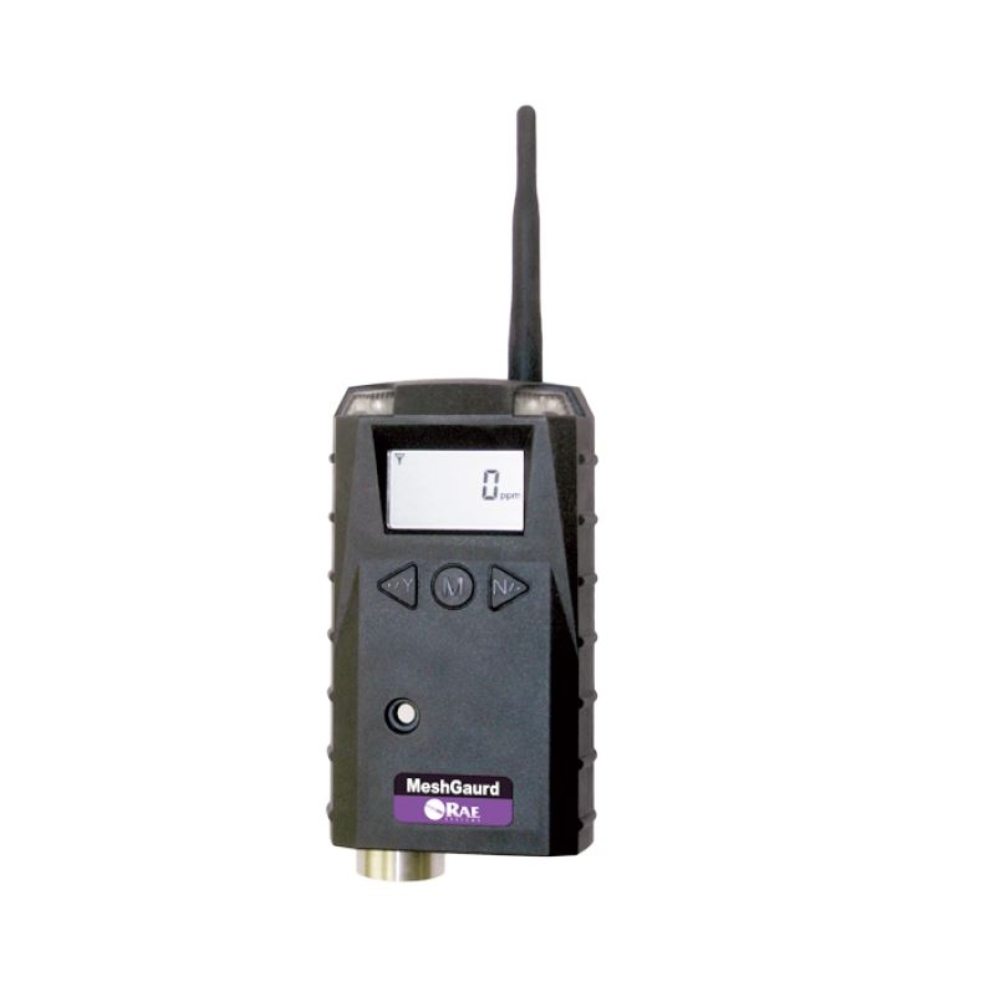
MeshGuard
Wireless Fixed Gas Detector
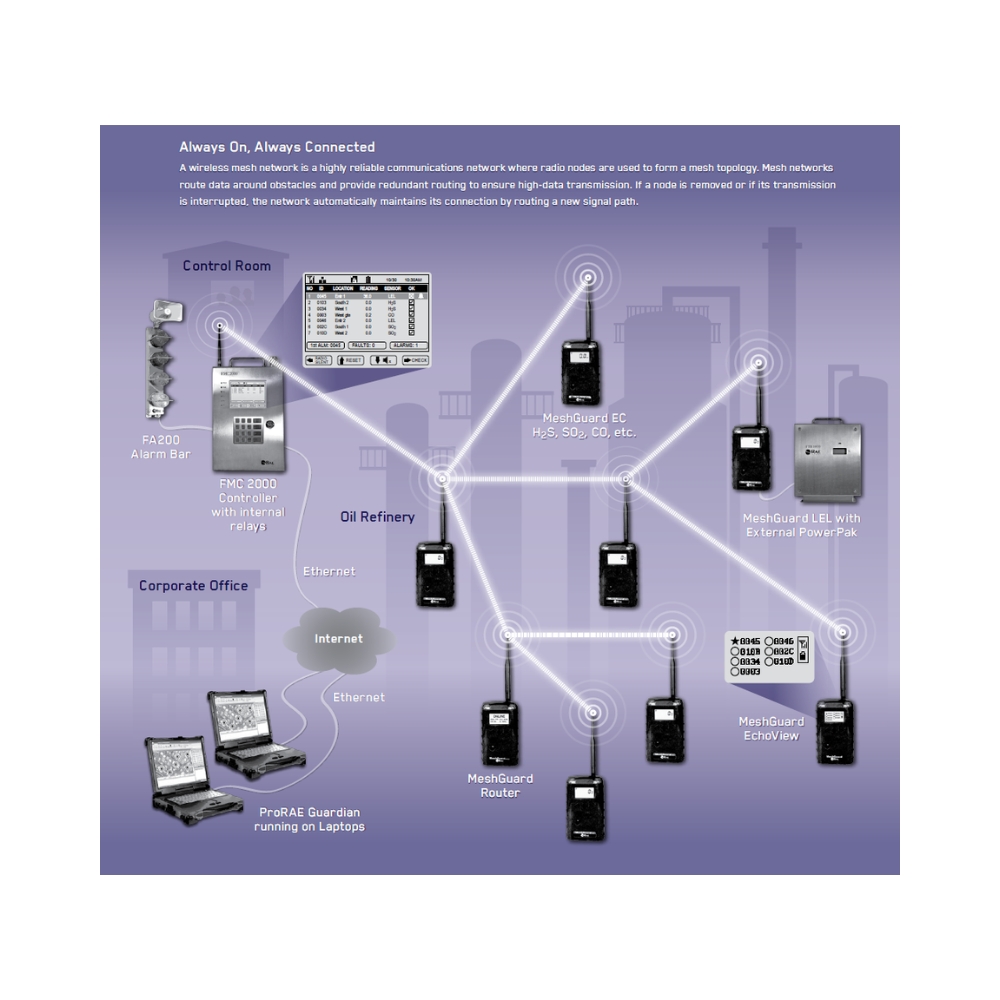
The MeshGuard by RAE Systems is a battery powered wireless gas detector that installs in minutes, with no cable, no conduit and no power supply to arrange. Units form their own network automatically as they come online, and the network heals itself by rerouting data through the best available path if a node drops out. With toxic sensors, it runs for up to six months on its internal battery, or longer with an external battery or the SolarPak option. Sensors are field replaceable for toxic and flammable gases, and the detector is intrinsically safe and IP65 rated.
KEY BENEFITS
- Deploys in minutes with no cable, no conduit and no power supply to arrange
- Runs for up to six months on the internal battery with toxic sensors, or up to two years on an external battery
- SolarPak option gives continuous uptime for a long term or permanent deployment
- Self-forming network brings units online automatically with no commissioning
- Self-healing network reroutes data through the best available path if a node drops
+ more in the Description tab below
Detection Where Cable Can’t Go
A six week shutdown needs gas detection. So does a construction phase, a tank entry, a drilling campaign or a work front that moved last week.
Hard wiring any of those is either impossible or absurd. Running armoured cable and conduit to a point you’ll remove in a month costs more than the detector, twice over, because someone has to pull it out again afterwards. So historically, the answer was people carrying portables, or no fixed coverage at all.
The MeshGuard is the alternative. It’s battery powered, wireless and mounted in minutes. When the job finishes, it comes down just as quickly. RAE Systems designed it for the fastest deployment and decommissioning time, and that second half is the part people forget when they cost a temporary installation.
Self Forming and Self Healing
This is what makes a wireless network trustworthy rather than just convenient.
Units form their own network. Switch a detector on and it comes online automatically, with no addressing, no configuration and no commissioning visit. Add a detector next week and it joins.
More importantly, the network heals itself. Rather than each detector relying on a single radio link back to the controller, the mesh routes data through the best available path. If a node fails, a vehicle parks in the wrong place or a structure goes up between two points, the data finds another route. Each unit has a line of sight range of up to 300 metres, and acts as a relay for the others.
That matters in exactly the places this product gets used. A congested plant during a turnaround is a hostile radio environment, and it changes hour by hour as scaffolding goes up and equipment moves. A point to point wireless link would drop. A mesh reroutes.
Battery Life
A high capacity lithium battery is installed as standard. With toxic gas sensors, it runs the detector for up to six months, or up to two years on an external battery.
Six months covers a turnaround, a drilling campaign or a construction phase, so the detector lasts the whole job without a battery plan or charging roster.
The flammable gas (LEL) sensor uses more power, so it runs on the external PowerPak battery, for up to 21 days. For longer deployments, the SolarPak option provides 24/7 uptime, so a remote wellhead or unmanned asset can run without a mains supply.
Mounting in Seconds
A magnetic mounting option is available. On a steel structure, a detector is positioned and secured in seconds, without drilling, brackets or fixings.
At 0.6 kg and 26.5 x 9.5 x 5.5 cm, one person can carry several and place them without access equipment. Combined with the self forming network, a set of detection points goes live in the time it would take to plan a cable route.
Field Replaceable Sensors
Sensors are field replaceable precision units for toxic and flammable gases. Options include H2S, CO, LEL, O2, NH3, Cl2 and SO2, and other sensors are available.
That means one detector body can serve different applications over its life. A unit monitoring hydrogen sulphide on one job can be reconfigured for a different hazard on the next, which suits a hire fleet or a contractor working across varied sites. It also means a sensor at end of life is changed on site, rather than the detector going away for service. Calibration is a two point field calibration.
Each detector comes with the specified sensor fitted, an operation and maintenance manual, a calibration gas test adapter, the high capacity lithium battery installed and a maintenance tool.
Alarms and Display
Each MeshGuard has two super bright red LEDs and a 90 dB alarm at 30 cm, so workers nearby are warned at the detector itself. A backlit LCD shows the reading, and three keys handle operation and programming.
Controller Options
The detectors are one half of the system. A controller gathers the network and turns readings into alarms and actions.
Multiple controller options are available for real time wireless data collection and viewing. The FMC 2000 is purpose built for MeshGuard, linking to monitors automatically and handling up to 24 wireless detectors. Talk to our Technical Consultants about the right controller for your deployment, as it sets the maximum detector count.
Where the Numbers Work
RAE Systems designed the MeshGuard system for quick deployment in areas where low cost and high return on investment are what matters.
Compare a temporary wired installation, where cable, conduit, labour, a power supply and removal all sit on the invoice, with a set of wireless detectors that arrive, get placed and leave. On a short job, the wireless option often costs a fraction of the wired one, and delivers coverage sooner.
That’s also why these units suit hire rather than purchase for many customers. Gastech runs a hire fleet, and a turnaround is exactly the kind of job hire is built for.
Being Straight About the Limits
Battery powered wireless detection is about where you can put a detection point, not about replacing a permanent hard wired system.
Where a detector forms part of a safety instrumented function, carries a SIL rating or has to drive an automatic shutdown, a wired installation is still the right answer. The MeshGuard covers the hazard that would otherwise have no coverage, or covers it while the permanent system is being built.
Our engineering team can work through which points suit which approach.
Where It’s Used
Oil and gas drilling operations, oil and gas production, plant maintenance turnarounds and shutdowns, tank farms and terminals, shipyards and maritime work, construction and commissioning before the permanent system exists, confined space and tank entry work, remote wellheads and unmanned assets, and landfill and wastewater sites where there’s no cable route.
Benefits
- Deploys in minutes with no cable, no conduit and no power supply to arrange
- Runs for up to six months on the internal battery with toxic sensors, or up to two years on an external battery
- SolarPak option gives continuous uptime for a long term or permanent deployment
- Self-forming network brings units online automatically with no commissioning
- Self-healing network reroutes data through the best available path if a node drops
- Magnetic mounting option puts a detector on a steel structure in seconds
- Intrinsically safe, certified IECEx and ATEX Ex ia I/IIC T4, for classified areas and mining
- IP65 rated with a sensor splash guard, so weather and washdown are not a problem
- Field replaceable precision sensors, so one detector body covers different gases
- Decommissions as fast as it deploys, which suits hire and short term contract work
Size
26.5 x 9.5 x 5.5 cm
Weight
0.6 kg
Alarms
2 super bright red LEDs. 90 dB at 30 cm
Display and keypad
Backlit custom LCD. Three operation and programming keys
Calibration
Two point field calibration
Radio
2.4 GHz ISM band, IEEE 802.15.4 compliant. Up to 300 m line of sight
Operating temperature
LEL, CO and H2S sensors: -40°C to +50°C. Other sensors: -20°C to +50°C
Humidity
5 to 95% RH, non condensing
Detector type
Battery powered wireless fixed gas detector
Network
Self-forming wireless mesh. Units come online automatically
Network resilience
Self-healing, automatically routing data back to the controller through the best available wireless path
Sensors
Field replaceable precision sensors for toxic and flammable gases
Battery
High capacity lithium, installed as standard
Battery life
Toxic sensors: up to 6 months on internal battery, up to 2 years on external battery. Flammable (LEL) sensor: up to 21 days on external PowerPak battery
Solar option
SolarPak for continuous uptime
Hazardous area
US and Canada: Class I, Division 1, Groups A, B, C and D, T4. ATEX I M1 / II 1G Ex ia I/IIC T4. IECEx Ex ia I/IIC T4
Ingress protection
IP65, weather resistant
Sensor protection
Splash guard equipped
Mounting
Magnetic mounting option available
RF certifications
FCC Part 15, CE, SRRC
Form factor
Compact and lightweight
Controller options
Multiple options for real time wireless data collection and viewing, including the FMC 2000 (up to 24 detectors)
Chlorine
Cl2
Carbon Monoxide
CO
Hydrogen Sulphide
H2S
Combustible Gas
LEL
Ammonia
NH3
Oxygen
O2
Sulphur Dioxide
SO2
- Aviation & Transportation
- Chemical Manufacturing
- Confined Space & Compliance
- Energy (Oil & Gas)
- Food & Beverage
- Landfill & Remediation
- Marine & Maritime
- Mining & Minerals
- Power Generation & BESS
- Water & Wastewater
In minutes. There is no cable, conduit or power supply to arrange, and units form their own network automatically as they come online.
With toxic gas sensors, up to six months on the internal battery, or up to two years on an external battery. The flammable gas (LEL) sensor runs for up to 21 days on the external PowerPak battery. The SolarPak option gives 24/7 uptime for longer deployments.
The mesh network is self-healing and reroutes data back to the controller through the best available path, so one node dropping does not take out the others.
Yes. The MeshGuard is intrinsically safe, certified IECEx and ATEX Ex ia I/IIC T4, and rated IP65 with a splash guard protecting the sensor.
The FMC 2000 is purpose built for MeshGuard and handles up to 24 wireless detectors. Talk to our Technical Consultants about the right controller for your deployment.
Not where a detector carries a SIL rating or drives an automatic shutdown. It is designed to cover hazards a wired system cannot reach economically, or to provide coverage while a permanent system is built.
Trusted by









Contact Us
Can’t find what you’re looking for? Our team is happy to help.