
Long Range Flame Simulators
Hazardous Area Flame Detector Testing
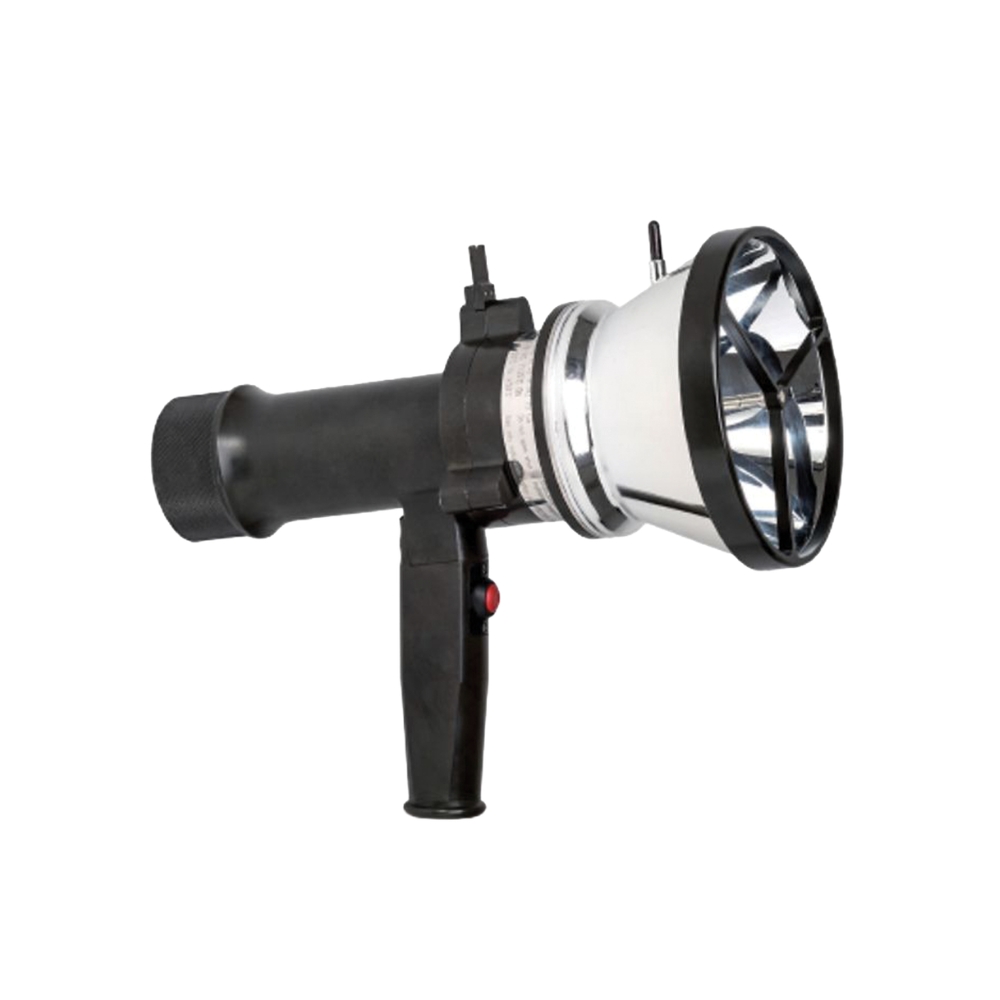
Spectrex flame simulators trigger a flame detector as a real fire would, which is the only way to test the whole detection chain without lighting one. The detector’s own self test confirms it can see. A simulator proves the alarm outputs fire, the wiring is intact, the panel receives the signal and the system responds. Four models match the detector technologies, testing from up to 12 metres, and all are ATEX and IECEx approved for hazardous areas.
KEY BENEFITS
- Tests the whole chain, from sensor through wiring to the fire alarm panel
- Activates the detector's actual alarm outputs, which its own self test deliberately does not
- Verifies the line of sight is clear and the viewing window is not obscured
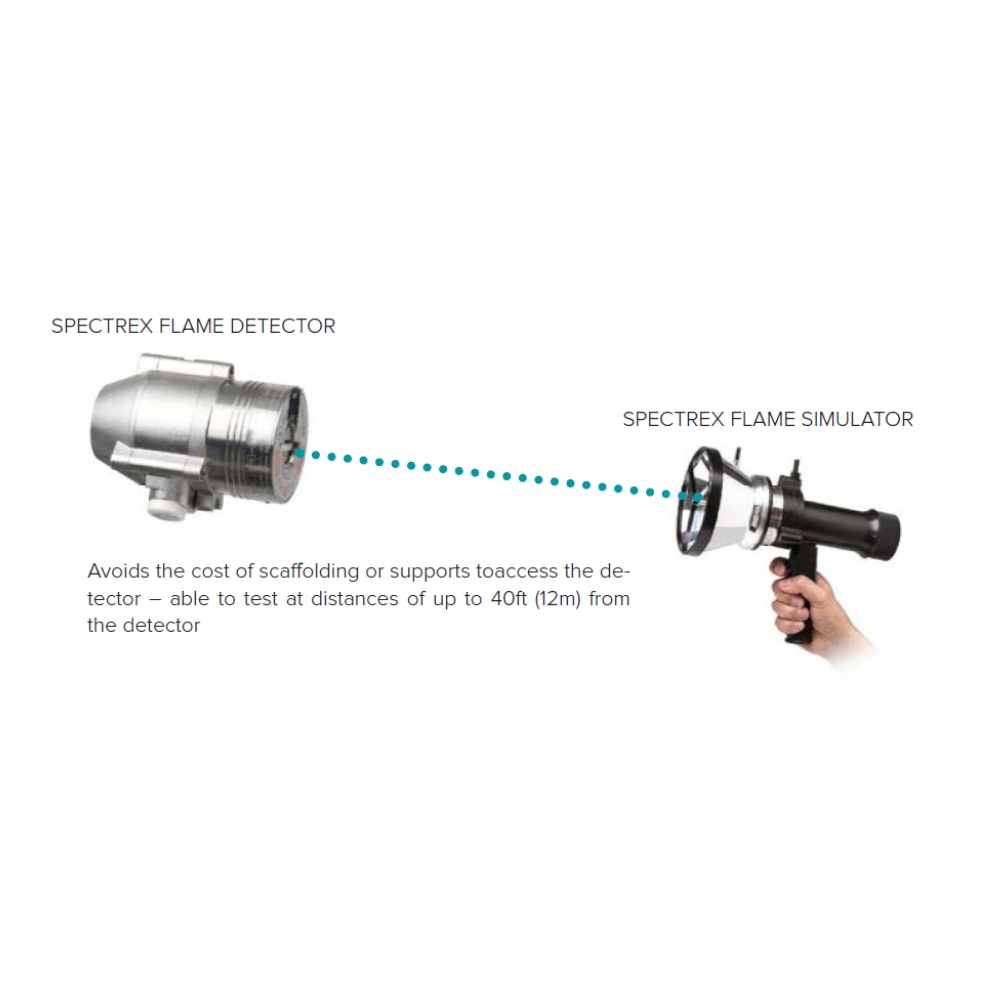
- Tests from up to 12 metres with the FS-1100 and FS-1400, so detectors can be reached from the ground
- ATEX and IECEx approved for use in gas and dust hazardous areas
+ more in the Description tab below
What the Self Test Doesn’t Cover
Most Spectrex optical flame detectors have an automatic built in self test, covering ultraviolet, UV/IR, single band infrared, triple infrared and multi infrared types. It checks window cleanliness and sensor operation.
What it doesn’t do is activate the alarm outputs, and rightly so, because a detector firing its relays several times an hour would be unusable.
So the self test answers one question and leaves the rest open. The detector can see. But whether the relay contact still closes, whether the cable is intact, whether the panel input is still connected, whether the notification devices work and whether the suppression release is armed are all unanswered. A detector can pass its own test for a year while any of those has failed.
What Actually Gets Tested
A flame simulator produces a signal the detector accepts as a real fire, so the outputs fire and the whole system responds. That single action verifies:
The detector’s sensors and internal electronics. The alarm activation software. The cleanliness of the viewing window and lens. The integrity of the wiring. The actual relay activation. And the correct function of any other outputs in use, whether 4-20 mA, RS-485 or HART.
Beyond the detector, it tests the cabling and connections back to the panel, the fire alarm panel itself, and the alarm notification. If you choose to leave it armed, it also proves the suppression release, though that has to be a decision made at the panel beforehand, not a surprise.
Line of Sight, Which Nothing Else Checks
This one is easy to overlook, and it’s the reason to test annually rather than only after a change.
A detector’s built in test confirms the window is clean. It can’t tell you whether something has been placed in the field of view. Racking gets moved, a partition goes up, scaffolding is erected, a new vessel is installed, a pipe run is added. Any of those can block the view of the area the detector is meant to watch, and the detector will keep reporting itself healthy throughout.
Triggering the detector from the position a fire would actually start proves the path is clear. That’s a different test from anything the instrument can do on itself.
Four Models
| Model | Detector type | Compatible detectors | Maximum testing distance |
|---|---|---|---|
| FS-1100 | Triple infrared (IR3) | SharpEye 40/40I, 40/40UFI, 20/20CTIx, 20/20MPI and older 20/20 IR3 models | Up to 12 m |
| FS-1200 | Ultraviolet and UV/IR | SharpEye 40/40 LB and L4B, 40/40U and UB, 20/20 UV and UV/IR | Up to 8 m (3 m for L4 and L4B) |
| FS-1300 | Single infrared | SharpEye 40/40R, 20/20R | Up to 3 m |
| FS-1400 | Multi infrared, including hydrogen | SharpEye 40/40M | Up to 12 m |
Matching the simulator to the detector matters. A simulator produces a specific spectral signature, and a detector tuned for hydrogen won’t respond to a source built for hydrocarbon flames. The wrong model produces a failed test on a detector that’s working correctly, which wastes a day and undermines confidence in the system.
Testing at Distance
Range is the practical constraint on this equipment. Flame detectors are routinely mounted high, in classified areas and in positions that are hard to reach, which is exactly why testing gets put off.
The FS-1100 and FS-1400 reach 12 metres, around a third further than the previous generation. That lets a technician test from ground level or an accessible platform, rather than arranging access equipment.
Testing distance depends on the detector’s sensitivity setting. At 12 metres, the detector needs to be set to its 60 metre sensitivity. At lower sensitivity settings, the simulator has to be closer: 9 m at 45 m sensitivity, 6 m at 30 m, and 2 m at 15 m. Plan the test positions around the settings on site.
Approved for the Area You’re Testing In
It’s worth stating, because it isn’t obvious until you think about it. The detector you need to test is usually inside a hazardous area, so the test equipment has to be certified to go in there with it.
Spectrex flame simulators are ATEX and IECEx approved, certified Ex d ib op is IIB + H2 T5 Gb for gas, and Ex ib tb IIIC T135°C Db for dust. They can be taken into the area with you, rather than the detector being removed or the area declassified for the test.
Lighting a real fire isn’t an option. It’s not permitted in a hazardous area and it’s dangerous in a non hazardous one, which leaves a simulator as the only safe way to do a full end to end test.
Annual Testing
Spectrex recommends a full system loop test at least once a year. Where the detector forms part of a SIL rated safety function, periodic proof testing is a requirement of the safety lifecycle, not just good practice.
That makes a simulator a recurring need, not a commissioning tool. The lithium ion battery gives up to 1,000 activations between charges, and recharges in about two hours, which covers most sites in a single visit.
Buy or Hire
For most operations, hiring makes more sense than owning.
Testing comes round once or twice a year. A simulator sitting in a store for the other eleven months still needs its battery maintained and its own condition checked, and it’s an asset earning nothing. Gastech supplies these for purchase where a site tests often enough to justify it, and through the hire fleet where it doesn’t.
Where testing is the problem rather than the equipment, our field service team carries out functional testing as part of a service programme.
Benefits
- Tests the whole chain, from sensor through wiring to the fire alarm panel
- Activates the detector's actual alarm outputs, which its own self test deliberately does not
- Verifies the line of sight is clear and the viewing window is not obscured
- Tests from up to 12 metres with the FS-1100 and FS-1400, so detectors can be reached from the ground
- ATEX and IECEx approved for use in gas and dust hazardous areas
- Up to 1,000 activations on a single charge, recharged in about two hours
- No real fire required, which is not permitted in a hazardous area anyway
- Four models matched to detector technology: IR3, UV and UV/IR, single IR, and Multi IR with hydrogen
- Supplied as a kit with battery, charger, user guide and carry case
- Available to hire as well as purchase
Function
External portable flame simulator for full functionality end to end testing of flame detectors and fire protection systems
Models
FS1100, FS1200, FS1300, FS1400
Maximum testing distance
FS-1100 and FS-1400: 12 m. FS-1200: 8 m (3 m for 40/40 L4 and L4B). FS-1300: 3 m. Distance depends on the detector's sensitivity setting
Hazardous area approval
ATEX and IECEx. Ex II 2 G D, Ex d ib op is IIB + H2 T5 Gb, Ex ib tb IIIC T135°C Db
IECEx certificate
SIR 15.0041X
Power
14.8 V rechargeable lithium ion battery (4 x 3.7 V), 2.2 Ah
Tests per charge
Up to 1,000 activations between charges
Supplied as
Kit including simulator, battery, charger, user guide and case
Verifies
Sensors, internal electronics, alarm activation software, window and lens cleanliness, wiring integrity, relay activation, and mA, RS-485 and HART outputs
Also verifies
Cabling and connections, fire alarm panel functionality, alarm notification, and suppression release where armed
Charging time
About 2 hours
Operating temperature
-20°C to +50°C
Ingress protection
IP65
Enclosure
Heavy duty copper free aluminium, black zinc coating
Dimensions and weight
230 x 185 x 136 mm. 2.5 kg
- Aviation & Transportation
- Carpark & HVAC
- Chemical Manufacturing
- Energy (Oil & Gas)
- Food & Beverage
- Landfill & Remediation
- Marine & Maritime
- Mining & Minerals
- Power Generation & BESS
- Technology & Semiconductor
- Water & Wastewater
The self test confirms the detector can see, and it deliberately does not activate the alarm outputs. A simulator proves the relays, the wiring, the panel and the notification all work.
Yes. The simulators are ATEX and IECEx approved, certified Ex d ib op is IIB + H2 T5 Gb for gas and Ex ib tb IIIC for dust, so they go into the area with the detector. Check the gas group against your site classification.
Up to 12 metres with the FS-1100 and FS-1400, 8 metres with the FS-1200, and 3 metres with the FS-1300. The distance depends on the detector's sensitivity setting, so the full 12 metres needs the detector set to its 60 metre sensitivity.
It depends on your detector. The FS-1100 suits IR3 detectors, the FS-1200 suits UV and UV/IR, the FS-1300 suits single IR, and the FS-1400 suits Multi IR detectors, including the 40/40M hydrogen variants.
Only if you leave the release armed. Disable it at the panel beforehand unless you are deliberately testing the release, which is a worthwhile test in its own right.
Generally annually, and where the detector forms part of a SIL rated safety function, periodic proof testing is part of the safety lifecycle.
Trusted by









Contact Us
Can’t find what you’re looking for? Our team is happy to help.