
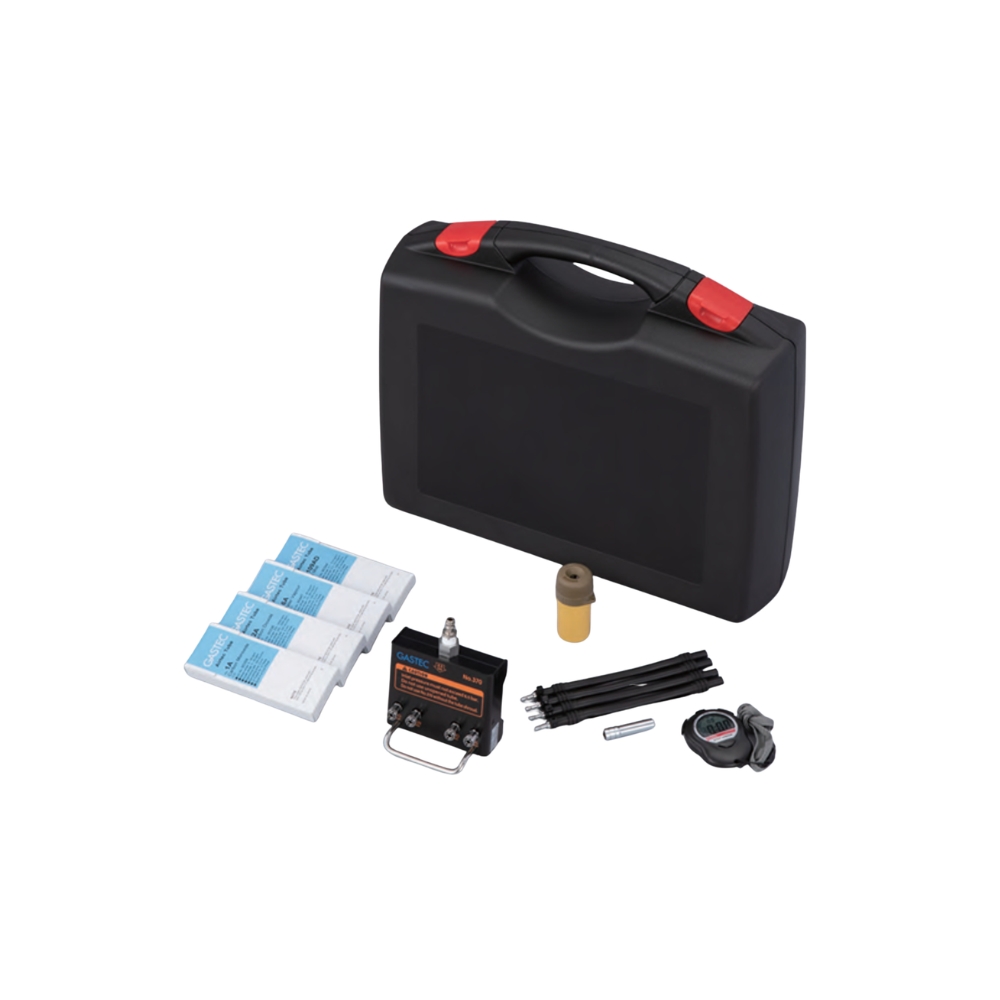
Gastec CG-1
Compressed Breathing Air Test Kit
The Gastec CG-1 measures four contaminants in compressed breathing air at the same time, using detector tubes and no electricity. Connect it to a cylinder or compressor through the pressure reducer, run the sample, and read carbon monoxide, carbon dioxide, water vapour and oil mist directly off the tubes. There’s nothing to charge and nothing to calibrate, and the whole kit packs into one carrying case.
KEY BENEFITS
- Measures carbon monoxide, carbon dioxide, water vapour and oil mist simultaneously
- Needs no electricity or power source of any kind
- Connects to a cylinder or compressor through the optional pressure reducer
- Nothing to calibrate, so there is no annual calibration cost or downtime
- Results in 5 to 10 minutes, read directly off the tube scale
+ more in the Description tab below
Four Contaminants, No Power
The CG-1 is a measuring device, a set of Gastec Airtec detector tubes and a stopwatch, all in one carrying case.
It connects to a breathing air cylinder or compressor through a pressure reducer. Air passes through four detector tubes at a controlled flow. Each tube changes colour along its length in proportion to the contaminant present, and the reading is taken from the scale printed on the tube. Carbon monoxide, carbon dioxide, water vapour and oil mist are all measured at once.
No electricity or power source is needed for the measurement. There’s no battery to charge, no sensor to drift and no calibration to schedule.
The Four Tubes
| Tube | Measuring range | Flow rate | Sampling time |
|---|---|---|---|
| Carbon monoxide (1A) | 5 to 50 ppm | 100 mL/min | 5 minutes |
| Carbon dioxide (2A) | 250 to 3,000 ppm | 190 mL/min | 5 minutes |
| Water vapour (6A) | 20 to 80 mg/m³ | 120 mL/min | 5 minutes |
| Oil mist (109AD) | 0.2 to 5.0 mg/m³ | 3,000 mL/min | 10 minutes |
Why That Matters More Than It Sounds
Breathing air testing on many sites happens at intervals rather than continuously, and an instrument that sits in a store for months has a particular way of failing.
An electronic analyser left unused still ages. Its battery runs down, its sensors drift, and its calibration expires. So the first thing that happens when someone needs it is finding out whether it still works, and sometimes it doesn’t.
Detector tubes don’t have that problem. The kit is ready when you pick it up, as long as the tubes are within their shelf life. For a site with one compressor tested quarterly, that reliability is worth more than a continuous readout it doesn’t need.
Test Downstream of the Filters
One practical point decides whether the test means anything, and it applies whichever instrument is used.
The measurement has to be taken downstream of the filtration, so the air being tested is the same air that will be breathed. Testing upstream tells you what the filters are dealing with, which is a different and much less useful question.
Oil Mist Is the Part People Forget
Oil mist is the contaminant most specific to compressed breathing air, and one a general purpose gas detector can’t measure.
A compressor fault can put oil into the air line, and the wearer breathes it in as a fine mist without noticing. The CG-1 measures oil mist directly, from 0.2 to 5.0 mg/m³, as one of its four parameters.
Where It Sits Against the ACG+
Both cover compressed breathing air, and they answer different questions.
The ACG+ monitors continuously, adds oxygen and VOCs, logs 90 days of data, and can shut the compressor down on alarm. That suits a critical or heavily used system where the air is breathed daily.
The CG-1 is a spot check. It tells you the air was acceptable at the moment you sampled it, at low cost and with no calibration or power needed. For a site with one compressor tested on a schedule, that’s proportionate.
The honest way to choose is by how a failure would be found. If a fault developing between quarterly tests would matter, monitor continuously. If a scheduled test is the control, tubes are the sensible answer.
Accessories
An optional pressure reducer, area flow meters and a conversion adapter are available, and all store in the CG-1 carrying case. Check which fittings your cylinders use before ordering, so the right connection arrives with the kit. Our Technical Consultants can help.
Where It’s Used
Breathing air compressor testing. Cylinder and SCBA filling station checks. Fire and emergency services breathing air. Commercial and recreational diving. Confined space entry using airline breathing apparatus. Spray painting and abrasive blasting. Marine and offshore. Mining. Any site testing breathing air to a schedule rather than monitoring it continuously.
Benefits
- Measures carbon monoxide, carbon dioxide, water vapour and oil mist simultaneously
- Needs no electricity or power source of any kind
- Connects to a cylinder or compressor through the optional pressure reducer
- Nothing to calibrate, so there is no annual calibration cost or downtime
- Results in 5 to 10 minutes, read directly off the tube scale
- Usable with minimal training, so testing does not depend on one person
- Result read immediately off the tube rather than sent away for analysis
- Supplied as a complete kit in a carrying case with tubes and stopwatch
- Optional pressure reducer, flow meters and conversion adapter store in the same case
- Low capital cost, which suits a site testing periodically rather than continuously
Instrument type
Compressed breathing air measurement kit using colorimetric detector tubes
Contaminants measured
Carbon monoxide 5 to 50 ppm. Carbon dioxide 250 to 3,000 ppm. Water vapour 20 to 80 mg/m³. Oil mist 0.2 to 5.0 mg/m³. Measured simultaneously
Measurement method
Gastec Airtec colorimetric detector tubes at controlled flow
Power required
None
Calibration
Not required
Connection
To a breathing air cylinder or compressor, through the pressure reducer
Supplied with
Measuring device, rubber shrouds (4), Airtec tubes (CO, CO2, water vapour, oil mist), stopwatch, tube tip holder, deep socket, carrying case and instruction manual
Optional pressure reducer
Optional. Connects to the cylinder or compressor, and stores in the carrying case
Optional flow meters
Optional area flow meters, stored in the carrying case
Flow rates and sampling times
CO 100 mL/min, 5 min. CO2 190 mL/min, 5 min. Water vapour 120 mL/min, 5 min. Oil mist 3,000 mL/min, 10 min
Carbon Monoxide
CO
Carbon Dioxide
CO2
- Aviation & Transportation
- Chemical Manufacturing
- Confined Space & Compliance
- Energy (Oil & Gas)
- Food & Beverage
- Marine & Maritime
- Medical & Healthcare
- Mining & Minerals
- Power Generation & BESS
- Water & Wastewater
Carbon monoxide, carbon dioxide, water vapour and oil mist, all at the same time, using colorimetric detector tubes.
Neither. There is nothing electrical in it, so there is no battery to charge and no calibration to schedule.
The measurement needs no electricity or power source. The kit includes a stopwatch, so talk to our Technical Consultants about use in a classified area.
Downstream of the filtration, so the air being tested is the same air that will be inhaled. Testing upstream measures what the filters are handling rather than what is getting through.
The ACG+ monitors continuously, adds oxygen and volatile organic compounds, logs data and can shut the compressor down. The CG-1 is a spot check at low capital cost with no power or calibration requirement.
How you'll connect it. The pressure reducer is optional, and connects the measuring device to a cylinder or compressor. Check your cylinder fittings with our Technical Consultants so the right connection arrives with the kit.
Trusted by









Contact Us
Can’t find what you’re looking for? Our team is happy to help.