
GDFM
Automated Gas Detector Locker System
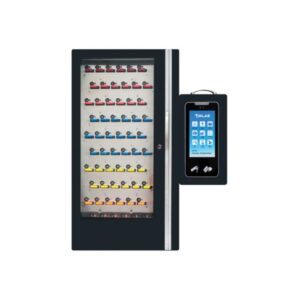
The GDFM is a secure locker system that issues, charges, tracks and returns portable gas detectors without anybody supervising it. A worker scans in, takes a charged and compliant instrument, and scans it back at the end of the shift. The system logs each transaction, charges what it holds, and flags anything overdue or unreturned. It scales from six instruments to over a hundred.
KEY BENEFITS
- Available around the clock, so shift start does not depend on the store being open
- Only approved users can take an instrument, verified by ID card, barcode or QR code
- Only issues fully charged instruments, with each cell showing full, charging or empty
- Each issue and return logged, so who had which unit is traceable
- Instruments with a bump test or calibration due can't be taken out
+ more in the Description tab below
It Replaces the Sign Out Sheet and the Person Holding It
The problem the GDFM solves is administrative before it’s technical.
Issuing gas detectors across shifts and contractors normally means a store, a person, a sign out sheet, and someone chasing units at the end of the week. It works until the store is shut, the person is elsewhere, or the sheet stops being filled in.
The GDFM removes all of that. A worker presents an ID card, a barcode or a QR code, the cabinet checks they’re approved, and a cell opens with a charged instrument in it. At the end of the shift, they scan the instrument back in. There’s no supervision and no paperwork, and it runs at three in the morning as readily as at nine.
Only Ready Instruments Go Out
This is the part that makes the GDFM more than a locker.
By default, the cabinet only issues instruments that are fully charged. Each cell charges what it holds and reports its state as full, charging or empty, and positioning detection confirms an instrument is seated properly, rather than just dropped in. LED lighting in each cell shows the user which one to use. The restriction can be relaxed if needed, so the cabinet issues a fully charged instrument first, and otherwise the one that’s been charging longest.
The same goes for compliance. An instrument with a bump test or calibration due can’t be borrowed. The cabinet checks for expired bump tests and calibrations on a schedule, hourly by default, so a non compliant instrument stays in the cabinet, rather than going out with a warning attached.
So a worker taking an instrument at shift start is taking one that’s charged and in date, because the system won’t hand over anything else.
Traceability Becomes Automatic
The value most sites notice after the first month is the record.
The cabinet records each issue and each return against the user, so who had which instrument on a given day is a lookup, not an investigation. When an incident has to be reconstructed, that’s the first question asked, and the one paper systems answer badly.
Automated reports give visibility of fleet usage, performance and inventory levels, and they tend to surprise people. Knowing how many instruments are actually in use, how often and by whom usually reveals a fleet that’s either larger than it needs to be, or held in the wrong place.
Paired With iNet Exchange
Where the fleet is on an iNet Exchange subscription, the GDFM adds proactive maintenance to the arrangement.
Device health is monitored, and problems are addressed before they affect operations, with replacement units dispatched within 48 hours. So an instrument that’s failing is replaced, rather than flagged and worked around.
The instrument list syncs with an iNet account, hourly by default, or can be managed manually where that suits better.
Scaling It
There are two cabinet models, and the arithmetic is straightforward.
| Model | Cells | Dimensions | Empty weight |
|---|---|---|---|
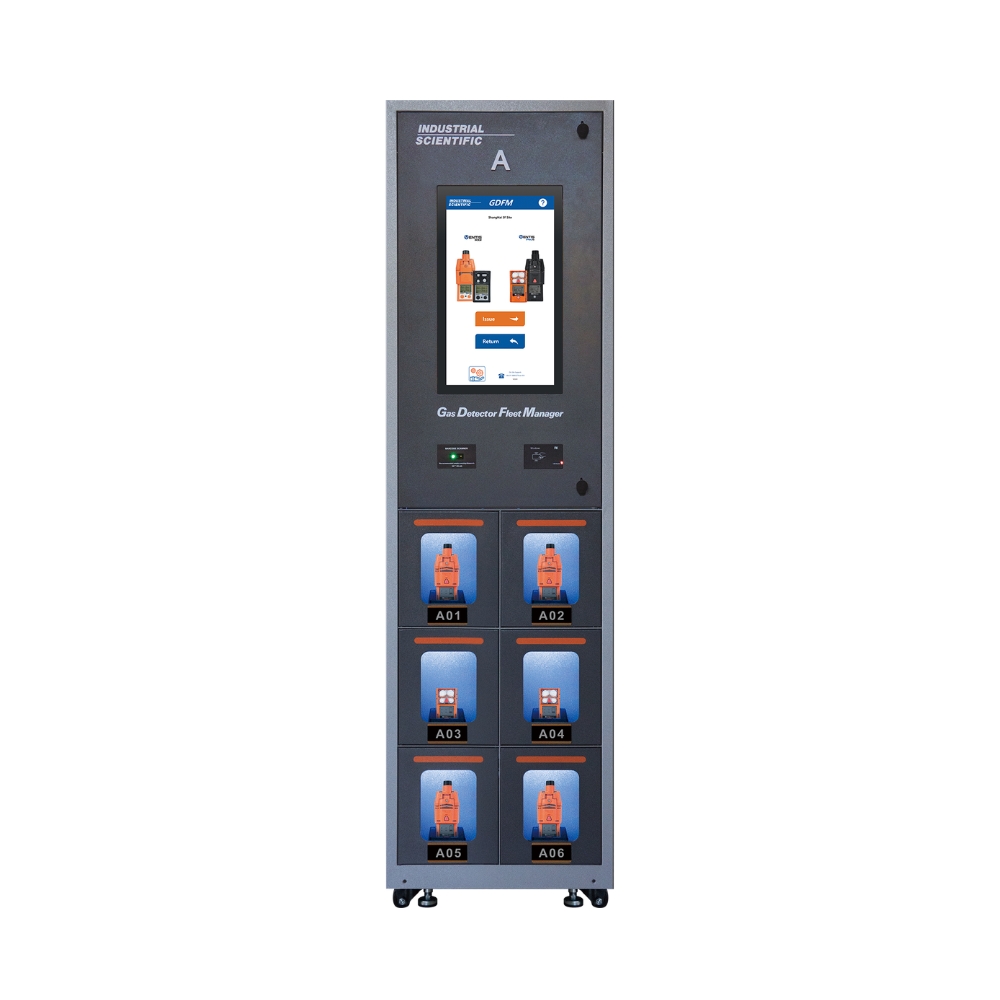
| Prime | 6 | 2100 x 574 x 420 mm | 80 kg |
| Satellite | 18 | 2100 x 833 x 420 mm | 130 kg |
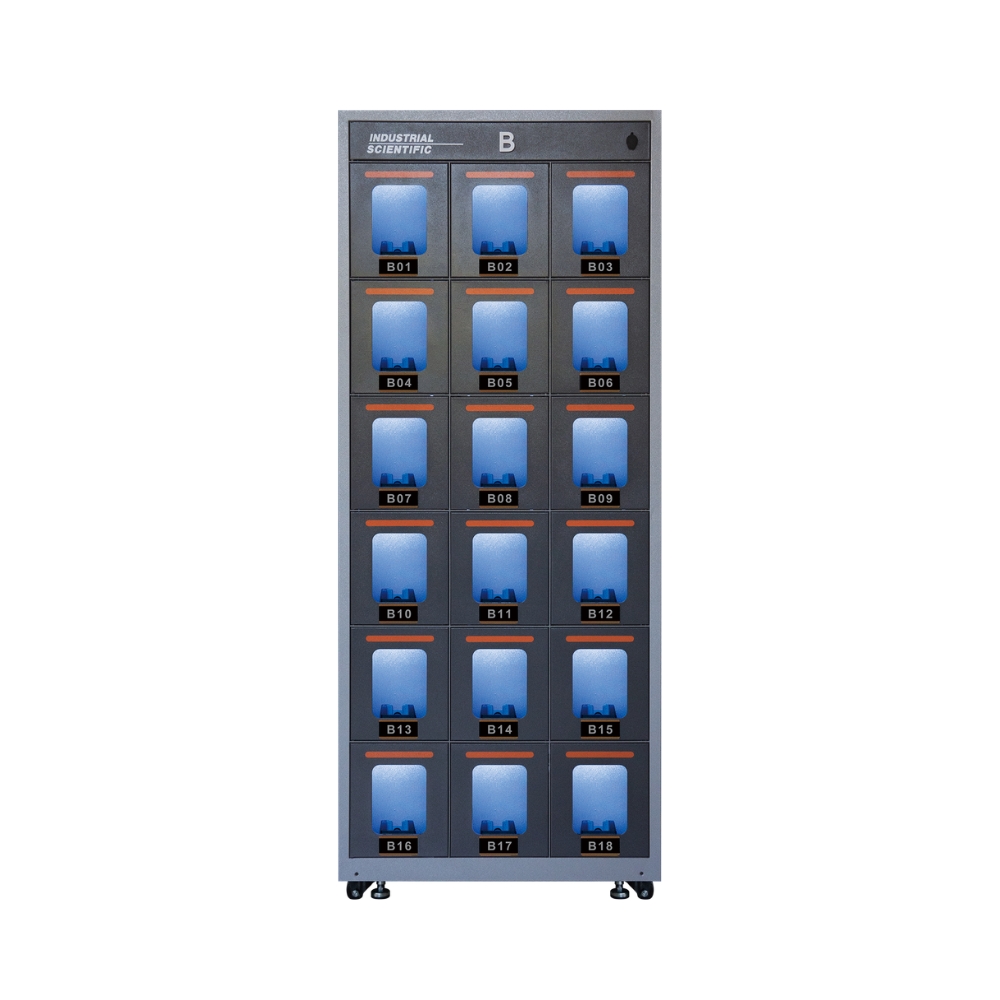
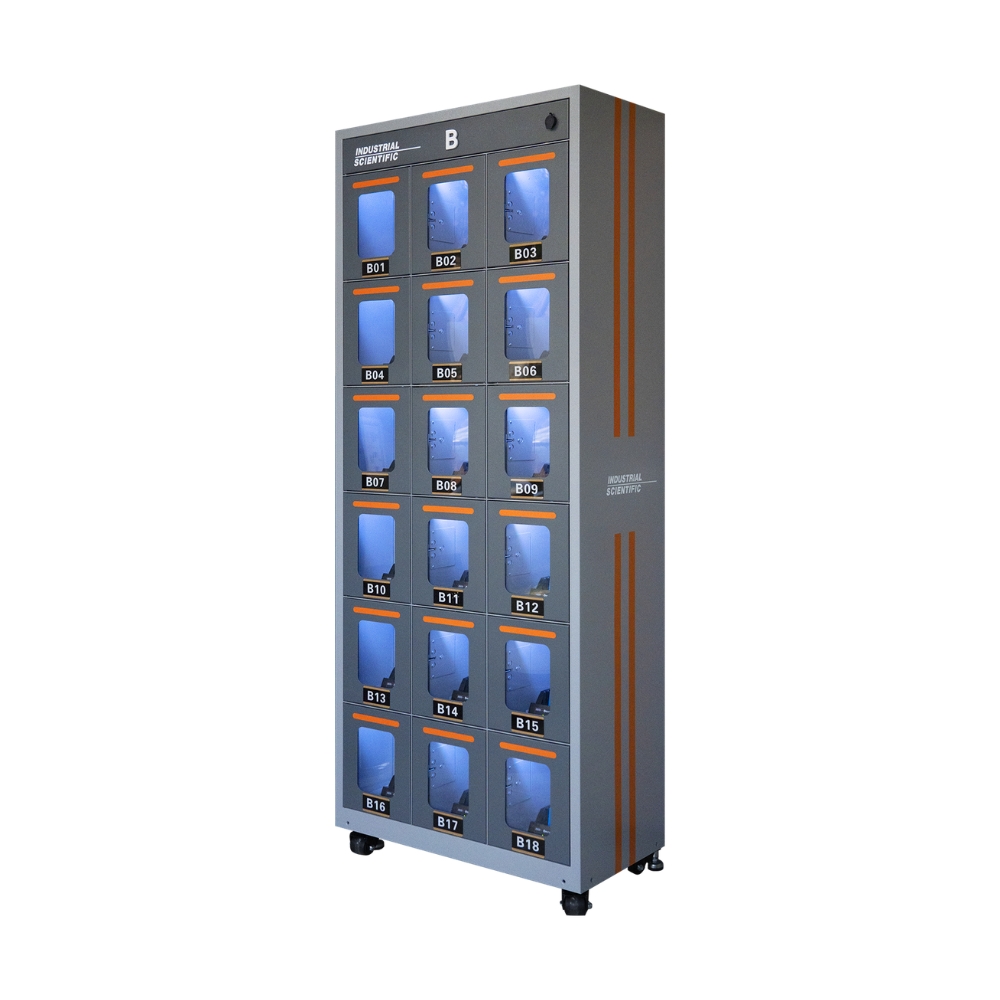
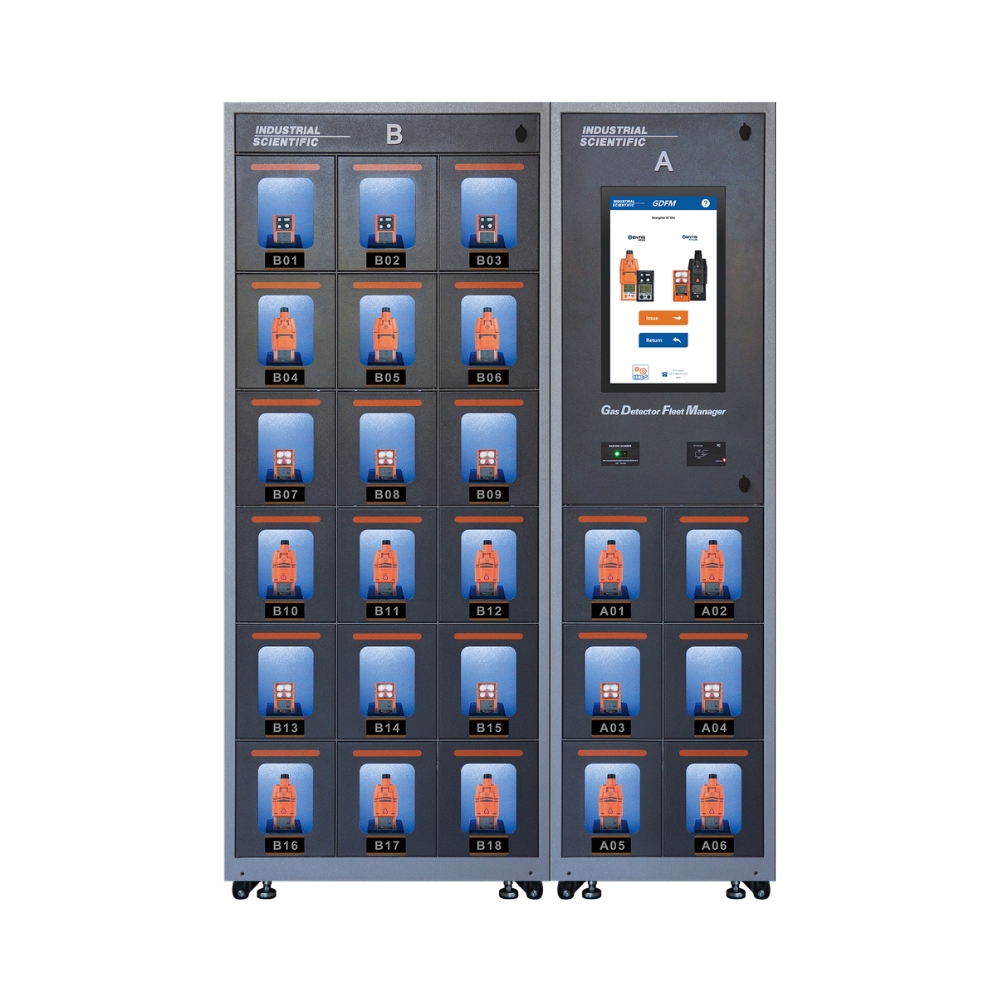
A Satellite can’t run on its own, as it needs a Prime. One Prime supports up to six Satellites, which gives a maximum of 114 instruments from a single installation.
Installation
The cabinet stands on adjustable feet, and Industrial Scientific recommends securing it to the ground with the front support plate. An optional rain shed fits on top for a sheltered outdoor location, and needs to be staked to the ground. The cabinet operates from 0 to 55°C.
Compartments are locked, with an emergency key unlock for service.
Where the Data Sits
This is worth knowing for anyone with a data policy.
The GDFM’s database and software run on the cabinet’s own host computer, which runs Windows 11. It connects by LAN through an external router, and remote assistance is supported. That keeps the records on site, which suits organisations restricted on where worker and equipment data can be held.
Where It’s Used
Gas detector storage and charging at scale. Multi shift operations. Sites with significant contractor movement. Remote workforce coordination. High volume safety equipment management. Sites with strict compliance protocols. Mining, oil and gas, and heavy industry. Operations already using iNet Exchange for fleet health.
Benefits
- Available around the clock, so shift start does not depend on the store being open
- Only approved users can take an instrument, verified by ID card, barcode or QR code
- Only issues fully charged instruments, with each cell showing full, charging or empty
- Each issue and return logged, so who had which unit is traceable
- Instruments with a bump test or calibration due can't be taken out
- Fleet utilisation reporting shows whether the fleet is the right size and in the right place
- Scales from a six cell Prime cabinet to 114 instruments across Prime and Satellites
- Locked compartments, with an optional rain shed for sheltered outdoor installation
- Records and database run on the cabinet's own host, on your local network
- Syncs with an iNet account, or manually where that is preferred
Product type
Automated secure locker system for portable gas detectors
Models
Prime, 6 cells. Satellite, 18 cells, requires a Prime unit
Maximum configuration
One Prime with up to six Satellites, giving 114 instruments
Dimensions, Prime
2100 mm high x 574 mm wide x 420 mm deep
Dimensions, Satellite
2100 mm high x 833 mm wide x 420 mm deep
Weight empty, Prime
80 kg
Weight empty, Satellite
130 kg
Display
21 inch touchscreen
Operating system
Windows 11, pre-installed
Power supply
100 to 240 V AC, 12 V DC, 15 A, 50 to 60 Hz
Operating temperature
0 to 55 °C
Network
LAN, compatible with an external router
Remote assistance
Supported
Charging detection
Full, charging or empty, per cell
Positioning detection
Yes
Cell lighting
LED in each cell
User identification
ID card reader, barcode scanner, QR code scanner
Instrument sync
Sync with an iNet account (hourly by default), or manual
Data storage
Database and software on the cabinet's host computer
Security
Locked compartments, emergency key unlock
Borrowing restrictions
Fully charged instruments only (configurable). Instruments with bump test or calibration due blocked (configurable)
Compliance check
Scheduled check for expired bump tests and calibrations, hourly by default
Options
Rain shed for sheltered outdoor installation (must be staked to the ground)
- Aviation & Transportation
- Carpark & HVAC
- Chemical Manufacturing
- Confined Space & Compliance
- Energy (Oil & Gas)
- Food & Beverage
- Landfill & Remediation
- Marine & Maritime
- Mining & Minerals
- Power Generation & BESS
- Technology & Semiconductor
- Water & Wastewater
On the cabinet's own host computer, which runs the GDFM database and software. It connects to your network by LAN through an external router.
A Prime cabinet holds six instruments and a Satellite holds eighteen. One Prime supports up to six Satellites, giving 114 instruments from a single installation.
No, it requires a Prime unit. The Prime carries the system and the Satellites extend its capacity.
Yes. Only approved users can take an instrument, the compartments are locked, and only charged, in date instruments are issued by default.
It connects by LAN through an external router, and remote assistance is supported. The operating records are held locally rather than in the cloud.
Trusted by









Contact Us
Can’t find what you’re looking for? Our team is happy to help.