
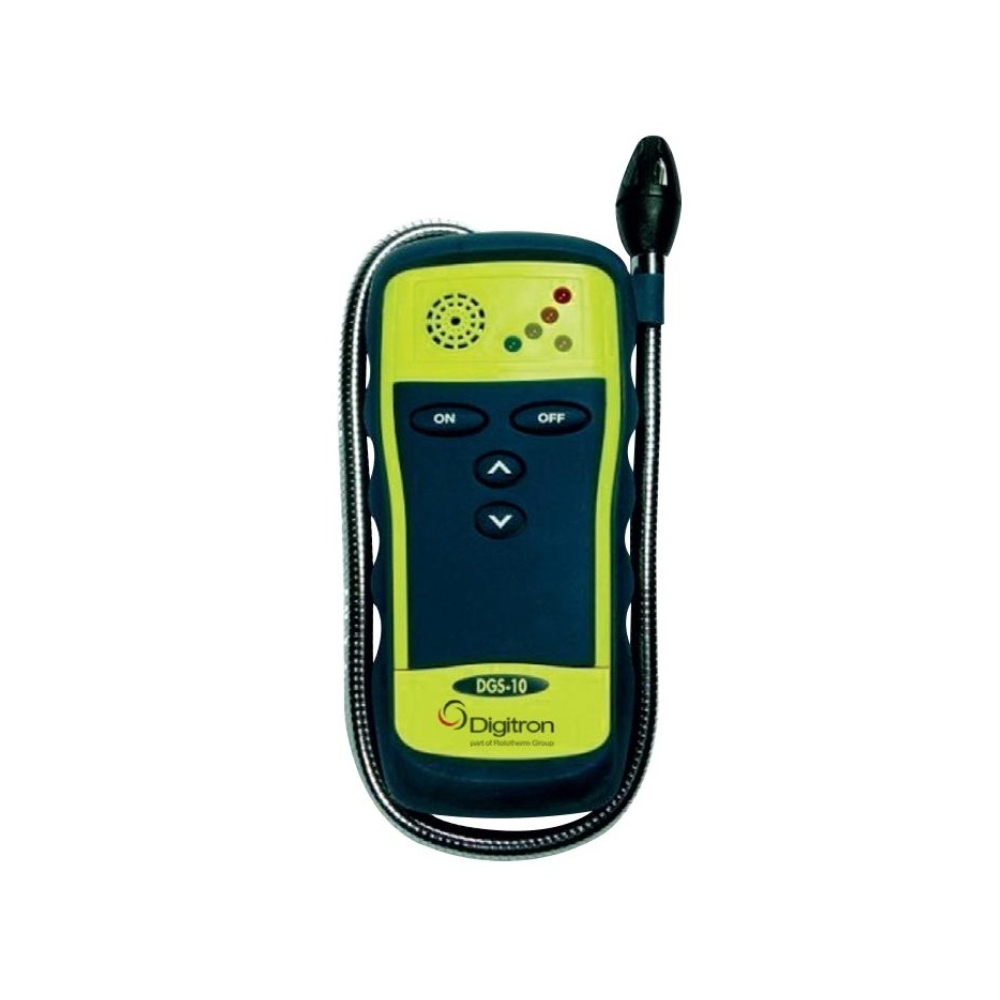
DGS-10
Gas Leak Detector
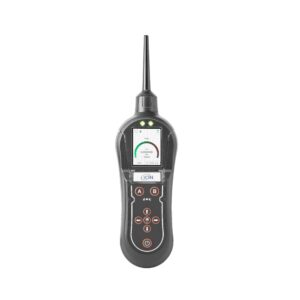
The DGS-10 finds a leak rather than measuring it. There is no concentration reading, just an audible and visual tick rate that speeds up as the sensor approaches the source, and a 400 millimetre gooseneck that reaches into places a hand cannot. Sensitivity is 10 parts per million on methane, and an LED in the sensor tip lights the area you are working in.
KEY BENEFITS
- Detects methane down to 10 parts per million
- Tick rate speeds up as the sensor approaches the leak, so the gradient leads you to it
- Tick rate is adjustable, which is what lets you keep following the gradient
- 406 mm flexible gooseneck reaches into tight and awkward spaces
- LED tip light illuminates the area the sensor is in
+ more in the Description tab below
Finding a Leak, Not Measuring It
This is worth understanding first, because it explains why this instrument gives no number.
A gas detector tells you the concentration where it’s standing. That’s what you want when the question is whether an atmosphere is safe.
It’s close to useless for finding a leak. Once you’re inside a gas cloud, the reading is high almost anywhere you put the sensor, and a high reading in five places doesn’t tell you which one is the source.
What finds a leak is the gradient. Concentration rises as you approach the source, and falls as you move away, and following that slope leads you to the leak. The DGS-10 is built to do exactly that, and nothing else.
How the Tick Rate Works
This is the technique, and it’s counterintuitive the first time.
Start by setting the red LED and the audible tick to the background gas level in the area. As the sensor moves into a higher concentration, the flashes and ticking speed up.
Then comes the part people miss. When the tick rate gets too fast to be useful, adjust it back down to background, and keep going. Then again. Each adjustment resets the scale, so the instrument stays sensitive to the next increase, rather than ticking flat out while you wander around.
So the adjustable tick rate isn’t a sensitivity setting to dial in once. It’s the working method, and it’s how you narrow down from a room to a joint.
The Gooseneck and the Tip Light
These are two practical features that matter more than they sound.
The gooseneck is 406 millimetres of flexible probe with a small sensor head. It reaches behind a unit, under a floor, into a duct or around the back of a manifold. A leak is rarely in a convenient place.
The sensor head has an LED built in, so the area the sensor is in is lit. On a job under a house or behind a boiler, that removes the juggling of a torch in one hand, a detector in the other, and a mirror somehow as well.
After use, the gooseneck wraps around the rubber sleeve on the body, which keeps it protected in a toolbox, rather than bent.
Gases It Responds To
Acetone, alcohol, ammonia, butane, gasoline, jet fuel, hydrogen sulphide, industrial solvents, methane, lacquer thinner, naphtha, propane and natural gas.
The sensor is solid state, and responds broadly to flammable gases and organic vapours, so the list is indicative rather than complete. It doesn’t identify which gas it has found, and it isn’t calibrated to report a concentration for any of them.
Two Things It Isn’t
Both are worth stating plainly, because getting either wrong has serious consequences.
It isn’t a hazardous area instrument. No ATEX, IECEx or intrinsic safety approval appears in its documentation. It’s a battery powered handheld tool for residential and commercial HVAC work, and it shouldn’t be taken into a classified area. For leak location in a Zone rated environment, a certified instrument is required.
It isn’t an atmospheric monitor. There are no alarm levels, no LEL reading, no oxygen measurement and no exposure logging. It can’t tell you whether a space is safe to enter, or whether someone has been overexposed. Confined space entry and personal monitoring need a portable gas detector built for the job.
Used for what it is, finding a leak in a plant room or a residential installation, it does that job well, and at low cost.
Where It’s Used
Residential and commercial heating installation and service. HVAC commissioning and fault finding. Checking that completed work is leak free. Gas appliance service. Plumbing and gas fitting. Building services maintenance.
Benefits
- Detects methane down to 10 parts per million
- Tick rate speeds up as the sensor approaches the leak, so the gradient leads you to it
- Tick rate is adjustable, which is what lets you keep following the gradient
- 406 mm flexible gooseneck reaches into tight and awkward spaces
- LED tip light illuminates the area the sensor is in
- Instantaneous response, with around one minute warm up
- Continuous duty cycle, so it stays on while you work
- Around 1,000 readings of 20 seconds from a single 9 volt battery
- Gooseneck wraps around the body for storage and protection
- Rubber boot protects the instrument, at just 450 grams
Instrument type
Handheld combustible gas leak detector
Sensor
Solid state
Sensitivity
10 ppm methane
Indication
Audible and visual tick rate, fully adjustable
Response time
Instantaneous
Warm up
Approximately 1 minute
Duty cycle
Continuous
Probe
406 mm flexible gooseneck with small sensor head
Tip light
LED integrated into the sensor head
Power supply
9 V alkaline battery
Battery life
Approximately 1,000 readings of 20 seconds
Dimensions
77 x 170 x 40 mm
Weight
450 g
Protection
Rubber boot
Acetone
C3H6O
Propane
C3H8
Butane
C4H10
Methane
CH4
Hydrogen Sulphide
H2S
Ammonia
NH3
- Carpark & HVAC
No. It indicates the presence of gas through an audible and visual tick rate that speeds up as you approach the source. It is built to find a leak rather than measure one.
Because it is the working method. When the ticking gets too fast to be useful you reset it to background and keep following the increase, which narrows you down from a room to a joint.
10 parts per million on methane, with instantaneous response and around one minute of warm up.
No. No hazardous area certification appears in any documentation, so it should not be taken into a classified area. Talk to us about a certified alternative for Zone rated work.
No. There are no alarm levels, no LEL reading and no oxygen measurement. Entry decisions need a portable gas detector built for that purpose.
A broad range of hydrocarbons and organic vapours including natural gas, methane, propane, butane, ammonia, hydrogen sulphide and common solvents. It does not identify which gas it has found.
Trusted by









Contact Us
Can’t find what you’re looking for? Our team is happy to help.