
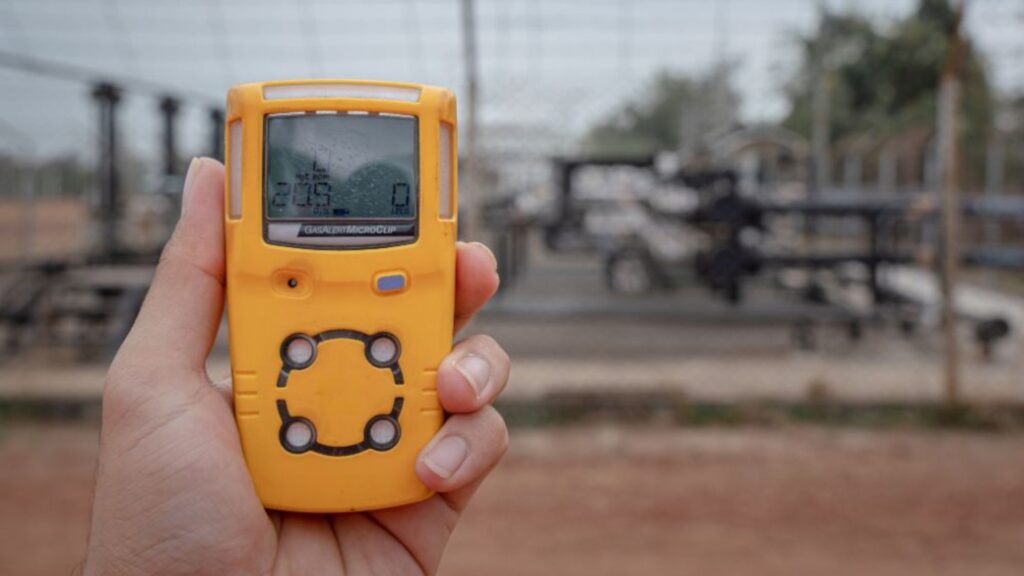
Cross sensitivity is a sensor’s reaction to gases other than the one it is designed to detect. Exposing a sensor to a non-target gas can cause an unwanted effect a positive response, a negative response or inhibition. Understanding these effects is important for anyone responsible for gas detector operation, calibration or site safety.
What Is a Positive Response?
A positive response means a sensor responds not just to its target gas but to another gas as well. This can give the user the impression that target gas is present when it is not, or that there is more of it than is actually the case. The result could be unnecessary evacuation, unwarranted ventilation activation or other corrective actions that are not required.
A practical example: a CO sensor has a positive response to H2. If the sensor is exposed to 200ppm of H2, it will display approximately 100ppm on the CO reading even though no carbon monoxide is present.
What Is a Negative Response?
A negative response occurs when a sensor produces a reduced reading on the target gas because it has been exposed to an interfering gas at the same time. This is the more dangerous scenario, the user may be exposed to a real gas hazard without knowing, because the instrument is showing a lower reading than the actual concentration.
An example: an SO2 sensor has a negative response to NO2. If the sensor is exposed to 10ppm of NO2 at the same time as 10ppm of SO2, the net result on the display could read 0ppm or even a negative value, depending on the instrument. The gas is present but the detector is not showing it.
What Is Inhibition?
Inhibition is similar to a negative response, but more severe. The sensor will not respond to the target gas at all if the inhibitor is present, and may take hours or even days to recover before it can detect the target gas again.
For example, a Cl2 sensor is inhibited by H2S. SO2 sensors can be inhibited by NH3 and require many hours to recover before responding to SO2 again.
The Real Danger of Cross Sensitivity
One of the most dangerous scenarios arises when a multi-gas detector is simultaneously monitoring NO2 and SO2. NO2 sensors can have a negative response to SO2 and vice versa. In this situation, it is possible for the instrument to display 0ppm for both gases even though both are present at hazardous levels. The detection system appears to be working, but it is not.
This is why understanding cross sensitivity is critical when selecting and configuring gas detectors for specific environments.
When Cross Sensitivity Can Be Used to Your Advantage
There are more types of gases in the world than there are different sensor types. In some cases, cross sensitivity can be used deliberately to detect a gas for which no dedicated sensor is readily available.
One example is phosphine fumigation gas (PH3). Both CO and SO2 sensors have high cross sensitivity to PH3 and can be used for high-ppm phosphine monitoring. This is a practical solution in environments where fumigation gases are a known hazard.
Another example involves formaldehyde. Formaldehyde calibration gas is expensive to produce and not readily available in disposable cylinders. However, some formaldehyde sensors are cross sensitive to CO gas, meaning they can be calibrated using low-cost, readily available CO calibration gas as an alternative. View Gastech’s range of calibration gases if you need support with sensor calibration.
A Common Cause of False Alarms: Alcohol Exposure
CO sensors are highly responsive to H2, acetylene, ethanol and alcohol. This creates a well-known problem in workplaces where gas detection equipment and breathing apparatus are maintained in the same area.
If alcohol is used to clean face masks nearby, CO sensors are likely to register false readings. The sensors can take a considerable time to recover after alcohol exposure. Since the onset of Covid-19, many users have reported increased false CO alarms due to alcohol-based hand sanitisers and surface cleaners in proximity to their gas detectors.
If your team is experiencing unexplained CO alarms, alcohol exposure is worth investigating before assuming there is a genuine gas leak.
What You Should Know About Cross Sensitivity Over Time
Cross sensitivity is not the same across all sensors and changes between manufacturers. Importantly, the level of cross sensitivity also changes as sensors age. Some sensors are manufactured with built-in filters to minimise the effects of cross sensitivity but these filters degrade over time, altering sensor performance.
Regular service and calibration is the most effective way to maintain accurate sensor performance and catch changes in cross sensitivity before they create a safety risk.
In Summary
Sensors respond to their target gas and, in many cases, to other gases as well. The sensor itself cannot analyse or differentiate between the gases to which it responds that responsibility sits with the operator and the system design.
Understanding cross sensitivity helps you select the right gas detector for your environment, configure it correctly, and respond appropriately when readings are unexpected. If you have questions about sensor performance or cross sensitivity for your specific application, talk to the Gastech technical team.
For current workplace exposure standards and gas monitoring guidance, refer to Safe Work Australia.