
Choosing An Air Quality Monitor
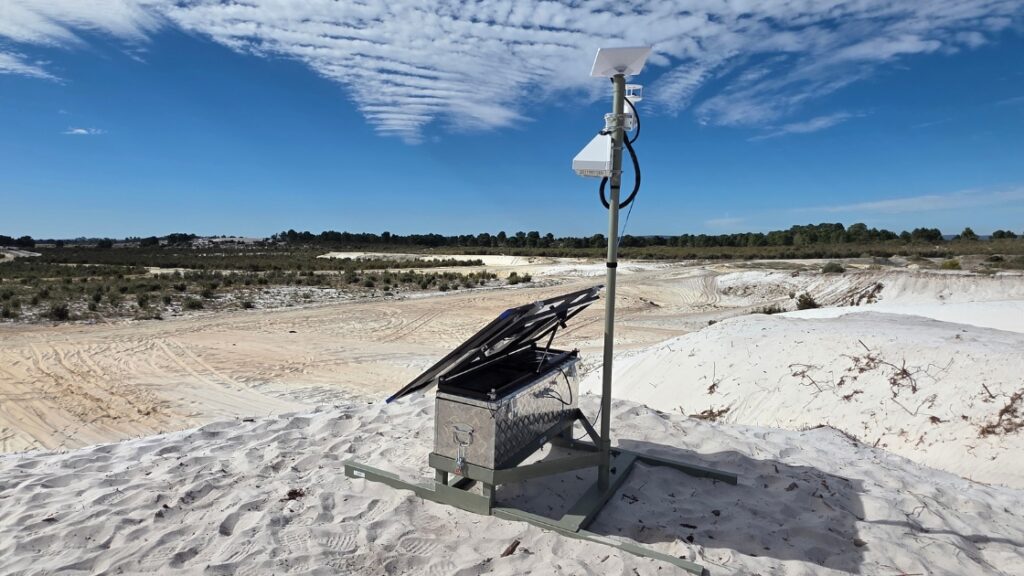
Most conversations about low cost air quality monitoring start in the wrong place. They start with accuracy.
That is understandable. A reference grade monitoring station is more accurate than a small sensor pod, and nobody wants to buy something that is less accurate. But accuracy is only half the question, and on most projects it is the less important half.
Here is why. Air quality readings vary dramatically over short distances. Concentrations at a fence line are not the same as concentrations fifty metres inside it. A reading beside a haul road on a mine site is not the reading at the site office. Pollution is not a uniform blanket over a site, it is a moving, uneven thing shaped by wind, terrain, buildings and whatever produced it.
Which means measuring in the right place has a larger effect on whether your data is valid than the difference in accuracy between a small pod and a reference station. A very accurate reading from the wrong location tells you very little. A slightly less accurate reading from exactly the right location tells you what you need to know.
That is the argument for small sensor systems, and it is a better argument than any specification.
Why Lab Specifications Are Close To Useless Here
If accuracy is not the first question, it is still a question. So how do you assess it?
Not from a laboratory test sheet. Electrochemical gas sensors are highly susceptible to environmental conditions and to cross interference from other gases, and a laboratory test typically uses a single dry gas under controlled conditions. That tells you almost nothing about how the sensor will behave in damp air, in a mixture of gases, and in direct sunlight, which is where it will actually be working.
What does tell you something is co-location data. That means the pod being run alongside a properly maintained reference station, in real conditions, over a meaningful period, with the results published.
So the question to ask a supplier is not what the specification says. It is whether they can show you co-location comparison results from field trials, and how long their equipment has been out in the field generating them.
If they cannot, that is your answer.
The Sensor Is Only Half The Product
This is the part most buyers do not realise they are buying.
An electrochemical sensor produces a raw electrical output. Turning that into a reliable concentration in parts per billion means separating the target gas signal from everything else in the output. Environmental effects, electronic noise, and interference from other gases present at the same time.
Nitrogen dioxide and ozone are the classic example. They interfere with each other significantly, and some systems handle it by measuring one and calculating the other. A calculated value inherits the errors in the measurement it came from.
Developing processing that handles this properly requires a large volume of comparison data between low cost sensors and reference instruments, gathered across a range of real conditions. It is not something that can be worked out on a bench.
Two things follow. Ask how the processing was developed and against what. And ask whether the algorithms are fixed and traceable, or whether they continue to change. An algorithm fixed by version number gives you the same output from the same input in three years time, which is what makes a long data set internally consistent. That matters a great deal if the data is ever going to support a compliance position or settle a dispute.
Ask What The Ongoing Cost Actually Is
Small sensor systems are sold on capital cost and are rarely operated on capital cost alone.
There is a SIM card and mobile data. There is the data processing that turns raw sensor output into usable readings. There is online access to the data. There is sensor replacement, since electrochemical sensors have a finite life measured in years rather than decades.
Some suppliers bundle all of that into one annual charge. Others price the elements separately, which can look cheaper at purchase and considerably less cheap over five years.
Work out the five year cost, not the purchase price. And establish who replaces a failed sensor and how quickly, because a pod with a dead sensor is producing a gap in your data set rather than a fault you will notice immediately.
Ask Who Owns The Data
Worth checking, because low cost air quality monitoring covers two quite different models.
Some systems are built around data sharing, with readings published to an open portal where anyone can view what any location is recording. That has real value for community and research networks.
It is not what you want for boundary monitoring during a dispute with a neighbour, or for a baseline study before a development application.
Establish whether your data is private and secured behind a login, or whether it is going somewhere public by default.
Three Things That Matter Specifically In Australia
Heat. A great deal of this equipment was developed and validated in the northern hemisphere, in conditions considerably milder than a Pilbara summer. Ask specifically about performance at high ambient temperature, because sensor behaviour and the processing that corrects for it both change with heat.
Dust. Optical particle counters have to deal with what is in the air, and Australian sites present more of it than most. Ask how the inlet is protected and what maintenance the particulate sensor actually needs.
Distance. A monitoring pod on a remote site is a long way from anyone who could attend it. That makes remote management and remote diagnosis worth more here than almost anywhere. Ask what can be changed and diagnosed without a site visit, and what a sensor failure requires somebody to physically do.
The Short Version
If you are comparing air quality monitoring systems, five questions will tell you more than any specification sheet.
Where can I put it, and what does that depend on. Can you show me co-location field data. How was the processing developed, and is it fixed and traceable. What does it cost to run for five years. And who can see my data.
Accuracy matters. It just is not the first question.
Try It Before You Commit
The location argument cuts both ways. If where you measure matters more than anything else, then the sensible first step is finding out what a location actually tells you before building a programme around it.
Gastech supplies air quality monitoring pods for hire as well as purchase, so a position can be tested for a month before a decision is made. Our Technical Consultants will work through what your project has to demonstrate, which channels that needs, and where the pods should go, with project engineering support from WA, NSW and QLD.