
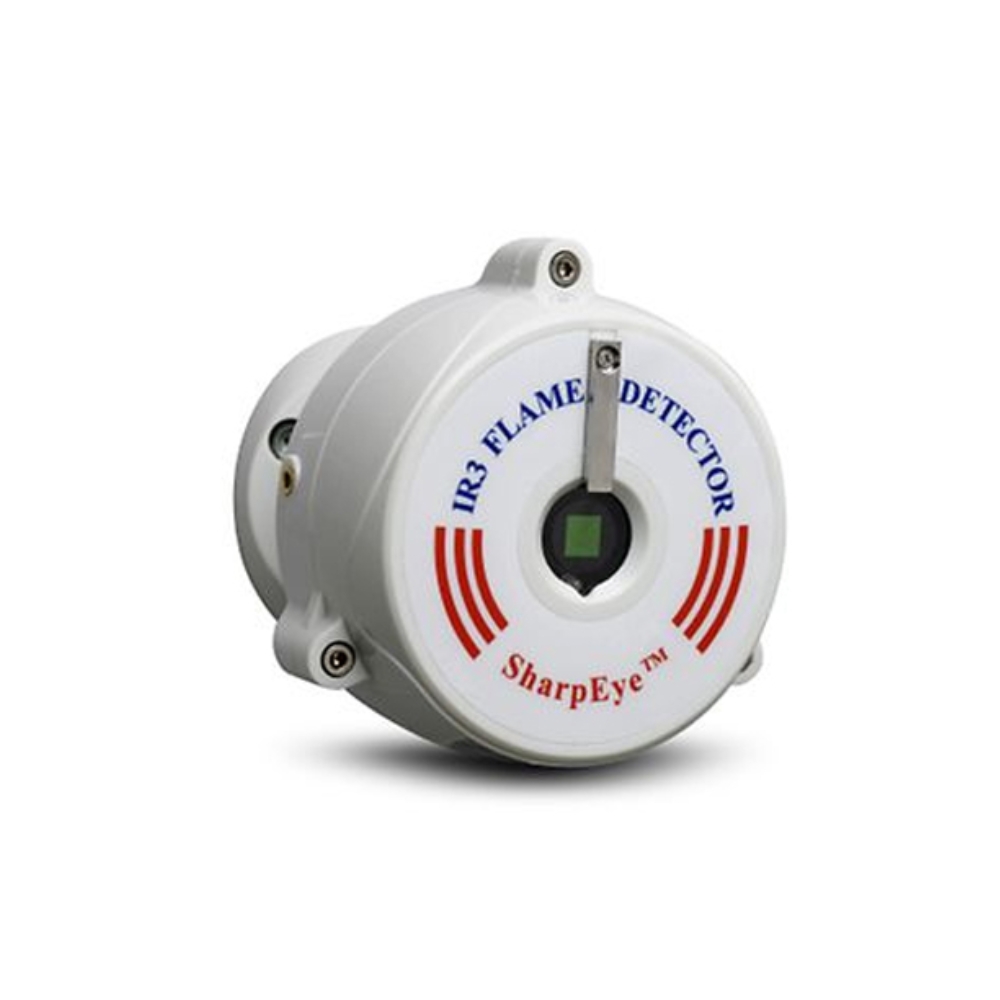
SharpEye 20/20 MPI
Mini Indoor Flame Detector
i
This product has been discontinued and is no longer available. In many cases we can still service and calibrate it. Talk to our team about spares or alternatives.
The SharpEye 20/20MPI is a triple infrared flame detector built for indoor building protection rather than industrial plant. It reaches 43 metres from a compact polycarbonate housing, which is unusual for a detector this size, and carries the false alarm immunity that triple infrared is specified for. Approved to EN 54-10 and compliant with the Construction Products Regulation, it suits airport terminals, transport hubs, storage buildings and public spaces.
KEY BENEFITS
- Detects a fire at up to 43 metres, unusually long for a compact detector
- Triple infrared gives the highest false alarm immunity of the optical technologies
- 100 degree horizontal field of view, wide enough to cover a concourse from one position
- Lightweight polycarbonate housing, so mounting into building structure is straightforward
- Low power consumption, which matters across a building sized installation
+ more in the Description tab below
An Indoor Detector, Not An Industrial One
This is the distinction that decides whether the 20/20MPI is the right product, and it separates it from the rest of the SharpEye range.
Most optical flame detectors are built for process plant. Stainless steel housings, hazardous area certification, and specifications aimed at refineries and offshore installations. The 20/20MPI is built for buildings. The housing is lightweight polycarbonate, the approvals are building fire product approvals, and the applications are terminals, stations, warehouses and public spaces.
That makes it the wrong detector for a classified hazardous area and the right one for a large indoor volume where a conventional smoke or heat detector would be too slow or too high to be useful. In a building with a ten metre ceiling, smoke takes time to reach a detector at the top and heat takes longer still. An optical flame detector sees the fire directly.
Forty Three Metres From A Compact Housing
Detection reaches up to 43 metres, and that figure is the reason the product exists in this form.
Compact detectors usually trade range for size. The 20/20MPI keeps the triple infrared detection principle intact, so it holds the range while shedding the weight and the cost of an industrial housing. A single detector can cover a large concourse, a warehouse aisle or an atrium where several conventional detectors would be needed.
Field of view is 100 degrees horizontally and 90 degrees vertically. The wide horizontal spread is what allows one unit mounted at the end of a space to see down its length.
Why Triple Infrared Indoors
Triple infrared watches several infrared bands at once and correlates them. A fire produces a strong signal on the channel tuned to hot carbon dioxide, comparatively little on the reference channels, and the flicker frequency characteristic of a flame. A hot object or a sunlit surface produces similar output across all channels and no flicker.
Indoors, the false alarm sources are different from a process plant but no less real. Sunlight through glazing, halogen and metal halide lighting, radiant heaters, hot equipment and reflections off polished floors all present something for a simpler detector to respond to. In a public building a false alarm means an evacuation, so immunity matters more here than in a plant room, not less.
Two Output Models
The detector is available in two versions, and the choice is made by what the fire panel expects.
One provides alarm and fault relay outputs on a four wire connection, which suits a conventional fire alarm panel taking volt free contacts. The other provides a stepped milliamp output on a three wire source connection, which suits an analogue addressable or industrial control system reading a current loop.
RS-485 Modbus is available on both for digital integration.
Built in test runs automatically and can be triggered manually, and the warranty is three years.
The Approvals Are Building Approvals
Worth being precise about, because it decides where the detector can be used.
The 20/20MPI holds EN 54-10, which is the recognised performance standard for flame detectors used in fire detection and alarm systems, and it is CPR compliant, meaning it can be used as a construction product within a building fire system. It also holds FM approval.
What it does not carry is hazardous area certification. There is no ATEX, IECEx or Ex rating on this detector, and the polycarbonate housing reflects that. For a classified area, the SharpEye 20/20MI is the compact alternative and is available in an intrinsically safe version.
What It Will Not See
Triple infrared detects fires through the carbon dioxide their combustion produces. Hydrogen burns to water vapour and produces no signature on these channels, and metal and inorganic fires produce neither.
Where hydrogen or metal fires are part of the risk, the SharpEye 20/20ML combines ultraviolet and infrared and covers all of them, though at a shorter 15 metre range.
Where It Is Used
Airport terminals and concourses. Train stations and transport interchanges. Warehouses and distribution centres. Storage buildings and racking areas. Public buildings and civic spaces. Atriums and large retail volumes. Sports and exhibition halls. Hangars and vehicle workshops. Carparks and electric vehicle charging areas. Indoor plant and switchrooms. Museums, archives and other high value storage.
Benefits
- Detects a fire at up to 43 metres, unusually long for a compact detector
- Triple infrared gives the highest false alarm immunity of the optical technologies
- 100 degree horizontal field of view, wide enough to cover a concourse from one position
- Lightweight polycarbonate housing, so mounting into building structure is straightforward
- Low power consumption, which matters across a building sized installation
- Approved to EN 54-10, the recognised performance standard for flame detectors
- Compliant with the Construction Products Regulation for use in building fire systems
- Two output models, relay outputs or stepped milliamp, to suit the fire panel
- RS-485 Modbus for integration into a building or fire management system
- Automatic and manual built in test, with a three year warranty
Detection principle
Triple infrared, three correlated channels with flicker frequency analysis
Fires detected
Hydrocarbon fuel and gas fires
Detection distance
Up to 43 m
Field of view
100° horizontal, 90° vertical
Housing
Lightweight polycarbonate
Power consumption
Low
Output, model one
Alarm and fault relay outputs, 4 wire
Output, model two
Stepped milliamp output, 3 wire source
Digital output
RS-485 Modbus compatible
Built in test
Automatic and manual
Performance approval
EN 54-10
Construction products
CPR compliant
Other approvals
FM
Hazardous area certification
None. Not for use in classified areas
Warranty
3 years
- Aviation & Transportation
- Chemical Manufacturing
- Food & Beverage
- Marine & Maritime
- Medical & Healthcare
- Mining & Minerals
- Power Generation & BESS
- Technology & Semiconductor
- Water & Wastewater
Up to 43 metres, which is unusually long for a compact detector and enough for a single unit to cover a concourse or a warehouse aisle.
No. It carries building fire approvals rather than hazardous area certification, and the housing is polycarbonate. Classified areas need the 20/20MI in its intrinsically safe version.
EN 54-10 for flame detector performance, CPR compliance for use as a construction product in a building fire system, and FM approval.
Relay outputs suit a conventional fire panel taking volt free contacts, while the stepped milliamp version suits an analogue addressable or industrial control system.
In a high ceilinged space, smoke takes time to reach a detector at the top and heat takes longer still. An optical flame detector sees the fire directly.
No. Hydrogen burns to water vapour rather than carbon dioxide, so it produces no signature on infrared channels. The 20/20ML covers hydrogen at up to 15 metres.
Trusted by









Contact Us
Can’t find what you’re looking for? Our team is happy to help.