
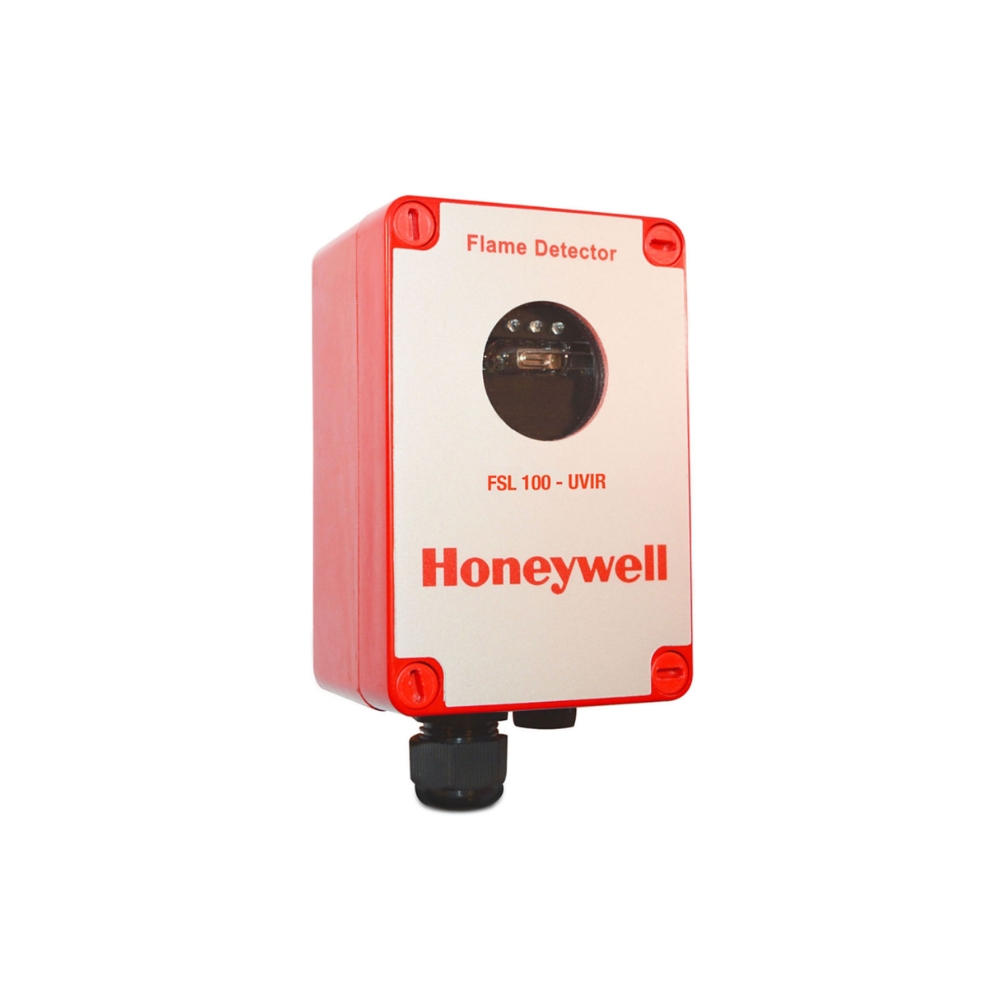
FSL100
Light Industrial Flame Detector
The FSL100 by Honeywell is an optical flame detector for light industrial and commercial applications, available in ultraviolet, combined ultraviolet and infrared, and triple infrared versions. It responds to flaming fires in seconds across a wide field of view, detecting both hydrocarbon and non-hydrocarbon fires. Installation, setup and operation are deliberately simple, and inbuilt automatic testing plus optional test lamps make routine checking straightforward.
KEY BENEFITS
- Three versions covering ultraviolet, combined ultraviolet and infrared, and triple infrared detection
- Detects a wide range of hydrocarbon and non-hydrocarbon flaming fires
- 90° cone of vision covers a large risk area from a single detector
- Detects a 0.1 m² n-heptane fire at up to 35 metres on the IR3, in under 10 seconds
- Certified to FM 3260 and EN 54-10 for flame detector performance
+ more in the Description tab below
Three Versions, One Platform
| Version | Detection | Maximum range (n-heptane) | EN 54-10 class | Suited to |
|---|---|---|---|---|
| FSL100 UV | Ultraviolet | 23 m (0.09 m² fire) | Class 2 | Fast response where ultraviolet interference is absent or controlled |
| FSL100 UV/IR | Combined ultraviolet and infrared | 23 m (0.09 m² fire) | Class 2 | Broad fuel coverage, alarming only when both sensors agree |
| FSL100 IR3 | Triple infrared | 35 m (0.1 m² fire) | Class 1 | Hydrocarbon fires, with the strongest rejection of false alarm sources and the longest range |
The detection principles are the same as the higher specification ranges. What changes is the target, which is light industrial and commercial fire protection rather than heavy process plant.
Where It Fits Against the Rest of the Range
It’s worth being direct about this, because specifying the wrong tier costs money in both directions.
The SharpEye and F-Guard ranges are built for heavy process environments: long detection distances, flameproof housings, Zone 1 certification and SIL rated safety functions. On a refinery or an offshore facility, that’s what the risk needs.
A lot of fire protection isn’t that. Warehouses, workshops, light manufacturing, plant rooms, storage areas and commercial buildings all need reliable flame detection without Zone 1 certification or 90 metre detection distances. Specifying a process detector for those areas means paying for capability the installation will never use.
The FSL100 covers that middle ground. It carries ATEX Zone 2 and 22, and FM non incendive approval for Class 1, 2 and 3, Division 2, so it can be installed indoors or outdoors. It’s often positioned to look into a Zone 1 area from a safe distance, rather than being installed inside one.
Wide Field of View
The FSL100 has a 90° cone of vision, so one detector covers a large risk area. On a light industrial site, that’s usually what decides how many units are needed.
Coverage is a volume rather than a line, so field of view and detection distance work together. A wide angle detector at moderate range often covers more useful space than a narrow one reaching further. That’s why a warehouse or workshop can often be protected with fewer detectors than a first estimate suggests.
An optional swivel mount handles installation and alignment. The detector body weighs 465 grams, or 745 grams with the mount, so it doesn’t need fabricated steelwork.
Speed, and Why It Matters Here
The FSL100 alarms in 8 to 30 seconds, depending on the fire and distance, and its maximum ranges are rated to alarm in under 10 seconds. That’s considerably faster than heat or smoke detection in the same space.
In a high ceilinged building, smoke has to travel to reach a detector, and heat takes longer still. An optical detector sees the fire directly, so the response time is detection time rather than travel time. In a workshop or storage area where the fuel is flammable liquid or packaging, that difference decides whether the response is to a small fire or a well established one.
Testing Without Setting Fire to Anything
Two features here reduce the cost of ownership more than the specification suggests.
An automatic self test continuously monitors the sensors, electronics and firmware, so the detector reports its own condition rather than waiting for an inspection to find a problem. A manual self test can also be triggered by a contact closure.
Optional test lamps allow both operational testing and field of view testing. The FSL100-TL is for safe areas. The FSL100-TLX is intrinsically safe, certified to IECEx and ATEX, for hazardous areas. The field of view test is the useful part. Confirming a detector still sees the area it’s meant to cover is normally difficult, and it’s exactly what changes when racking is moved, a partition goes up or plant is relocated.
Outputs and Certification
Alarm and fault relays, each SPDT rated 2 A at 30 VDC, plus a stepped 0-20 mA sinking output, give a straightforward connection to a fire alarm panel or control system. The alarm can be set as latching or non latching, and the detector also connects to a fire panel by end of line and alarm resistors.
Performance certification covers FM 3260 and EN 54-10, which confirm the detector detects fires as claimed. That’s separate from hazardous area certification, which confirms the detector won’t cause an explosion. The FSL100 holds both, and a specifier working to a fire and gas philosophy will usually ask to see the performance approval.
Built for the Job
The housing is glass reinforced polyester (GRP), UV resistant and self extinguishing, in red or white, and rated IP65. A pressure compensating element helps prevent moisture building up inside. It runs on 12 to 24 VDC, drawing just 25 mA in normal operation, and operates from -40°C to +70°C in safe areas, or -25°C to +70°C in hazardous areas.
Where It’s Used
Warehouses and distribution centres. Workshops and light manufacturing. Storage areas and racking. Plant and machinery rooms. Waste and recycling facilities. Loading bays and vehicle areas. Paint and coating areas. Commercial buildings and infrastructure. Fuel and flammable liquid stores. Areas next to a classified zone, where the detector looks in from a safe distance.
Benefits
- Three versions covering ultraviolet, combined ultraviolet and infrared, and triple infrared detection
- Detects a wide range of hydrocarbon and non-hydrocarbon flaming fires
- 90° cone of vision covers a large risk area from a single detector
- Detects a 0.1 m² n-heptane fire at up to 35 metres on the IR3, in under 10 seconds
- Certified to FM 3260 and EN 54-10 for flame detector performance
- ATEX Zone 2 and 22 and FM Class 1, 2 and 3 Division 2, suitable indoors or outdoors
- Inbuilt automatic test provides continuous internal health monitoring
- Test lamps allow operational and field of view testing without applying fire
- Alarm and fault relays plus a stepped 0-20 mA output, with latching or non latching alarms
- Compact GRP housing in red or white, with an optional swivel mount
Detection principle
Optical, available as ultraviolet, combined ultraviolet and infrared, or triple infrared
Versions
FSL100 UV, FSL100 UV/IR, FSL100 IR3
Fires detected
A wide range of hydrocarbon and non-hydrocarbon flaming fires
Field of view
90° cone of vision
Response
Alarm response 8 to 30 seconds. Maximum ranges rated to alarm in under 10 seconds
Built in test
Automatic, providing continuous internal health monitoring
Test lamps
FSL100-TL for safe areas. FSL100-TLX intrinsically safe (IECEx and ATEX) for hazardous areas
Analogue output
0-20 mA stepped, sinking, non isolated. 0 mA power or microprocessor fault, 2 mA optical fault, 4 mA normal, 20 mA alarm
Relay outputs
Alarm and fault, SPDT, 30 VDC 2 A, 60 W maximum. Alarm latching or non latching (factory set to latching)
Hazardous area
ATEX Zone 2 and 22. FM 3611 non incendive, Class 1, 2 and 3, Division 2
Performance certification
FM 3260. EN 54-10: Class 1 (IR3), Class 2 (UV and UV/IR)
Housing
GRP, non incendive, UV resistant, self extinguishing (UL 94 V-0). Red or white. IP65
Mounting
Optional bracket and optional swivel mount
Installation
Indoor or outdoor
Maximum range
IR3: 35 m for a 0.1 m² n-heptane fire. UV and UV/IR: 23 m for a 0.09 m² n-heptane fire
Power
12 to 24 VDC (10 to 28 VDC). 25 mA normal, about 75 mA in alarm
Operating temperature
Safe areas: -40°C to +70°C. Hazardous areas: -25°C to +70°C
Humidity
0 to 95% RH, non condensing
Dimensions and weight
125 x 80 x 57 mm. 465 g, or 745 g with optional mount
Warranty
24 months from commissioning, or 30 months from shipment, whichever is sooner
- Aviation & Transportation
- Carpark & HVAC
- Chemical Manufacturing
- Energy (Oil & Gas)
- Food & Beverage
- Landfill & Remediation
- Marine & Maritime
- Mining & Minerals
- Power Generation & BESS
- Technology & Semiconductor
- Water & Wastewater
The detection technology. Ultraviolet responds fastest where ultraviolet interference is absent, combined ultraviolet and infrared gives the broadest fuel coverage by requiring both sensors to agree, and triple infrared gives the highest rejection of false alarm sources for hydrocarbon fires.
It carries ATEX Zone 2 and 22 certification and FM non incendive approval for Class 1, 2 and 3, Division 2. It's often positioned to look into a Zone 1 area from a safe distance, rather than being installed inside one.
Those are built for heavy process environments with long detection distances, flameproof housings and Zone 1 certification. The FSL100 covers light industrial and commercial applications that do not need that specification.
Optional test lamps allow both operational and field of view testing. Use the FSL100-TL in safe areas, or the intrinsically safe FSL100-TLX in hazardous areas. It's the practical way to confirm coverage after racking, partitions or plant have moved.
Yes, the range detects a wide range of both hydrocarbon and non-hydrocarbon flaming fires, with coverage depending on which version is fitted.
FM 3260 and EN 54-10, both of which certify detection performance. That is separate from the hazardous area certification, and it is the one a fire engineer will usually ask to see.
Trusted by









Contact Us
Can’t find what you’re looking for? Our team is happy to help.