
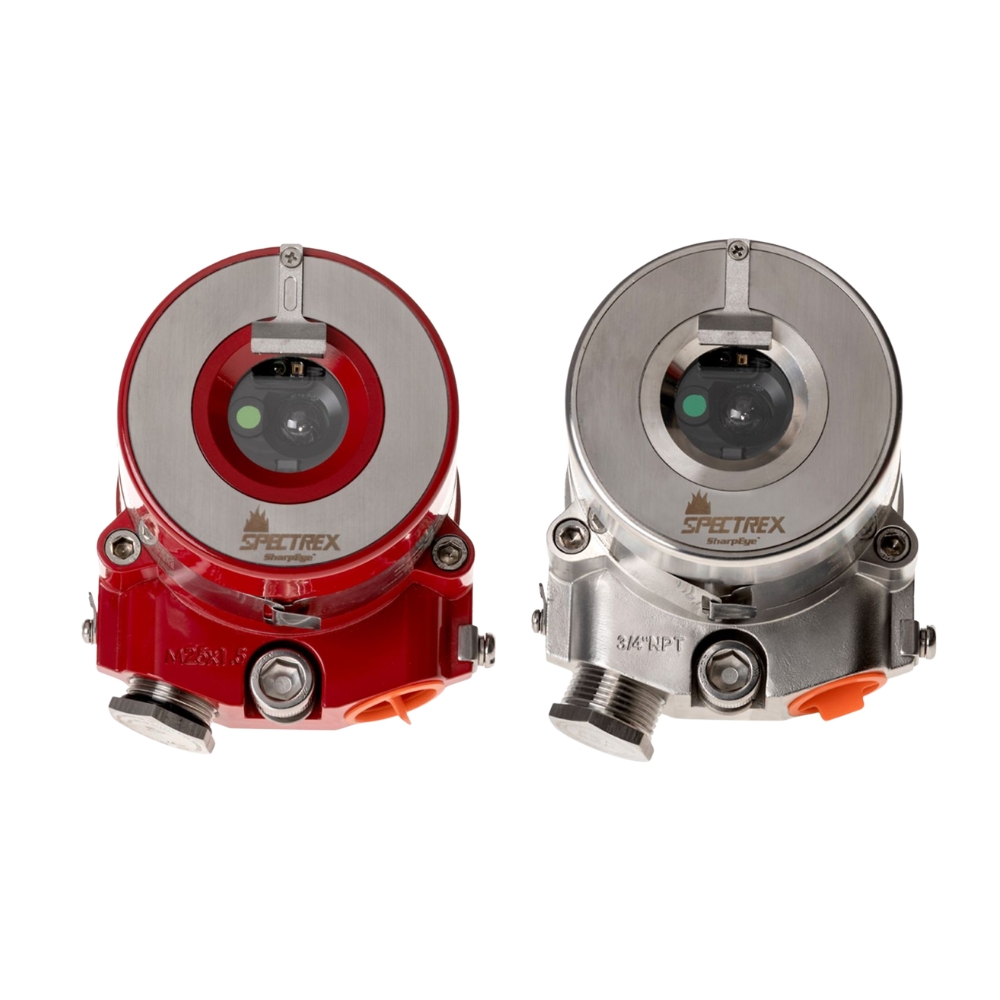
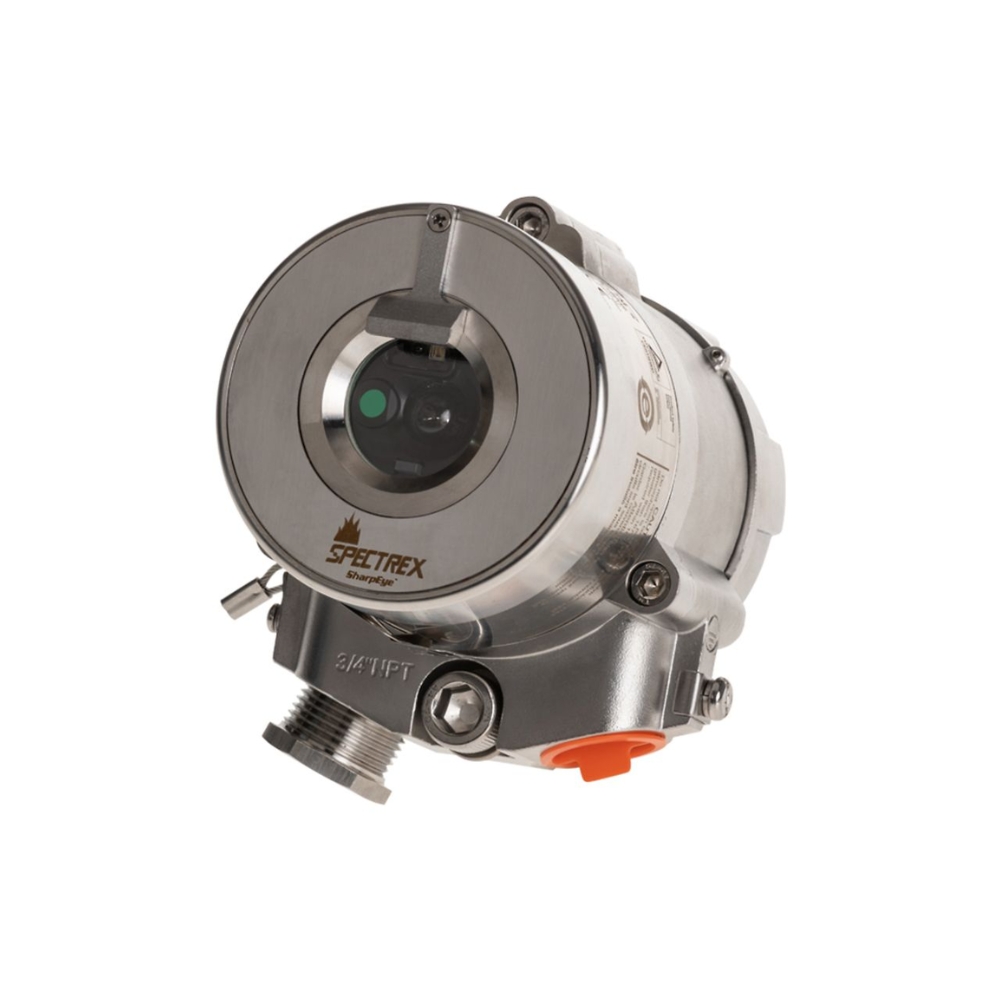
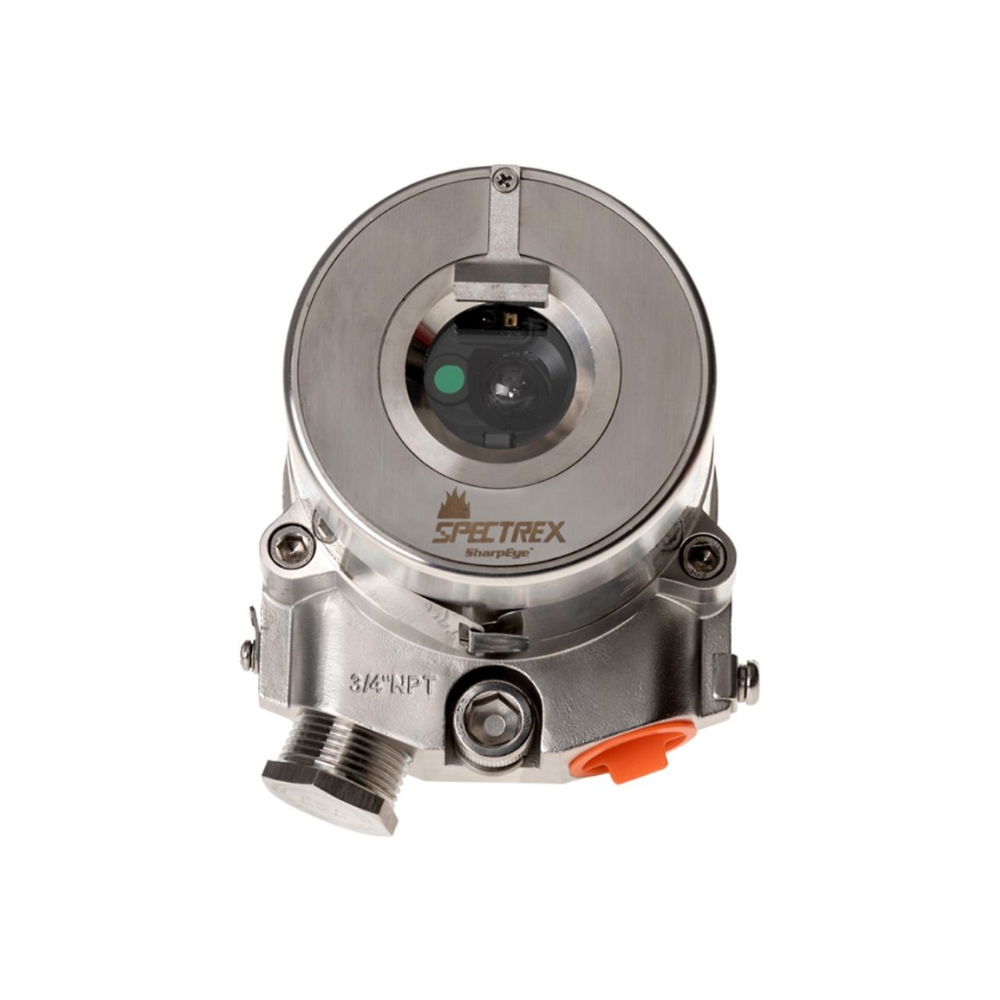
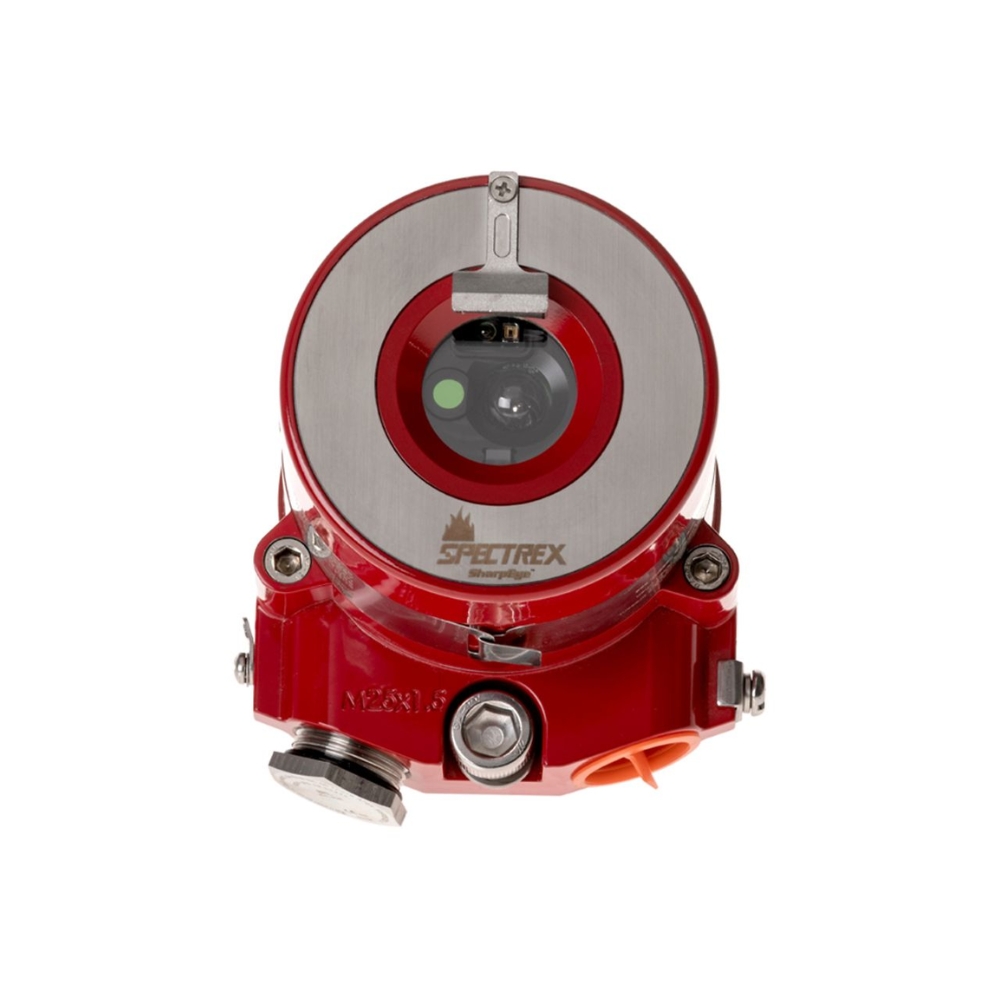
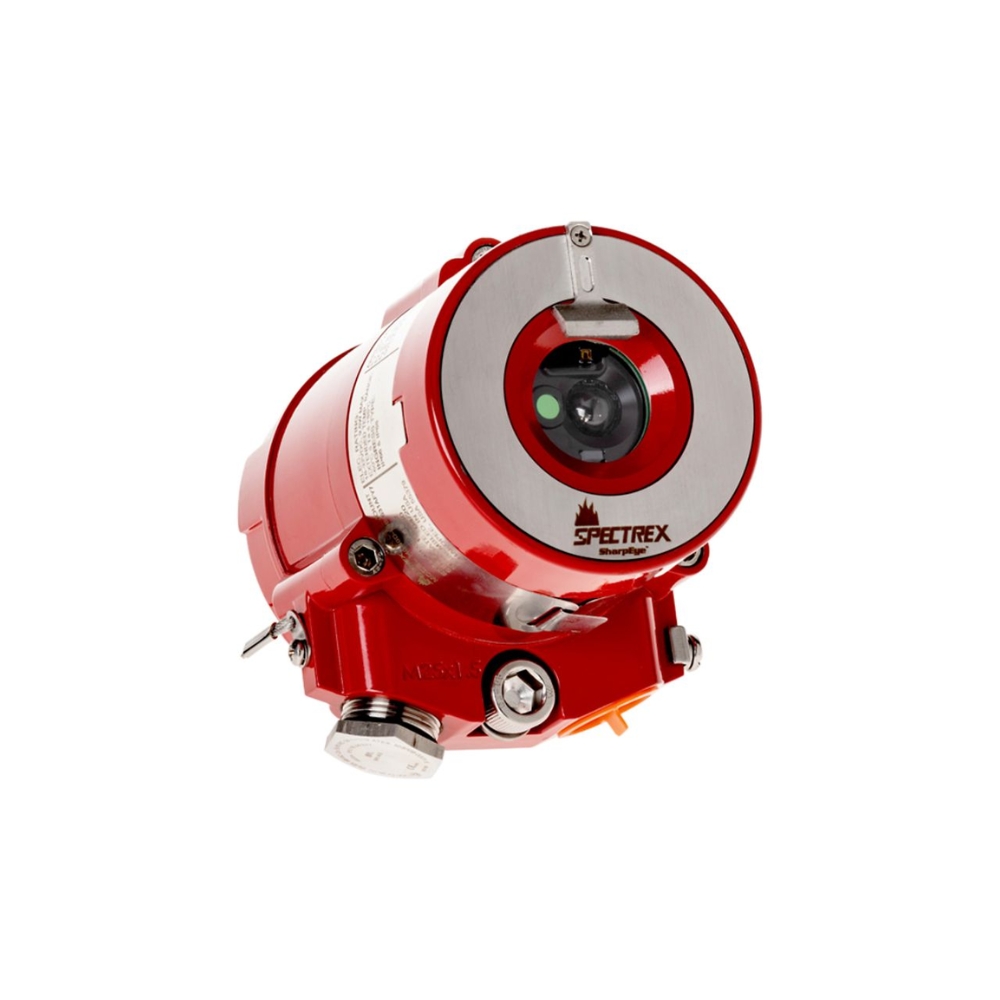
SharpEye 40/40 UV/IR
UV/IR Flame Detector
The SharpEye 40/40 UV/IR from Spectrex combines an ultraviolet and an infrared sensor, and alarms only when both agree. That’s what lets it ignore welding arcs, hot surfaces and sunlight. Four variants cover two decisions: how much fuel coverage you need, and how fast the detector has to respond. The D-Series detects a flash fire in 20 milliseconds and carries a five year warranty. All variants have heated optics, HART and Modbus, and Zone 1 certification.
KEY BENEFITS
- Four variants on one platform, from broad fuel coverage through to 20 millisecond response
- Broad spectrum versions detect hydrocarbon, hydrogen, metal and inorganic fires
- D-Series detects a flash fire in 20 ms and an explosion in 50 ms, fast enough for suppression release
- Both sensors must agree before alarming, which is what rejects welding arcs and hot surfaces
- Dedicated logic in the ultraviolet channel rejects false alarms caused by solar radiation
+ more in the Description tab below
Four Variants, Two Decisions
| Variant | Fuel coverage | Response | n-heptane range (0.1 m² pan) |
|---|---|---|---|
| 40/40C-LB | Hydrocarbon, hydrogen, metal and inorganic fires | Typically under 5 seconds | 15 m |
| 40/40C-L4B | Hydrocarbon fires, plus magnesium alloy | Typically under 5 seconds | 28 m |
| 40/40D-LB | Hydrocarbon, hydrogen, silane, metal and inorganic fires | Standard, 20 ms flash fire, 50 ms explosion | Contact us for details |
| 40/40D-L4B | Hydrocarbon fires, plus magnesium alloy | Standard (typically 5 s at 28 m), 20 ms flash fire, 50 ms explosion | 28 m |
It’s two axes, not four products. The series decides how fast it responds: C for standard industrial applications, and D where speed matters. The suffix decides what it can see: LB gives broad spectrum coverage, and L4B narrows to hydrocarbon.
Work out the fuels first, then the speed. Going the other way round tends to produce a detector that’s quick at seeing the wrong thing.
Why Both Sensors Have to Agree
A UV/IR detector watches the short wave ultraviolet and the infrared at the same time. Signals from each sensor are analysed independently for frequency, intensity and duration, and an alarm is raised only when both agree they’re looking at a fire.
That’s the whole point of the technology. Ultraviolet alone is very fast, but responds to welding arcs, lightning and other short wavelength sources. Infrared alone can be fooled by hot bodies and modulated blackbody radiation. Requiring both cancels out most of each weakness, because a welding arc has no fire infrared signature, and a hot exhaust gives off no ultraviolet.
The ultraviolet channel also has a dedicated logic circuit to reject solar radiation. On an outdoor Australian installation, that’s the false alarm source you’ll meet most often.
Fuel Coverage: LB or L4B
This is the choice that decides whether the detector sees your fire at all.
The LB variants use an infrared band of 2.5 to 3.0 microns. They detect hydrocarbon fuel and gas fires, hydroxyl and hydrogen fires, and metal and inorganic fires. If the site risk includes hydrogen, or anything that doesn’t burn as a hydrocarbon, this is the variant that sees it. The 40/40D-LB also detects silane fires.
The L4B variants use an infrared band of 4.3 to 4.8 microns, which restricts detection to hydrocarbon based fires. That sounds like a downgrade, but it isn’t. Narrowing the band narrows what can trigger it, so where the fuel risk is purely hydrocarbon, the L4B gives cleaner rejection and nearly double the detection range. On the C-Series, that’s 28 metres for an n-heptane pan fire, against 15 metres on the LB.
Hydrogen is worth singling out. A hydrogen flame is close to invisible, and gives off very little in the bands a hydrocarbon detector watches. A detector tuned for a diesel fire can look straight at a hydrogen fire and register nothing. As hydrogen projects in Western Australia move into construction, the LB variants are the ones that meet that requirement. The 40/40D-LB detects hydrogen at up to 21 metres, and the 40/40C-LB at up to 11 metres.
For magnesium alloy fires, talk to our Technical Consultants. Spectrex recommends confirming the application with them.
Speed: C-Series or D-Series
A growing pan fire and a vapour cloud ignition are different events on different timescales.
The C-Series is built for the first, responding in typically under 5 seconds. The D-Series is built for both. It responds in 20 milliseconds to a flash fire at 3 metres, and in 50 milliseconds to an explosion, alongside a standard response mode for growing fires.
Twenty milliseconds isn’t a marketing number. It’s the difference between detecting an explosion and detecting its aftermath, and it’s what lets a detector sit in front of a suppression system that has to act before a fireball develops. Where the risk is a release that could ignite, rather than a fire that could start, the D-Series is the specification.
The D-Series also has the wider temperature range, at -60°C to +85°C against -40°C to +75°C on the C-Series, and a five year warranty against three.
HART and Modbus
Both series offer HART on the 0-20 mA output, and an RS-485 Modbus link, alongside alarm, fault and auxiliary relays.
HART gives real diagnostic information during installation and maintenance, rather than a single analogue value. Configuration and detector health can be read during commissioning, and a detector reporting a developing problem can be interrogated before it faults. On a site with twenty detectors mounted at height, that’s the difference between a scheduled inspection programme and a targeted one.
Approvals
Hazardous area approval says the detector won’t cause an explosion in a classified area. The 40/40 range holds ATEX, IECEx and UKCA, and FM and FMC, with CSA on stainless steel D-Series detectors, for Zone 1 installation.
Both series are SIL 3 compatible, for use in safety instrumented systems.
Heated Optics
Heated optics prevent condensation and icing on the window. An obscured optical detector isn’t degraded. It’s blind. In Australian conditions, condensation on a cool morning is a more common problem than ice. The D-Series has two heater modes, including a low power mode.
Testing
The automatic built in test confirms window cleanliness and detector operation, and a smart field of view integrity test checks the optical path. But it doesn’t activate the alarm outputs. It proves the detector can see, not that anything happens downstream when it does.
Proving the relay contacts, the 4-20 mA output, the wiring, the fire alarm panel, the notification and the suppression release needs an external flame simulator. The Spectrex FS-1200 is the ex proof simulator for the 40/40 LB and L4B variants, and Gastech supplies it for purchase or hire.
Where It’s Used
Refineries and petrochemical plant. Oil and gas processing, terminals and loading facilities. Storage tank farms. LNG production and storage. Hydrogen production, storage, refuelling and fuel cells. Hydrogenation in refining, food processing and chemical plants. Offshore platforms and vessels. Turbine halls and enclosures. Aircraft hangars and fuel farms. Battery energy storage installations. Semiconductor facilities handling hydrogen and silane. Pharmaceutical plants. Hazardous materials stores. Compressor stations. Mine site fuel storage and workshops.
Benefits
- Four variants on one platform, from broad fuel coverage through to 20 millisecond response
- Broad spectrum versions detect hydrocarbon, hydrogen, metal and inorganic fires
- D-Series detects a flash fire in 20 ms and an explosion in 50 ms, fast enough for suppression release
- Both sensors must agree before alarming, which is what rejects welding arcs and hot surfaces
- Dedicated logic in the ultraviolet channel rejects false alarms caused by solar radiation
- Heated window prevents condensation and icing from obscuring the optics
- HART output provides real diagnostic information during installation and maintenance
- Five year warranty on the D-Series, three years on the C-Series
- Zone 1 approved, with ATEX, IECEx, UKCA, FM and FMC, plus CSA on stainless steel D-Series
- SIL 3 compatible, for use in safety instrumented systems
Detection principle
Combined ultraviolet and infrared, alarm on confirmation from both sensors
Spectral response
UV 0.185 to 0.260 µm. IR: LB 2.5 to 3.0 µm, L4B 4.3 to 4.8 µm
Solar rejection
Dedicated logic circuit in the ultraviolet channel
Field of view
100° horizontal, 95° vertical
Window
Heated, to prevent condensation and icing
Built in test
Automatic, covering window cleanliness and overall detector operation. Smart field of view integrity test
Outputs
Alarm, fault and auxiliary relays, SPDT volt free, 2 A at 30 VDC. 0-20 mA (stepped) with HART. RS-485 Modbus. Analog voltage output
Operating voltage
24 VDC nominal (18 to 32 VDC)
Power consumption (LB, L4B)
90 mA (2.2 W) normal without heater. 320 mA (7.7 W) with heater and alarm
Cable entries
2 x 3/4 inch 14 NPT or 2 x M25 x 1.5
Humidity
Up to 100% RH, non condensing
Operating temperature
C-Series: -40°C to +75°C. D-Series: -60°C to +85°C
Hazardous area approval
ATEX, IECEx, UKCA. FM and FMC. CSA US/C (stainless steel D-Series)
Safety integrity
SIL 3 compatible
Warranty
C-Series: 3 years. D-Series: 5 years
-
-
40/40C-LB
Series
C, standard industrial
Infrared band
Broad spectrum
Hydrocarbon fires
Yes
Hydrogen fires
Yes
Metal fires
Yes
Response time
Typically under 5 seconds
Inorganic fires
Yes
n-heptane range
15 m
Hydrogen range
11 m
-
-
40/40C-L4B
Series
C, standard industrial
Infrared band
4.5 micron
Hydrocarbon fires
Yes
Hydrogen fires
No
Magnesium alloy fires
up to 10 m
Inorganic fires
No
Response time
Under 5 seconds
n-heptane range
28 m
-
-
40/40D-LB
Series
D, ultra fast
Infrared band
Broad spectrum
Hydrocarbon fires
Yes
Hydrogen fires
Yes
Metal fires
Yes
Inorganic fires
Yes
Response time
Standard, ultra fast 20 ms (flash fire at 3 m), high speed 50 ms (explosion at 10 m)
Silane fires
Yes
Hydrogen range
21 m
-
-
40/40D-L4B
Series
D, ultra fast
Infrared band
4.5 micron
Hydrocarbon fires
Yes
Hydrogen fires
No
Magnesium alloy fires
No
Inorganic fires
No
n-heptane range
28 m
Response time
Standard, ultra fast 20 ms (flash fire at 3 m), high speed 50 ms (explosion at 10 m)
- Aviation & Transportation
- Chemical Manufacturing
- Energy (Oil & Gas)
- Landfill & Remediation
- Marine & Maritime
- Mining & Minerals
- Power Generation & BESS
- Technology & Semiconductor
- Water & Wastewater
Response speed, temperature range and warranty. The C-Series responds in typically under 5 seconds, runs from -40°C to +75°C, and carries a three year warranty. The D-Series adds 20 ms flash fire and 50 ms explosion response, runs from -60°C to +85°C, and carries a five year warranty.
Fuel coverage. LB uses a broad spectrum infrared band and detects hydrocarbon, hydrogen, metal and inorganic fires. L4B is restricted to hydrocarbon fires, which gives cleaner false alarm rejection and nearly double the detection range.
An LB variant. A hydrogen flame emits very little in the bands a hydrocarbon detector watches, so the L4B will not see it.
Because ultraviolet alone responds to welding arcs and lightning, and infrared alone responds to hot bodies. Requiring both to agree removes most of each weakness.
Hazardous area approval says the detector won't cause an explosion in a classified area. The 40/40 range holds ATEX, IECEx, UKCA, FM and FMC approval for Zone 1. Talk to our Technical Consultants about performance approvals for your project.
No. It confirms window cleanliness and detector operation only. Testing the relays, wiring, panel and notification needs an external flame simulator, such as the Spectrex FS-1200.
Trusted by









Contact Us
Can’t find what you’re looking for? Our team is happy to help.