
OmniPoint
Multi-Sensor Fixed Gas Detector
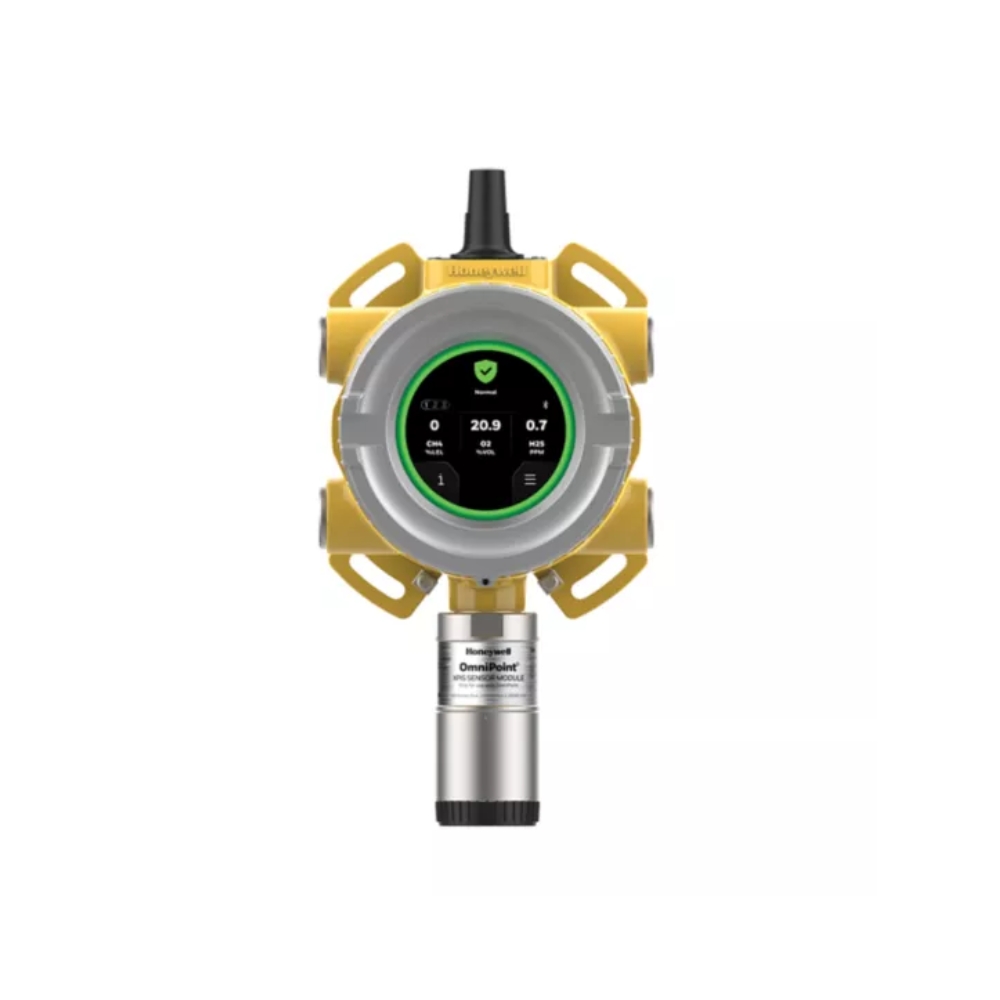
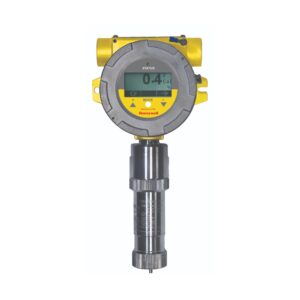
The OmniPoint by Honeywell is a fixed gas transmitter that runs up to three sensors at once, so a single unit can watch toxic, oxygen and flammable hazards at the same point. Sensor cartridges arrive pre-calibrated and clip in, and setup runs from a colour touch display or a phone over Bluetooth with no magnet required. It operates from minus 55 to plus 75 degrees Celsius in an IP66 and IP67 housing, with a five year warranty on the transmitter. It is Honeywell’s next generation platform and the upgrade path from the XNX.
KEY BENEFITS
- Runs up to three sensors on one transmitter, so a single unit covers toxic, oxygen and flammable at one point
- Fewer transmitters means less cable, fewer entries and a smaller installed footprint
- Pre-calibrated replaceable sensor cartridges swap out without a bench calibration
- Colour touch display and LED status ring read clearly across a plant, with no magnet needed
- Optional Bluetooth allows remote zero and span calibration from a phone up to 20 metres away
+ more in the Description tab below
Three Sensors, One Transmitter
Fixed gas detection has historically been one transmitter per gas. Three hazards at one location meant three transmitters, three cable runs, three sets of entries and three devices to maintain.
The OmniPoint carries three fully configurable 4 to 20 mA channels and supports three sensors simultaneously. So a compressor house needing methane, hydrogen sulphide and oxygen depletion runs from one head rather than three.
The saving compounds. One mounting point instead of three. One cable route. One device in the maintenance schedule. Across a plant with dozens of detection points, that is a materially smaller installation and a materially smaller service load.
The Interface Is the Part You Will Notice
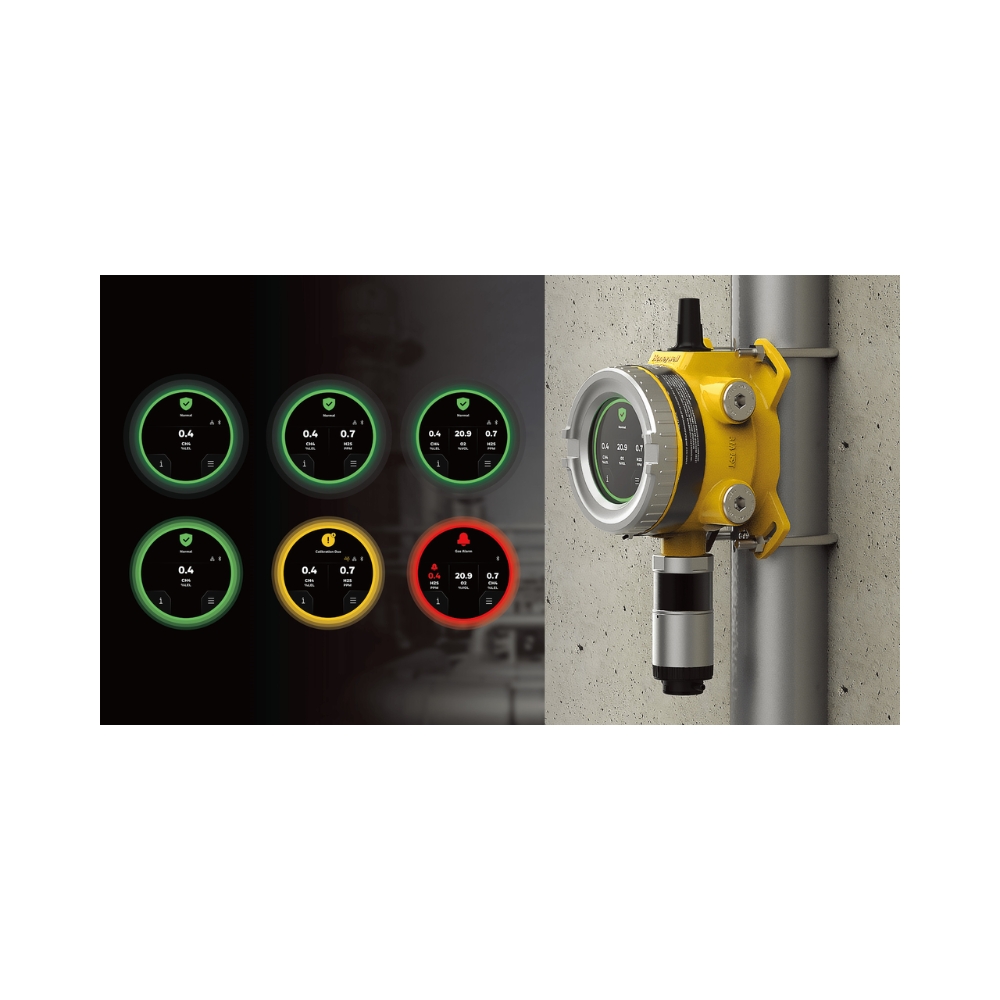
A three inch circular full colour TFT display sits behind four capacitive touch keys, with an LED ring around it that reads green for normal, red for alarm, yellow for fault or warning and blue when Bluetooth is connected.
Two practical consequences. The status is legible from a distance without walking up to the unit and squinting at a segment display. And configuration happens through touch keys rather than a magnetic wand, so nobody is hunting for the magnet at the top of a ladder.
Information is presented in plain language with instructions attached rather than as a fault code, so a technician who has not read the manual recently can still act on what the screen says.
Calibrate It From Your Phone
The optional Bluetooth module adds BLE 5.0 point to point connection to a phone or tablet up to 20 metres away, using the OmniPoint app.
Over that link you get gas readings with names and units, device information, remote zero and span calibration, configuration, and detailed transmitter data including instrument status, optical signal level, supply voltage, temperature, and fault and alarm history.
Remote calibration at 20 metres is the interesting part. A transmitter mounted high, in an awkward position, or inside a classified area can be calibrated without getting a body next to it.
Sensor Cartridges and Modules
The sensor design is modular in two layers. A sensor module houses the cell, and inside it sits a pre-calibrated replaceable cartridge.
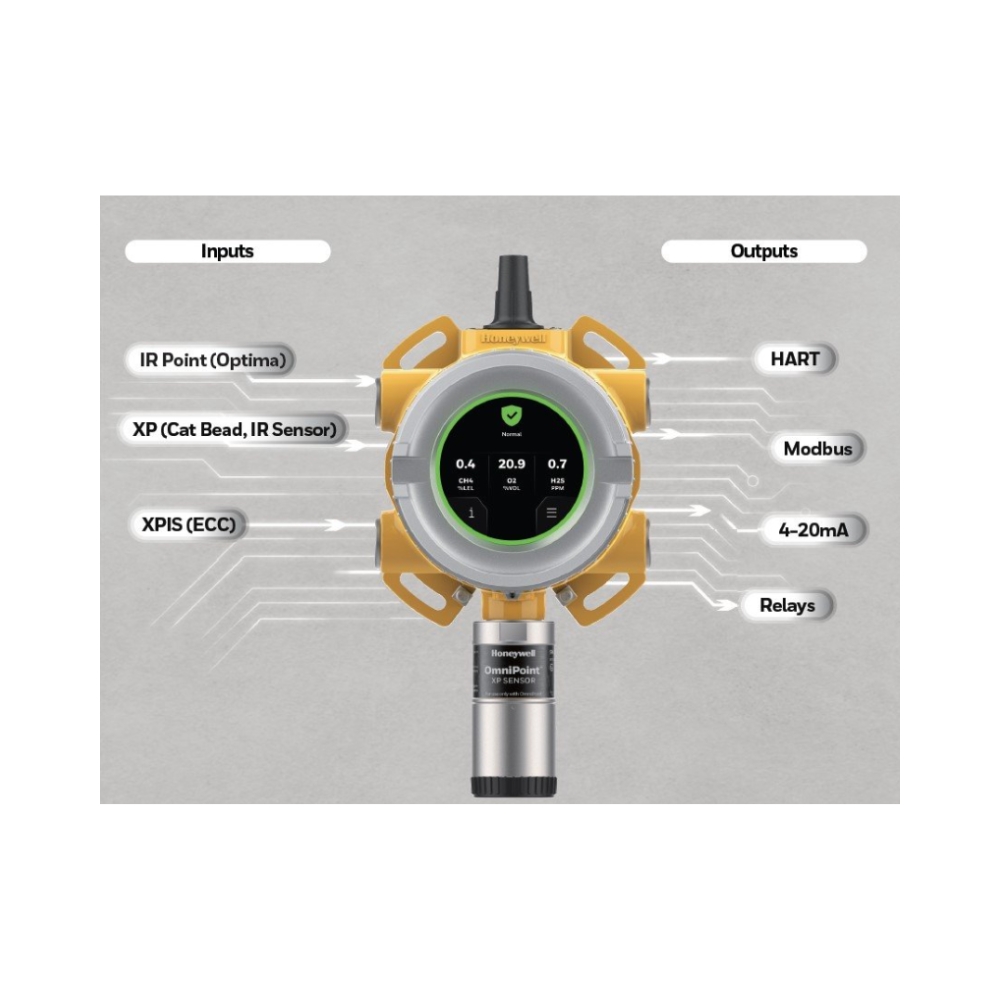
Two module types cover the range. XPIS modules take electrochemical cartridges for toxic gases and oxygen. XP modules take catalytic or infrared cartridges for flammable gases. Both connect back to the transmitter on two wires at distances up to 300 metres.
Because cartridges arrive pre-calibrated, replacing a sensor is a swap rather than a calibration exercise. That matters for a site with a large detector count, where sensor replacement is the bulk of the annual workload.
The universal electronics module accepts different sensor inputs, which simplifies both ordering and what you hold on the shelf.
It Also Drives a Searchpoint Optima Plus
The OmniPoint supports a Searchpoint Optima Plus open path infrared detector alongside its own sensor modules. Maximum draw for an Optima plus two catalytic XP sensors is 17 watts.
For a site already running Optima Plus units, that means the new transmitter platform does not orphan existing detection hardware.
Outputs and Integration
Three channels of 4 to 20 mA are fully configurable, supporting current sink, current source and isolated modes, and the transmitter detects automatically which mode it should run in. Signal accuracy is 1 percent of full scale.
Default current levels follow a clear scheme: 1 mA for fault, 2 mA during warm-up and inhibit, 3 mA for a warning, 4 to 20 mA for normal measurement and 21 mA for maximum over range. A control system reading that loop can tell the difference between a fault and a zero reading, which a plain 4 to 20 mA output cannot.
Relays come as standard rather than as an option. Three single pole double throw alarm relays are fully user configurable against alarm state, plus one single pole double throw fault relay which is normally energised, so a power loss registers as a fault. Contacts are rated 250 volts AC or 24 volts DC at 5 amps on resistive loads.
HART 7 runs over the first 4 to 20 mA channel in point to point or multi-drop mode, up to eight drops. An optional Modbus RTU module adds an isolated RS485 output at up to 57,600 baud, addressable 1 to 247 with up to 32 units per loop.
Built for Temperature and Salt
The operating range is minus 55 to plus 75 degrees Celsius at 0 to 99 percent humidity non-condensing. That is wider than almost anything else in the category and removes a specification problem across Australian sites, from an unshaded Pilbara skid to a cold store.
Housings are five-coat marine finish painted aluminium alloy, or 316 stainless steel where salt, washdown or chemically aggressive conditions call for it. Ingress protection is IP66 and IP67 to IEC and EN 60529, and NEMA 4X.
Four cable and conduit entries are built into the housing at M25 or three quarter inch NPT, with a separate top entry for the Bluetooth antenna. Mounting is to a flat wall or, with the optional kit, to pipework from 50 to 140 millimetres.
Coming From an XNX
The OmniPoint is Honeywell’s next generation platform and the successor to the XNX Universal Transmitter.
What you gain is multi-sensor capability on one head, a colour touch interface in place of the magnet driven menu, Bluetooth configuration and calibration, richer diagnostics, and relays as standard.
What carries across is the Honeywell sensor ecosystem, including Searchpoint Optima Plus support, and the same 4 to 20 mA, HART and Modbus integration paths your control system already speaks.
For a site running XNX now, a staged replacement is realistic. Where three XNX units sit at one location, one OmniPoint can replace all three, so the transmitter count comes down as the upgrade proceeds. Gastech can review an existing installation and work out what consolidates.
Where It Is Used
Oil and gas refineries and onshore terminals. LNG gas transmission. Chemical and petrochemical plant. Power generation. Hydrogen storage and production. Utilities and wastewater treatment. Mining and mineral processing. Landfill gas systems. Compressor stations. Marine and offshore installations. Cold stores and ammonia refrigeration plant.
Benefits
- Runs up to three sensors on one transmitter, so a single unit covers toxic, oxygen and flammable at one point
- Fewer transmitters means less cable, fewer entries and a smaller installed footprint
- Pre-calibrated replaceable sensor cartridges swap out without a bench calibration
- Colour touch display and LED status ring read clearly across a plant, with no magnet needed
- Optional Bluetooth allows remote zero and span calibration from a phone up to 20 metres away
- Operates from minus 55 to plus 75 degrees Celsius, beyond what most transmitters manage
- Three configurable alarm relays plus a normally energised fault relay come as standard
- Automatically detects current sink or source mode, removing a common commissioning error
- Five year transmitter warranty, with three years on most sensor cartridges
- Drives a Searchpoint Optima Plus as well as its own sensor modules
Sensors supported
Up to three simultaneously
Display
3 inch circular high resolution full colour TFT, five digit alphanumeric with separate units
Interface
Four capacitive touch keys. No magnet required
Status indicator
LED ring around the display. Green normal, red alarm, yellow fault or warning, blue Bluetooth
Current output
Three channels of fully configurable 4 to 20 mA, with current sink, current source and isolated modes. Mode detected automatically
Current output accuracy
Plus or minus 1% of full scale
Default current levels
1 mA fault, 2 mA warm-up and inhibit, 3 mA warning, 4 to 20 mA normal, 21 mA maximum over range
Relays
Three configurable single pole double throw alarm relays, plus one single pole double throw fault relay, normally energised
Relay rating
250 V AC or 24 V DC at 5 A, resistive loads only
HART
HART 7 over the first 4 to 20 mA channel. Point to point or multi-drop, up to 8 drops
Modbus, optional
Isolated RS485, 2,400 to 57,600 baud, 9,600 default. Address 1 to 247, up to 32 units per loop
Bluetooth, optional
BLE 5.0 point to point, up to 20 metres, with remote zero and span calibration through the OmniPoint app
Input voltage
12 to 32 V DC for catalytic, infrared and electrochemical sensors. 18 to 32 V DC with Optima
Power consumption
Transmitter 4.5 W normal, 8.5 W maximum. Electrochemical sensor 0.3 W maximum. Catalytic or infrared sensor 1.7 W maximum. 17 W maximum with Optima and two catalytic sensors
Sensor wiring
Two wire, up to 300 metres for either module type
Enclosure material
Five-coat marine finish painted aluminium alloy, or 316 stainless steel
Weight, enclosure only
2.45 kg aluminium, 5.37 kg stainless
Weight, with display module
2.92 kg aluminium, 5.84 kg stainless
Weight, sensor module with cartridge
0.80 kg electrochemical, 0.69 kg catalytic or infrared
Cable entries
Four conduit or cable entries at M25 or three quarter inch NPT, plus one top M22 entry for the Bluetooth antenna
Mounting
Flat wall, or pipework 50 to 140 mm with the optional pipe mount kit
Ingress protection
IP66 and IP67 to IEC and EN 60529. NEMA 4X
Operating temperature
Minus 55°C to plus 75°C
Operating humidity
0 to 99% RH, non-condensing
Operating pressure
90 kPa to 110 kPa
Storage conditions
Minus 55°C to plus 75°C, 0 to 99% RH non-condensing
Hazardous area approvals
UL and cUL classified to UL 1203, UL 913, UL 61010-1 and the corresponding CSA standards. Class I Division 1 Groups A, B, C and D. Class II Division 1 Groups F and G
Warranty, transmitter
5 years
Propane
C3H8
Chlorine
Cl2
Ammonia
NH3
Sulphur Dioxide
SO2
- Aviation & Transportation
- Chemical Manufacturing
- Confined Space & Compliance
- Energy (Oil & Gas)
- Food & Beverage
- Landfill & Remediation
- Marine & Maritime
- Mining & Minerals
- Power Generation & BESS
- Technology & Semiconductor
- Water & Wastewater
Up to three simultaneously, across toxic, oxygen and flammable gases, each on its own configurable 4 to 20 mA channel.
Yes, through the touch key interface or over Bluetooth from a phone up to 20 metres away, including remote zero and span.
No, three configurable alarm relays and a normally energised fault relay are standard.
OmniPoint is the next generation platform, adding three sensor support on one head, a colour touch display, Bluetooth configuration and richer diagnostics.
No, cartridges arrive pre-calibrated, so a sensor change is a swap rather than a bench calibration.
Yes, the transmitter supports an Optima Plus alongside its own sensor modules, drawing up to 17 watts with two catalytic sensors as well.
Trusted by









Contact Us
Can’t find what you’re looking for? Our team is happy to help.