
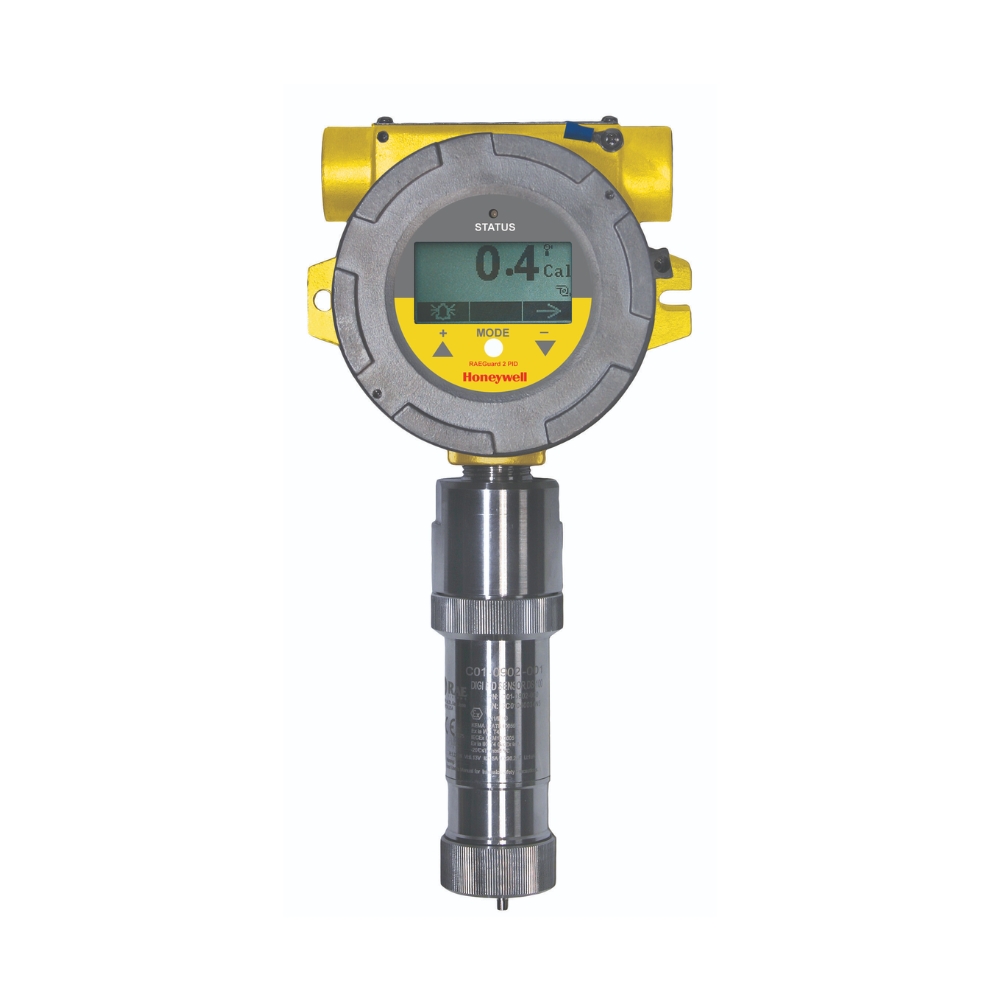
RAEGuard 2 PID
Fixed VOC Detector
The RAEGuard 2 PID continuously monitors volatile organic compounds in Zone 1 hazardous areas. A magnetic key adjusts parameters and runs calibration through the housing, with the explosion proof enclosure in place, and the DigiPID sensor module is designed to be easily removed for calibration or maintenance. Over 200 correction factors are pre-programmed, so the display can read your target compound rather than isobutylene.
KEY BENEFITS
- Magnetic key calibrates and adjusts settings without opening the explosion-proof housing
- DigiPID sensor module is easily removed for calibration or maintenance
- Over 200 correction factors pre-programmed, reading the actual target compound
- Patented pump duty cycling helps keep the PID sensor clean between services
- Three ranges from 0.01 to 100 ppm through to 1 to 1,000 ppm isobutylene equivalent
+ more in the Description tab below
Maintenance With the Enclosure in Place
This is the main argument for this detector, and it’s worth understanding what it saves.
An explosion proof enclosure in a Zone 1 area is only explosion proof while it’s closed. Opening one to adjust a setting or calibrate a sensor means a hot work permit, a gas clearance and a procedure, or shutting the area down. On a plant with a dozen detectors, that administrative load is the real cost of fixed VOC monitoring.
The RAEGuard 2 PID reduces it. A three key magnetic bar works through the housing, so calibration and parameter adjustment both happen with the explosion proof enclosure in place.
The DigiPID sensor module is designed to be easily removed for calibration or maintenance, so lamp cleaning, sensor replacement and bench calibration don’t mean working on the detector in place. Follow Honeywell’s procedure for removing the module in your area classification.
Reading Your Compound, Not Isobutylene
A photoionisation detector responds to any compound whose ionisation potential sits below the lamp energy, which covers several hundred substances. It’s calibrated against isobutylene and reports in isobutylene equivalent units, so a raw PID reading isn’t the concentration of the compound you’re actually measuring.
A correction factor converts one to the other, and the RAEGuard 2 PID holds more than 200 of them pre-programmed. Select the target compound, and the display reads that compound directly.
That matters more on a fixed installation than on a portable. Nobody is standing beside the detector with a correction factor table, so the number on the display, and the number the relays trip against, needs to be the real one.
Detected compounds include benzene, toluene, xylene, acetone, methyl ethyl ketone, vinyl chloride, phenol, dimethyl ether, ammonia and a broad range of solvents.
Keeping the Sensor Clean and the Reading Honest
This is a difference between fixed and portable PIDs that’s rarely explained.
A portable PID is zeroed in clean air before each use, so drift is corrected daily by the operator. A fixed PID can’t be. It sits in a classified area for months at a time, and anything that builds up on the lamp or sensor shows up as a shift in each reading and each alarm decision.
The RAEGuard 2 PID uses RAE Systems’ patented pump duty cycling, which helps keep the PID sensor clean. The pump cycles on and off within a 10 second period, and a lower duty cycle has a greater cleaning effect. Its digital smart sensor technology also supports environmental self adaptation.
Honeywell rates zero and span drift at ±10% of full scale per month, so periodic calibration is still part of the job. The magnetic key interface is what makes that calibration quick, with two point calibration as standard and three point calibration optional.
Three Ranges, and One Important Caveat
| Range, isobutylene equivalent | Suits |
|---|---|
| 0.01 to 100 ppm | Low level and exposure related monitoring |
| 0.1 to 1,000 ppm | General industrial VOC monitoring |
| 1 to 1,000 ppm | Higher concentration monitoring. See caveat below |
The caveat matters, and it’s easy to miss. On the 1 to 1,000 ppm range, correction factors and relays aren’t available. So that version reads in isobutylene equivalent only, and can’t drive an external alarm or a process action.
If the installation needs a relay output, or needs to read a specific compound, choose one of the other two ranges. Check this before ordering, rather than discovering it at commissioning.
Outputs and Integration
Three output paths run together.
An analogue 4 to 20 mA three wire output, for a conventional controller. RS-485 Modbus, for digital integration. And dry contact relays rated 30 V at 2 A, normally open or normally closed, one for high and low alarm, and another for fault.
The relays are what let the detector act rather than just report, triggering building alarms, ventilation or a process response directly.
Supply is 10 to 28 V DC, at under 5 W.
At the detector, there’s a 128 x 64 backlit graphic display, an LED status indicator for alarm and fault, and a local audible alarm. So anyone standing in front of it knows its state without going to a panel.
Diffusion or Pumped
The RAEGuard 2 PID can operate in diffusion or flow through mode, and the choice follows the installation.
In diffusion mode, the detector waits for gas to reach it, which suits general area monitoring where the release point isn’t known.
With the internal diaphragm pump, drawing up to 500 cc per minute, it samples continuously, which suits a specific point, a duct, an enclosure, or a location the gas won’t reach by itself.
Where It’s Used
Refineries and petrochemical plants. Power plants. Solvent recovery systems. Painting and coating operations. Wastewater treatment plants. Chemical manufacturing and storage. Tank farms and loading facilities. Benzene monitoring in classified areas. Any Zone 1 location where volatile organic compounds need continuous monitoring, rather than periodic survey.
Benefits
- Magnetic key calibrates and adjusts settings without opening the explosion-proof housing
- DigiPID sensor module is easily removed for calibration or maintenance
- Over 200 correction factors pre-programmed, reading the actual target compound
- Patented pump duty cycling helps keep the PID sensor clean between services
- Three ranges from 0.01 to 100 ppm through to 1 to 1,000 ppm isobutylene equivalent
- 316 stainless steel explosion proof enclosure, rated IP65 for outdoor hazardous areas
- Three dry contact relays for high, low and fault, normally open or normally closed
- Analogue 4 to 20 mA and RS-485 Modbus outputs together
- Diffusion or pumped versions available
- Graphic display with LED status indication and local audible alarm at the detector
Product type
Fixed photoionisation detector for volatile organic compounds
Detection ranges
0.01 to 100 ppm, 0.1 to 1,000 ppm, or 1 to 1,000 ppm isobutylene equivalent
Correction factors
More than 200 pre-programmed. Not available on the 1 to 1,000 ppm range
Sampling
Diffusion or flow through. Internal diaphragm pump, up to 500 cc/min
Sensor module
DigiPID, removable for calibration or maintenance. Follow Honeywell's procedure for your area classification
PID cleaning
RAE Systems patented pump duty cycling
Enclosure
316 stainless steel, explosion proof, IP65, suitable for outdoor hazardous environments
Field adjustment
Three key magnetic bar, with the enclosure in place
Display
128 x 64 backlit matrix LCD, graphic display, with LED status indication
Local alarm
Audible at the detector
Supply voltage
10 to 28 V DC, 210 mA at 24 V, under 5 W
Analogue output
4 to 20 mA, three wire
Digital output
RS-485, Modbus protocol
Relays
Dry contacts, 30 V at 2 A, normally open or normally closed. One for high and low alarm, one for fault. Not available on the 1 to 1,000 ppm range
Resolution
10 ppb or 1 ppm, depending on range
Response time
T90 under 30 seconds
Accuracy
±2% at the calibration point
Calibration
Two point, off line and field. Three point optional
Drift
Zero and span ±10% full scale per month
Operating conditions
-20 to +55°C. 0 to 95% RH, non condensing. 90 to 110 kPa
Size and weight
257 x 201 x 107 mm. 3.5 kg
Mounting
2 inch pipe or wall mounting. 3/4 inch NPT male
Sensor life
2 years
DigiPID module certification
ATEX II 1G Ex ia IIC T4 and I M1 Ex ia I. IECEx Ex ia IIC T4 Ga and Ex ia I. UL and CSA Class I, Division 1, Groups A, B, C and D, T4
ATEX
Ex II 2(1)G, Ex d [ia Ga] IIC T4 Gb
IECEx
Ex d [ia Ga] IIC T4 Gb
UL and CSA
Class I, Division 1, Groups A, B, C and D, T4
Warranty
Detector head: 2 years housing and electronics, 1 year pump. DigiPID module: 2 years lamp, 1 year sensor, pump, electronics and housing
Acetone
C3H6O
Benzene
C6H6
Toluene (Methylbenzene)
C7H8
Xylene
C8H10
Ammonia
NH3
- Chemical Manufacturing
- Energy (Oil & Gas)
- Power Generation & BESS
- Water & Wastewater
Yes. A three key magnetic bar works through the housing for calibration and parameter adjustment, with the explosion proof enclosure in place.
A photoionisation detector reads in isobutylene equivalent units. A correction factor converts that to the concentration of your actual compound, and more than 200 are pre-programmed so the display reads the target gas directly.
It depends on the concentration expected. Note that the 1 to 1,000 ppm range has no correction factors and no relays, so if you need either, choose one of the other two.
RAE Systems' patented pump duty cycling helps keep the PID sensor clean. Honeywell rates drift at ±10% of full scale per month, so periodic calibration is still needed, and the magnetic key makes that quick.
Zone 1 under ATEX and IECEx as Ex d [ia Ga] IIC T4 Gb, and Class I Division 1 Groups A, B, C and D under UL and CSA.
It can run in diffusion or flow through mode. Diffusion suits general area monitoring where the release point is unknown. The internal pump, drawing up to 500 cc per minute, suits a specific point, or a location the gas won't reach by itself.
Trusted by









Contact Us
Can’t find what you’re looking for? Our team is happy to help.