
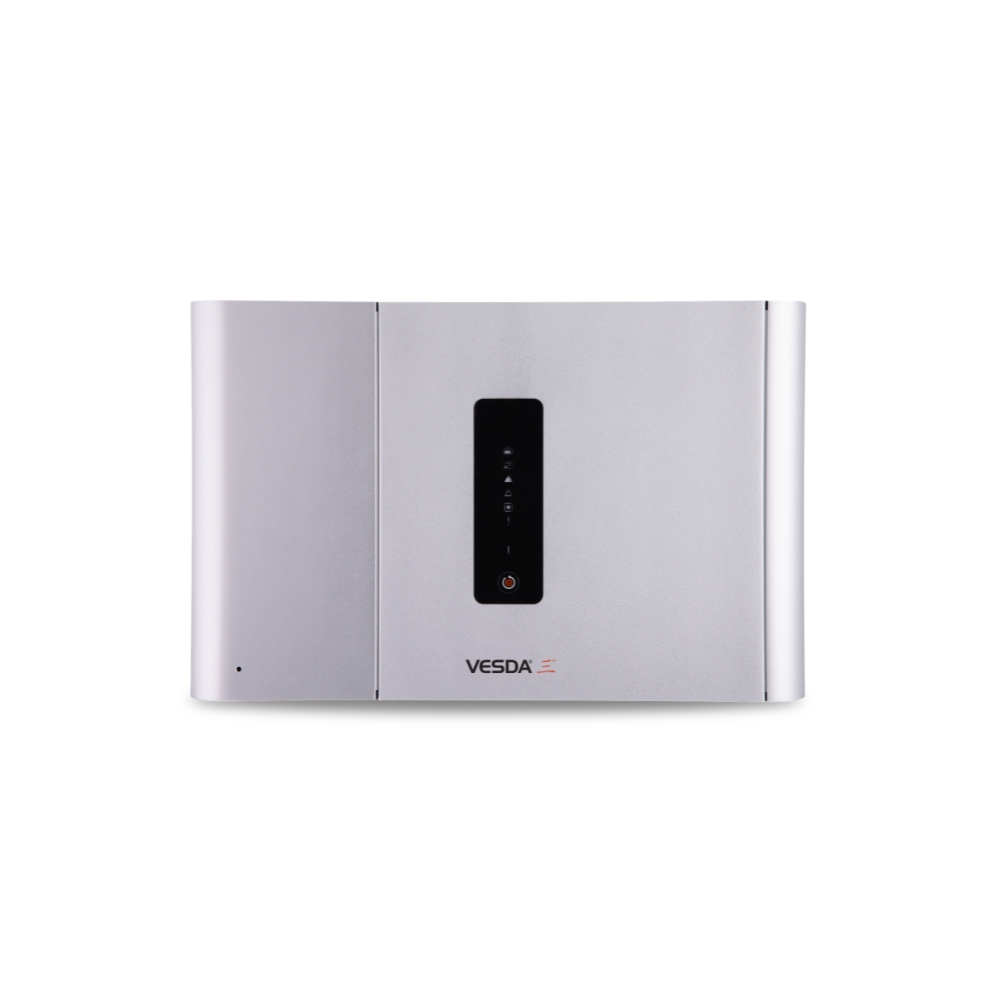
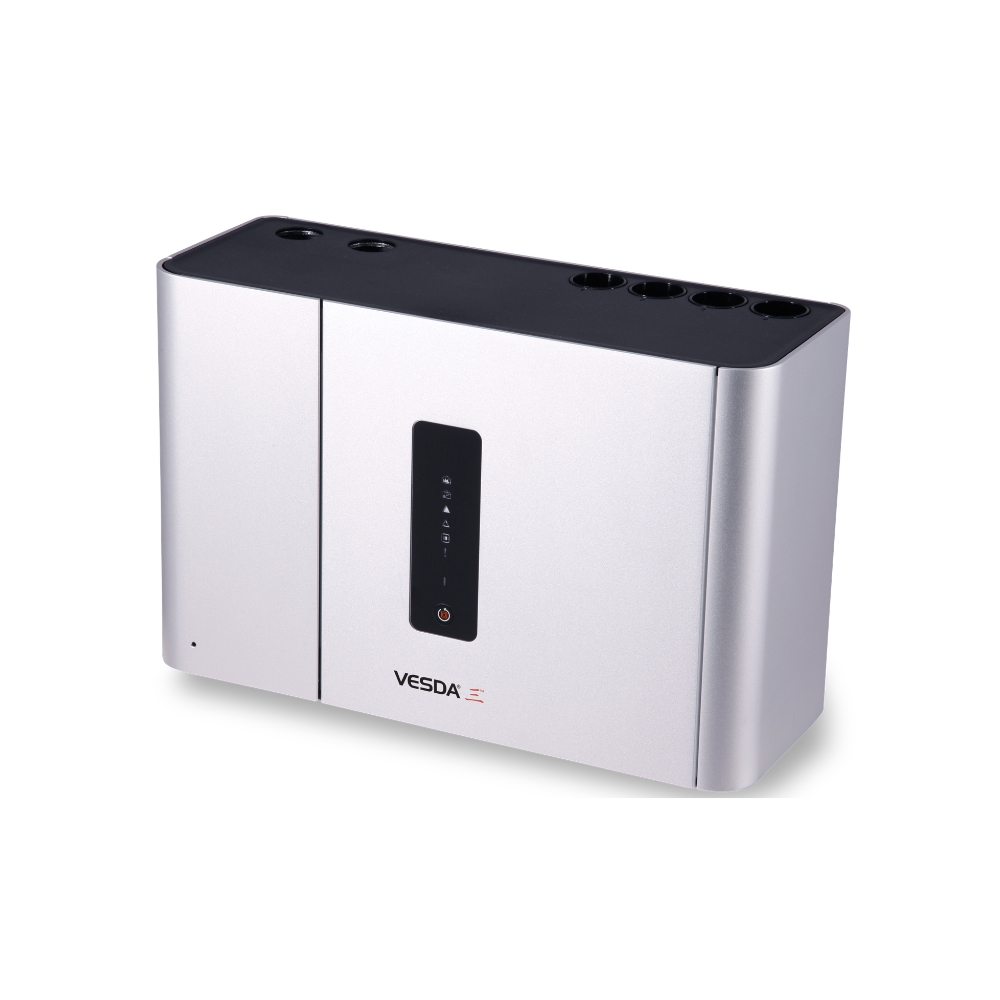
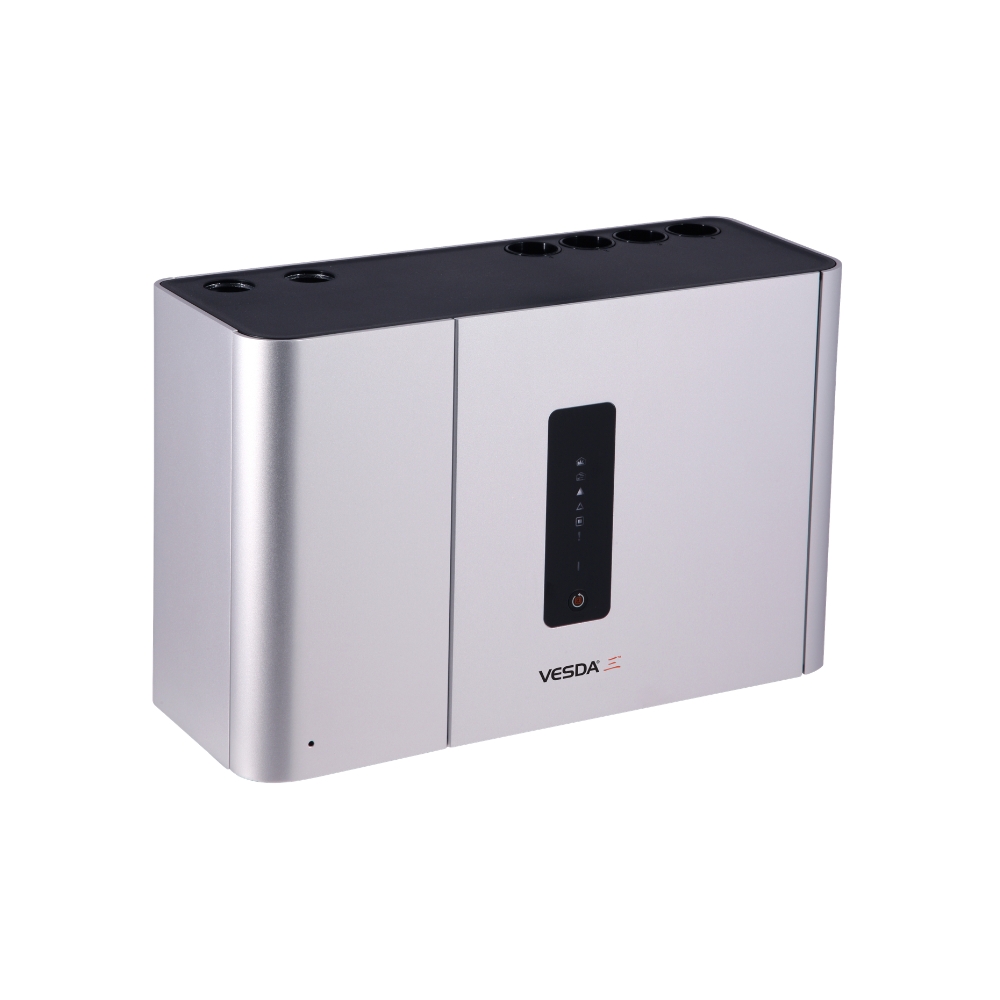
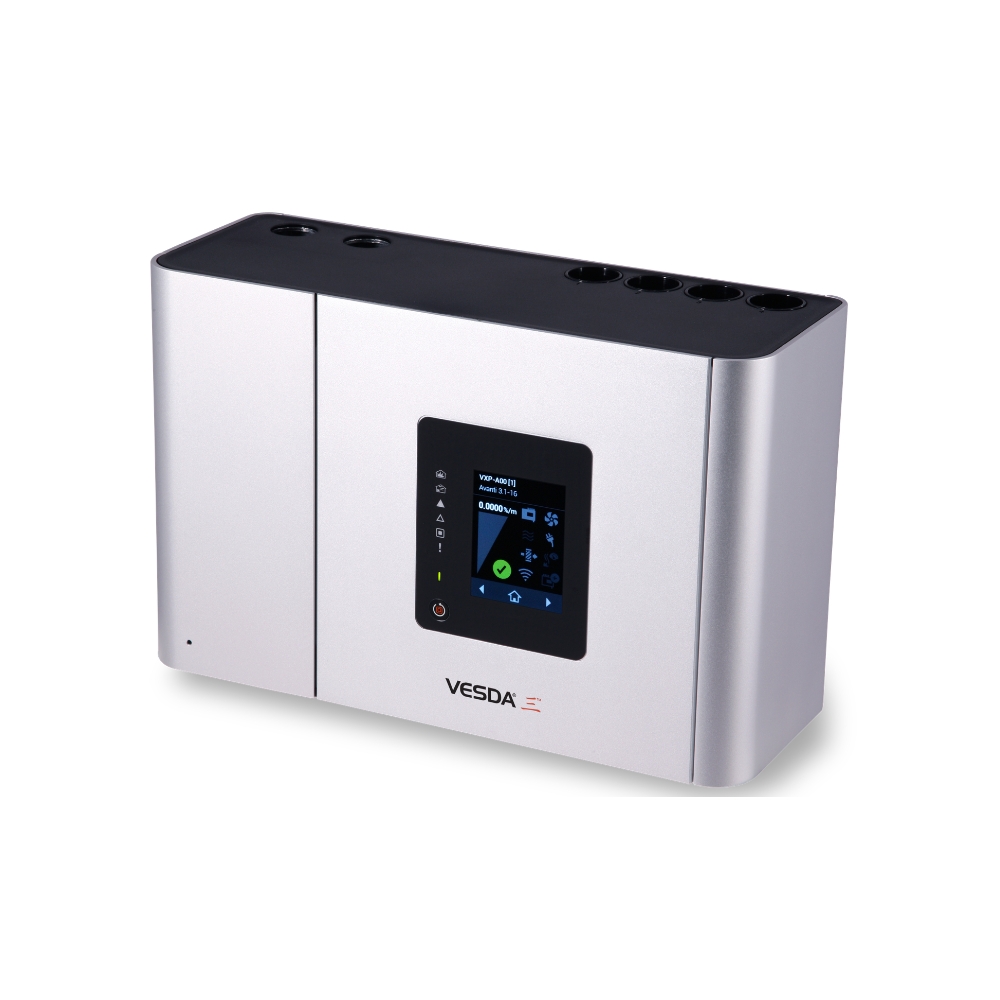
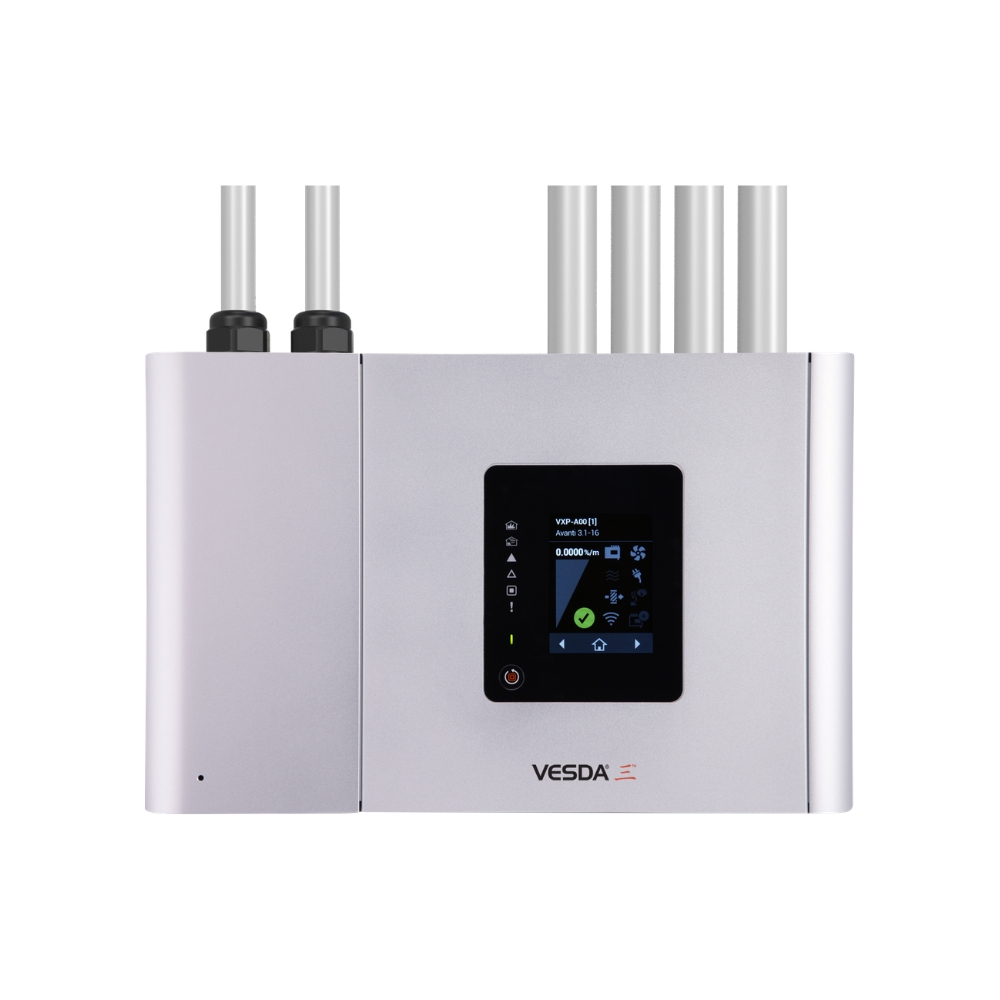
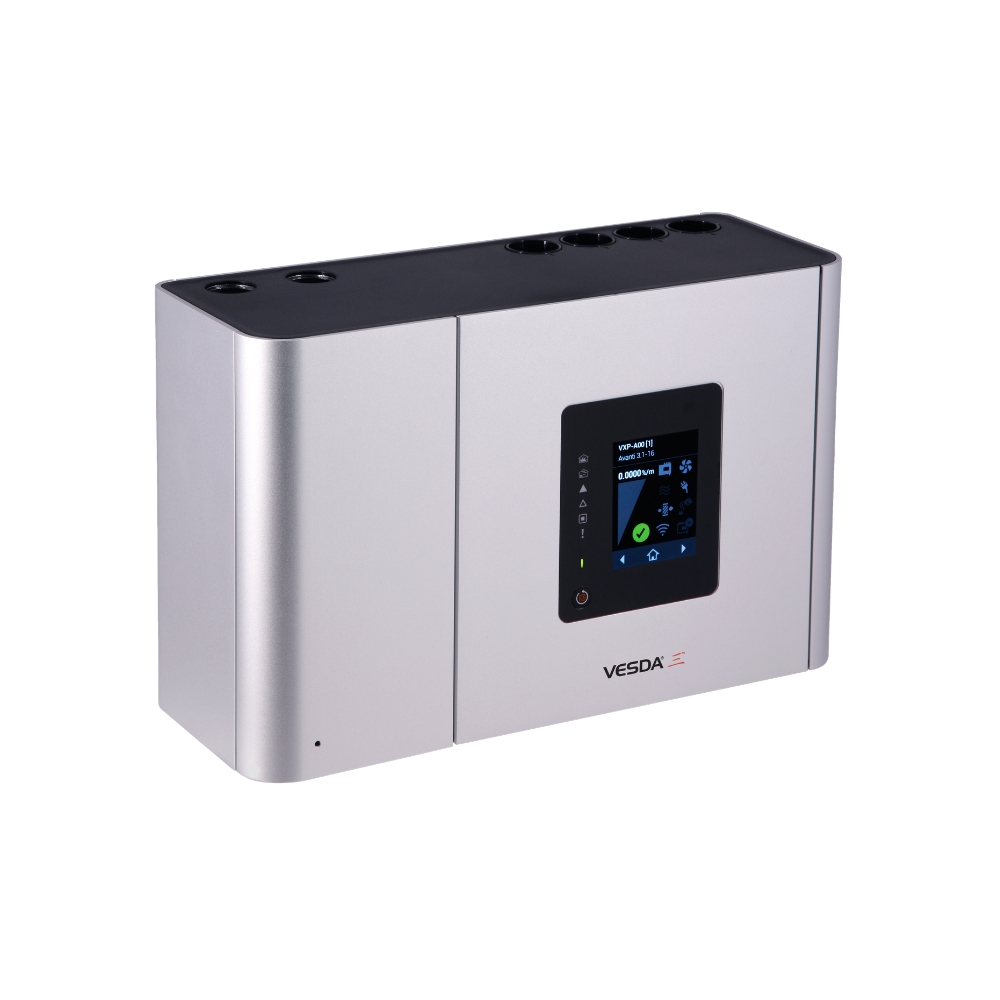
VESDA-E VEU
Aspirating Smoke Detector
The VESDA-E VEU is the premium detector in the VESDA-E range. Its sensitivity range runs from 0.001% to 20% obscuration per metre, fifteen times wider than the VESDA VLP it replaces, and it supports up to 800 metres of pipe network, covering as much as 6,500 square metres from a single detector. Flair detection technology images the sampled particles directly, which allows very early warning with fewer nuisance alarms.
KEY BENEFITS
- Sensitivity range fifteen times wider than the VESDA VLP, from 0.001% to 20% obscuration per metre
- Up to 800 metres of branched pipe network from one detector, covering up to 6,500 square metres
- Increases coverage in high airflow applications by at least 40 percent, and by up to 80 percent in high ceilings
- Flair detection chamber images particles directly using a CMOS imager and multiple photodiodes
- Four alarm levels, so the response can escalate rather than being a single threshold
+ more in the Description tab below
What Makes It the Premium Detector
Two things, and they work together.
The sensitivity range runs from 0.001% to 20% obscuration per metre, fifteen times wider than the VESDA VLP. That matters at both ends. At the sensitive end, it detects early smoke long before there’s a flame, which is the point of aspirating detection. At the other end, it keeps measuring through heavy smoke rather than saturating, so the system still gives useful information during a developing fire.
The other is capacity. A powerful aspirator supports a total pipe length of up to 800 metres with branches, giving area coverage of up to 6,500 square metres from a single detector. Provision for more sampling holes increases coverage in high airflow applications by at least 40%, and the longer pipe runs increase coverage in high ceiling applications by up to 80%.
The practical result is fewer detectors covering a given building, and detectors mounted where they can be reached, rather than where the pipe run ran out.
Flair, and Why Nuisance Alarms Matter More Than Sensitivity
A very sensitive detector that cries wolf gets its thresholds raised until it’s no longer very sensitive. That’s how aspirating systems get quietly degraded after commissioning.
Flair is the detection chamber at the core of the VEU, and it takes a different approach. Rather than just measuring scattered light, it images the sampled particles directly, using a CMOS imager combined with multiple photodiodes. That gives better detection and fewer nuisance alarms, with higher stability and a longer working life.
Alongside it, multi stage filtration and clean air barriers protect the optics across the detector’s life, so performance doesn’t drift as the chamber ages. Referencing takes account of external environmental conditions, which covers the case where the outside air itself is the source of a nuisance alarm.
Four Alarm Levels
Most detection is a single threshold. The VEU provides four alarm levels: Alert, Action, Fire 1 and Fire 2.
That allows a graduated response rather than a yes or no. An Alert can notify a facilities team to investigate. An Action can start ventilation or shut down equipment. Fire 1 and Fire 2 escalate to evacuation and suppression. In a data centre or a switchroom, acting on a developing problem before it becomes an evacuation is the whole value of very early warning.
Seven programmable relays, each latching or non latching, let each level drive the right action.
Maintenance That’s Predictable
The smart onboard filter keeps track of its dust count and remaining filter life, so the detector tells you when it needs a new filter, rather than waiting for a flow fault.
That changes filter replacement from a calendar task to a condition based one. On a clean site, the filter lasts longer than the schedule assumes, and money is wasted replacing it early. On a dusty site, it doesn’t last as long as the schedule assumes, which is worse. Knowing the actual remaining life takes the guesswork out of both.
An event log holding 20,000 events supports analysis after an incident, and diagnosis of a recurring nuisance alarm, which is usually the harder problem.
Commissioning and Connectivity
AutoConfig handles airflow normalisation, and AutoLearn Smoke and Flow can be started from within the detector, so out of box operation is possible without a laptop.
For designed systems, ASPIRE models the pipe network, and Xtralis VSC handles configuration, commissioning and maintenance. Ethernet, USB and VESDAnet are standard, and WiFi allows a tablet or laptop running the configuration software to connect wirelessly through the network. Remote monitoring is available through iVESDA, for system review and proactive maintenance.
VESDAnet provides two way communication with redundancy, so the network keeps working through a single point wiring failure, rather than losing a segment.
Replacing a VLP
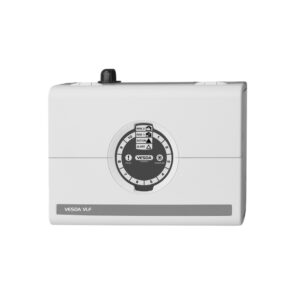
The VEU is fully backward compatible with existing VESDA installations. It uses the same mounting footprint and the same pipe, conduit and electrical connector positions as the VESDA VLP, and it works on existing VESDAnet installations alongside older detectors.
For a building with an ageing VESDA system, that means detectors can be replaced progressively rather than as one big project, using the pipe network already installed.
Where It’s Used
Data centres and server rooms. Warehouses and distribution centres with high ceilings. Cold stores. Switchrooms and electrical infrastructure. Battery and UPS rooms. Heritage buildings where visible detection is unacceptable. Clean rooms and laboratories. Telecommunications facilities. Archives, museums and high value storage. Atriums and large volume spaces where smoke stratifies before reaching the ceiling.
Benefits
- Sensitivity range fifteen times wider than the VESDA VLP, from 0.001% to 20% obscuration per metre
- Up to 800 metres of branched pipe network from one detector, covering up to 6,500 square metres
- Increases coverage in high airflow applications by at least 40 percent, and by up to 80 percent in high ceilings
- Flair detection chamber images particles directly using a CMOS imager and multiple photodiodes
- Four alarm levels, so the response can escalate rather than being a single threshold
- Smart onboard filter tracks dust count and remaining filter life, making maintenance predictable
- AutoLearn smoke and flow for rapid commissioning without manual threshold setting
- Event log holding 20,000 events for analysis and diagnostics
- 7 programmable relays, plus Ethernet, USB and VESDAnet as standard, with WiFi for wireless configuration
- Fully backward compatible with VESDA VLP, using the same mounting footprint and connections
Detector type
Aspirating smoke detector, premium detector of the VESDA-E range
Detection technology
Flair detection chamber, direct particle imaging using a CMOS imager and multiple photodiodes
Sensitivity range
0.001% to 20% obscuration per metre
Sensitivity comparison
Fifteen times wider than VESDA VLP
Alarm levels
Four
Total pipe length, branched
Up to 800 m total, with branches
Area coverage
Up to 6,500 m²
Coverage increase, high airflow
At least 40% over previous generation
Coverage increase, high ceilings
Up to 80% over previous generation
Pipe network
Up to four pipes
Filtration
Multi stage, with clean air barriers protecting the optics
Filter monitoring
Smart onboard filter retaining dust count and remaining filter life
Event log
20,000 events
Commissioning
AutoConfig airflow normalisation, AutoLearn smoke and flow
Connectivity
Ethernet, USB and VESDAnet standard, WiFi for wireless configuration
Remote monitoring
iVESDA
Software support
ASPIRE for pipe network design, Xtralis VSC for configuration and maintenance
Display options
VEU-A00: LED indication. VEU-A10: 3.5 inch display
Ingress protection
IP40
Backward compatibility
Same mounting footprint, pipe, conduit and connector positions as VESDA VLP
EN 54-20 classification
Determined by the pipe design and hole count, calculated in ASPIRE
Threshold ranges
Alert, Action and Fire 1: 0.001% to 2.0% obs/m. Fire 2: 0.001% to 20% obs/m
Measurement range
0% to 32% obs/m
Relays
7 programmable relays, latching or non latching. Contacts rated 2 A at 30 VDC (resistive)
Supply voltage
18 to 30 VDC (24 V nominal)
Power consumption at 24 VDC
About 7 W to 16 W, depending on model and aspirator setting
Dimensions and weight
350 x 225 x 135 mm. About 4.9 kg
Operating conditions
Ambient 0°C to 39°C. Sampled air -20°C to 60°C. Humidity 5% to 95% RH, non condensing
Minimum airflow per pipe
15 L/min
Cable access
4 x 26 mm cable entries. Screw terminals 0.2 to 2.5 mm²
- Aviation & Transportation
- Carpark & HVAC
- Chemical Manufacturing
- Energy (Oil & Gas)
- Food & Beverage
- Landfill & Remediation
- Medical & Healthcare
- Mining & Minerals
- Power Generation & BESS
- Technology & Semiconductor
- Water & Wastewater
A point detector waits for smoke to reach it. An aspirating detector continuously draws air from a pipe network back to a central detection chamber, so it detects at concentrations far below what a point detector responds to.
Up to 6,500 square metres, using up to 800 metres of branched pipe network.
The detection chamber at the core of the VEU. It images the sampled particles directly rather than only measuring scattered light, which allows it to distinguish smoke from dust, steam and exhaust.
Yes. It uses the same mounting footprint and the same pipe, conduit and electrical connector positions, and it works on existing VESDAnet installations alongside legacy detectors.
That depends on the pipe design and the number of sampling holes rather than on the detector alone, and it is calculated in ASPIRE during design.
So the response can escalate. An early level can trigger investigation or ventilation, with evacuation and suppression reserved for the higher levels. A single threshold does not allow that.
Trusted by









Contact Us
Can’t find what you’re looking for? Our team is happy to help.