
VESDA VLF
Aspirating Smoke Detector
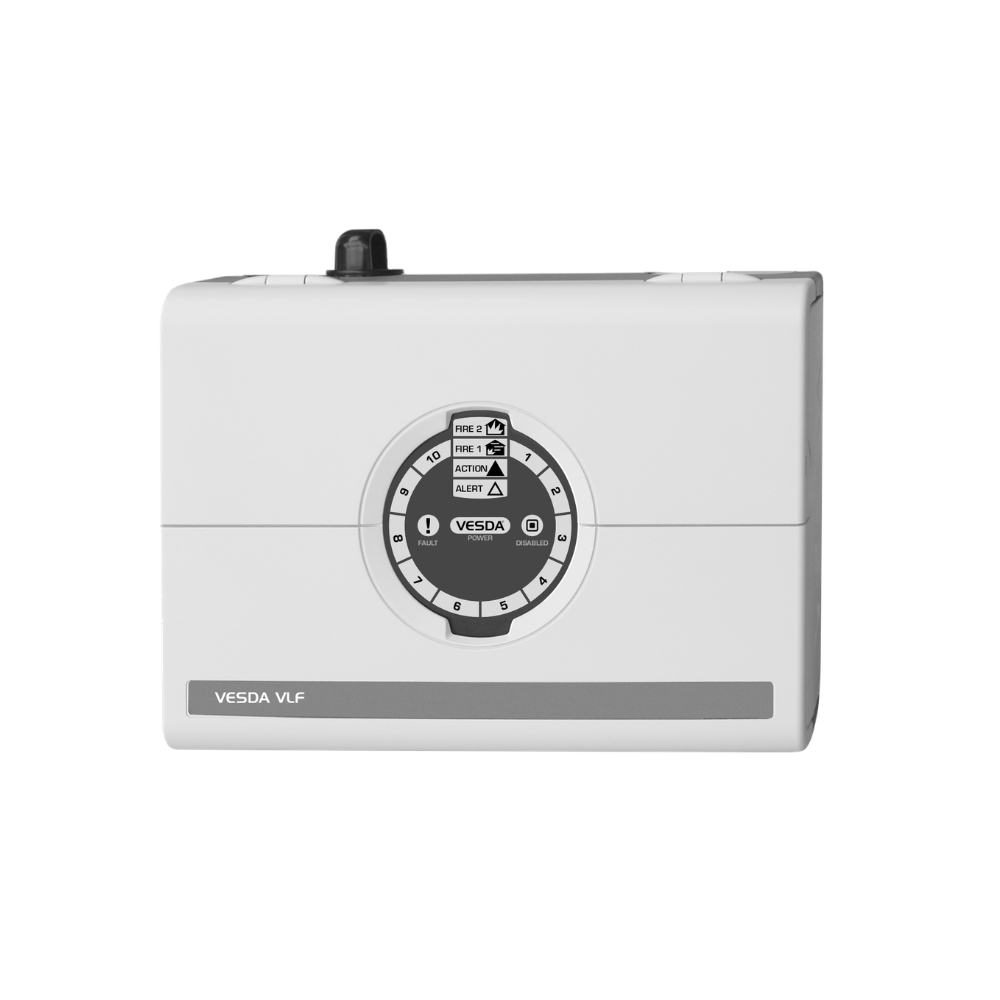
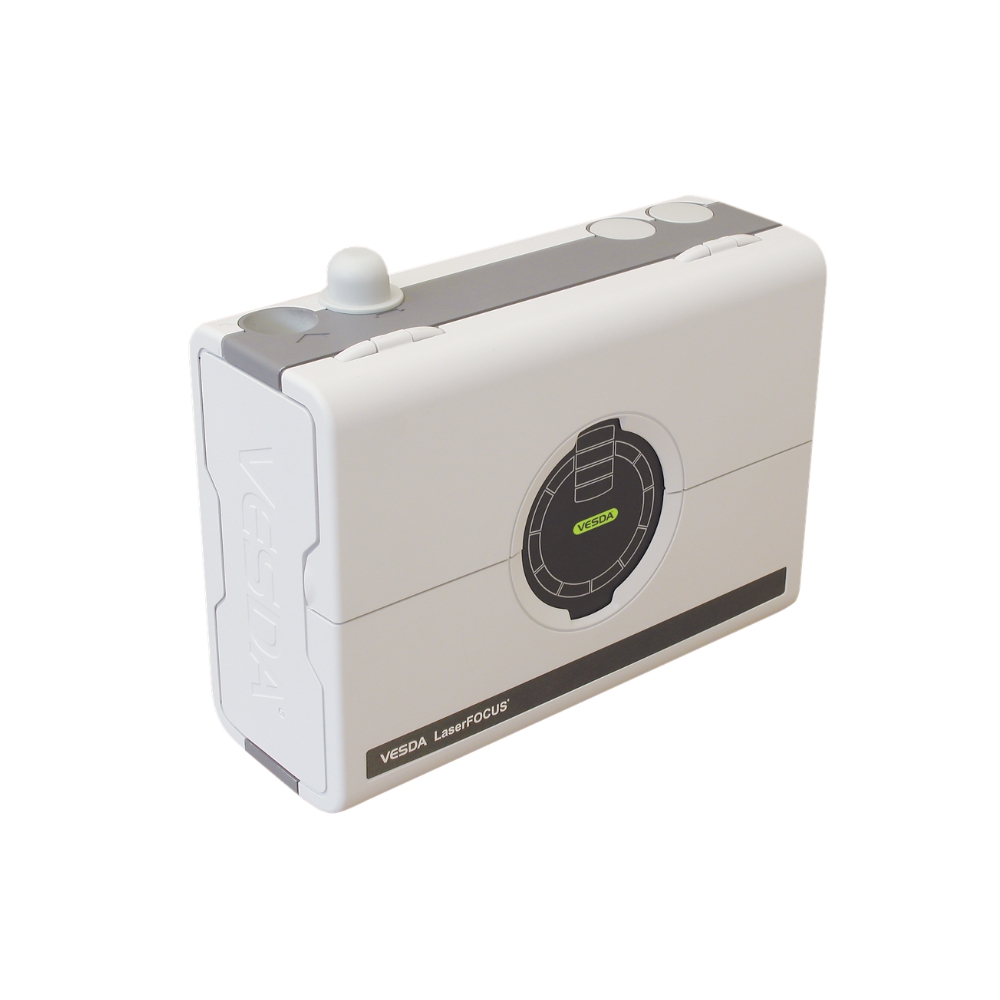
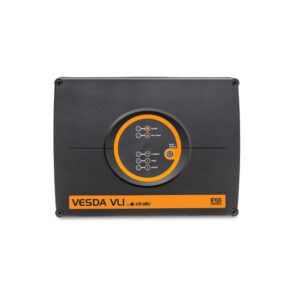
The VESDA VLF, also known as LaserFOCUS, brings aspirating smoke detection to small business critical spaces that would previously have been left with conventional detection. It installs and commissions out of the box with no programming tools, and the Smoke Dial display shows what the detector is seeing from across a room. The VLF-250 covers up to 250 square metres and the VLF-500 up to 500.
KEY BENEFITS
- Installs and commissions out of the box, with no interface or programming tools required
- Smoke Dial display shows the smoke level at a glance, readable from a distance
- Instant Fault Finder identifies the specific fault condition behind a fault indication
- Patented ultrasonic flow sensing, immune to temperature and pressure changes and unaffected by contamination
- Sensitivity range of 0.025 to 20 percent obscuration per metre
+ more in the Description tab below
Aspirating Detection for Small Spaces
Aspirating smoke detection has historically been specified for large or high value spaces, because the cost and design effort only made sense at scale. That left many small rooms that genuinely needed very early warning protected by a conventional detector on the ceiling.
The VLF exists for those rooms: a comms room, a small server room, a switchboard cupboard, a plant room, an archive store, a lift motor room. Each one is small, and in most cases it’s the room a business can’t afford to lose.
The detection principle is the same. Air is drawn continuously through sampling holes in a pipe network, filtered, and passed into a chamber where laser based light scattering detects very small amounts of smoke. A clean air barrier protects the optics. What changes is the scale, and with it the cost and the complexity.
Out of the Box
This is the practical difference between the VLF and the rest of the range.
The VLF can be installed and commissioned out of the box, without a special interface or software programming tools. Thresholds arrive pre set, and AutoLearn doesn’t change them while it’s learning, so protection is continuous from the moment it’s powered up. Pre engineered pipe network designs keep simple installations simple.
For a single small room, that removes much of the specialist commissioning effort. For advanced configuration, the VLF is still supported by VSC and ASPIRE, and it can be configured offline or online, so the capability is there when a project needs it.
The Smoke Dial
The display is a ring of LEDs that shows the smoke level, rather than a numeric readout.
That sounds cosmetic, but it isn’t. Someone walking past a comms room can see at a glance whether the detector is reading nothing, reading something, or approaching alarm. A numeric display needs someone to stop, read it and know what the number means. On equipment that’s checked in passing rather than watched continuously, a visual indication that works from a distance gets noticed.
Alongside it, the Instant Fault Finder is opened through the field service door. It turns the Smoke Dial into a fault indicator that identifies the specific fault condition, such as filter, aspirator, high or low flow, or field wiring. That information can be passed to the fire service company, so technicians arrive fully prepared, turning a fault call into a fix rather than a diagnosis followed by a second visit.
Ultrasonic Flow Sensing
The VLF was the first air sampling smoke detector to use ultrasonic flow sensing, and Xtralis’s patented system is still the approach it uses.
Airflow through the pipe network has to be monitored, because a blocked or broken pipe is a detector protecting nothing. Ultrasonic sensing gives a direct reading of the sampling pipe flow rate. It’s immune to air temperature and pressure changes, and unaffected by contamination.
Two Models
| VLF-250 | VLF-500 | |
|---|---|---|
| Area coverage | Up to 250 m² | Up to 500 m² |
| Maximum pipe, single run | 1 x 25 m, up to 12 holes | 1 x 50 m, up to 24 holes |
| Maximum pipe, two branches | 2 x 15 m per branch | 2 x 30 m per branch, up to 12 holes per branch |
| EN 54-20 (Class A / B / C) | 12 holes each | 30 holes each |
| Current at 24 VDC | 220 mA nominal | 410 mA nominal, 490 mA in alarm |
Coverage figures depend on local codes and standards. The EN 54-20 class achieved depends on the pipe design and hole count, rather than the detector alone, and is calculated in ASPIRE.
For the VLF-250, Class A is achieved with 12 holes at 0.12% obs/m, Class B with 12 holes at 0.35%, and Class C with 12 holes at 0.80%. For the VLF-500, Class A is achieved with 30 holes at 0.05% obs/m, Class B with 30 holes at 0.15%, and Class C with 30 holes at 0.32%.
Alarms, Outputs and Logging
Four alarm levels (Alert, Action, Fire 1 and Fire 2) can be set from 0.025% obs/m, with individual alarm delays of 0 to 60 seconds. Two sets of alarm thresholds can be switched by time or through the general purpose input, which suits rooms with different day and night conditions.
Three changeover relays cover Fire 1, Action and Fault. The general purpose input can reset, disable or put the detector on standby, switch threshold sets, or act as an external input. Optional interface cards add VESDAnet or multifunction control.
Up to 18,000 events are stored, time and date stamped, in separate logs for smoke level, flow level, detector status and faults.
Where It’s Used
Communications and server rooms. Switchboard and electrical cupboards. Small plant rooms. Lift motor rooms. Archive and record stores. Small laboratories. Retail back of house. Hotel and residential plant spaces. Control rooms. Small cold stores. Museum and gallery display cases and stores. Any small room where losing the contents or the function would stop the business.
Benefits
- Installs and commissions out of the box, with no interface or programming tools required
- Smoke Dial display shows the smoke level at a glance, readable from a distance
- Instant Fault Finder identifies the specific fault condition behind a fault indication
- Patented ultrasonic flow sensing, immune to temperature and pressure changes and unaffected by contamination
- Sensitivity range of 0.025 to 20 percent obscuration per metre
- Delivers EN 54-20 Class A, B or C depending on the pipe design
- Three changeover relays for fire, action and fault
- Accepts both metric and American pipe sizes
- Field replaceable and monitored filter
- Compact at about 2 kg, and mounts upright, inverted or horizontally
Detector type
Aspirating smoke detector, VESDA LaserFOCUS
Detection
Laser based light scattering
Sensitivity range
0.025 to 20% obscuration per metre
Alert and Action threshold range
0.025 to 2.0% obscuration per metre
Fire threshold range
Fire 1 and Fire 2: 0.025% to 20% obs/m
Display
Smoke Dial LED display
Fault diagnosis
Instant Fault Finder, accessed through the field service door
Flow sensing
Patented ultrasonic, immune to air temperature and pressure changes, unaffected by contamination
Commissioning
Out of the box, no interface or programming tools required. AutoLearn Smoke and Flow (15 minutes to 15 days, default 14 days) doesn't change pre set thresholds while running
Relay outputs
Three changeover relays for Fire 1, Action and Fault. Contacts rated 2 A at 30 V DC, NO or NC
Supply voltage
18 to 30 V DC, 24 V nominal
Power consumption
VLF-500: 410 mA nominal, 490 mA in alarm at 24 VDC. VLF-250: 220 mA nominal, 295 mA in alarm at 24 VDC
Filtration
Field replaceable and monitored
Pipe size
25 mm external diameter, 15 to 21 mm internal
Pipe compatibility
Metric 25 mm and American IPS 21 mm
Cable access
Three 25 mm entries, one rear and two top
Cable termination
Screw terminals, 0.2 to 2.5 mm²
Ingress protection
IP30
EN 54-20 classification
Class A, B or C, determined by the pipe design and hole count and calculated in ASPIRE
Software support
VSC for configuration, ASPIRE for pipe network design
Approvals
CCC, FM Class I Div II, ActivFire (ISO/AS 7240-20), CE, UKCA, LPCB, VdS, NF, EN 54-20
Dimensions
256 x 183 x 92 mm
Mounting
Upright, inverted or horizontal
Operating conditions
Ambient 0°C to 38°C. Sampled air -20°C to 60°C. Humidity 5% to 95% RH, non condensing
Alarm delays and threshold sets
Individual alarm delays 0 to 60 seconds. Two alarm threshold settings, switched by time or GPI
Interfaces
RS232 programming port. General purpose input: reset, disable, standby, alarm set 1, alarm set 2, external input. Optional VESDAnet and multifunction control cards
Event log
Up to 18,000 events, time and date stamped, in separate logs for smoke level, flow level, detector status and faults
-
-
VLF-250
Area coverage
Up to 250 m², depending on local codes and standards
Maximum pipe length, one pipe
1 x 25 m, maximum 12 holes
Maximum pipe length, two branches
2 x 15 m per branch
Sampling holes, Class A / B / C
12 / 12 / 12
Nominal current at 24 V DC
410 mA nominal, 490 mA in alarm
-
-
VLF-500
Area coverage
Up to 500 m², depending on local codes and standards
Maximum pipe length, one pipe
1 x 50 m, maximum 24 holes
Maximum pipe length, two branches
2 x 30 m per branch, maximum 12 holes per branch
Sampling holes, Class A / B / C
30 / 30 / 30
Nominal current at 24 V DC
410 mA
- Aviation & Transportation
- Carpark & HVAC
- Chemical Manufacturing
- Energy (Oil & Gas)
- Food & Beverage
- Landfill & Remediation
- Medical & Healthcare
- Mining & Minerals
- Power Generation & BESS
- Technology & Semiconductor
- Water & Wastewater
Up to 250 square metres on the VLF-250 and 500 on the VLF-500, which covers most comms rooms, plant rooms, switchrooms and small stores.
No. The VLF installs and commissions out of the box, with thresholds pre-set. VSC and ASPIRE are available for advanced configuration if a project requires it.
A ring of LEDs showing the smoke level relative to the alarm threshold, so somebody passing the detector can see its state without stopping to read a number.
Ultrasonic flow sensing gives a direct reading of pipe flow rate and reports a high or low flow fault. It's immune to temperature and pressure changes and unaffected by contamination, and the Instant Fault Finder shows which fault has occurred.
Coverage decides it. The VLF-250 handles 25 metres of pipe in a single run or two 15 metre branches. The VLF-500 handles 50 metres or two 30 metre branches.
That depends on the pipe design and the number of sampling holes rather than on the detector alone, and it is calculated in ASPIRE.
Trusted by









Contact Us
Can’t find what you’re looking for? Our team is happy to help.