
BW Flex 4
Multi-Gas Detector
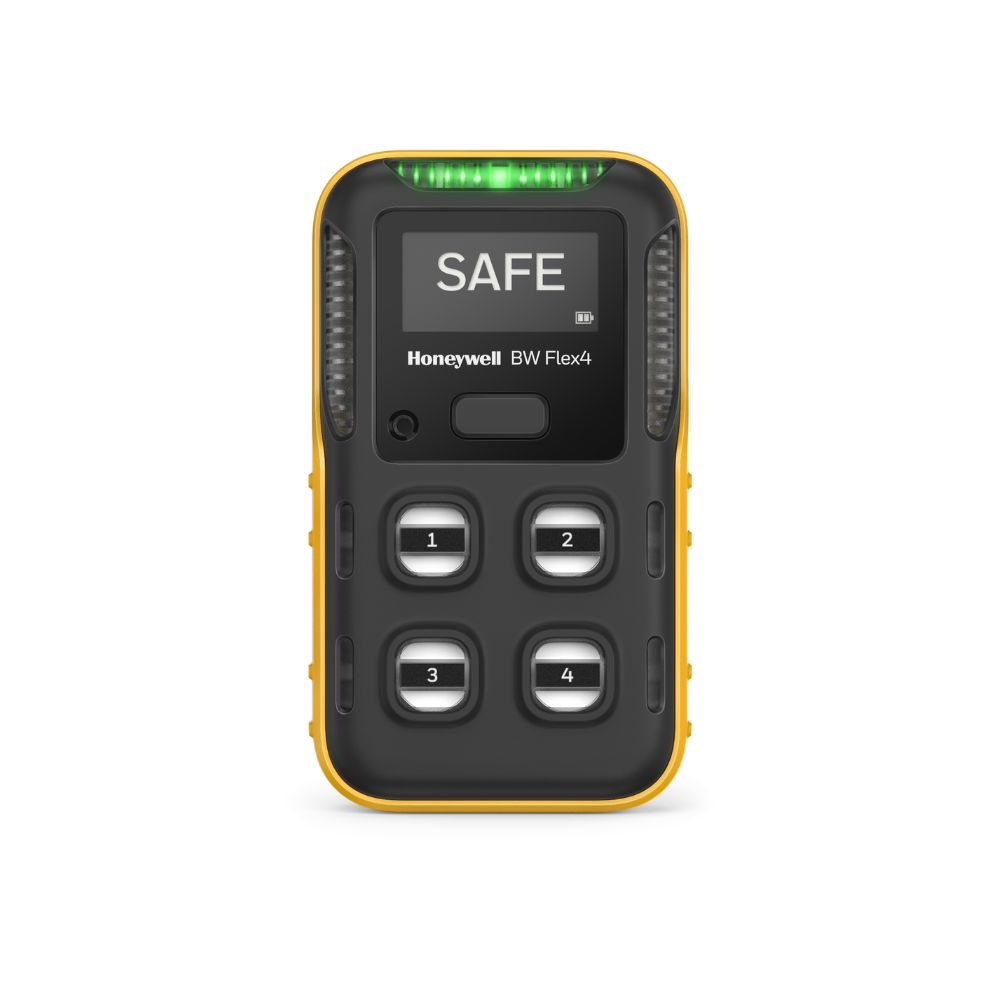
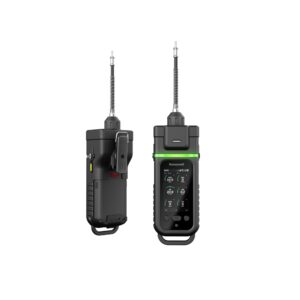
The Honeywell BW Flex 4 takes four sensors chosen from fourteen types. One of those is a dual toxic sensor reading hydrogen sulphide and carbon monoxide together, so four slots can cover five gas hazards. Battery life reaches 40 days at eight hours a day with the infrared sensor fitted, and SafetyTick and IntelliFlash give a green, amber and red status check without picking the instrument up.
KEY BENEFITS
- Four sensor slots covering up to five gas hazards, using the dual toxic sensor
- Fourteen sensor types available, from common gases to less usual ones like HCN and chlorine
- 40 days of battery life at eight hours a day with the infrared sensor, on a 4.5 hour charge
- Infrared LEL sensor is immune to silicone poisoning, unlike a catalytic bead
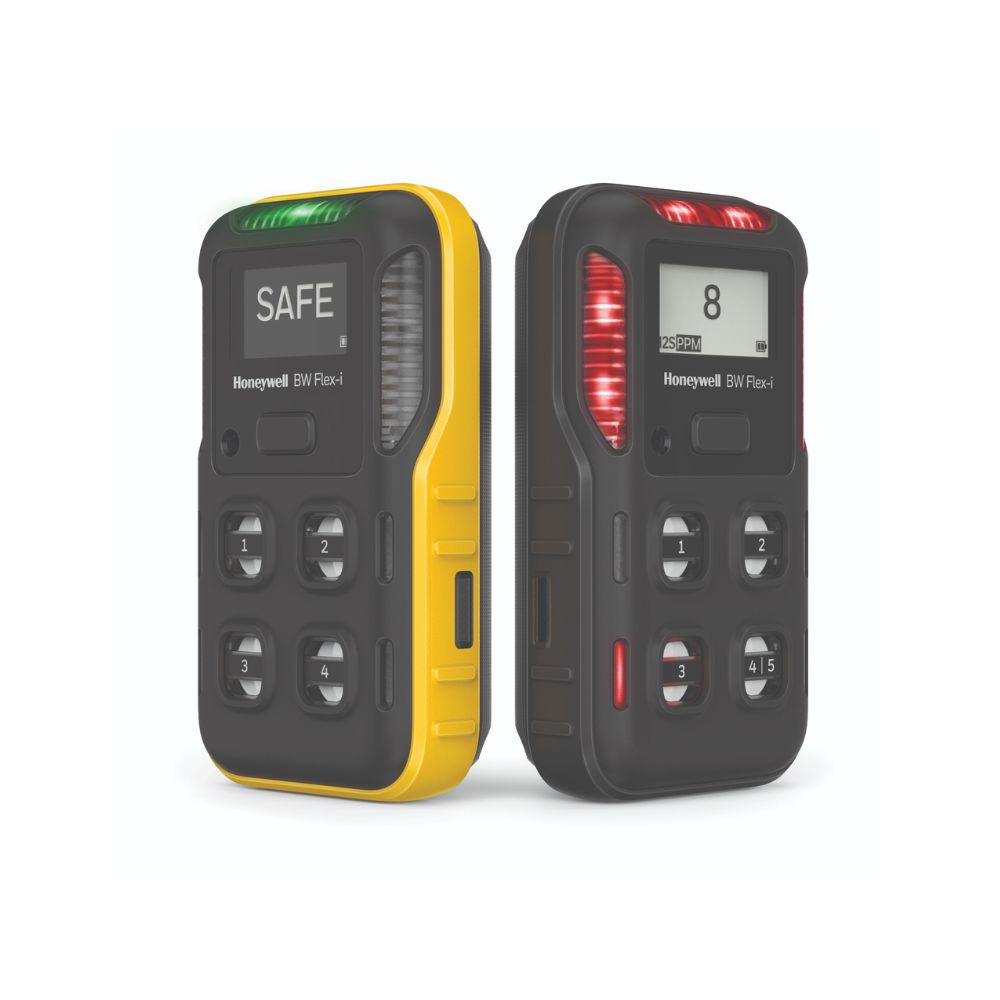
- SafetyTick and IntelliFlash give green, amber and red status at a glance
+ more in the Description tab below
Four Sensors, Five Gases
The naming is worth explaining because it confuses people.
The instrument has four sensor slots. Fourteen sensor types are available to fill them, and one of those is a dual toxic sensor that reads hydrogen sulphide and carbon monoxide from a single position. So four slots can deliver five gas readings, which is why Honeywell call it the Flex 4 rather than selling two instruments.
In practice, using the dual toxic sensor for hydrogen sulphide and carbon monoxide, a standard confined space setup of LEL, oxygen, H2S and CO only uses three slots. That leaves one free.
One caution on configuration. Some sensor combinations are not recommended because of cross sensitivity and possible interference. Gastech will confirm a configuration works before you order it.
The Infrared Sensor Cannot Detect Hydrogen Or Acetylene
This is the most important thing on the page and it is easy to miss, because in most other respects the infrared LEL sensor is the better choice.
The infrared sensor gives 40 days of battery life against around 15 hours from a catalytic bead, and it is immune to silicone poisoning, which is the failure mode that quietly disables catalytic sensors. On most sites it is the obvious selection.
What it cannot do is detect hydrogen or acetylene. Infrared detection works on the absorption characteristics of hydrocarbons, and neither of those gases has the molecular structure to absorb in that band. A Flex fitted with the infrared sensor will read zero in a hydrogen atmosphere.
So where hydrogen or acetylene is part of the risk, the catalytic LEL sensor has to be specified instead, and the battery life goes with it. That is a real trade off rather than a footnote, and it needs deciding before the instrument is ordered rather than discovered afterwards.
Two catalytic options exist, filtered and unfiltered. The unfiltered version is lead free.
Battery Life, And What The Figures Mean
The headline figure is 40 days at eight hours of use per day with the infrared sensor, on a 4.5 hour charge. With a catalytic LEL sensor it is up to 15 hours.
Both figures depend on alarm duration, since alarming draws considerably more power than monitoring. The practical consequence of 40 days is that the daily charging cycle disappears, and with it the compliance problem of instruments that were not put on charge overnight.
Status Without Picking It Up
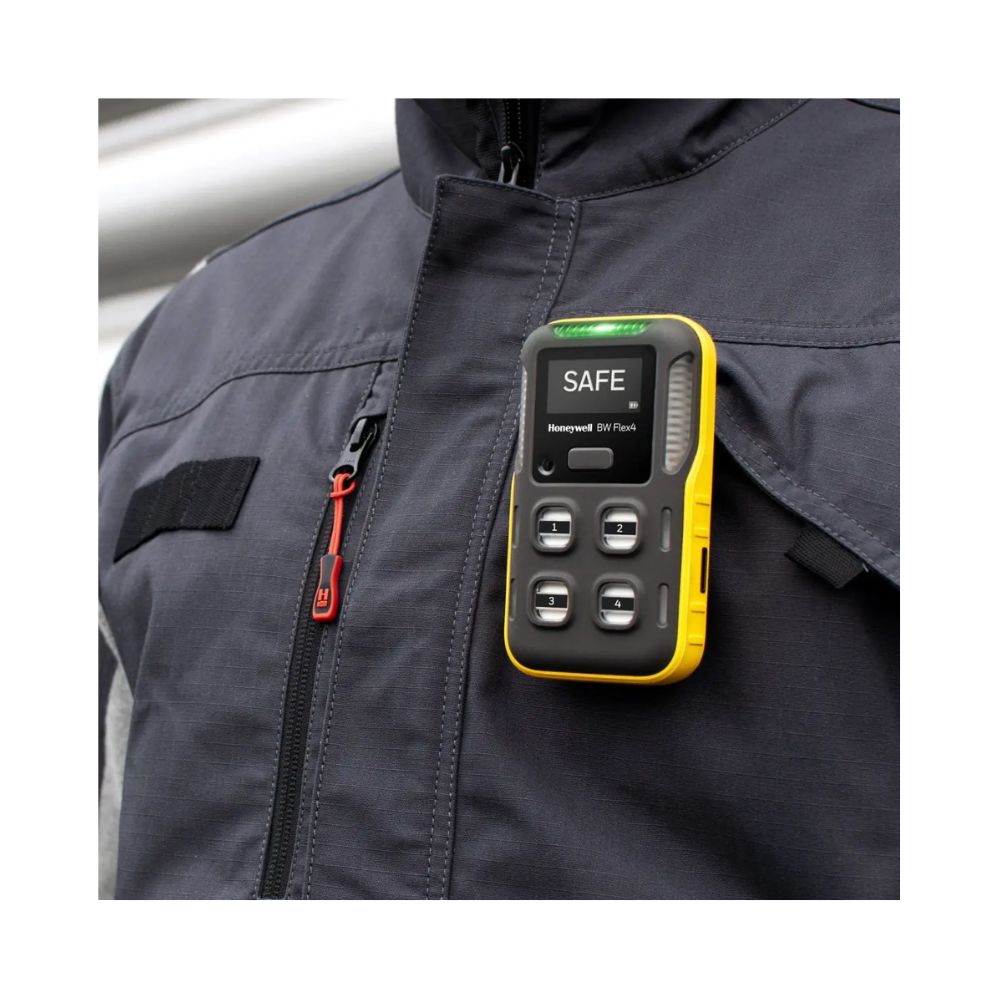
SafetyTick and IntelliFlash work together to give a three colour status indication. Green for good to go, amber for maintenance needed, red for stop.
The value is in who can read it. A supervisor walking past a rack of instruments can see which ones are ready without knowing anything about gas detection. A worker collecting one at the start of a shift knows immediately whether to take it. Ultra bright alarm LEDs cover the alarm condition itself.
The display can be configured to show all gases at once or one at a time, depending on preference.
Wireless Configuration And Fleet Management
Bluetooth Low Energy connects the instrument to a phone or PC for remote measurement, field reporting of incidents, and full configuration and calibration.
Three pieces of software cover it. The Safety Communicator app gives remote situational awareness from a control room. The Device Configurator app handles instrument setup. Safety Suite Device Configurator provides fleet management on iOS, Android and Windows.
Settings that can be changed include high, low, TWA and STEL alarm set points, latching alarms and peak hold, and always on operation. Calibration and bump test reminders can be set with enforcement policies, and worker and location assignments applied.
For automated bump testing and calibration, the instrument is compatible with the IntelliDoX system.
Maintenance Intervals Worth Knowing
Two figures decide the cost of running a fleet, and both are published.
Maximum calibration interval is 180 days for most sensors. Hydrogen cyanide is the exception at 90 days.
Expected operating life runs 3 to 5 years or more for the infrared sensors, both catalytic LEL types, oxygen, hydrogen sulphide, carbon monoxide and sulphur dioxide. The dual toxic sensor, the hydrogen compensated carbon monoxide sensor, nitric oxide and nitrogen dioxide are 2 years or more. Hydrogen cyanide and chlorine are 1 to 2 years.
Those numbers matter when specifying, because a chlorine sensor replaced annually has a different cost profile from an oxygen sensor lasting five years, and the difference is invisible at purchase.
Certified For Marine And Mining As Well As Industry
The approvals list is unusually broad, covering ATEX, IECEx, CSA, FTZU, INMETRO, GOSST, CCCF, CPA, KRS, MED, DNV, SABS, FCCID, IC, UKCA and CE.
MED and DNV are the ones worth drawing out, because they are marine approvals. Together with IP66 and IP68 they make the instrument suitable for shipboard and offshore use, where an industrial only certification would not be accepted. IECEx is the scheme Australian hazardous areas are assessed under.
Certified temperature is minus 40 to plus 60 degrees Celsius, reducing to minus 20 to plus 60 with a catalytic LEL sensor fitted.
Where It Is Used
Confined space entry. Oil and gas processing and terminals. Chemical plant. Water and wastewater treatment. Mining, surface and underground. Marine and offshore. Waste and recycling. Power generation. Manufacturing. Food and beverage production. Utilities and infrastructure maintenance. Emergency response.
Benefits
- Four sensor slots covering up to five gas hazards, using the dual toxic sensor
- Fourteen sensor types available, from common gases to less usual ones like HCN and chlorine
- 40 days of battery life at eight hours a day with the infrared sensor, on a 4.5 hour charge
- Infrared LEL sensor is immune to silicone poisoning, unlike a catalytic bead
- SafetyTick and IntelliFlash give green, amber and red status at a glance
- Single pushbutton operation, so training time is short
- Bluetooth Low Energy for wireless configuration, reporting and calibration
- Reflex self test runs an analog sensor diagnostic at 10 minute intervals
- Most sensors carry a 180 day maximum calibration interval
- IP66 and IP68, with marine approvals including MED and DNV
Sensor positions
Four, covering up to five gas hazards using the dual toxic sensor
Sensor types available
Fourteen
Dimensions
108.2 x 61.5 x 43.2 mm with alligator clip. 108.2 x 61.5 x 37.8 mm with Klick Fast stud
Weight, catalytic LEL
189 g with alligator clip, 173 g with Klick Fast stud
Weight, infrared LEL
186 g with alligator clip, 170 g with Klick Fast stud
Certified temperature
Minus 40 to plus 60 °C. Minus 20 to plus 60 °C with a catalytic LEL sensor
Working humidity
5 to 95% RH, non condensing and sensor dependent
Ingress protection
IP66 and IP68
Typical battery life
40 days at 8 hours use per day with the NDIR sensor. Up to 15 hours with catalytic LEL. Both depend on alarm duration
Battery charge time
4.5 hours
Alarms
Visual, vibrating and audible at 95 dB. Low, High, TWA, STEL, Negative Drift, Over Limit, Multi-alarm and Low Battery
Status indicators
SafetyTick and IntelliFlash, green, amber and red
Self test
Sensor and circuitry diagnostic on activation. Reflex analog sensor diagnostic at 10 minute intervals
Connectivity
Bluetooth Low Energy
Software
Honeywell Safety Communicator App, Device Configurator App, Safety Suite Device Configurator on iOS, Android and Windows
Docking station
IntelliDoX automated test and calibration system
IntelliDoX automated test and calibration system
180 days for most sensors. 90 days for hydrogen cyanide
Expected sensor life
3 to 5+ years for most sensors. 2+ years for dual toxic, CO-H, NO and NO2. 1 to 2 years for HCN and chlorine
Certifications
ATEX, IECEx, CSA, FTZU, INMETRO, GOSST, CCCF, CPA, KRS, MED, DNV, SABS, FCCID, IC, UKCA, CE
Chlorine
Cl2
Carbon Monoxide
CO
Carbon Dioxide
CO2
Hydrogen Sulphide
H2S
Hydrogen Cyanide
HCN
Combustible Gas
LEL
Nitric Oxide
NO
Nitrogen Dioxide
NO2
Oxygen
O2
Sulphur Dioxide
SO2
- Aviation & Transportation
- Chemical Manufacturing
- Confined Space & Compliance
- Energy (Oil & Gas)
- Food & Beverage
- Landfill & Remediation
- Marine & Maritime
- Medical & Healthcare
- Mining & Minerals
- Power Generation & BESS
- Technology & Semiconductor
- Water & Wastewater
It has four sensor positions, and one available sensor is a dual toxic type reading hydrogen sulphide and carbon monoxide together. So four sensors can cover five gas hazards.
No. The infrared sensor cannot detect hydrogen or acetylene. Where either is part of the risk, the catalytic LEL sensor must be specified instead.
Battery life and poisoning immunity. The infrared sensor gives 40 days at eight hours a day against around 15 hours from a catalytic bead, and it is immune to silicone poisoning.
The maximum calibration interval is 180 days for most sensors, and 90 days for hydrogen cyanide.
Most run 3 to 5 years or more. The dual toxic, hydrogen compensated CO, nitric oxide and nitrogen dioxide sensors are 2 years or more. Hydrogen cyanide and chlorine are 1 to 2 years.
Not always. Some combinations are not recommended because of cross sensitivity and interference, so confirm your configuration with us before ordering.
Trusted by









Contact Us
Can’t find what you’re looking for? Our team is happy to help.