
Ax60+
Modular Fixed Gas Detection System
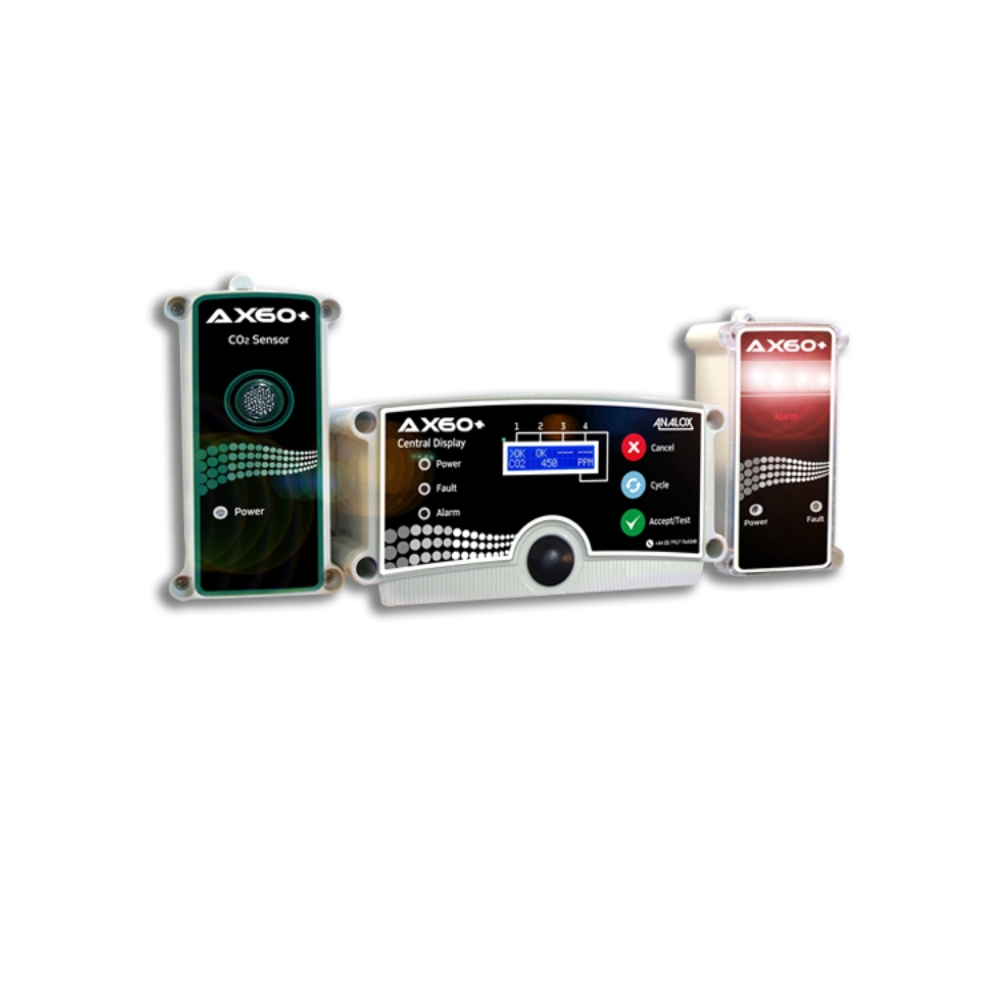
The Analox Ax60+ is a modular fixed gas detection system that monitors carbon dioxide, oxygen and carbon monoxide from one central display. You build it to suit the site, connecting up to four sensors and up to eight alarm units, then use the relays to drive ventilation or shut off the gas supply. Sensors are calibrated from the central display, and the CO2 sensor and electronics carry a five year warranty. It’s widely used in breweries, cellars, dispense areas, laboratories and plant rooms where a CO2 or oxygen hazard needs to be caught early.
KEY BENEFITS
- One central display handles up to four sensors, so a CO2 cellar and an oxygen store need only one system
- Mix sensor types on the same panel, which means CO₂, CO and oxygen monitoring share one display and one set of spares
- Up to four alarm units per sensor, and eight per system, so alarms can sit at each entry point
- Configurable relays drive extraction fans or an optional solenoid valve to shut the gas supply off automatically
- Sensors calibrate from the front panel menu, so routine maintenance does not need a service visit
+ more in the Description tab below
An Oxygen Monitor Won’t Keep You Safe Around CO2
This is the most common and most expensive mistake in beverage and hospitality gas safety.
The logic sounds reasonable. Carbon dioxide displaces oxygen, so an oxygen monitor should catch a CO2 leak. In practice, it doesn’t. Oxygen alarms typically sit at 19.5% and 18%. By the time a CO2 leak has pushed oxygen down that far, the carbon dioxide in the room is already at a level that will harm anyone in it.
Carbon dioxide is toxic in its own right, well before it becomes an asphyxiation risk. If you store or use CO2, you need a CO2 sensor. The Ax60+ CO2 is that sensor, reading from 0 to 5%, which is 0 to 50,000 ppm.
Build the System Around the Site
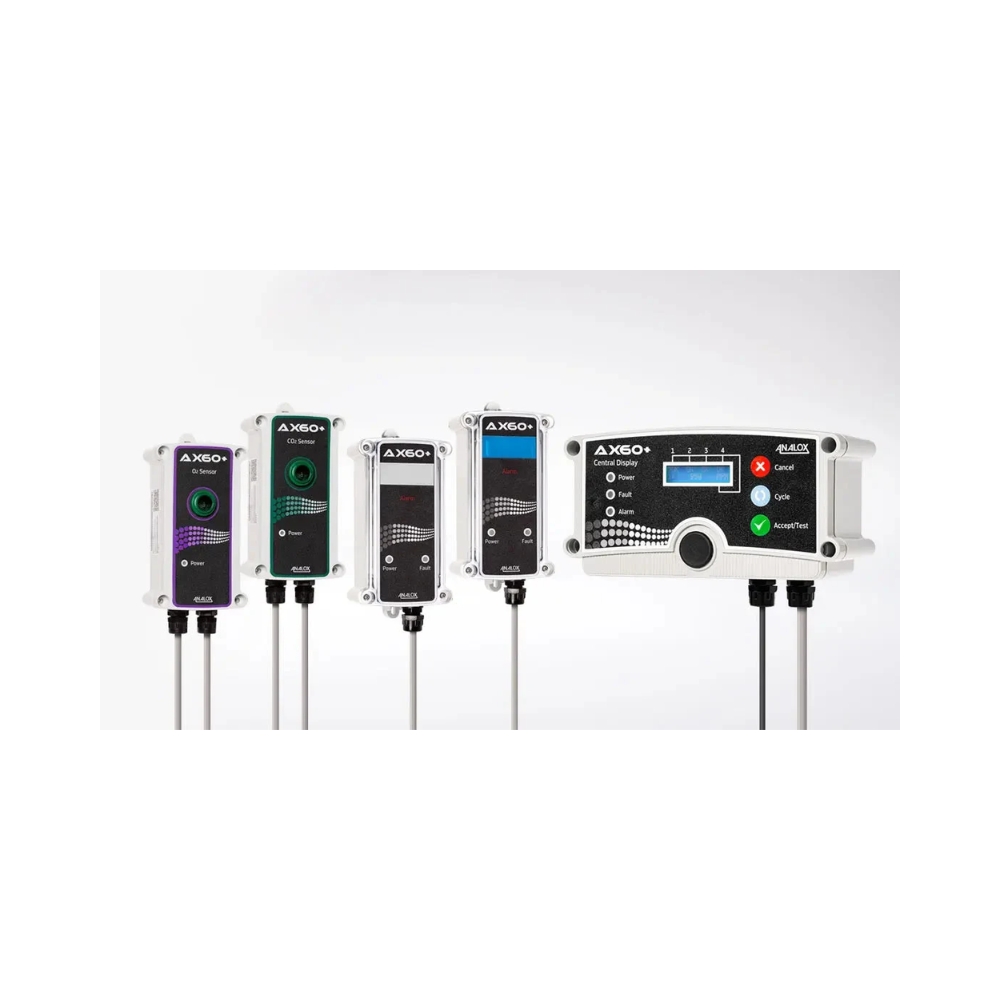
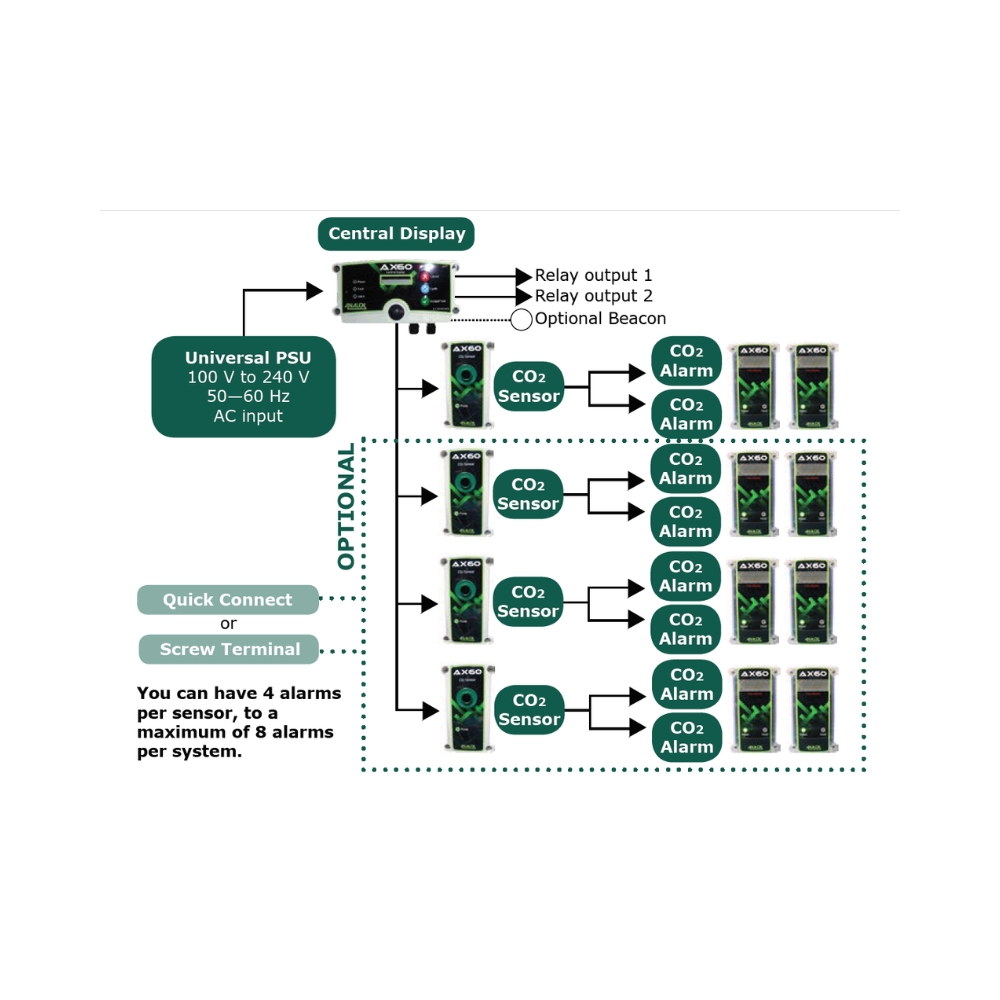
The Ax60+ is modular. A central display unit anchors the system and accepts up to four sensors, in any mix from the range.
A brewery might run two CO2 sensors in the cellar and a SAFE-OX in the nitrogen store. A laboratory might run CO2 and SAFE-OX sensors side by side. Both are the same system with different sensors.
Each sensor supports up to four alarm units, with up to eight per system. That matters, because the alarm needs to be where people are, not where the panel is. Put a strobe and sounder outside each door, and staff know before they walk in.
The Variants
The Ax60+ CO2 monitors carbon dioxide in cellars, dispense areas, laboratories and plant rooms.
The Ax60+ SAFE-OX monitors oxygen depletion and enrichment where inert gases or oxygen are stored.
The Ax60+ Cultivate is a CO2 safety sensor built for indoor growing, such as vertical farms and greenhouses.
The Ax60+ Kiosk is a standalone CO2 monitor and alarm for small areas, with no central display needed.
The Ax60+ CO monitors low levels of carbon monoxide, from 0 to 25 ppm, in ambient air or low pressure air lines, including helium and nitrogen background applications.
The Data Output Module (DOM) adds four 4-20 mA analogue outputs and Modbus RTU, for building management system integration.
The central display unit is needed for all builds, except the Kiosk.
Oxygen Depletion and Enrichment in One Sensor
The SAFE-OX reads 0 to 25% oxygen, with an accuracy of ±0.75%, and alarms in both directions. Low oxygen is the asphyxiation risk. High oxygen is a fire risk, and it’s the one people forget. Three alarms are configurable, set by default at 19.5% (low), 23% (high) and 18% (low low).
It uses a lead free electrochemical sensor with a 30 second warm up, and stays accurate around helium, nitrogen and argon as standard. That matters in laboratories and MRI suites, where helium can confuse many oxygen sensors.
The SAFE-OX replaces the older Ax60+ O2 sensor.
Automatic Response, Not Just an Alarm
Two configurable relays are built into the central display unit, rated 250 VAC or 30 VDC at 3 A.
Wire them to extraction, and a leak triggers ventilation without anyone there. Add the optional solenoid valve, and the system can shut the gas supply off at the source. For a cellar that’s unattended most of the day, that’s the difference between a leak and an incident.
Alarms latch by default, so a brief excursion can’t clear itself unnoticed. Latching can be switched off where it isn’t wanted.
Calibration You Can Do Yourself
Sensor calibration runs from the central display’s technical menu, with zero and span both adjustable on site. That takes a recurring service cost out of the system. If you’d rather, we can handle calibration under a service agreement, and supply certified calibration gas either way.
Warm up is 40 seconds from power on, and the CO2 sensor responds in under 30 seconds (T90).
Mounting Matters
Gas density decides sensor height, and getting it wrong makes the system close to useless.
Carbon dioxide is heavier than air, so CO2 and Cultivate sensors mount about 300 to 450 mm above the floor, where the gas will pool. SAFE-OX and CO sensors mount at average head height, where people breathe.
Sensor and alarm units are rated IP55, and the central display unit IP54. All are water resistant rather than waterproof, so none should sit outdoors without protection or in direct sun.
Working With Existing Ax60 Systems
If you already run the older Ax60, there’s partial compatibility. Ax60+ CO2 sensors work with both Ax60 and Ax60+ central displays. Older Ax60 sensors only work with Ax60 central displays. Oxygen sensors need an Ax60+ central display.
That makes a staged upgrade possible. Replace the panel first, and your existing Ax60+ CO2 sensors carry over.
Where It’s Used
Breweries, wineries and cider makers, pubs, restaurants and fast food dispense areas, beverage cellars and gas stores, laboratories and cryogenic storage, hospitals and medical gas areas, plant rooms, and indoor horticulture and controlled atmosphere storage.
Benefits
- One central display handles up to four sensors, so a CO2 cellar and an oxygen store need only one system
- Mix sensor types on the same panel, which means CO₂, CO and oxygen monitoring share one display and one set of spares
- Up to four alarm units per sensor, and eight per system, so alarms can sit at each entry point
- Configurable relays drive extraction fans or an optional solenoid valve to shut the gas supply off automatically
- Sensors calibrate from the front panel menu, so routine maintenance does not need a service visit
- Five year warranty on the CO2 sensor and electronics
- NDIR carbon dioxide sensing responds in under 30 seconds, fast enough to catch a cellar leak before levels get dangerous
- SAFE-OX monitors oxygen depletion and enrichment with three configurable alarms, accurate around helium, nitrogen and argon
- Default CO2 alarm points ship pre configured, and can be set to suit Australian exposure limits
- Data Output Module adds four 4-20 mA outputs and Modbus RTU for building management systems
Central Display Unit
Sensors supported
Up to 4 per central display
Alarm units supported
Up to 4 per sensor, up to 8 per system
Warm-up time
40 seconds
Display
LCD dot matrix, backlit
Relays
2 configurable, rated 250 V AC or 30 V DC, 3 A maximum
Power supply
100 to 240 V at 1.5 A through the transformer, or 24 V DC direct
Maximum power consumption
Under 24 W
Operating temperature
Minus 5°C to plus 50°C
IP rating
IP54
Dimensions
175 x 106 x 67 mm
Warranty
5 years electronics
-
-
Carbon Dioxide Sensor
Measurement technique
Non-dispersive infrared (NDIR)
Range
0 to 5%, which is 0 to 50,000 ppm
Response time
Under 30 seconds to T90
Warm-up time
40 seconds
Default alarm set points
EH40 defaults: TWA 5,000 ppm, AL1 15,000 ppm, AL2 30,000 ppm. US defaults also available. Set to suit Australian exposure limits on commissioning
IP rating
IP55
Dimensions
72 x 132 x 52 mm
Installation height
About 300 to 450 mm above floor level
Warranty
5 years
Connection
Quick connect or direct connect
-
-
SAFE-OX Oxygen Sensor
Measurement technique
Lead free electrochemical, partial pressure
Range
0 to 25% O₂
Accuracy
Plus or minus 0.75%
Alarm directions
Depletion and enrichment
Default alarm set points
AL2: 19.5% (low). AL3: 23% (high). AL4: 18% (low low)
Response time
Under 60 seconds
Warm-up time
30 seconds
Background gas tolerance
Accurate with helium, nitrogen and argon as standard
Installation height
Average head height
Warranty
5 years graded
-
-
CO Sensor
Measurement technique
Electrochemical
Range
0 to 25 ppm
Accuracy
Less than ±1 ppm CO, ±5% of reading (constant temperature and pressure)
Default alarm set points
AL1: 3 ppm. AL2: 5 ppm. AL3: 10 ppm
Mode of measurement
Ambient air, or low pressure air lines (1 to 3 barg). Helium and nitrogen background versions available
Alarm Unit
Strobe
White LED, over 100 cd, optional blue, red or amber filters
Sounder
Minimum 80 dBA at 3 m
IP rating
IP55
Dimensions
72 x 132 x 52 mm
Warranty
5 years electronics
Carbon Monoxide
CO
Carbon Dioxide
CO2
Oxygen
O2
- Aviation & Transportation
- Chemical Manufacturing
- Confined Space & Compliance
- Food & Beverage
- Marine & Maritime
- Medical & Healthcare
- Mining & Minerals
- Power Generation & BESS
- Technology & Semiconductor
- Water & Wastewater
Carbon dioxide, carbon monoxide and oxygen, with sensors ordered separately and mixed on one central display.
Up to four sensors per central display unit. Each sensor takes up to four alarm units, with up to eight alarm units per system.
Yes for all builds apart from the Ax60+ Kiosk, which is a standalone CO₂ monitor and alarm.
Yes. The Data Output Module adds four 4-20 mA analogue outputs and Modbus RTU, so readings pass through to a BMS.
CO2 and Cultivate sensors mount about 300 to 450 mm above floor level, because CO2 is heavier than air. SAFE-OX and CO sensors mount at average head height.
Analox lists no hazardous area certification for the range, so speak to Gastech before specifying it for a classified area.
Trusted by









Contact Us
Can’t find what you’re looking for? Our team is happy to help.