
Searchline Excel
Open Path Flammable Gas Detector
The Searchline Excel by Honeywell is an open path infrared detector for flammable hydrocarbon gases, available in two range options from the same platform. The Plus covers 2 to 120 metres for process areas, and the Edge reaches 330 metres for perimeter and fence line monitoring. Advanced transmitter and receiver optics keep it detecting through thick fog long after other open path detectors lose coverage. Setup and maintenance run over Bluetooth from a phone, and the detector is calibration free.
KEY BENEFITS
- Two range options on one platform, from 2 metres in a process area out to 330 metres on a fence line
- Advanced optics keep detecting through thick fog after other open path detectors lose coverage
- Calibration free and low maintenance, which removes the recurring cost from a large installation
- Bluetooth setup and maintenance from an intrinsically safe phone, so no enclosure is opened
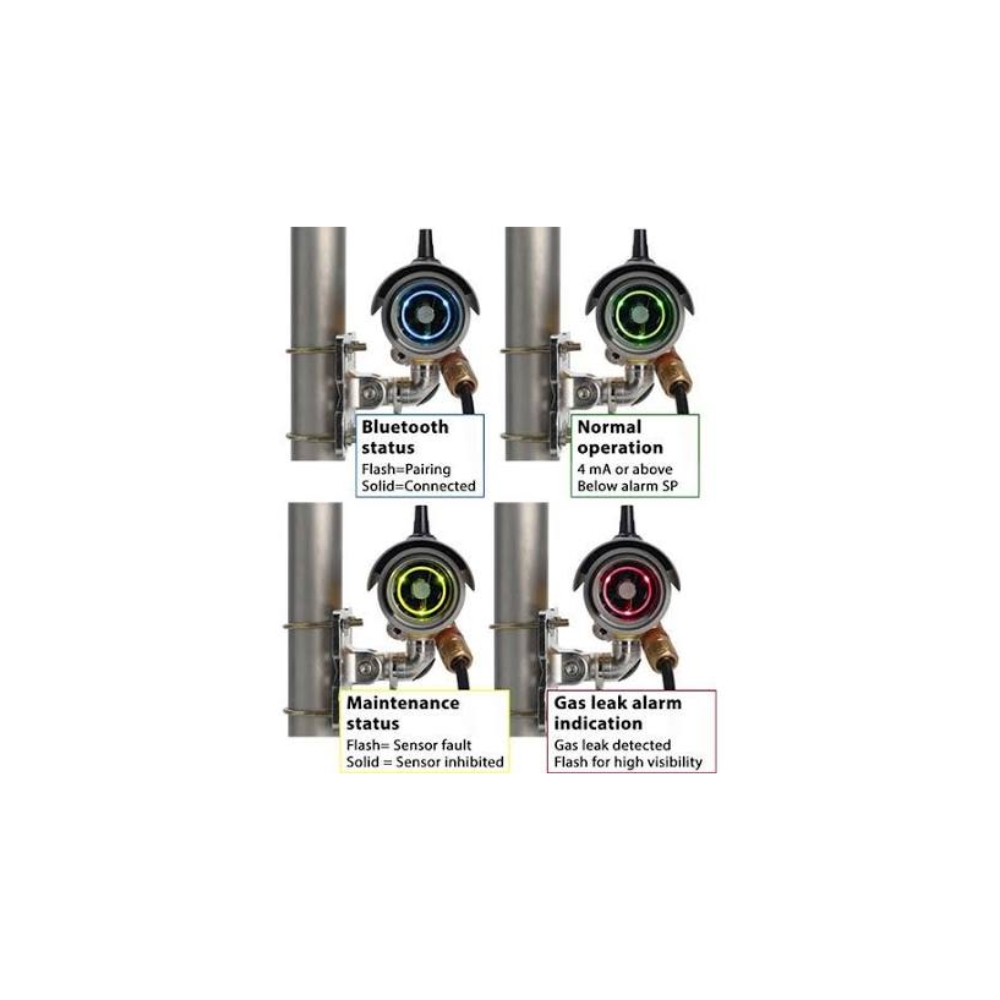
- High visibility LED halo ring shows detector status from a distance at a glance
+ more in the Description tab below
Two Range Options, One Detector
The Searchline Excel comes in two versions that differ in one way only: path length.
| Excel Plus | Excel Edge | |
|---|---|---|
| Path length | 2 m to 120 m | 60 m to 330 m |
| Recommended minimum alarm | See manual | 0.5 LEL.m |
| Typical use | Process areas, pipe racks, compressor houses, tank bunds | Perimeter and fence line monitoring |
Detection range, response time, operating temperature, power, outputs, repeatability, drift, warm up and ingress protection are the same on both. So the choice is about geometry, not performance. Measure the beam path you need to cover, and the version follows.
The two overlap between 60 and 120 metres. In that band either will work, and the choice usually comes down to what else is being installed on site, since one model type means one set of spares.
Seeing Through Fog Is the Whole Argument
An open path detector that stops working in bad weather fails at exactly the moment conditions are worst and attention is lowest.
Fog, rain, snow and dust all scatter infrared, and a beam crossing 200 metres of it loses a lot of signal.
Honeywell’s answer is optical. Advanced transmitter and receiver optics keep monitoring in thick fog long after other open path detectors, NDIR or laser based, stop providing coverage. Where the signal does degrade, advanced diagnostics report window clarity and alignment accuracy, so a real problem can be told apart from the weather.
For an Australian site, that means a coastal fog bank or a Pilbara dust event doesn’t open a gap in your fire and gas coverage.
Calibration Free
Open path detectors are usually the hardest instruments on a site to calibrate. They’re mounted high, aimed across a distance, and applying test gas across a beam is awkward.
The Searchline Excel is calibration free. There’s no routine gas application, no annual calibration visit to each beam and no ladder work to schedule.
Combined with automatic reporting and full logging of alarms, events and maintenance actions, that changes what an open path installation costs to own. The detector keeps its own record and tells you when it needs attention, rather than needing a scheduled visit to confirm it’s working.
Bluetooth, Not a Screwdriver
Setup and maintenance run over Bluetooth. Pair the detector with Honeywell’s intrinsically safe ruggedised phone, then use the Honeywell Fixed Platform App to interact with it.
Bluetooth range is up to 20 metres, depending on the device and conditions. So a detector mounted high on a pole can be checked from the ground, in a classified area, without opening an enclosure.
Through the app, you get readings, device status, configuration and diagnostics. On a site with twenty beams, that’s the difference between a day of access equipment and an afternoon walking the site with a phone.
Alignment and Mounting
Alignment is where open path installations go wrong, and where the labour goes.
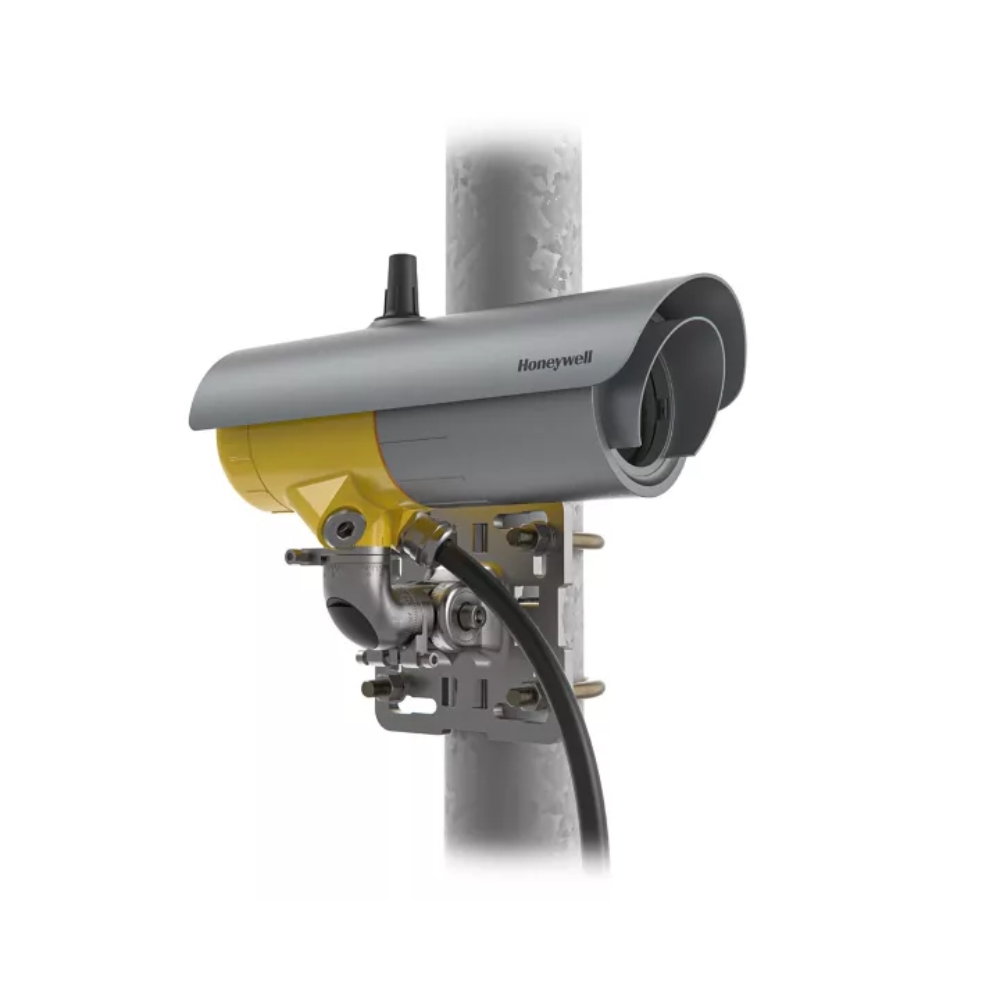
The Honeywell Fixed Platform Universal Mount, with its advanced alignment scope, makes the mechanical installation straightforward. The diagnostics then report alignment accuracy continuously, rather than leaving you to discover drift when the detector faults.
Continuous alignment reporting matters more at long range. A small angular error over 330 metres becomes a large error at the receiver.
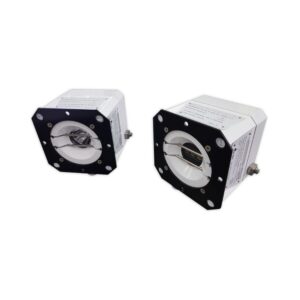
The transmitter and receiver each weigh about 6 kg and measure 103 mm in diameter x 325 mm x 180 mm.
Reading LEL Metres
Both versions read 0 to 5 LEL metres, linearised, with recommended alarms at 1 LEL.m (low) and 3 LEL.m (high).
LEL metres measures the total gas along the beam, rather than the concentration at one point. It reports the quantity of gas in the monitored line, so a wide thin cloud and a narrow dense one can read the same. On a large site, that’s the useful measurement, because what matters is whether gas is in the area.
Repeatability is ±0.4 LEL.m. Temperature drift from -40°C to +65°C is ±0.2 LEL.m at zero and ±0.5 LEL.m at 3 LEL.m.
Integration
Outputs include 4-20 mA with HART, Modbus, Bluetooth, and three relays for fault, alarm 1 and alarm 2. Relays are rated to 32 VAC or VDC at 2 A resistive.
The analogue signal carries diagnostic states, not just a reading. Normal operation is 4 to 20 mA, with 1 mA for fault, 2 mA for inhibit, 3 mA for warning and 21 mA for over range. A control system reading that loop can tell a fault from a clean zero, which a plain 4-20 mA output can’t.
Power is 24 VDC nominal, across 18 to 32 VDC. Consumption rises as the temperature falls, so a cold climate installation needs the supply sized for the low temperature figures.
Certified for Hazardous Areas
Both versions are certified IECEx ULD 18.0016X, Ex db ia IIC T4 Gb for flameproof installations, or Ex db eb ia IIC T4 Gb for increased safety installations, with Ex tb IIIC for dust. They also carry ATEX and cULus approval, and SIL 2 certification by TÜV SÜD to EN 61508.
Marine and Offshore
Both versions are rated to DNVGL-CG-0339 Location Class B for temperature and humidity, and to IP66 and IP67, Type 4X to NEMA 250.
They’re also tested for resistance to salt mist and sulphuric atmosphere. For offshore platforms, FPSOs, marine terminals and coastal plant, that combination is what separates a detector that survives from one that corrodes.
Where It’s Used
Refineries and petrochemical plant, upstream and downstream, LNG production, storage and transfer, onshore terminals and tank farms, offshore platforms and FPSOs, pipe racks and process modules, compressor houses and stations, tank bunds and loading areas, perimeter and fence line monitoring, site boundary monitoring, and mining and mineral processing where hydrocarbon fuel is stored in volume.
Benefits
- Two range options on one platform, from 2 metres in a process area out to 330 metres on a fence line
- Advanced optics keep detecting through thick fog after other open path detectors lose coverage
- Calibration free and low maintenance, which removes the recurring cost from a large installation
- Bluetooth setup and maintenance from an intrinsically safe phone, so no enclosure is opened
- High visibility LED halo ring shows detector status from a distance at a glance
- Automatic reporting with full logging of alarms, events and maintenance actions
- Advanced diagnostics report window clarity and alignment accuracy before they cost you coverage
- Responds in under 3 seconds, fast enough to catch a cloud crossing the beam
- Operates from minus 55 to plus 75 degrees Celsius, well beyond Australian extremes
- IECEx, ATEX and cULus certified, and SIL 2 certified by TÜV SÜD
Weight
Receiver 6.1 kg. Transmitter 6.0 kg. Universal mounting bracket 3.1 kg
Dimensions
103 mm diameter x 325 mm x 180 mm
Excel Plus Path Length
2 m to 120 m
Excel Edge Path Length
60 m to 330 m
Excel Edge Recommended minimum alarm setting
0.5 LEL.m
Detection principle
Open path infrared
Primary gases
Responds to a wide range of hydrocarbon gases which absorb infrared at the required wavelengths, including methane, ethane, propane, butane, pentane, hexane, ethylene and propylene
Performance approvals
FM performance approved for methane, ethane, propane, butane, pentane, ethylene and propylene. DNV approved for methane and propane
Range
0 to 5 LEL.m, linearised. See the manual for ppm.m equivalents
Recommended alarm setting
Low 1 LEL.m, high 3 LEL.m
Speed of response
T90 under 3 seconds
Repeatability
Plus or minus 0.4 LEL.m
Temperature drift, minus 40°C to plus 65°C
Plus or minus 0.2 LEL.m at zero, plus or minus 0.5 LEL.m at 3 LEL.m
Analogue output
4 to 20 mA normal operation, 1 mA fault, 2 mA inhibit, 3 mA warning, 21 mA over range
Output signals
4 to 20 mA with HART, fault relay, alarm 1 relay, alarm 2 relay, Modbus, Bluetooth
Bluetooth range
Up to 20 m, depending on mobile device and conditions
Relay ratings
Maximum 32 V DC or AC, maximum 2 A resistive load
Power supply
24 V DC nominal, 18 V DC to 32 V DC
Power consumption, transmitter
3.8 W above plus 30°C. 5.6 W between plus 30°C and minus 30°C. 11.8 W below minus 30°C
Power consumption, receiver
3.0 W above plus 30°C. 4.8 W between plus 30°C and minus 30°C. 7.4 W below minus 30°C
Operating temperature
Minus 55°C to plus 75°C. DNVGL-CG-0339 Location Class B
Storage temperature
Minus 55°C to plus 75°C. DNVGL-CG-0339 Location Class B
Humidity
0 to 99% relative humidity, non-condensing. DNVGL-CG-0339 Location Class B
Pressure
91.5 to 105.5 kPa, non-compensated
Warm-up time
Under 5 minutes operational, under 1 hour fully stabilised
Ingress protection
IP66 and IP67, Type 4X to NEMA 250. Tested for resistance to salt mist and sulfuric atmosphere
Internal battery cell
10 year lifetime, replaced by authorised service only
Calibration
Not required
Diagnostics
Window clarity and alignment accuracy, with automatic reporting and full logging of alarms, events and maintenance actions
Safety approvals
IECEx ULD 18.0016X: Ex db ia IIC T4 Gb (Ex d installations), Ex db eb ia IIC T4 Gb (Ex e installations), Ex tb IIIC T100°C Db, Ta -55°C to +75°C. ATEX. cULus: Class I, Division 1, Groups B, C and D, T4. Class I, Zone 1 AEx db ia IIC T4 Gb
Performance approvals
ANSI/FM/IEC/EN 60079-29-4
Functional safety
SIL 2, certified by TÜV SÜD to EN 61508
Ethylene (Ethene)
C2H4
Propane
C3H8
Butane
C4H10
Pentane
C5H12
Hexane
C6H14
Methane
CH4
- Aviation & Transportation
- Chemical Manufacturing
- Energy (Oil & Gas)
- Landfill & Remediation
- Marine & Maritime
- Power Generation & BESS
- Water & Wastewater
Path length only. The Plus covers 2 to 120 metres and the Edge covers 60 to 330 metres, with all other specifications identical.
Measure the beam path you want to cover. Under 60 metres takes the Plus, over 120 metres takes the Edge, and either works in the overlap between.
No, the Searchline Excel is calibration free, which removes the recurring cost of applying test gas across a beam mounted at height.
Yes, the advanced transmitter and receiver optics maintain coverage in thick fog after other open path detectors, whether NDIR or laser based, lose it.
Yes, setup and maintenance run over Bluetooth from an intrinsically safe phone up to 20 metres away using the Honeywell Fixed Platform App.
It measures the total gas along the beam rather than the concentration at one point, so a wide thin cloud and a narrow dense one can give the same figure.
Trusted by









Contact Us
Can’t find what you’re looking for? Our team is happy to help.