
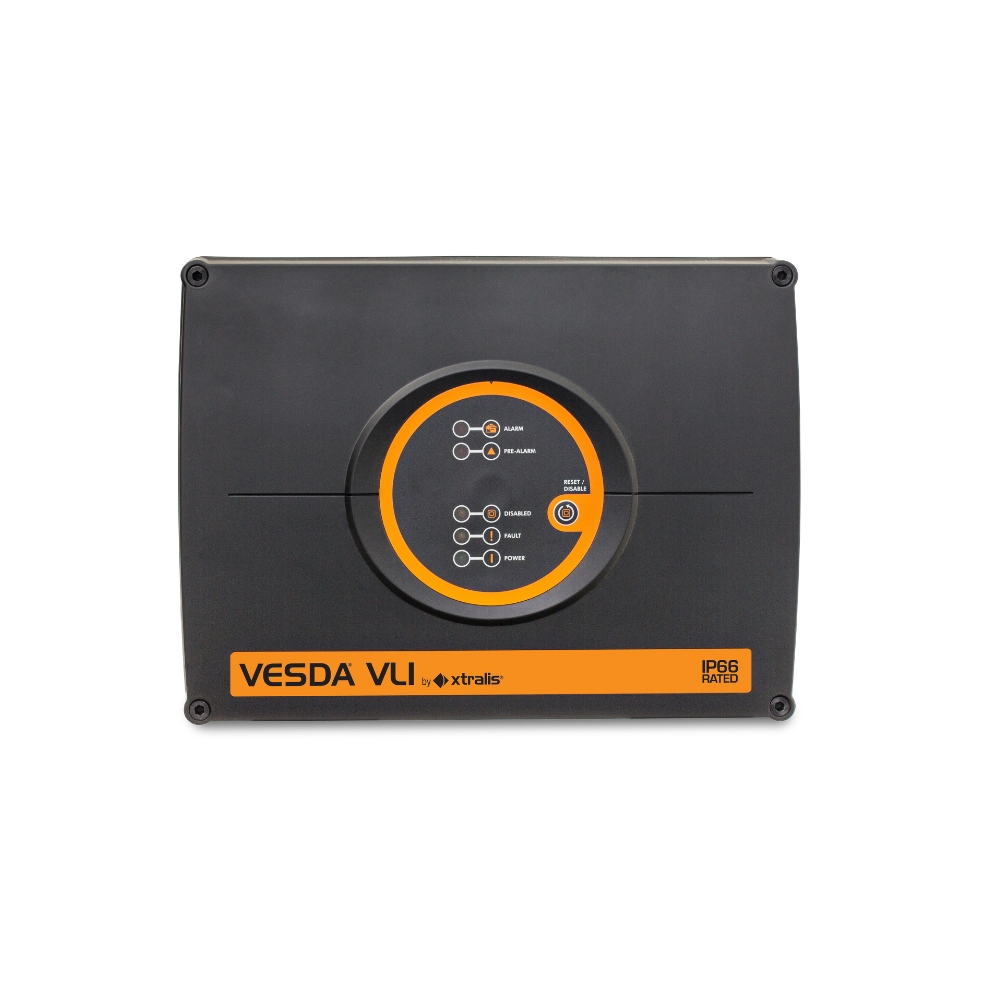
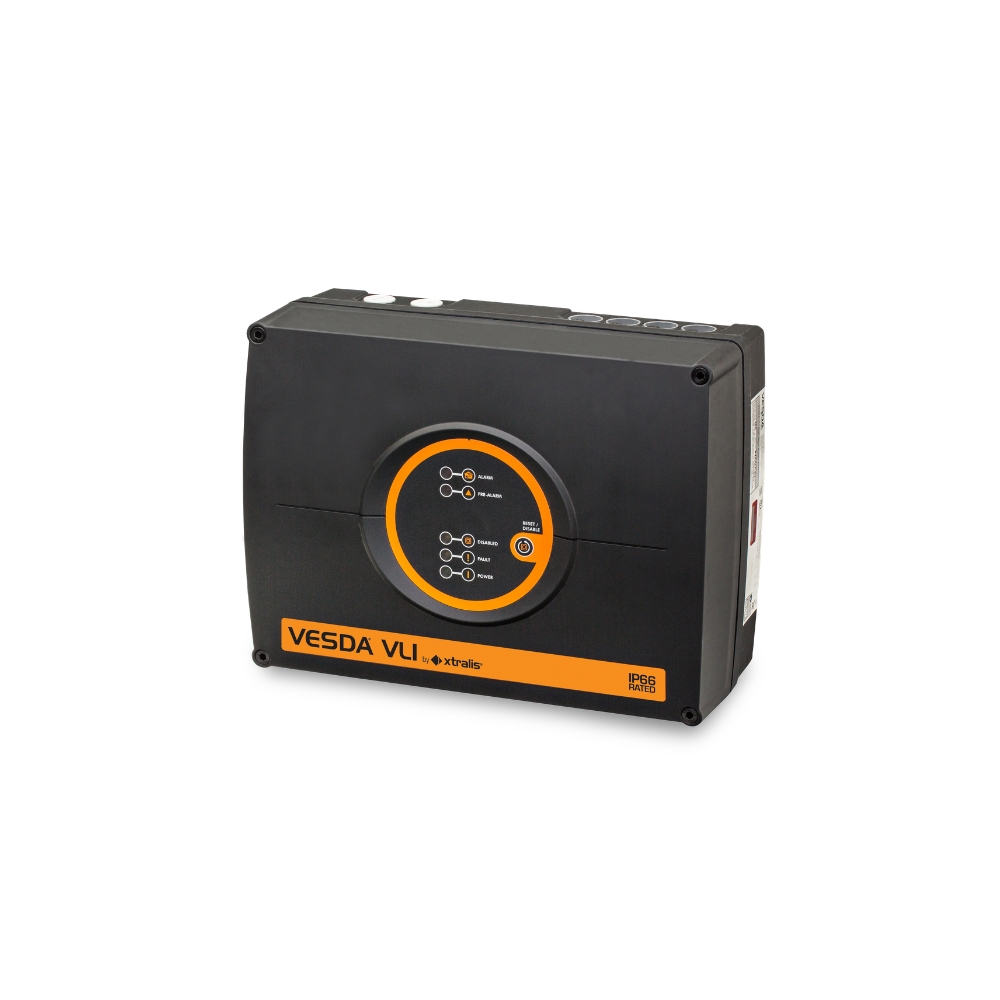
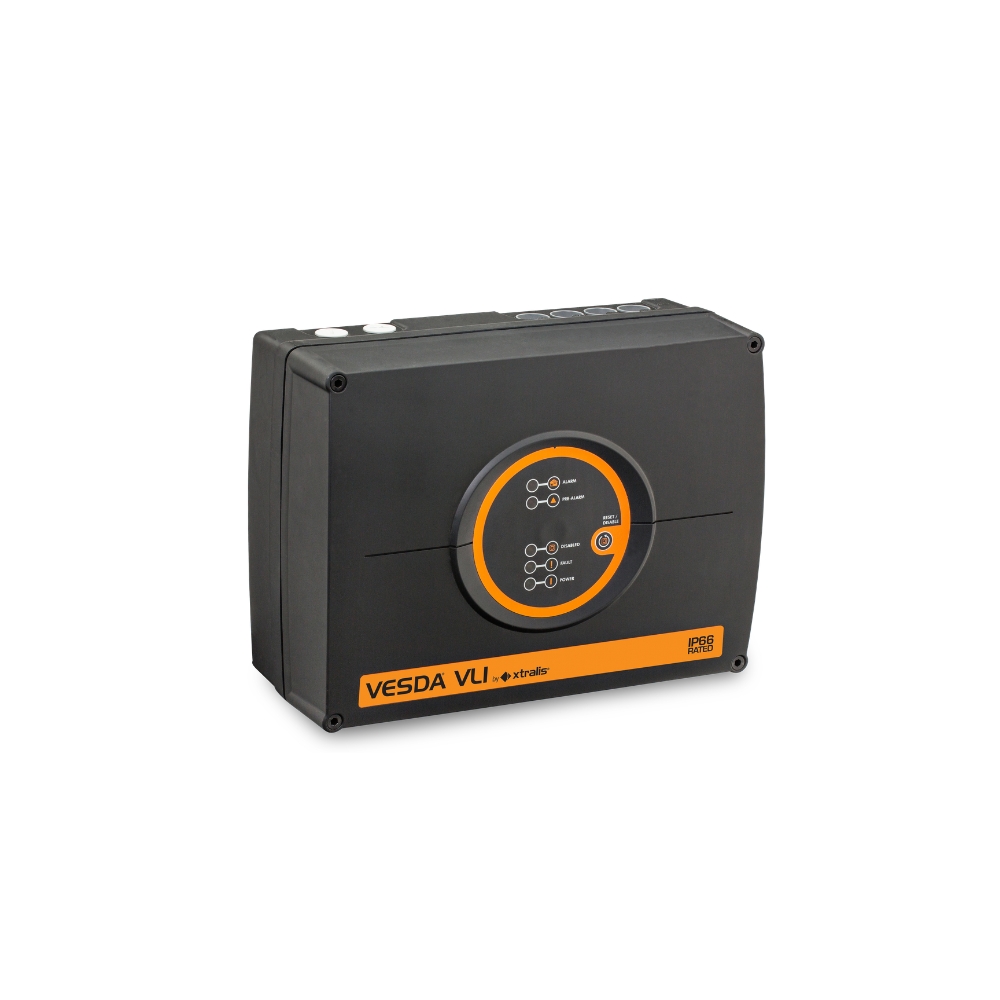
VESDA VLI
Aspirating Smoke Detector
The VESDA VLI is built for the environments that defeat other aspirating smoke detectors. Dust, lint, oil mist and airborne fibres normally clog filters and coat optics until the detector spends more time in fault than in service. The VLI answers that with four stages of air treatment and a clean air barrier over the optics, in an IP66 housing that needs no external enclosure.
KEY BENEFITS
- IP66 enclosure removes the need for an expensive external housing on most industrial sites
- Fail-safe Intelligent Filter is fully monitored, so sensitivity stays consistent across the detector's life
- Absolute detection with no recalibration required, even after years in a dirty atmosphere
- Four stage air treatment before the chamber: intelligent filter, lint trap, inertial separator and secondary filter
- Covers up to 2,000 square metres with 360 metres of pipe across up to four inlets
+ more in the Description tab below
Built for the Environments That Defeat Other Detectors
Aspirating smoke detection has a weakness in dirty air. The system works by continuously drawing air through a filter and into an optical chamber, which means it also continuously draws in whatever else is in that air.
In a mine, a conveyor gallery, a processing plant or a petrochemical facility, that means dust, lint, fibres and oil mist. Filters clog, optics get coated and sensitivity drifts. The detector ends up either in fault, or recalibrated to the point where it’s no longer doing its job. On many industrial sites, aspirating detection has been ruled out for exactly this reason.
The VLI is the answer to that specific problem. Xtralis describes it as an industry first early warning aspirating detector for industrial applications and harsh environments, and the air treatment is where the engineering sits.
Four Stages Before the Chamber
Air passes through four separate stages before it reaches the detection chamber.
The Intelligent Filter splits the air sample. A smaller, unfiltered portion passes through a set of ultrasonic flow sensors, while the larger portion passes through a HEPA filter. That dramatically reduces the contaminants reaching the aspirator and detection chamber, extending the detector’s life in harsh conditions. Filter loading is constantly monitored, so the detector maintains consistent sensitivity across its whole operating life, rather than degrading silently.
A lint trap captures fibrous particles, the material that defeats most filters in textile, timber and agricultural environments.
A sub sampling probe acts as an inertial separator. Larger dust particles are less likely to pass through it, so they’re exhausted out of the detector rather than reaching the chamber.
A secondary filter provides the final stage. A third filter inside the chamber assembly then creates a clean air barrier that protects the optical surfaces.
That combination is what allows absolute detection without recalibration. On an industrial site, that’s the difference between a system that stays trustworthy and one that gets adjusted until it isn’t.
IP66, and Why That Saves Money
The enclosure is rated IP66, giving complete protection against dust and against strong water jets from any direction.
That does something specific to the installed cost. In most industrial applications, and particularly in very harsh environments, it removes the need for an expensive external IP enclosure. The detector goes on the wall, rather than inside a purpose bought housing that then has to be sealed and maintained in its own right.
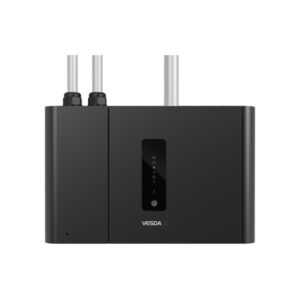
The external housing has a rubberised finish, and a steel support bracket makes mounting easy.
Two Models
| Model | Status reporting | Notes |
|---|---|---|
| VLI-880 | Relay outputs | Standard VLI |
| VLI-885 | Relay outputs and VESDAnet | Contact us for availability |
Specify the VLI-885 where the detector needs to sit on an existing VESDAnet network alongside other VESDA detectors. The VLI-880 suits a standalone installation reporting through relays.
Both have five relays, rated 2 A at 30 VDC: one fire, one fault and three configurable, each set as latching or non latching. General purpose inputs and relays can be expanded, and optional remote displays are available, with or without seven extra relays.
Flow Monitoring
Airflow is monitored by four sets of ultrasonic flow sensors at the detector inlets, with air path monitoring across the network. By comparing those readings with the unfiltered path in the Intelligent Filter, the detector tracks how the filter is loading and adjusts to keep sensitivity consistent.
Clean Air Zero is a user initiated feature that draws clean air into the chamber and takes a reference reading of the background, which supports consistent absolute detection and guards against nuisance alarms. Referencing takes account of external environmental conditions, where the outside air itself is the source of a nuisance alarm.
Commissioning and Maintenance
AutoLearn Smoke and Flow reduces setup time and sets alarm and flow thresholds from the actual conditions on site. Xtralis recommends running it for at least 14 days. In a variable industrial atmosphere, that’s more valuable than in a controlled one, because nobody can predict from a drawing what normal looks like in a conveyor gallery.
The detector is modular, with field replaceable parts, so a fault is repaired in place rather than by removing the unit. A local USB configuration port and easy access cable terminations reduce time on site, and the pipe ports accept both imperial and metric pipe.
ASPIRE handles pipe network design, and Xtralis VSC and VSM4 cover configuration, commissioning and maintenance. The VLI is compatible with existing VESDA installations. All alarms, service and fault events are logged with time and date stamps, holding up to 18,000 events.
Where It’s Used
Mines and underground infrastructure. Conveyors and transfer points. Manufacturing and processing plants. Petrochemical facilities. Timber and joinery works. Textile production. Waste and recycling facilities. Grain handling and agricultural storage. Cement and quarry plant. Warehouses with dusty operations. Workshops and vehicle maintenance areas. Any space where an aspirating detector would once have been ruled out because of contamination.
Benefits
- IP66 enclosure removes the need for an expensive external housing on most industrial sites
- Fail-safe Intelligent Filter is fully monitored, so sensitivity stays consistent across the detector's life
- Absolute detection with no recalibration required, even after years in a dirty atmosphere
- Four stage air treatment before the chamber: intelligent filter, lint trap, inertial separator and secondary filter
- Covers up to 2,000 square metres with 360 metres of pipe across up to four inlets
- Five relays, one fire, one fault and three configurable as latching or non-latching
- Ultrasonic flow sensing on all four inlets, with air path monitoring
- Five high intensity status LEDs, readable across a plant floor
- Approved to EN 54-20, FM, ActivFire, LPCB and SIL 2 (IEC 61508)
- Rubberised external housing and a steel support bracket for industrial mounting
Detector type
Industrial aspirating smoke detector, VESDA Laser Industrial
Models
VLI-880. VLI-885 adding VESDAnet (contact us for availability)
Area coverage
Up to 2,000 m²
Inlet pipes
Up to four
Total pipe length
Up to 360 m
Detection
Robust absolute smoke detection, no recalibration required
Air treatment
Intelligent Filter, lint trap, sub-sampling probe as inertial separator, and secondary filter
Filter monitoring
Fully monitored and fail-safe, providing consistent sensitivity over the detector's operational life
Optics protection
Clean air barrier
Flow sensing
Four sets of ultrasonic flow sensors, with air path monitoring
Zero reference
Clean Air Zero
Environmental compensation
Referencing
Commissioning
AutoLearn Smoke and Flow
Relays
Five, rated 2 A at 30 VDC. Fire (NO), fault (NC), three configurable (NO). Each latching or non latching
Expansion
General purpose inputs and relays expandable
Status indication
Five high intensity LEDs
Ingress protection
IP66, full dust protection and protection against strong water jets from all directions
Housing
Rubberised external finish, steel support bracket for mounting
Serviceability
Modular field replaceable parts
Configuration
Local USB port
Pipe ports
Imperial and metric
Hazardous location approval
Class 1 Division 2, Groups A, B, C and D
Certification
FM, ActivFire, CE, UKCA, LPCB, NF. SIL 2 per IEC 61508. EN 54-20: Class A (24 holes), Class B (28 holes), Class C (60 holes)
Software support
ASPIRE for pipe design, Xtralis VSC and VSM4
Integration
Relay outputs. VESDAnet on VLI-885. Compatible with existing VESDA installations
EN 54-20 classification
Determined by the pipe design and hole count, calculated in ASPIRE
Sensitivity range
0.05% to 20% obs/m
Threshold ranges
Alert: 0.05% to 1.99% obs/m. Action: 0.1% to 1.995% obs/m. Fire 1: 0.15% to 2.0% obs/m. Fire 2: 0.155% to 20% obs/m
Supply voltage
18 to 30 VDC
Power consumption at 24 VDC
10 W nominal, 10.5 W in alarm
Dimensions and weight
426.5 x 316.5 x 180 mm. 6.035 kg
Operating conditions
Ambient 0°C to 38°C. Sampled air -20°C to 60°C. Humidity 10% to 95% RH, non condensing
Airflow and pipe limits
Minimum total airflow 40 L/min, minimum per pipe 20 L/min. Maximum single pipe length 120 m. Pipe internal diameter 15 to 21 mm, external diameter 25 mm
Cable access
4 x 25 mm cable entries. Screw terminals 0.2 to 2.5 mm²
Event log
Up to 18,000 events, with time and date stamp
General purpose input (5 to 30 VDC)
External reset, mains OK, standby, isolate, night time threshold, reset and isolate, inverted reset
Remote displays
Optional VESDA VLI remote display, with 7 relays or without relays
- Aviation & Transportation
- Carpark & HVAC
- Chemical Manufacturing
- Energy (Oil & Gas)
- Food & Beverage
- Landfill & Remediation
- Marine & Maritime
- Mining & Minerals
- Power Generation & BESS
- Technology & Semiconductor
- Water & Wastewater
Dirty air is the weakness of aspirating detection, because the system continuously draws in whatever is in the atmosphere. The VLI treats the air in four stages before it reaches the chamber and protects the optics with a clean air barrier.
No. Absolute detection combined with the monitored filter and the clean air barrier maintains consistent sensitivity across the detector's operational life without recalibration.
On most industrial applications, no. The IP66 housing gives full dust protection and protection against strong water jets, which removes the cost of a separate enclosure.
The VLI-885 adds VESDAnet, which you need if the detector has to sit on an existing VESDA network. The VLI-880 reports through relay outputs. Talk to our Technical Consultants about VLI-885 availability.
Up to 2,000 square metres, using up to four inlet pipes and 360 metres of pipe in total.
Four sets of ultrasonic flow sensors monitor airflow at the inlets. By comparing them with a sensor in the unfiltered path of the Intelligent Filter, the detector tracks filter loading and keeps sensitivity consistent across its life.
Trusted by









Contact Us
Can’t find what you’re looking for? Our team is happy to help.