
VESDA-E VEA
Addressable Aspirating Smoke Detector
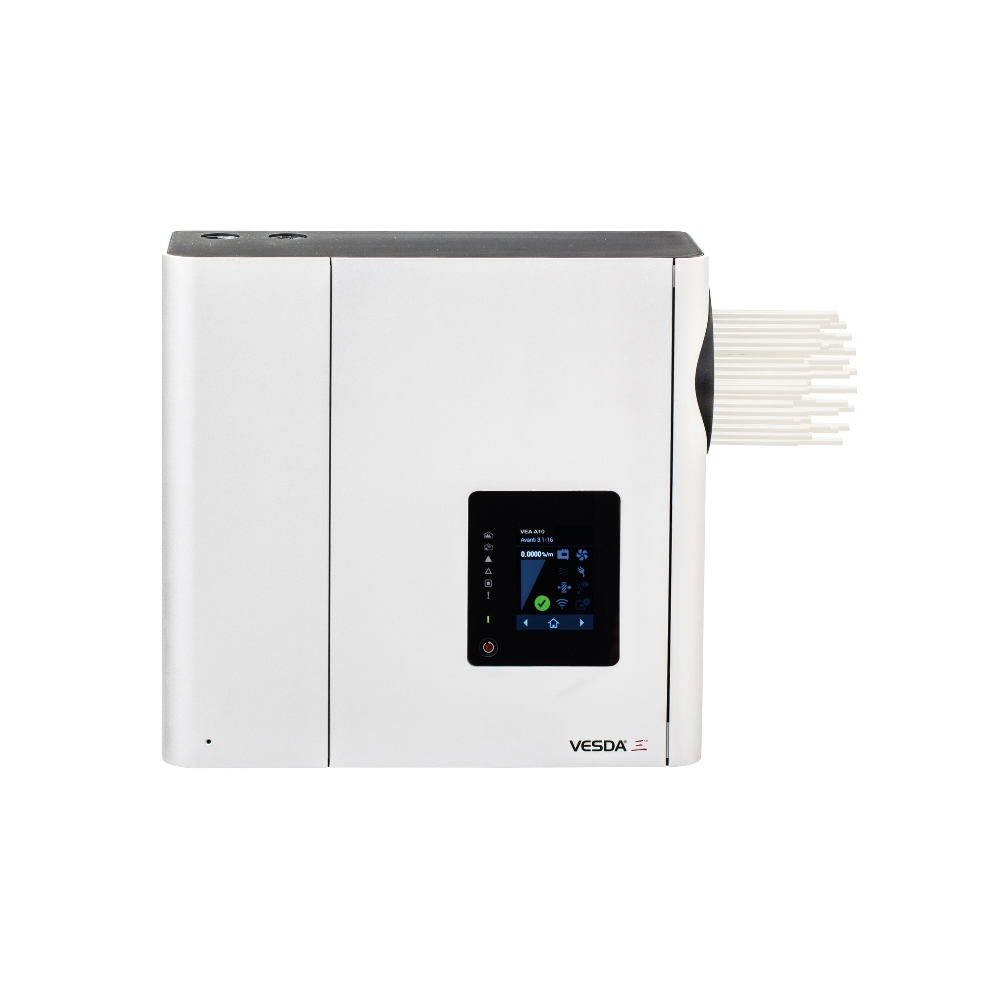
Conventional aspirating detection tells you there’s smoke somewhere in the pipe network. The VESDA-E VEA tells you which of up to 40 sampling points found it. Flexible microbore tubes, up to 100 metres each, run to individual sampling points. Each one is monitored for blockage and breakage, cleaned automatically, and tested from the detector, rather than by entering 40 rooms.
KEY BENEFITS
- Pinpoints which of up to 40 sampling points detected smoke, rather than only that smoke exists
- Flexible microbore tubes to each sampling point, up to 100 metres per tube
- Automatic sampling point cleaning at set intervals, so points do not block and stay blocked
- Automatic detection of tube breakage and sampling point presence at set intervals
- Single point and single tube blockage detection, so a fault is located not just reported
+ more in the Description tab below
Knowing Where, Not Just Whether
This is the capability that separates the VEA from the rest of aspirating detection, and it opens up applications the others can’t serve.
A conventional aspirating detector samples a whole pipe network into one chamber. When it alarms, it tells you smoke is present somewhere along that network. In a warehouse or a plant room, that’s enough, because the whole space is one area and the response is the same wherever it started.
It isn’t enough in a building divided into rooms: a hotel corridor, a hospital ward, a school, an office floor, a prison wing, a block of apartments. Knowing that smoke is somewhere across 40 rooms isn’t actionable in the way knowing which room is.
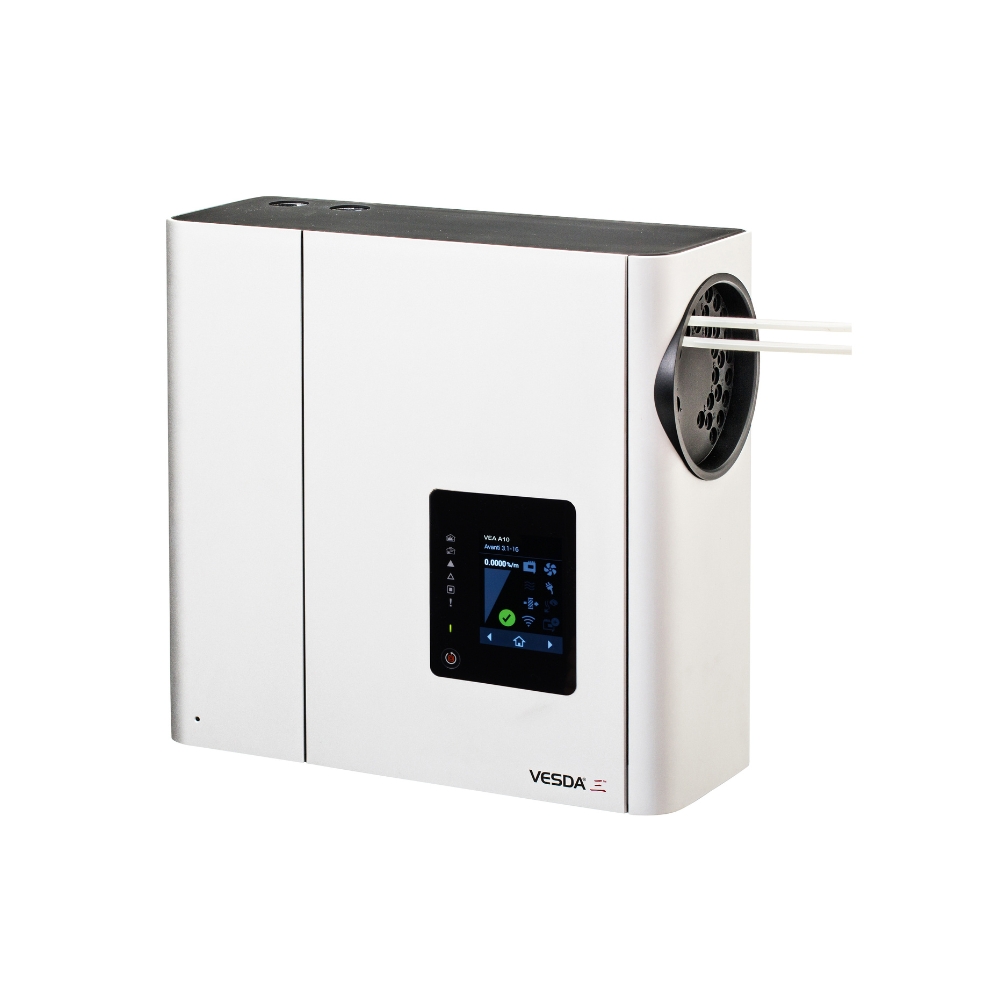
The VEA solves that with a separate microbore tube to each sampling point. It draws a combined air sample from all of them into a laser detection chamber. When a Fire 1 alarm is raised, a rotary valve then scans the sampling locations one by one to identify which point the smoke came from. In pre alarm, a smoke scan can also be started manually to help investigate the source. That turns an alarm into a location.
Electrical Cabinets
This is worth calling out on its own, because it’s one of the VEA’s strongest applications.
Detecting a fire inside a switchboard or electrical cabinet is difficult. A point detector inside a cabinet is impractical to install and service, and a detector outside it only responds after the fire has left the enclosure. Running a microbore tube into each cabinet gives detection inside the enclosure, and tells you which cabinet, with all the equipment mounted in one accessible place.
On a switchroom with 30 cabinets, that’s one detector, 30 tubes and a single point of maintenance.
It Checks and Cleans Itself
A microbore tube is narrow, so blockage is a legitimate concern. The VEA is designed around that.
Sampling points are cleaned automatically at set intervals. Tube breakage and sampling point presence are checked automatically at set intervals too, so a tube disconnected during other building work is picked up, rather than silently protecting nothing. Single sampling point and single tube blockage detection means a fault is located, not just reported, which is the difference between a fix and a search.
That end to end system integrity monitoring is what allows a 40 point system to be trusted. Without it, a network of narrow tubes across a building would be a maintenance liability.
Testing 40 Rooms Without Entering Them
Local smoke test ports at the detector are used during servicing to verify the system is fully working. Testing and maintenance happen in one accessible place, without interrupting the building.
Consider what that replaces. Testing point detectors in a hotel means booking out rooms or working around guests, floor by floor. In a hospital, it means access to wards. In a prison, it means an escort. In an office, it means after hours. The VEA does it from a plant room, with the building operating normally.
Field replaceable filter, smoke sensor module, pump and rotary valve mean less downtime, with repairs done on site rather than by removing the detector.
Sensitivity per Point
Three alarm sensitivity settings are available for the sampling points, which matters in a building where rooms aren’t the same. The Fire 1 threshold at the sampling hole can be set to high (1.6% obs/m), enhanced (4.0% obs/m) or standard (8.0% obs/m).
A server room and a kitchen on the same detector need different thresholds. Without per point sensitivity, either the kitchen generates nuisance alarms or the server room is under protected. Setting them individually means one detector can cover a mixed floor without a compromise that weakens both.
Two pre alarm levels, Alert and Action, sit below Fire 1.
Installation
Flexible microbore tubes are considerably faster to install than rigid sampling pipe, and they route through a building more easily. Normal diameter tube runs up to 100 metres per tube, and reduced diameter tube up to 15 metres, with tubes of different lengths on the same detector. A linear vacuum pump gives fast detection times over long tube lengths.
The detector has an IP40 enclosure and mounts easily on a steel support bracket. During commissioning, a normalisation process establishes the flow performance for the network as built.
Two Models
| Model | Interface |
|---|---|
| VEA-040-A00 | LEDs showing alarm, trouble, disable and power status, with a reset and disable button |
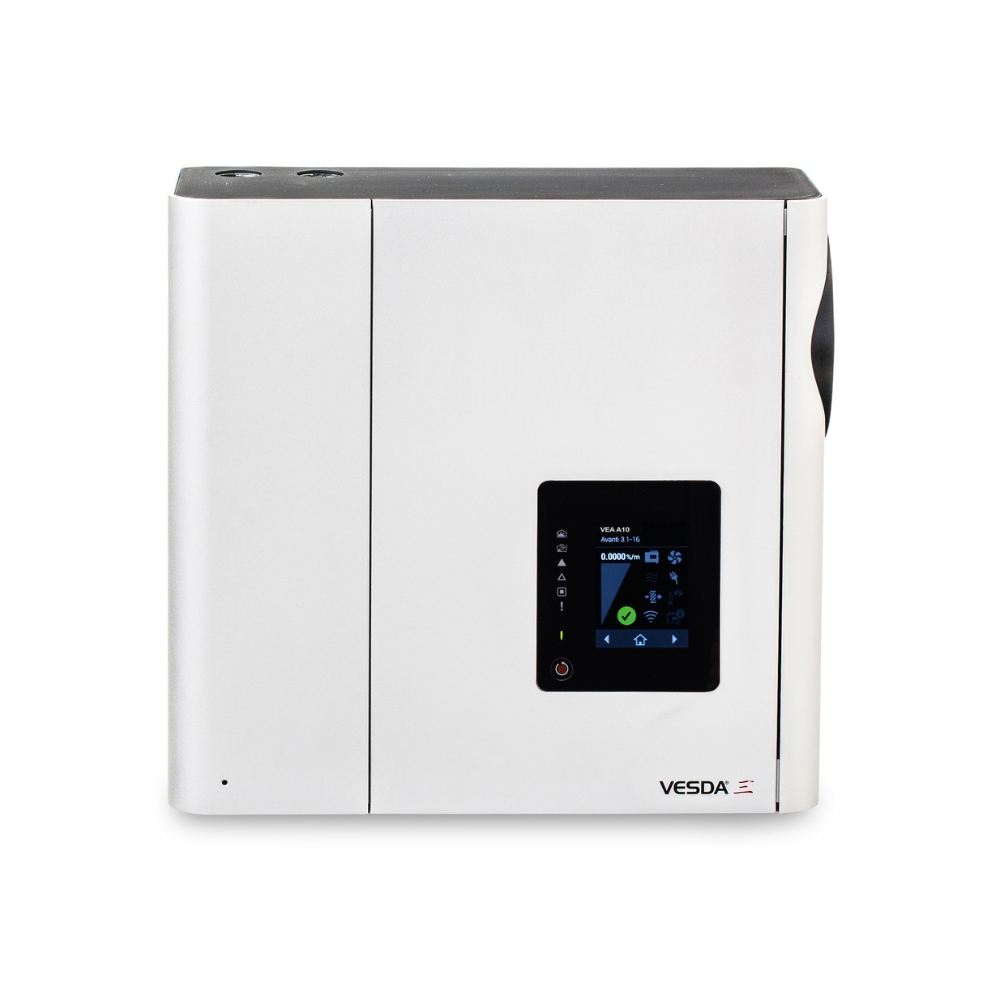
| VEA-040-A10 | LEDs plus a 3.5 inch colour touch screen showing alarm and fault conditions and smoke level |
On a system with 40 addresses, having that information at the detector is worth it, because that’s where someone will be standing when they need it.
Outputs and Connectivity
Seven programmable relays, each latching or non latching, and two general purpose inputs (one monitored, one unmonitored) are standard. Alarms and fire location can be signalled through the relays and VESDAnet. The optional 40 relay Local StaX module can identify and signal fire source locations on a fire panel loop.
Ethernet is used for configuration and secondary monitoring, and a USB port handles field installation and maintenance. VESDAnet provides two way communication with redundancy, so the network keeps running through a single point wiring failure. Up to 20,000 events are logged, with time and date stamps.
Where It’s Used
Hotels and accommodation. Hospitals and healthcare facilities. Schools and universities. Offices and commercial floors. Correctional facilities. Retail. Electrical cabinets and switchrooms. Data centres. Aged care. Any building divided into rooms where knowing which room matters, and any application where testing needs access to occupied space.
Benefits
- Pinpoints which of up to 40 sampling points detected smoke, rather than only that smoke exists
- Flexible microbore tubes to each sampling point, up to 100 metres per tube
- Automatic sampling point cleaning at set intervals, so points do not block and stay blocked
- Automatic detection of tube breakage and sampling point presence at set intervals
- Single point and single tube blockage detection, so a fault is located not just reported
- Centralised testing and maintenance from the detector, with no need to enter occupied rooms
- Three sensitivity settings per sampling point, so different rooms can be set differently
- Laser based absolute detection with coarse particle filtering and a clean air barrier
- Field replaceable filter, smoke sensor module, pump and rotary valve
- ActivFire listed to ISO 7240-20, with EN 54-20 Class A, B and C, VdS and FM approvals
Detector type
Addressable aspirating smoke detector
Models
VEA-040-A00 with LEDs, VEA-040-A10 with 3.5 inch colour display
Addressable sampling points
Up to 40
Sampling method
Multi-channel microbore air sampling with patented air sampling points
Detection
Laser based, absolutely calibrated
Sensitivity settings
Three, selectable per sampling point
Alarm thresholds
Alert and Action pre alarms, then Fire 1. Fire 1 at the sampling hole: high 1.6% obs/m, enhanced 4.0% obs/m, standard 8.0% obs/m
Microbore tube length
Normal diameter: up to 100 m per tube. Reduced diameter: up to 15 m per tube. Variable lengths supported
Tube connection
Flexible microbore tube with push-fit connectors
Filtration
Coarse particle filtering with clean air barrier for optics protection
System integrity
End to end monitoring. Automatic tube breakage and sampling point presence detection at set intervals
Blockage detection
Single sampling point and single tube blockage detection at set intervals
Self cleaning
Automatic sampling point cleaning at set intervals
Testing
Local smoke test ports for centralised verification during servicing
Serviceability
Field replaceable filter, smoke sensor module, pump and rotary valve
Commissioning
Normalisation process establishes flow performance parameters
Connectivity
USB 2.0, Ethernet (RJ45, 100BASE-T), VESDAnet
Expansion
VESDA-E VEA 40 relay Local StaX module
Ingress protection
IP40
Software support
Xtralis VSC and VSM4
Approvals
EN 54-20 and ISO 7240-20 (Class A, B and C), CE, UKCA, VdS, ActivFire (ISO 7240-20), FM
Integration
Fire warning and suppression release systems, and building management systems
- Aviation & Transportation
- Carpark & HVAC
- Chemical Manufacturing
- Energy (Oil & Gas)
- Food & Beverage
- Landfill & Remediation
- Medical & Healthcare
- Mining & Minerals
- Power Generation & BESS
- Technology & Semiconductor
- Water & Wastewater
Conventional aspirating detection tells you smoke is present somewhere in the pipe network. The VEA identifies which of up to 40 sampling points found it.
Up to 40 individually addressable sampling points. Normal diameter microbore tube runs up to 100 metres per tube, and tubes can be different lengths.
Sampling points are cleaned automatically at set intervals, and single point and single tube blockage detection locates a blockage rather than only reporting one.
From the detector, using local smoke test ports during servicing. That avoids entering occupied rooms to test each point.
Yes, three sensitivity settings are available per sampling point, so a server room and a kitchen on the same detector can be set differently.
Yes, and it is one of the strongest applications. A microbore tube runs into each cabinet, giving detection inside the enclosure and identifying which cabinet, with all equipment in one accessible location.
Trusted by









Contact Us
Can’t find what you’re looking for? Our team is happy to help.