
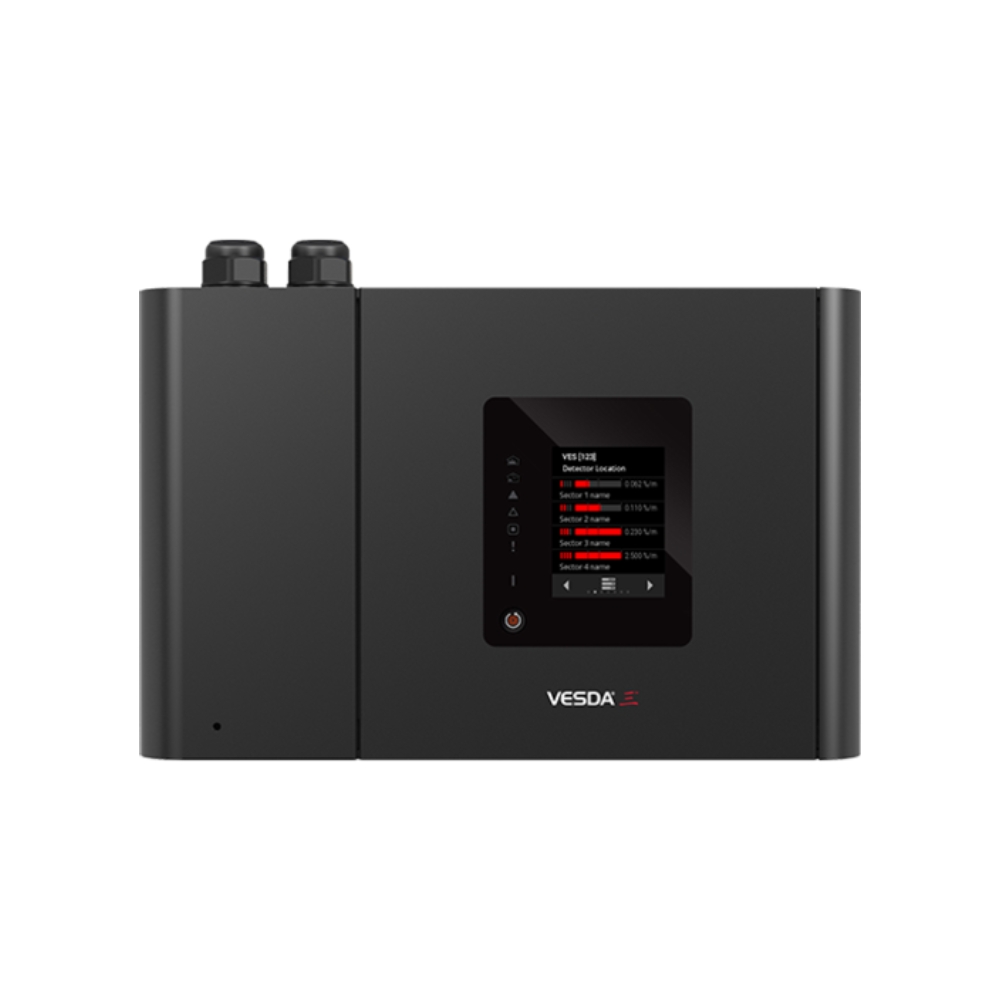
VESDA-E VES
Sector Addressable Aspirating Smoke Detector
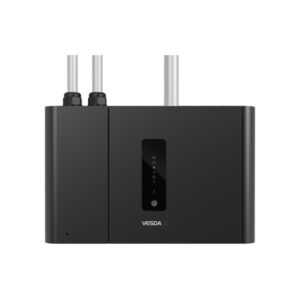
The VESDA-E VES divides one detection zone into four separate sectors and tells you which sector the smoke came from. A valve mechanism in the inlet manifold controls airflow from each of the four pipes. When smoke is detected the detector scans each sector, identifies the source, then keeps monitoring all four to track how the fire develops.
KEY BENEFITS
- Divides one zone into four individually addressable sectors, so the search area shrinks
- Identifies the First Alarm Sector, then continues monitoring all four to track fire growth
- Four configurable alarm levels per sector, not per detector
- Fast Scan identifies the sector carrying smoke once the adaptive scan threshold is crossed
- Same Flair detection technology and sensitivity as the VEP, with sector awareness added
+ more in the Description tab below
Four Sectors From One Detector
A four pipe aspirating detector normally samples all four pipes into one chamber. It tells you smoke is present somewhere across the whole network.
The VES adds a valve mechanism to the inlet manifold and the software to control it. That lets the detector isolate and sample each pipe individually. So the four pipes become four sectors, and one detection zone becomes four addressable sub-zones.
The example Xtralis use is a data room, where each pipe covers a separate aisle. That is the case where knowing the zone is not enough. Responding means walking down the right aisle rather than searching all of them.
How The Scan Works
The sequence is worth understanding, because it explains why the VES does not lose the continuous monitoring that makes aspirating detection valuable.
In normal operation the detector draws air from all four pipes simultaneously, exactly as a standard four pipe detector does. Nothing is given up in sensitivity or response.
When the smoke level crosses an adaptive scan threshold, the detector initiates a Fast Scan of each sector individually. The sector with the highest smoke concentration is designated the First Alarm Sector and signalled to the user.
Once the scan is complete and the source identified, the detector returns to sampling all four sectors and continues to monitor them, reporting separate alarm levels for each. So it tells you where the fire started, then how it is spreading. That is more useful than either alone.
Alarm indication per sector is retained until a reset is applied.
Four Alarm Levels Per Sector
Each sector carries its own Alert, Action, Fire 1 and Fire 2 thresholds, individually configurable.
That matters where the four sectors are not the same. In a mixed building one pipe might cover a server aisle and another a plant space, and those need different thresholds. Setting them per sector means one detector covers both without a compromise that weakens either.
Flow fault thresholds are also set per port. So a busy sector and a still one are each monitored against what is normal for them, rather than against one detector wide figure.
The Same Detection As The VEP
The VES is built on the VEP platform, so the detection performance is the same and the sector capability is added rather than traded for.
Flair is the detection chamber at the core of it, using CMOS imaging, multi-directional light scattering and characterisation algorithms. Rather than only measuring how much light is scattered, it images the particles and characterises them. That is what separates smoke from dust, steam and exhaust. Multi stage filtration with clean air barriers protects the optics, and absolute calibration keeps performance consistent across the detector’s life without drift compensation.
Total pipe length is up to 560 metres and area coverage up to 2,000 square metres.
Two Models
| Model | Interface |
|---|---|
| VES-A00-P | LED status indication |
| VES-A10-P | 3.5 inch display with sector status |
The display version is worth more on this detector than on the others in the range, because there is more to show. It presents smoke levels as a bar graph and indicates fault conditions. When the adaptive scan threshold is exceeded it transitions automatically to a sector status page showing smoke and alarm levels for each sector.
That means the person standing at the detector during an event sees which sector is affected without needing software or a panel to tell them.
Replacing A VLS
The VES is compatible with existing VESDA installations and occupies the same mounting footprint and the same pipe, conduit and electrical connector positions as the VESDA VLS.
It also works on existing VESDAnet installations alongside legacy detectors. So an ageing VESDA system can be upgraded progressively rather than as one project, reusing the pipe network already in place.
Connectivity
Ethernet and WiFi are standard, allowing a tablet or PC running Xtralis monitoring and configuration software to connect wirelessly through the corporate network. VESDAnet provides bi-directional communication with redundancy, so the network keeps operating through a single point wiring failure. Alarms can be signalled by relay, by VESDAnet, or both.
AutoConfig provides out of box operation, with AutoLearn smoke and flow setting thresholds from the conditions in the building. ASPIRE handles pipe network design and Xtralis VSC covers configuration, commissioning and maintenance.
Where It Is Used
Data centres and server rooms, with one sector per aisle. Switchrooms and electrical infrastructure. Warehouses divided into bays or racking runs. Manufacturing floors with distinct process areas. Cold stores with separate chambers. Archives and record storage. Telecommunications facilities. Any single zone large enough that responding to an alarm means searching, and divisible into four areas worth identifying separately.
Benefits
- Divides one zone into four individually addressable sectors, so the search area shrinks
- Identifies the First Alarm Sector, then continues monitoring all four to track fire growth
- Four configurable alarm levels per sector, not per detector
- Fast Scan identifies the sector carrying smoke once the adaptive scan threshold is crossed
- Same Flair detection technology and sensitivity as the VEP, with sector awareness added
- Covers up to 2,000 square metres with 560 metres of total pipe length
- Display transitions automatically to sector status when the scan threshold is exceeded
- Flow fault thresholds per port, so sectors with different airflow are each monitored properly
- Uses standard sampling pipe, not microbore, so an existing four pipe layout can be adapted
- Backward compatible with VESDA VLS, using the same mounting footprint and connections
Detector type
Sector addressable aspirating smoke detector
Models
VES-A00-P with LEDs, VES-A10-P with 3.5 inch display
Sectors
Four individually addressable inlet pipes
Sector control
Valve mechanism in the inlet manifold, controlled by detector software
Detection technology
Flair detection chamber, CMOS imaging with multi-directional light scattering and particle characterisation
Source identification
Fast Scan on crossing the adaptive scan threshold, designating the First Alarm Sector
Ongoing monitoring
Continues sampling all four sectors after the scan, reporting separate alarm levels per sector
Alarm levels
Four per sector: Alert, Action, Fire 1 and Fire 2, individually configurable
Alarm retention
Per sector indication retained until reset
Flow fault thresholds
Per port
Area coverage
Up to 2,000 m²
Total pipe length
Up to 560 m
Pipe size
25 mm external diameter, or 3/4 inch IPS
Cable entries
Four, 26 mm
Filtration
Multi stage, with clean air barriers protecting the optics
Calibration
Absolute, no drift compensation required
Commissioning
AutoConfig, plus AutoLearn smoke and flow
Connectivity
Ethernet and WiFi standard, plus VESDAnet
Alarm signalling
Relays and VESDAnet
Backward compatibility
Same mounting footprint, pipe, conduit and connector positions as VESDA VLS
Software support
ASPIRE for pipe design, Xtralis VSC for configuration and maintenance
EN 54-20 classification
Determined by the pipe design and hole count, calculated in ASPIRE
- Aviation & Transportation
- Carpark & HVAC
- Chemical Manufacturing
- Energy (Oil & Gas)
- Food & Beverage
- Landfill & Remediation
- Medical & Healthcare
- Mining & Minerals
- Power Generation & BESS
- Technology & Semiconductor
- Water & Wastewater
The four inlet pipes become four separately monitored sectors, so the detector reports which sector the smoke came from rather than only that smoke is present in the network.
No. It samples all four pipes together in normal operation, scans individually only once the adaptive scan threshold is crossed, then returns to monitoring all four.
Fast Scan samples each sector and designates the one with the highest smoke concentration as the First Alarm Sector.
The VES gives four sectors using standard sampling pipe. The VEA gives up to 40 individual points using microbore tube. Sectors suit dividing a large open zone, individual points suit a building divided into rooms.
Yes. It uses the same mounting footprint and the same pipe, conduit and electrical connector positions, and works on existing VESDAnet installations.
Yes, all four alarm levels are individually configurable per sector, and flow fault thresholds are set per port.
Trusted by









Contact Us
Can’t find what you’re looking for? Our team is happy to help.