
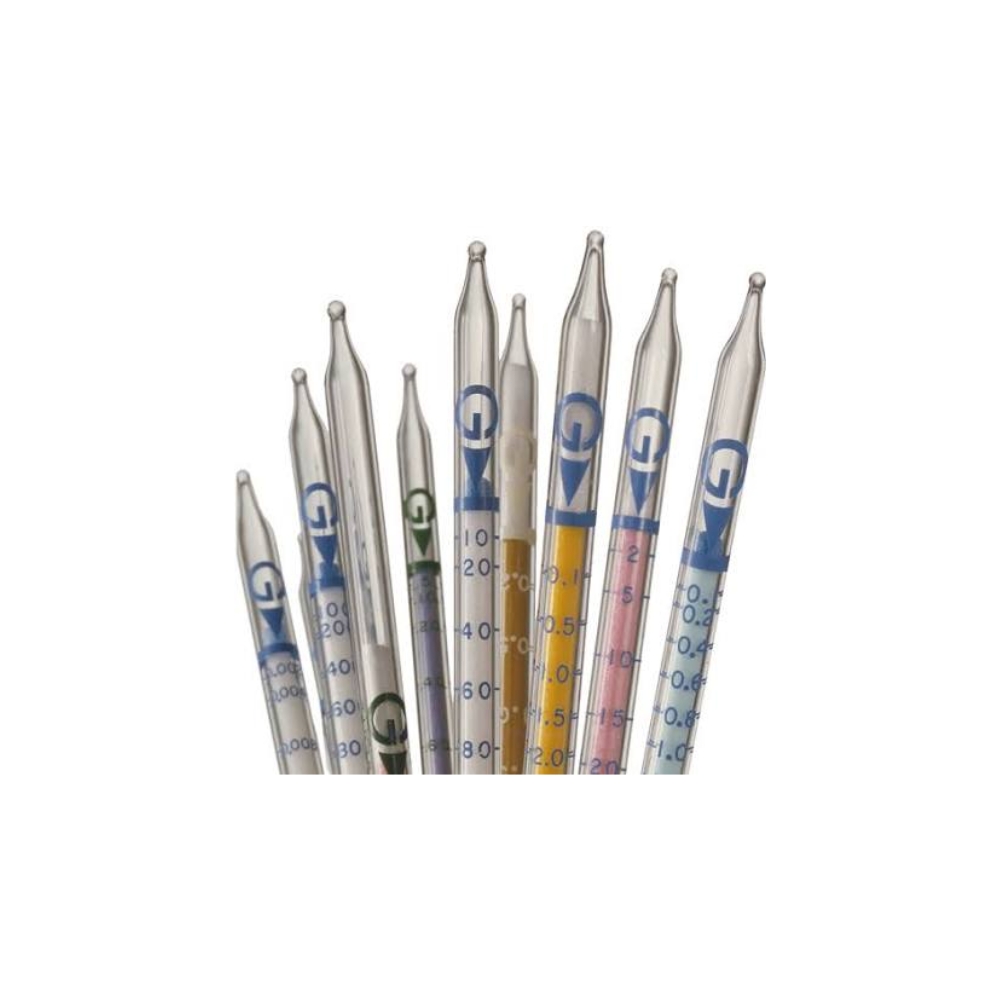
Polytec Tubes
Multi-Gas Qualitative Tubes
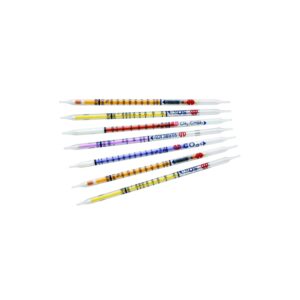
Polytec tubes answer the question no other gas detection product does, which is what is in there rather than how much. Each tube holds up to eight reaction layers, each responding to a different substance, so one tube evaluates up to fifteen gases and shows what is present. Five tubes cover it, one screening a genuinely unknown atmosphere and four targeted at defined gas groups. They use the same GV-100S pump as standard Gastec tubes.
KEY BENEFITS
- Identifies what is present rather than measuring a substance you already know about
- Between one and eight reaction layers in a single tube, each responding to a different substance
- A single tube evaluates up to fifteen gases
- No. 107 screens a genuinely unknown atmosphere with no defined gas list
- Four targeted panels covering odour, hydrocarbon, industrial and combustion gas groups
+ more in the Description tab below
The Question Nothing Else Answers
Other gas detection products answer how much. Polytec tubes answer what is it.
A standard detector tube measures one substance you already know is there. That works because a risk assessment has identified the hazard in advance. It fails completely when nobody knows what has been released, which is when the measurement matters most.
Three situations cause that.
A release where nobody knows what has escaped: a transport incident, a spill, an unlabelled drum, or an unexplained odour in a building.
A confined space with an undocumented history: a vessel, tank or container whose previous contents are unknown, where the residue rather than the current contents is the hazard.
A fire, where the combustion products are the hazard, and they depend entirely on what burned.
In all three, no electronic instrument answers the first question. A four gas detector covers four gases and says nothing about the hundreds of others. A photoionisation detector tells you volatile organics are present without identifying which. Polytec tubes narrow it down.
How the Layers Work
A Polytec tube has between one and eight reagent layers stacked along its length, rather than one reagent filling it. Each layer responds to a different substance, and one tube evaluates up to 15 gases.
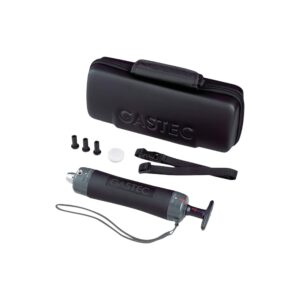
Draw a sample through with a Gastec GV-100S pump, wait the sampling time, and the layers react according to what’s in the air. The pattern of colours across them shows what’s present.
The result is qualitative, not quantitative. It tells you the sample contains, for example, hydrogen sulphide and sulphur dioxide, which is enough to choose the specific tubes to measure them. Polytec is the step before the measurement, not a substitute for it.
Interpretation is against the chart supplied with the tube, and it’s a genuine skill rather than a simple reading. Anyone planning to use these during an incident should practise on known samples first.
The Five Polytec Tubes
| Gases covered | Tube no. and name | Type | Pump strokes | Shelf life |
|---|---|---|---|---|
| Unknown gases | 107 Polytec Tube-1 | Qualitative | 3 | 3 years |
| NH3, SO2, H2S, CO, NO2, mercaptans | 25 Polytec Tube-2 | Qualitative | 1 | 2 years |
| NH3, H2S, hydrocarbons | 26 Polytec Tube-3 | Qualitative | 1 | 2 years |
| NH3, HCl, H2S, SO2, NO2, CO, CO2 | 27 Polytec Tube-4 | Qualitative | 1 | 18 months |
| HCl, phosgene, SO2, NO2, H2S, HCN, CO, CO2 | 28 Polytec Tube-5 | Qualitative | 1 | 18 months |
Note the numbering, because it catches people out. The tube names run from one to five, but the tube numbers don’t. Polytec Tube-1 is No. 107, and Tube-2 to Tube-5 are numbers 25 to 28. Order by number rather than by name.
Choosing Between Them
The five do two different jobs. One screens an unknown atmosphere, and four are targeted panels.
No. 107 is the one for a genuinely unknown atmosphere. It has no defined gas list because it’s a broad screen. It takes three pump strokes rather than one, and has the longest shelf life at three years. If you have no idea what’s been released, this is the starting point.
Comparing the gas lists of the other four shows what each is aimed at.
No. 25 covers ammonia, sulphur dioxide, hydrogen sulphide, carbon monoxide and nitrogen dioxide, and is listed with mercaptans, which puts it with sewer gas, decomposition, and the sulphur compounds behind most odour complaints.
No. 26 is the only one with a hydrocarbon layer, alongside ammonia and hydrogen sulphide. That suits fuel, solvent and organic release assessment.
No. 27 is the broad industrial panel, covering seven gases: ammonia, hydrogen chloride, hydrogen sulphide, sulphur dioxide, nitrogen dioxide, carbon monoxide and carbon dioxide.
No. 28 is the combustion and incident panel. It’s the only tube covering phosgene and hydrogen cyanide, both produced when chlorinated plastics and nitrogen containing materials burn. For fire attendance and post fire assessment, this is the one.
Hydrogen sulphide appears in all four panels, so any of them will pick it up.
One thing worth planning for: the two panels most likely to be bought and held for an incident, No. 27 and No. 28, have the shortest shelf life, at 18 months. So the tubes least likely to be used need the most attention to stock rotation. Put it in the diary, because a hazmat kit with expired tubes is worse than no kit.
For fire investigation, Gastec also makes the No. 108 Qualitative Analysis Tube, which detects kerosene and gasoline (petrol). It’s useful where an accelerant may have been involved. Talk to our Technical Consultants about availability.
Establish Airflow Before You Measure
This is a point from Gastec’s own procedure that’s easy to skip.
Before sampling, confirm which way the air is moving at the measurement site. A smoke tester set does this by producing visible white smoke.
It matters because a sample drawn from the wrong side of a release measures clean air. On a leak in a ventilated space, air movement decides where the substance actually is, and a negative result taken upwind is false reassurance.
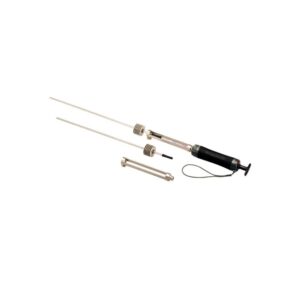
An extension hose connects to the pump for sampling at a distance, which puts the sample point somewhere the operator shouldn’t be standing.
What a Negative Result Means
It’s worth being precise, because this is the most likely route to a wrong conclusion.
If a layer doesn’t react, the concentration of that substance is below the level at which the reagent responds. That isn’t the same as the substance being absent.
So a Polytec tube showing no reaction means the atmosphere doesn’t contain those substances at detectable levels. It doesn’t clear the space, and it doesn’t rule out something at low concentration, or something outside that tube’s coverage.
For an entry decision, a Polytec result informs the assessment, rather than making it.
Where It Sits Against the Rest of the Range
Three tube types answer three different questions.
Colorimetric tubes measure a known substance at a known moment, covering more than 500 applications.
Dosimeter tubes measure accumulated exposure to a known substance over a shift, giving a time weighted average.
Polytec tubes identify what’s present when the substance isn’t known, so a standard tube can then be chosen. They come before the other two, not instead of them.
Colorimetric and Polytec tubes use the same Gastec GV-100S pump, which has a non sparking design. Dosimeter tubes need no pump at all.
Where It’s Used
Emergency response to an unknown release. Fire and rescue attendance and post fire assessment. Hazmat response. Transport incidents and spills. Unlabelled drums and containers. Confined space entry where previous contents are undocumented. Vessel and tank entry. Shipping container inspection. Odour complaint investigation. Sewer and wastewater assessment. Preliminary surveys before choosing specific detection equipment.
Benefits
- Identifies what is present rather than measuring a substance you already know about
- Between one and eight reaction layers in a single tube, each responding to a different substance
- A single tube evaluates up to fifteen gases
- No. 107 screens a genuinely unknown atmosphere with no defined gas list
- Four targeted panels covering odour, hydrocarbon, industrial and combustion gas groups
- No. 28 covers phosgene and hydrogen cyanide, the products of burning plastics
- Immediate identification on site, with no laboratory involved
- Uses the same GV-100S pump as standard Gastec detector tubes
- No power and no calibration, so a kit is ready when it is picked up
- Uses a non sparking Gastec pump, with no power or calibration needed
Product type
Qualitative multi layer detector tubes
Reaction layers
One to eight per tube, each responding to a different substance
Gases evaluated
Up to fifteen in a single tube
Result type
Qualitative, identifying what is present rather than measuring concentration
Tubes available
No. 107 Polytec Tube-1, No. 25 Tube-2, No. 26 Tube-3, No. 27 Tube-4, No. 28 Tube-5
Pump strokes
Three for No. 107, one for the others
Shelf life
Three years for No. 107, two years for No. 25 and 26, eighteen months for No. 27 and 28
Interpretation
Colour pattern read against the chart in the instruction sheet
Pump required
Yes. Gastec GV-100S sampling pump
Method
Break both tube ends, connect to the pump or extension hose, draw the sample and wait the sampling time
Accessories
Extension hose for remote sampling. Smoke tester set for confirming airflow direction
Quality control
Each production lot tested and calibrated independently, with the lot number printed on the tube
Storage
Store in a cool, dark place. Validity date printed on the box
Detection threshold
Layers do not react below the reagent response level
Related tube
No. 108 Qualitative Analysis Tube for Fire Investigation (kerosene, gasoline)
- Aviation & Transportation
- Carpark & HVAC
- Chemical Manufacturing
- Confined Space & Compliance
- Energy (Oil & Gas)
- Food & Beverage
- Landfill & Remediation
- Marine & Maritime
- Medical & Healthcare
- Mining & Minerals
- Power Generation & BESS
- Technology & Semiconductor
- Water & Wastewater
What is present in the sample, identified by the pattern of colour changes across its reaction layers. It is qualitative, so it tells you what rather than how much.
No. 107 if the atmosphere is genuinely unknown. No. 25 for odour and sulphur compounds including mercaptans. No. 26 where hydrocarbons are likely. No. 27 for broad industrial coverage. No. 28 for combustion products, since it is the only one covering phosgene and hydrogen cyanide.
Polytec Tube-1 is No. 107, and Tube-2 through Tube-5 are numbers 25 to 28. Order by number to avoid confusion.
That means those substances are below the concentration at which the reagents react. It does not mean the atmosphere is clear, and it does not rule out something outside that tube's coverage.
Three years for No. 107, two years for No. 25 and 26, and eighteen months for No. 27 and 28. The shortest shelf life is on the two panels most likely to be held for an incident, so stock rotation matters.
Yes, a Gastec GV-100S, which is the same pump used for standard colorimetric tubes. If you already have one, you only need the tubes.
Trusted by









Contact Us
Can’t find what you’re looking for? Our team is happy to help.