
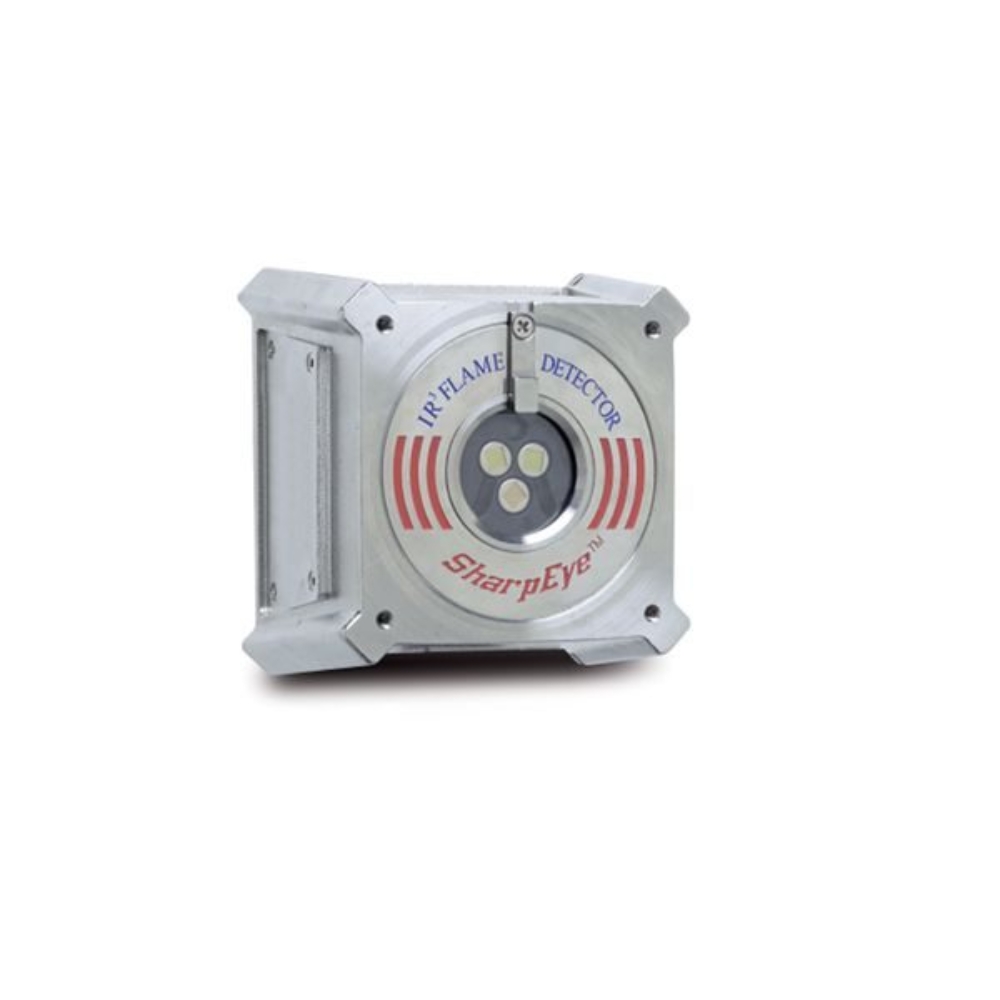
SharpEye 20/20 MI
Mini Triple IR Flame Detector
i
This product has been discontinued and is no longer available. In many cases we can still service and calibrate it. Talk to our team about spares or alternatives.
The SharpEye 20/20MI is a compact triple infrared flame detector with the highest false alarm immunity of the optical technologies, in a rugged stainless steel housing. Three infrared channels are correlated against each other, so a hot surface or a welding arc cannot produce the signature of a fire. Power draw is 80 percent lower than comparable detectors, the field of view is 100 degrees in both planes, and it is available in general purpose or intrinsically safe form.
KEY BENEFITS
- Triple spectrum design gives the highest immunity to false alarms of the optical technologies
- Draws 80 percent less power, which matters on solar, battery and remote installations
- 100 degree field of view in both horizontal and vertical planes
- Selectable sensitivity, so the detector is tuned to the area rather than accepted as shipped
- Intrinsically safe version available alongside the general purpose model
+ more in the Description tab below
Triple Infrared In A Compact Housing
Triple infrared detection works by watching several infrared bands at once and comparing them. A hydrocarbon fire produces a strong signal on the channel tuned to hot carbon dioxide, comparatively little on the reference channels, and the flicker frequency characteristic of a flame. A hot surface, a heater or sunlight on metal produces broadly similar output across all three channels and no flicker.
Requiring several views of the same event to agree is what delivers the immunity. It is why triple infrared is specified where false alarms would be expensive or where a detector cannot be allowed to be bypassed.
The 20/20MI brings that to a compact detector for smaller protected areas, where previously the choice was a larger detector than the risk warranted or a technology with weaker rejection.
Eighty Percent Less Power
This is the specification that decides installations rather than the detection performance.
The 20/20MI draws 80 percent less power than comparable detectors. On a mains powered plant that is a footnote. On a solar powered remote site, a battery backed system or an installation where the loop budget is already committed, it is the difference between the detector being possible and not.
It also compounds. A lower draw per detector means more detectors on one supply, smaller cable, and a smaller solar array or battery bank. On a remote wellhead or an unmanned asset, that is a materially cheaper installation.
Sensitivity You Can Select
Sensitivity is selectable, and functions are user programmable through software from a PC or a handheld device.
That matters more on a short range detector than a long one. A detector covering a small enclosure sits close to the hazard, so the same sensitivity that suits a 30 metre open bay will be over-responsive at three metres. Being able to set it on site means the detector is tuned to the area rather than to a default.
General Purpose Or Intrinsically Safe
The 20/20MI is available in two forms. A general purpose non-Ex approved version for unclassified areas, and an intrinsically safe Ex ia version for classified ones.
The intrinsically safe route is worth understanding. Rather than containing an explosion, an Ex ia detector limits the energy in the circuit so an ignition cannot occur. That requires a matched barrier or galvanic isolator in the safe area, and the certification applies to the loop rather than to the detector alone. Gastech supplies the barriers and verifies the loop as part of specifying it.
For a small classified area such as a pump skid or a sample house, an intrinsically safe compact detector is often a simpler installation than a flameproof one, because the cabling and glanding requirements are lighter.
What It Will Not See
Worth stating plainly, because it saves a wrong purchase.
Triple infrared detects fires through the carbon dioxide their combustion produces. Hydrogen contains no carbon and burns to water vapour, so a hydrogen fire produces no signature on these channels and the detector will register nothing. Metal and inorganic fires produce neither signature.
Where hydrogen, metals or inorganic materials are part of the risk, the SharpEye 20/20ML is the compact alternative, combining ultraviolet and infrared to cover all of them at up to 15 metres.
Integration
Connection is a standard four wire arrangement. Analogue output is 4 to 20 mA in sink or source, three or four wire, and RS-485 Modbus is available for digital integration.
Built in test runs automatically and can be triggered manually. Mean time between failures is quoted at a minimum of 100,000 hours, with a three year warranty.
Approvals held include FM, ATEX through SIRA, DNV and ABS, which covers land based industrial installation through to marine and offshore.
Where It Is Used
Pump and compressor skids. Small process enclosures and cabinets. Remote wellheads and unmanned assets on solar or battery power. Sample and analyser houses. Generator and plant rooms. Fuel dispensing and small storage areas. Turbine enclosures. Machinery spaces on vessels and offshore installations. Loading racks and transfer points. Small tank farms and bunded areas.
Benefits
- Triple spectrum design gives the highest immunity to false alarms of the optical technologies
- Draws 80 percent less power, which matters on solar, battery and remote installations
- 100 degree field of view in both horizontal and vertical planes
- Selectable sensitivity, so the detector is tuned to the area rather than accepted as shipped
- Intrinsically safe version available alongside the general purpose model
- Rugged stainless steel housing
- User programmable from a PC or handheld device
- 4 to 20 mA in sink or source, plus RS-485 Modbus
- Mean time between failures of at least 100,000 hours
- Three year warranty
Detection principle
Triple infrared, three correlated channels with flicker frequency analysis
Fires detected
Hydrocarbon fuel and gas fires
Field of view
100° horizontal, 100° vertical
Sensitivity
Selectable
Power consumption
80% lower than comparable detectors
Configuration
User programmable functions, set via software from a PC or handheld device
Built in test
Automatic and manual
Connection
Standard 4 wire
Analogue output
4 to 20 mA, sink or source, 3 and 4 wire configurations
Digital output
RS-485 Modbus compatible
Housing
Rugged stainless steel
Certification options
General purpose non-Ex approved, or intrinsically safe Ex ia
Approvals
FM, ATEX via SIRA, DNV and ABS
MTBF
Minimum 100,000 hours
Warranty
3 years
- Aviation & Transportation
- Chemical Manufacturing
- Energy (Oil & Gas)
- Food & Beverage
- Landfill & Remediation
- Marine & Maritime
- Mining & Minerals
- Power Generation & BESS
- Technology & Semiconductor
- Water & Wastewater
Because three infrared channels are compared against each other. A fire produces a strong signal on one channel and little on the others, while a hot surface produces similar output across all three.
More detectors on one supply, smaller cable, and a smaller solar array or battery bank, which is what makes the detector viable on remote and unmanned sites.
Yes, the 20/20MI is available as general purpose non-Ex approved or as intrinsically safe Ex ia for classified areas.
No. Hydrogen burns to water vapour rather than carbon dioxide, so it produces no signature on infrared channels. The SharpEye 20/20ML covers hydrogen in a compact housing.
Yes, sensitivity is selectable and functions are user programmable from a PC or handheld device.
Technology and fuel coverage. The MI is triple infrared with the highest false alarm immunity for hydrocarbon fires. The ML is UV/IR and covers hydrogen, metal and inorganic fires as well.
Trusted by









Contact Us
Can’t find what you’re looking for? Our team is happy to help.