
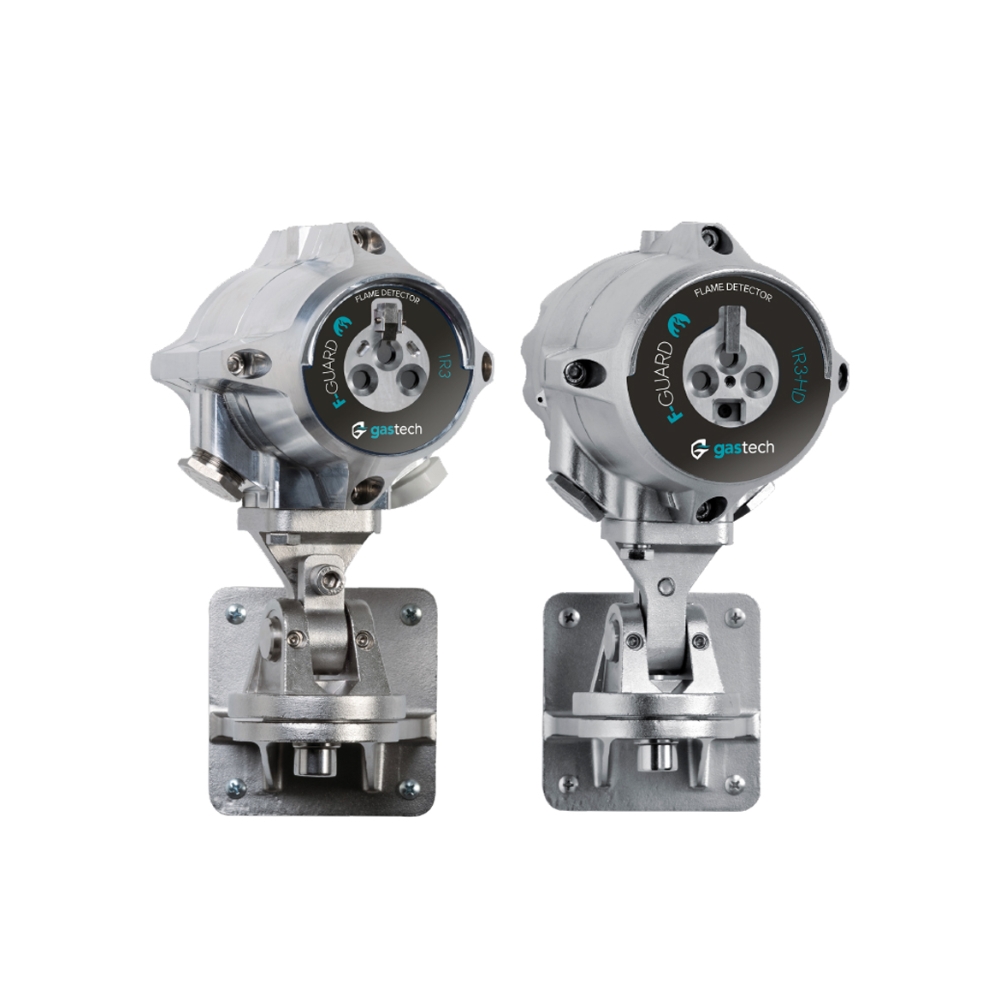
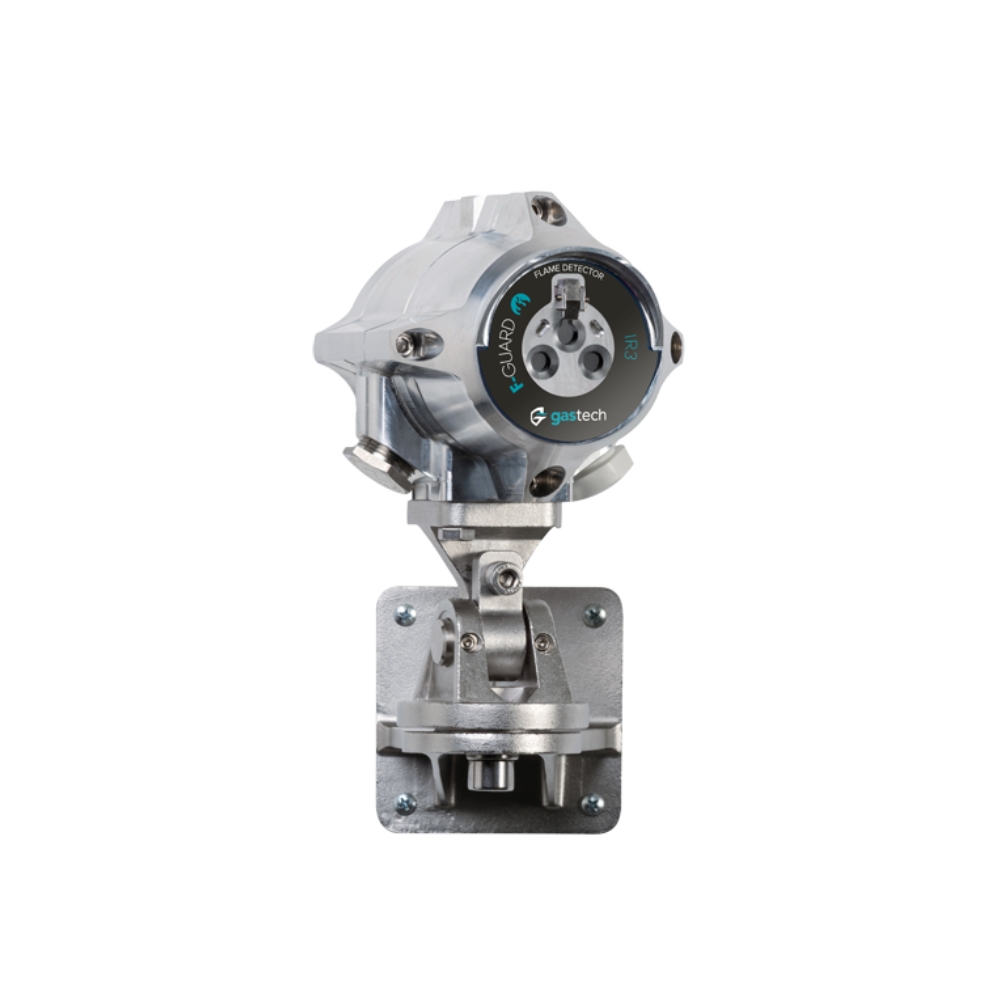
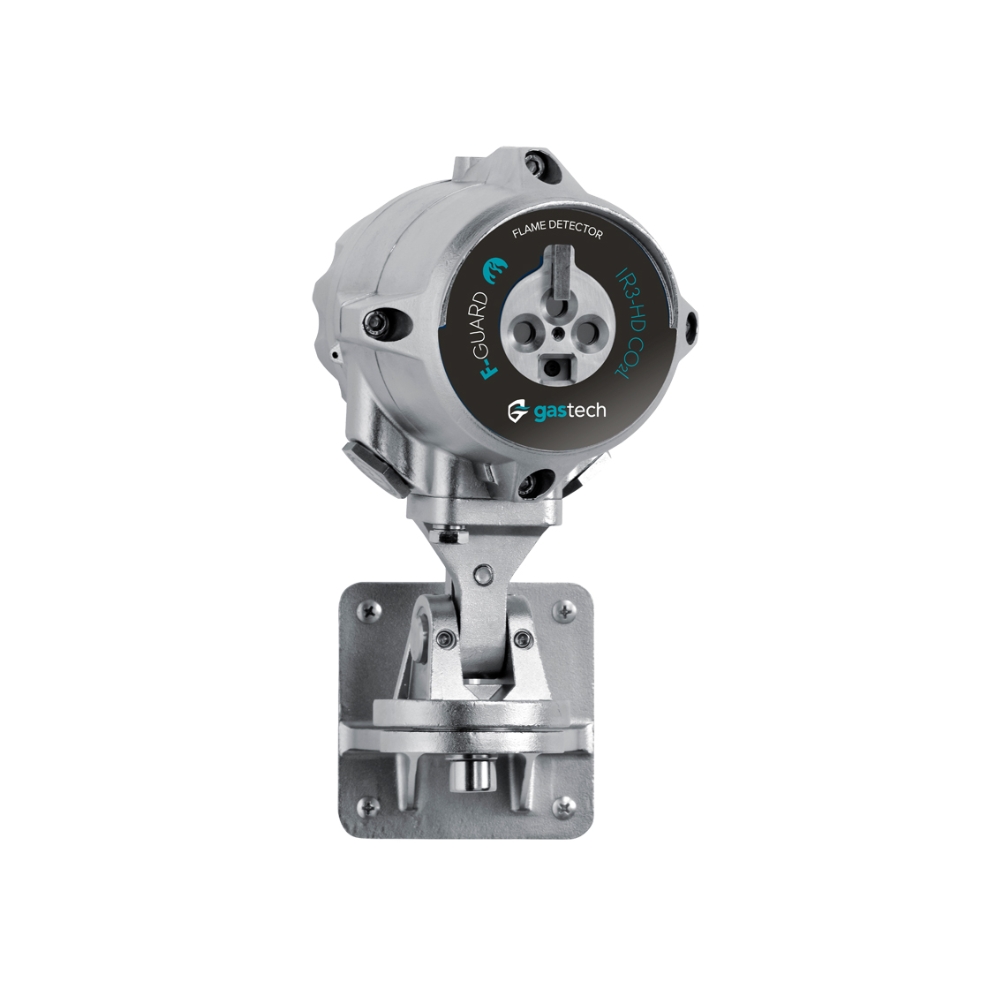
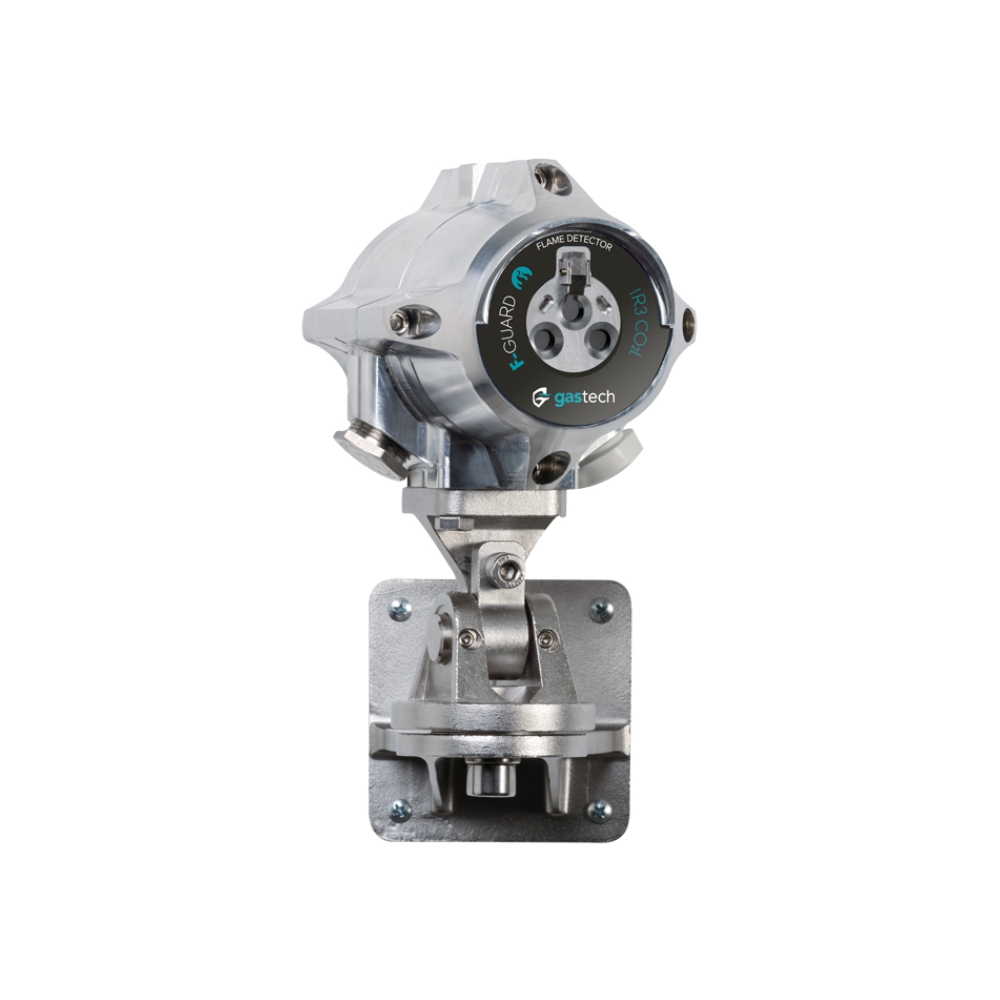
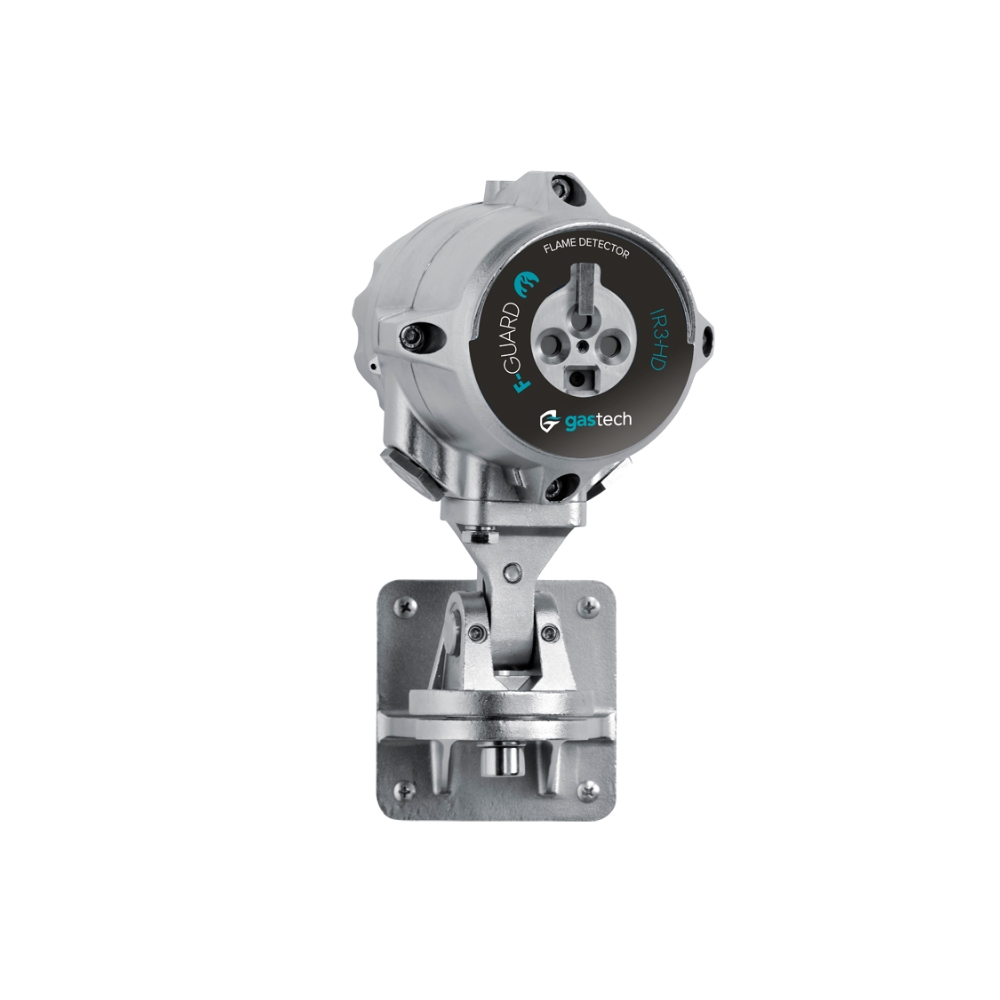
F-Guard IR3
Triple IR Flame Detector
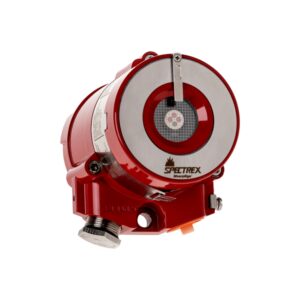
The F-Guard IR3 is Gastech’s triple infrared flame detector, and the longest reaching detector in the F-Guard range, detecting a 0.1 square metre n-heptane pan fire at up to 80 metres. Ultra fast mode responds to a fireball or explosion within 40 milliseconds. A CO2L option handles locations where combustion exhaust gases are present, such as aircraft hangars and truck loading racks. An HD option adds live video with automatic event recording. All variants carry a 5 year warranty.
KEY BENEFITS
- Detects a 0.1 square metre hydrocarbon pan fire at up to 80 metres
- Ultra fast mode responds to a fireball or explosion within 40 milliseconds
- Detects a standard pan fire in as little as 1.5 seconds at up to 30 metres (HD and CO2L)
- Three infrared wavelengths between 4.0 and 5.0 micron with clear separation
- All three sensors share the same field of view, so they compare the same scene
+ more in the Description tab below
Four Variants, Two Decisions
| Variant | Optimised for | Video |
|---|---|---|
| F-Guard IR3 | Hydrocarbon fires, general industrial | No |
| F-Guard IR3-HD | Hydrocarbon fires, general industrial | HD video with event recording |
| F-Guard IR3 CO2L | Hydrocarbon fires where combustion exhaust is present | No |
| F-Guard IR3-HD CO2L | Hydrocarbon fires where combustion exhaust is present | HD video with event recording |
Two questions decide it. Is there exhaust in the detector’s field of view, which selects standard or CO2L. And do you want to see the scene as well as be told about it, which selects HD.
Eighty Metres
Detection reaches 80 metres for a 0.1 square metre n-heptane pan fire, the longest range in the F-Guard family.
Range decides detector count, and detector count decides installed cost. Across a large open process area, a tank farm or a loading facility, the difference between a 40 metre detector and an 80 metre one is often half the detectors, half the cabling and half the commissioning.
At shorter distances, the detector is quicker. The HD and CO2L variants detect a standard pan fire in 1.5 seconds at up to 30 metres, and the HD in 1.2 seconds at 15 metres. The standard IR3 responds in 2.6 seconds at up to 30 metres.
Forty Milliseconds
Fires and explosions are different events on different timescales, and a detector built for one will be wrong for the other.
A slow growing fire develops over seconds, and a detector responding in a second or two is more than enough. A vapour cloud ignition doesn’t develop. It just happens. The F-Guard IR3 has an ultra fast detection mode that responds within 40 milliseconds to a fireball or explosion.
That speed is what lets the detector sit in front of a suppression system that has to act before a fireball spreads, rather than one that records the aftermath.
Why the CO2L Variant Exists
This is the most useful thing on the page, because it explains a problem people usually meet after installation rather than before.
Triple infrared detection works by watching the infrared band given off by hot carbon dioxide, the product of hydrocarbon combustion. That signature is strong and specific, which is what gives IR3 its range and its immunity.
The difficulty is that some environments produce hot carbon dioxide as a matter of routine: a jet engine running in an aircraft hangar, a helicopter on a pad with exhaust and downwash, diesel trucks idling at a loading rack. In those places, the very signature the detector looks for is being produced by normal operations.
The CO2L variant is built for exactly that. It gives fast, robust detection of heavy hydrocarbon fires in locations where combustion exhaust gases may be present, telling a fire apart from the exhaust around it.
If your protected area has running engines, specify CO2L. If it doesn’t, the standard variant gives you the performance without the optimisation you don’t need.
What the HD Video Changes
The HD variants provide high definition colour video of the monitored area, with clear imaging of a fire and of personnel at up to 30 metres.
The value is in what happens after the alarm. A responder can see the situation before entering the area: whether the fire is where the detector says, whether anyone is inside, and how far it has developed. Those are decisions currently made by walking in and looking.
Recording is automatic, from one minute before the alarm to up to three minutes after, with video and event data written to non volatile memory. For an incident investigation, that’s the difference between reconstructing events from a log and watching them. Video integrates over ONVIF Profile S on a standard IP network.
Three Wavelengths, One Field of View
The detector uses three infrared wavelengths in the 4.0 to 5.0 micron range, with clear separation between them.
One design detail is worth drawing out. All three sensors share the same field of view, 90° horizontal and 75° vertical, so they compare the same scene rather than three slightly different ones. Where sensors see marginally different areas, an object at the edge of one field can produce a mismatch that looks like a fire signature. Aligning the fields removes that source of false alarm.
Combined with flicker frequency analysis, that’s what lets the detector work in all weather and light conditions with high immunity to false alarms. Five sensitivity ranges, from Extreme to Very Low, let it be matched to the site.
Event Logging and Self Test
Alarms, faults and other relevant events are written to non volatile memory, so the detector holds its own history rather than relying on the panel to log it. On the HD variants, video is stored alongside.
The built in test runs automatically and can be triggered manually, checking window cleanliness and the overall operation of the detector. A dirty optics warning flags when the window needs cleaning, before it affects detection.
It’s worth understanding the limit, which applies to all flame detectors. The self test confirms the detector can see. It doesn’t activate the alarm outputs, so proving the relays, the loop, the panel and any suppression release needs an external flame simulator. Gastech supplies F-Guard simulators matched to each detector type.
Integration
Outputs are universal, covering 3 and 4 wire configurations, 0-20 mA in sink or source with HART 7, and fire, auxiliary and fault relays rated 2 A at 30 VDC. An RS-485 port provides Modbus RTU. An alarm delay of 0 to 30 seconds is configurable.
That range of options means the detector drops into an existing fire and gas system, rather than needing one built around it.
Built for Harsh Sites
The housing is 316 stainless steel, rated IP66 and IP67 (IP66 and IP68 on the CO2L), and NEMA 4X and 6P. It operates from -55°C to +75°C, with a high temperature option to +85°C on the IR3 and IR3-HD. All variants carry a 5 year warranty.
Where It’s Used
Refineries and petrochemical plant. Oil and gas processing and terminals. LNG facilities. Large open process areas where detection range decides detector count. Tank farms and bunded areas. Offshore platforms and vessels. Aircraft hangars and helipads, using the CO2L variant. Truck loading racks and fuel dispensing, using the CO2L variant. Turbine halls. Compressor stations. Mine site fuel storage. Recycling and waste handling facilities.
Benefits
- Detects a 0.1 square metre hydrocarbon pan fire at up to 80 metres
- Ultra fast mode responds to a fireball or explosion within 40 milliseconds
- Detects a standard pan fire in as little as 1.5 seconds at up to 30 metres (HD and CO2L)
- Three infrared wavelengths between 4.0 and 5.0 micron with clear separation
- All three sensors share the same field of view, so they compare the same scene
- CO2L option works where combustion exhaust gases would confuse a standard detector
- HD option streams live video and records the event automatically
- Data and event logger writes alarms, faults and events to non volatile memory
- Built in test checks window cleanliness and overall operation, automatically or on demand
- Universal outputs in 3 and 4 wire, sink or source, with HART 7 and Modbus over RS-485
Detection principle
Triple infrared, three wavelengths in the 4.0 to 5.0 micron range with clear separation
Fires detected
All types of hydrocarbon fires, visible and non visible
Detection distance
Up to 80 m for a 0.1 m² n-heptane pan fire (confirm for standard IR3)
Explosion response
40 milliseconds
Detection time, standard fire
IR3: 2.6 s at 0 to 30 m, 3.7 s at 30 to 70 m. IR3-HD and CO2L: 1.5 s at 0 to 30 m, 4.1 s at 30 to 70 m
Ultra fast mode
Within 40 milliseconds for fireballs or explosions
Sensor alignment
All sensors share the same field of view
Built in test
Automatic and manual, covering window cleanliness and overall detector operation
Data and event logger
Alarms, faults and other relevant events written to non volatile memory
Analogue output
0-20 mA (stepped), sink or source, 3 and 4 wire (isolated). HART 7
Relays
Fire (alarm), auxiliary and fault. Volt free, 2 A at 30 VDC
Digital output
RS-485 port using Modbus RTU
Video output, HD variants
High definition colour, clear imaging of fire and personnel to 30 m
Video recording, HD variants
Automatic, 1 minute before the alarm to up to 3 minutes after, written to non volatile memory
Field of view
90° horizontal, 75° vertical
Time delay
0 to 30 seconds
Sensitivity
5 ranges: Extreme, High, Medium, Low, Very Low
Indication
Tri colour LED
Operating voltage
24 VDC nominal (18 to 32 VDC)
Current consumption
IR3: 120 mA standby, 180 mA maximum. IR3-HD: 180 mA standby, 250 mA maximum. CO2L: 180 mA standby, 300 mA maximum
Size and weight
IR3 and CO2L: 140 x 90 x 90 mm, 3.0 kg. IR3-HD: 200 x 130 x 130 mm, 4.4 kg
Housing and protection
316 stainless steel. IP66 and IP67 (IP66 and IP68 on CO2L). NEMA 4X and 6P
Operating temperature
-55°C to +75°C. High temperature option to +85°C (IR3 and IR3-HD)
Warranty
5 years
Operating conditions
All weather and light conditions
Certification
IECEx, FM United States, FM Canada, EUTEC, ActivFire. Standard version certified db for gas. HD version certified db, tb and eb for gas and dust.
-
-
IR3
Optimised for exhaust environments
No
HD video output
No
Automatic video recording
No
-
-
IR3-HD
Optimised for exhaust environments
No
HD video output
Yes, to 30 m
Automatic video recording
Yes
-
-
IR3 CO2L
Optimised for exhaust environments
Yes
HD video output
No
Automatic video recording
No
-
-
IR3-HD CO2L
Optimised for exhaust environments
Yes
HD video output
Yes, to 30 m
Automatic video recording
Yes
- Aviation & Transportation
- Chemical Manufacturing
- Energy (Oil & Gas)
- Landfill & Remediation
- Marine & Maritime
- Mining & Minerals
- Power Generation & BESS
- Technology & Semiconductor
- Water & Wastewater
Up to 80 metres for a 0.1 square metre n-heptane pan fire. The HD and CO2L variants detect a standard fire in 1.5 seconds at up to 30 metres.
It is optimised for locations where combustion exhaust gases are present, such as aircraft hangars, helipads and truck loading racks, where a standard infrared detector would be seeing the same hot carbon dioxide it is tuned to detect.
Within 40 milliseconds in ultra fast mode, which is what allows it to sit in front of a suppression system expected to act before a fireball propagates.
Live high definition video of the area and automatic recording of the event, so responders can see the situation before entering and an investigation has footage rather than a log.
No. Hydrogen burns to water vapour rather than carbon dioxide, so it produces no signature on these channels. The F-Guard IR3-H2 is built for hydrogen.
No, it confirms window cleanliness and detector operation only. Testing the relays, wiring, panel and notification needs an F-Guard flame simulator.
Only the HD version. It's certified for dust ignition protection (tb) as well as flameproof (db) and increased safety (eb). The Standard version is certified flameproof (db) only, so it suits gas hazardous areas but not dust.
Trusted by









Contact Us
Can’t find what you’re looking for? Our team is happy to help.