
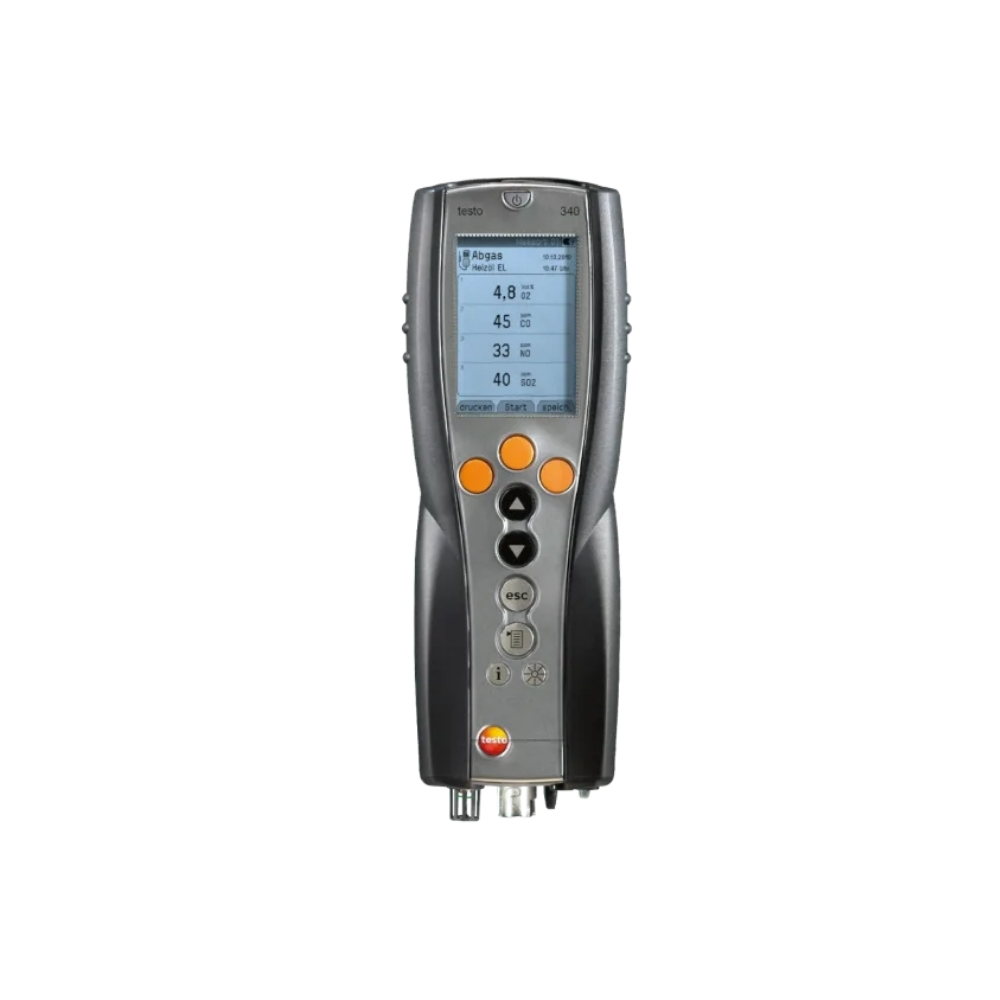
testo 340
Industrial Combustion Analyser
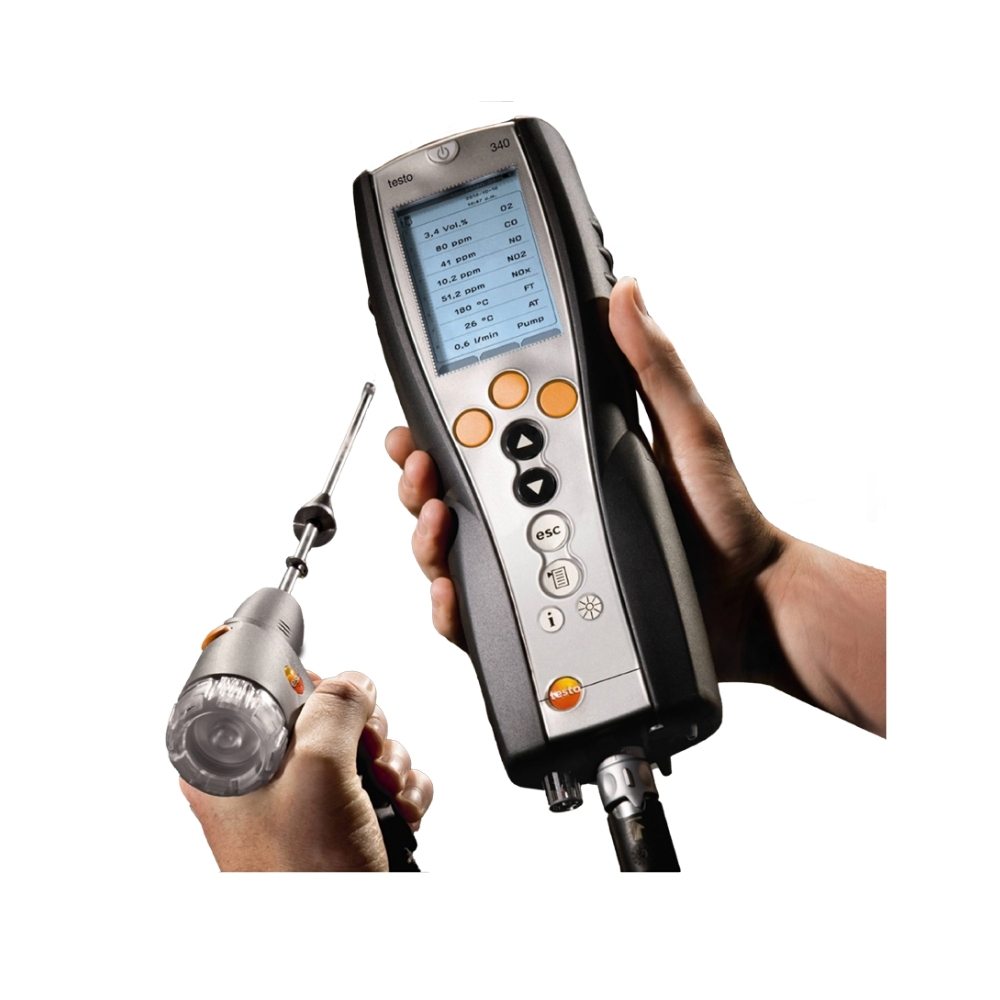
The testo 340 sits between Testo’s boiler analysers and its industrial emissions systems. It takes four gas sensors, with O2 fitted as standard and up to three more from CO, COlow, NO, NOlow, NO2 and SO2. It measures NO and NO2 separately for a real NOx figure, extends CO measurement to 50,000 ppm with automatic dilution, and calculates mass emissions with a Pitot tube. A Diesel Kit comes ready for diesel engine exhaust testing.
KEY BENEFITS
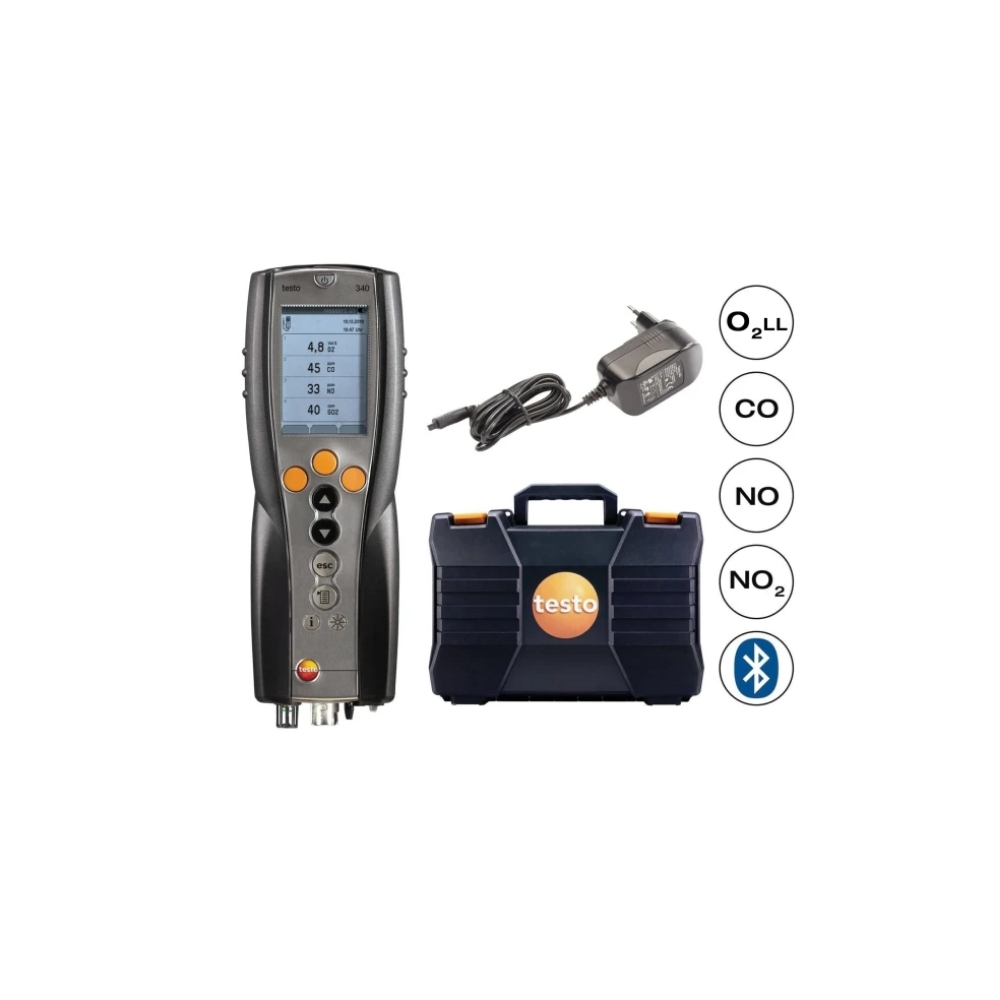
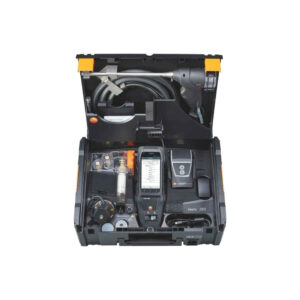
- Diesel Kit arrives ready for engine exhaust testing, with O2, CO, NO and NO2 sensors and an engine probe
- Takes up to four gas sensors, plug and play and field changeable
- Measures NO and NO2 separately for a real NOx figure rather than a calculated one
- Automatic dilution extends carbon monoxide measurement to 50,000 ppm without damaging the sensor
- Calculates mass emissions with a Pitot tube, which is what an environmental licence is written against
+ more in the Description tab below
Ready for the Job
The difficulty with a configurable analyser is that the customer has to know which sensors they need before they buy one, and getting it wrong is expensive.
The testo 340 Diesel Kit takes that decision away for diesel engine work. It arrives with O2, CO, NO and NO2 sensors, CO2 calculated from O2, an engine probe with thermocouple (335 mm long, up to 1,000°C), a power supply, carry case and Bluetooth. Talk to our Technical Consultants about configurations for boilers, burners and gas engines.
Sensors are plug and play and field changeable, so a configuration can be revised as the work changes.
Four Sensor Positions
Oxygen is the base sensor in all testo 340 analysers, and up to three more are added from CO, COlow, NO, NOlow, NO2 and SO2.
The combination matters. The standard CO sensor covers 0 to 10,000 ppm and suits tuning standard systems. The low range COlow sensor covers 0 to 500 ppm with 0.1 ppm resolution, and suits critical low CO limits, where the standard sensor lacks the resolution. The same applies to nitric oxide: NOlow measures 0 to 300 ppm with 0.1 ppm resolution, against 0 to 4,000 ppm with 1 ppm resolution on the standard NO sensor.
Sulphur dioxide (0 to 5,000 ppm) is the sensor to add for sulphur bearing fuels.
Why NO and NO2 Are Measured Separately
This decides whether a NOx figure is worth putting in a report.
NOx is nitric oxide plus nitrogen dioxide. Many analysers measure NO alone, then estimate NOx using an assumed ratio. That works where the ratio is stable. In engine exhaust, the NO2 share can vary a lot, so a NOx figure based on NO alone can be wrong.
Measuring both gives the real NOx value. On engine tuning, and on any measurement going into a compliance record, that’s the difference between a defensible number and an approximation.
To avoid absorption affecting NO2 readings, Testo recommends that a measurement doesn’t run longer than 2 hours.
Dilution to Fifty Thousand
Engine conditions often aren’t known when the instrument goes on, and an analyser that saturates gives you nothing while damaging its own sensor.
When the CO concentration exceeds a set threshold, the sensor in the dilution slot is automatically diluted with fresh air at a factor of 5. That extends CO measurement up to 50,000 ppm, NO up to 15,000 ppm and SO2 up to 25,000 ppm, with the corrected value calculated and displayed.
An optional dilution of all sensors, at a factor of 2, extends CO up to 20,000 ppm and NO up to 6,000 ppm.
The point isn’t the headline number. It’s that a measurement can carry on at an unexpectedly high concentration, without abandoning the test or shortening the sensor’s life.
Mass Emissions
This is the capability most likely to be the reason someone chooses the 340, and it’s easy to miss.
Concentration in parts per million tells you whether combustion is running correctly. It doesn’t tell you what the site actually emitted, because a low concentration in a very large gas flow can be more mass than a high concentration in a small one. Environmental licences and reporting are often written in mass terms, such as kilograms per hour or tonnes per year.
With a Pitot tube, the testo 340 measures flue gas velocity, and from that, plus the duct dimensions and gas concentration, it calculates the mass flow of pollutants including CO, NOx and SO2. Differential pressure and flow measurement are built in for exactly this.
So one instrument answers both the tuning question and the reporting question.
Probes, Reach and Protection
Modular flue gas probes come in 335 mm and 700 mm lengths, rated to 500°C or 1,000°C, with or without particle filters for dusty gas. Engine probes suit servicing and emissions work on stationary gas and diesel engines.
Hose extensions matter more than they sound. Two extensions plus the standard hose give up to 7.8 metres, which often means the measurement is taken standing on the ground rather than up a ladder at the sampling point.
Sensor protection goes beyond dilution. The condensate trap shows a warning when it reaches 90% full, and the filters protecting the CO and NO sensors can be replaced on their own, rather than replacing the whole sensor.
Where It Sits in the Range
It’s worth being direct, because all three Testo tiers overlap at the edges.
The testo 310 II covers boilers and hot water plant with oxygen and carbon monoxide. If that’s the work, it’s the right instrument, and the 340 adds cost without adding anything useful.
The testo 340 adds nitrogen oxides and sulphur dioxide, dilution, mass emission calculation and industrial probes. That covers boiler and burner tuning, engine work, and pre compliance testing.
The testo 350 takes up to six sensors, adding infrared CO2, hydrogen sulphide and hydrocarbons. It also adds gas preparation for wet gas, and the data bus, which measures before and after an after treatment system at the same time.
If you’re tuning engines and boilers and reporting emissions, the 340 is usually the answer. If you’re proving a scrubber works or running long term measurements in wet gas, it’s the 350.
Where It’s Used
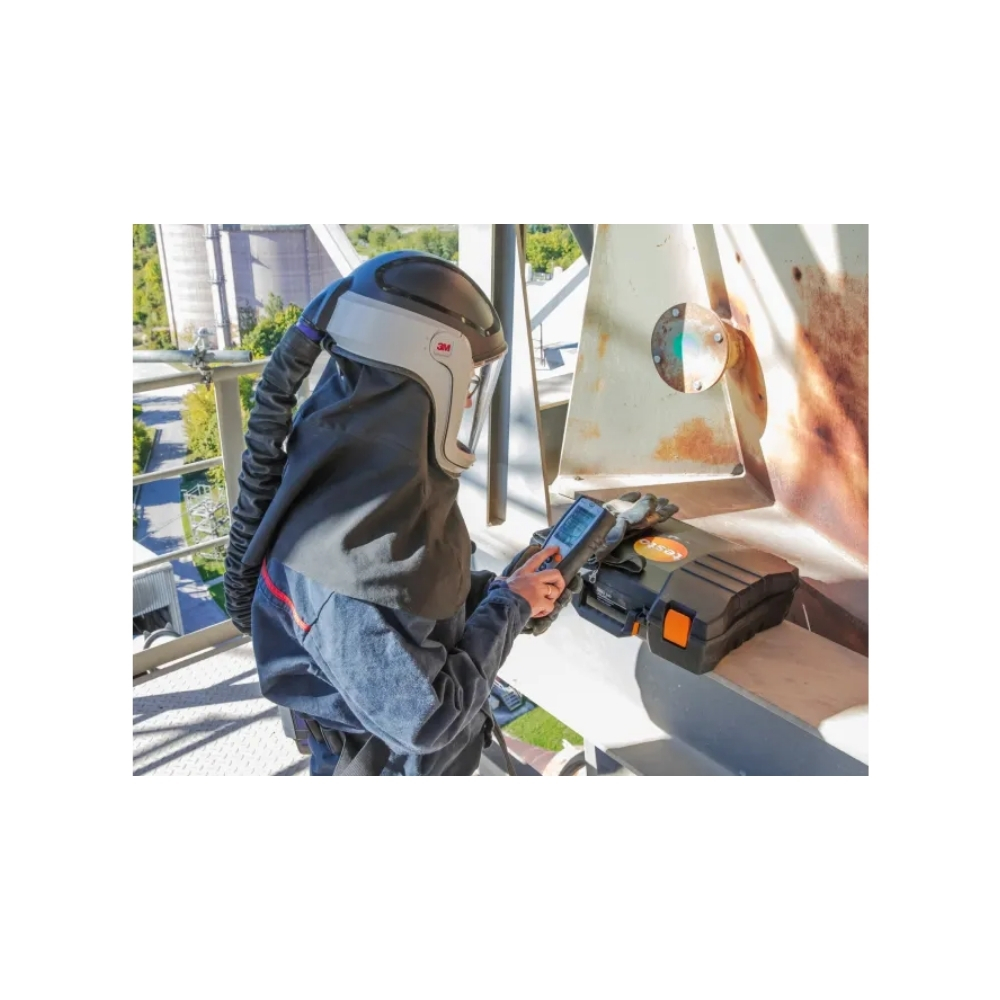
Industrial burners and boilers. Stationary industrial engines. Gas turbines. Gas engines and cogeneration plant. Thermal processes. Generator sets. Pre compliance emissions testing. Functional testing of permanently installed emissions monitoring equipment. Marine engines.
Benefits
- Diesel Kit arrives ready for engine exhaust testing, with O2, CO, NO and NO2 sensors and an engine probe
- Takes up to four gas sensors, plug and play and field changeable
- Measures NO and NO2 separately for a real NOx figure rather than a calculated one
- Automatic dilution extends carbon monoxide measurement to 50,000 ppm without damaging the sensor
- Calculates mass emissions with a Pitot tube, which is what an environmental licence is written against
- Measures temperature from -40 to +1,200°C, and up to 1,780°C with a type S thermocouple
- Onboard data logging with measurement data managed on a PC
- Hose extensions reach up to 7.8 metres, so testing can happen from the ground
- Compact at 960 g, with over 6 hours of battery life and 30 second zeroing
- Sensor protection includes automatic dilution, a condensate trap warning and replaceable sensor filters
Instrument type
Portable industrial flue gas and combustion analyser
Sensor positions
CO H2 compensated (0 to 10,000 ppm), COlow H2 compensated (0 to 500 ppm), NO (0 to 4,000 ppm), NOlow (0 to 300 ppm), NO2 (0 to 500 ppm), SO2 (0 to 5,000 ppm)
Sensor options
CO, COlow, NO, NOlow, NO2, SO2
Sensors
Plug and play, field changeable
Measurement range extension
Single slot dilution, factor 5: CO up to 50,000 ppm, NO up to 15,000 ppm, SO2 up to 25,000 ppm. Optional dilution of all sensors, factor 2: CO up to 20,000 ppm, NO up to 6,000 ppm
Corrected values
Calculated and displayed automatically
Temperature
-40 to +1,200°C (NiCrNi). Up to 1,780°C with type S thermocouple
Draught
Minus 40 to plus 40 hPa
Differential pressure
Minus 200 to plus 200 hPa
Flow measurement
Integrated, for mass emission calculation with a Pitot tube
Calculated values
Efficiency 0 to 120%, flue gas loss 0 to 99.9%, flue gas dew point 0 to 99.9 °C, carbon dioxide from oxygen, mass flow of NOx and CO
Data logging
Onboard, with measurement data management on PC
Sensor protection
Automatic dilution, condensate trap warning at 90%, replaceable filters for CO and NO sensors
Diagnostics
Onboard instrument status via the information button
Hose extensions
Up to 7.8 m (two probe hose extensions)
Probe families
Modular flue gas probes at 335 and 700 mm, 500 or 1,000 °C, with or without particle filter. Industrial engine gas sampling probes. Industrial gas sampling probes for extreme temperature, high dust or wet gas
Power
Rechargeable battery 3.7 V, 2.4 Ah, over 6 hours. Mains unit 6.3 V, 2 A
Oxygen
0 to 25 vol %, fitted as standard. Accuracy ±0.2 vol %
Measurement duration
Maximum 2 hours recommended, to avoid absorption
Sensor slots
Slot 1: O2. Slot 2: CO, COlow, NO, NOlow or SO2 (dilution slot). Slot 3: NO, NOlow or NO2. Slot 4: CO, COlow, SO2 or NO2
Absolute pressure
600 to 1,150 hPa
Interfaces
Bluetooth, USB, IR/IrDA
Weight and dimensions
960 g. 283 x 103 x 65 mm
Protection and display
IP40. Monochrome graphic display, 160 x 240 pixels
Operating temperature
-5 to +50°C
Pump
0.6 L/min (regulated). Maximum positive pressure +50 mbar, negative -200 mbar at probe tip
Carbon Monoxide
CO
Carbon Dioxide
CO2
Nitric Oxide
NO
Nitrogen Dioxide
NO2
Oxygen
O2
Sulphur Dioxide
SO2
- Aviation & Transportation
- Carpark & HVAC
- Chemical Manufacturing
- Energy (Oil & Gas)
- Food & Beverage
- Landfill & Remediation
- Marine & Maritime
- Mining & Minerals
- Power Generation & BESS
- Technology & Semiconductor
- Water & Wastewater
For diesel engines, the Diesel Kit comes ready with O2, CO, NO and NO2 sensors and an engine probe. For boilers, burners and gas engines, talk to our Technical Consultants about the right sensor configuration.
Four. Oxygen is fitted as standard and up to three more are chosen from carbon monoxide, low range carbon monoxide, nitric oxide, low range nitric oxide, nitrogen dioxide and sulphur dioxide.
Because in gas engines the NO2 component of NOx fluctuates greatly, so a NOx figure calculated from NO alone can be substantially wrong.
Automatic dilution at a factor of 5 extends CO measurement up to 50,000 ppm and displays the corrected value, so the test continues and the sensor is protected.
Yes. With a Pitot tube it measures flue gas velocity and calculates mass flow of nitrogen oxides and carbon monoxide, which is how environmental licences are generally written.
The testo 350 takes up to six sensors, against four on the 340, and adds infrared CO2, hydrogen sulphide and hydrocarbons, gas preparation for wet gas, and simultaneous measurement before and after an after treatment system.
Trusted by









Contact Us
Can’t find what you’re looking for? Our team is happy to help.