
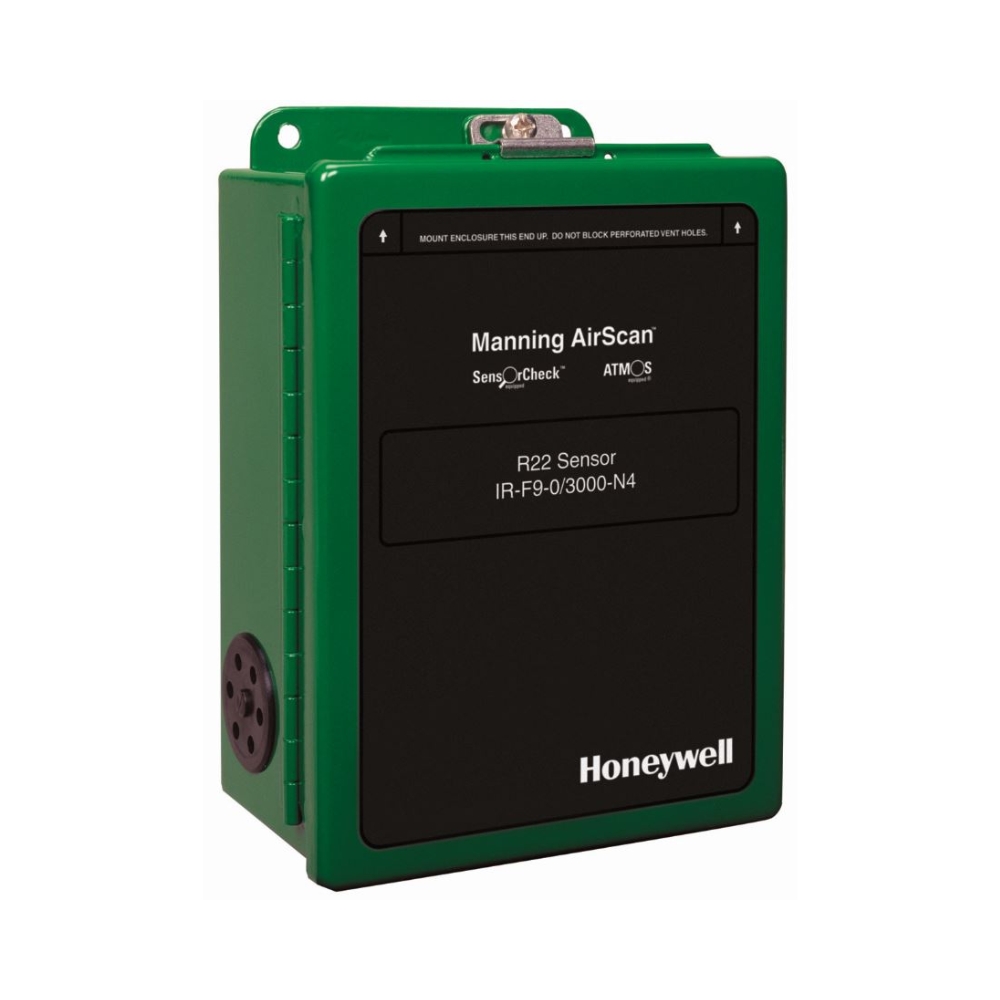
AirScan IRF9
Fixed Refrigerant Gas Detector
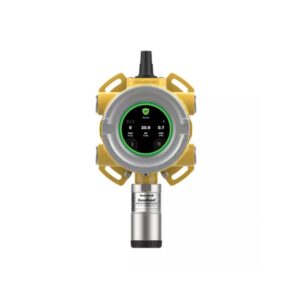
The AirScan IRF9 by Honeywell is an infrared diffusion sensor that detects refrigerants, ammonia and carbon dioxide from a single platform. It responds only to the gas it is configured for, so a reading tells you what actually leaked instead of flagging a general presence of gas. There are no pumps, filters or sample lines to maintain, and SensorCheck technology confirms the sensor is still alive on a 24 hour cycle. Three temperature variants cover standard plant rooms through to superheat conditions down to minus 50 degrees Celsius, which suits cold stores, ice rinks, breweries and chiller plant rooms across Australian industry.
KEY BENEFITS
- Detects 11 refrigerants plus ammonia and carbon dioxide from one sensor platform, so a mixed site standardises on a single device
- Refrigerant specific response means a reading points at the actual leaked gas rather than a general gas presence
- True diffusion design needs no pumps, filters or sample lines, which removes the usual consumable and servicing burden
- SensorCheck confirms sensor viability on a 24 hour cycle and outputs a 0.5 mA fault signal if the check fails
- Superheat variant operates down to minus 50 degrees Celsius, so blast freezers and low temperature stores stay covered
+ more in the Description tab below
Refrigerant Specific Detection Instead of a General Gas Reading
A refrigerant leak is expensive twice over. You lose the gas, and you lose the plant while someone finds the source. Detection that only tells you gas is present doesn’t solve that.
The AirScan IRF9 uses infrared absorption tuned to the gas it’s configured for. It responds to that gas and largely ignores the rest. In a plant room with several systems, that’s the difference between knowing which circuit failed and checking all of them.
Response is fast, too. The IRF9 reaches T90 in 10 seconds with full scale calibration gas at 0.75 litres per minute.
One Platform for Refrigerants, Ammonia and Carbon Dioxide
The same sensor platform covers three quite different jobs: refrigerant monitoring in machinery rooms, ammonia monitoring in industrial refrigeration, and carbon dioxide monitoring in beverage plants, cellars and secondary refrigeration circuits.
Refrigerant ranges are 0 to 500 ppm, 0 to 1,000 ppm and 0 to 3,000 ppm. Ammonia ranges are 0 to 2% and 0 to 4%. Carbon dioxide ranges are 0 to 1% and 0 to 3%.
For a site running ammonia in the engine room and CO2 on a secondary loop, that means one device type, one set of spares and one training session.
No Pumps, No Filters, No Sample Lines
Sample draw systems pull air from several points through tubing to a central analyser. Points are read in sequence, so there’s always a gap between a leak starting and that point being checked.
The IRF9 is a true diffusion sensor. Gas reaches the sensor through the air, and each installed point is monitored continuously. There are no moving parts, no pumps to seize and no filters to replace.
That lowers the running cost of a multi point installation. It also removes the tubing runs that need proving after any plant change.
Built for Cold, Wet and Washdown Conditions
Refrigeration plant is a hard place for electronics. It’s cold, often wet, and washdown is routine in food areas.
Honeywell offers the IRF9 in three temperature builds. Standard covers -30°C to +60°C. ATMOS extends that to -40°C. Superheat reaches -50°C. All three handle 0 to 100% relative humidity, including condensing conditions.
An internal reference channel compensates for dust, source degradation, humidity and temperature changes, food odours and chemical cleaners. That stops a sensor in a cold store drifting into nuisance alarms as conditions change around it.
The enclosure is 16 gauge painted steel or stainless steel, UL 508 listed and CSA certified for use with industrial control equipment. The stainless steel option is the one to choose for food and beverage areas.
SensorCheck Confirms the Sensor Is Working
A gas detector that has quietly failed is worse than no detector, because the plant believes it’s protected.
SensorCheck runs an internal microprocessor check of the sensor’s electrical viability on a 24 hour cycle. If the check fails, the sensor sends a 0.5 mA signal that a Manning gas monitor or PLC reads as a fault. An internal light also shows if a sensor has dried out or been disconnected.
So a failed sensor announces itself, instead of waiting to be found at the next service.
Works With Your Existing Manning Readout
The IRF9 outputs a linear 4-20 mA signal, proportional to gas concentration, into a load of up to 500 ohms. It works with any Honeywell Analytics Manning readout or alarm unit.
For sites already running Manning panels, that means adding or replacing detection points without touching the control layer. Power is 24 VDC regulated, at 1.2 A maximum. Use three conductor stranded shielded cable with a drain wire.
Australian Compliance Context
In Australia, machinery room requirements for refrigerating systems sit under AS/NZS 5149.3:2016, which covers the installation site, including detection and mechanical ventilation. The Australian and New Zealand Refrigerant Handling Code of Practice backs up the point that detectors should be refrigerant specific and placed where a leak will collect.
Refrigerant specific infrared detection is what the IRF9 is built for. Alarm thresholds, detector placement and ventilation interlocks depend on the refrigerant class, charge size and room volume, so set them against the standard for your installation. Our Technical Consultants can help work through it.
Where It’s Used
Cold stores and blast freezers, supermarket and produce refrigeration, breweries, wineries and beverage plants, ice rinks, chiller and machinery plant rooms, gas bottling plants, rack houses and product coolers, chemical process cooling, and data centre and hospital chiller plant.
Benefits
- Detects 11 refrigerants plus ammonia and carbon dioxide from one sensor platform, so a mixed site standardises on a single device
- Refrigerant specific response means a reading points at the actual leaked gas rather than a general gas presence
- True diffusion design needs no pumps, filters or sample lines, which removes the usual consumable and servicing burden
- SensorCheck confirms sensor viability on a 24 hour cycle and outputs a 0.5 mA fault signal if the check fails
- Superheat variant operates down to minus 50 degrees Celsius, so blast freezers and low temperature stores stay covered
- Rated for condensing humidity to 100 percent RH, which handles washdown areas and cold room defrost cycles
- Internal reference channel compensates for dust, humidity swings, food odours and cleaning chemicals to cut nuisance alarms
- Stainless steel enclosure option suits food and beverage areas where hygiene washdown is routine
- Linear 4 to 20 mA output drives any Honeywell Analytics Manning readout, so existing panels stay in place
- Three selectable refrigerant ranges let you set a low trip point where a small leak matters most
Detection principle
Infrared absorption, gas specific
Gases monitored
R-22, R-134a, R-404a, R-407a, R-410a, R-422d, R-507a, R-514a, HFO-1233zd, HFO-1234yf, HFO-1234ze, ammonia and carbon dioxide
Gas sampling
Diffusion method with no moving parts, continuous real time monitoring of all points
Refrigerant ranges
0 to 500 ppm, 0 to 1,000 ppm, 0 to 3,000 ppm
Ammonia ranges
0 to 2%, 0 to 4%
Carbon dioxide ranges
0 to 1%, 0 to 3%
Output
Linear 4 to 20 mA into a load resistor of 500 ohm maximum
Accuracy
Plus or minus 3% full scale
Repeatability
Plus or minus 1% full scale
Response time
T90 = 10 seconds with full scale calibration gas at 0.75 litres per minute
Operating temperature, standard
Minus 30°C to plus 60°C
Operating temperature, ATMOS
Minus 40°C to plus 60°C
Operating temperature, Superheat
Minus 50°C to plus 60°C
Storage temperature
Minus 28°C to plus 60°C
Humidity
0 to 100% RH, condensing
Sensor viability test
SensorCheck, internal microprocessor determines sensor electrical viability on a 24 hour cycle. A failed test outputs a 0.5 mA fault signal. An internal light indicates a dried out or disconnected sensor.
Enclosure
16 gauge painted steel or stainless steel. UL 508 listed, CSA certified for use with industrial control equipment.
Enclosure rating
NEMA 4 (NEMA 1 versions also available)
Power source
24 VDC regulated, 1.2 A maximum
Cable recommendation
Three conductor stranded shielded cable with drain wire, in a vinyl jacket. For runs up to 61 m, use 0.82 mm2 (18 AWG) cable
Operating life
10 years
Mounting
Wall mounted, vertically
Certifications
UL 508 listed, CSA certified, AB32 compliant, CARB compliant
Weight
About 2.0 kg
Carbon Dioxide
CO2
Ammonia
NH3
- Aviation & Transportation
- Carpark & HVAC
- Chemical Manufacturing
- Confined Space & Compliance
- Food & Beverage
- Marine & Maritime
- Medical & Healthcare
- Power Generation & BESS
- Technology & Semiconductor
- Water & Wastewater
It covers ammonia, carbon dioxide and 11 refrigerants: R-22, R-134a, R-404a, R-407a, R-410a, R-422d, R-507a, R-514a, HFO-1233zd, HFO-1234yf and HFO-1234ze. Each sensor is configured for one target gas, so specify the gas and range at the time of order.
No. The Honeywell documentation lists NEMA 4, UL 508 and CSA for industrial control equipment, with AB32 and CARB compliance. It does not carry ATEX or IECEx certification. For classified hazardous areas, look at the XNX Universal Transmitter or Sensepoint XCD instead.
In most installations yes. The IRF9 outputs 4 to 20 mA into any Honeywell Analytics Manning readout or alarm unit, which handles display, alarm relays and ventilation interlocks. Honeywell's catalogue also lists an 85 to 103 dB horn against this product, so a local audible option may be available. Confirm with Gastech before specifying.
That depends on which build you specify. Standard covers minus 30 degrees Celsius, ATMOS covers minus 40 degrees, and Superheat covers minus 50 degrees. All three run up to plus 60 degrees Celsius and handle condensing humidity to 100 percent RH.
No. It is a true diffusion sensor with no moving parts. Gas reaches the sensor through the air, so each point is monitored continuously without tubing runs or consumable filters.
An internal microprocessor tests the sensor's electrical viability on a 24 hour cycle. If the test fails, the sensor outputs a 0.5 mA signal that a Manning monitor or PLC reads as a fault. An internal light also shows whether a sensor has dried out or been disconnected.
Trusted by









Contact Us
Can’t find what you’re looking for? Our team is happy to help.