
D-Guard²S
Fixed Gas Detector with Sounder Strobe
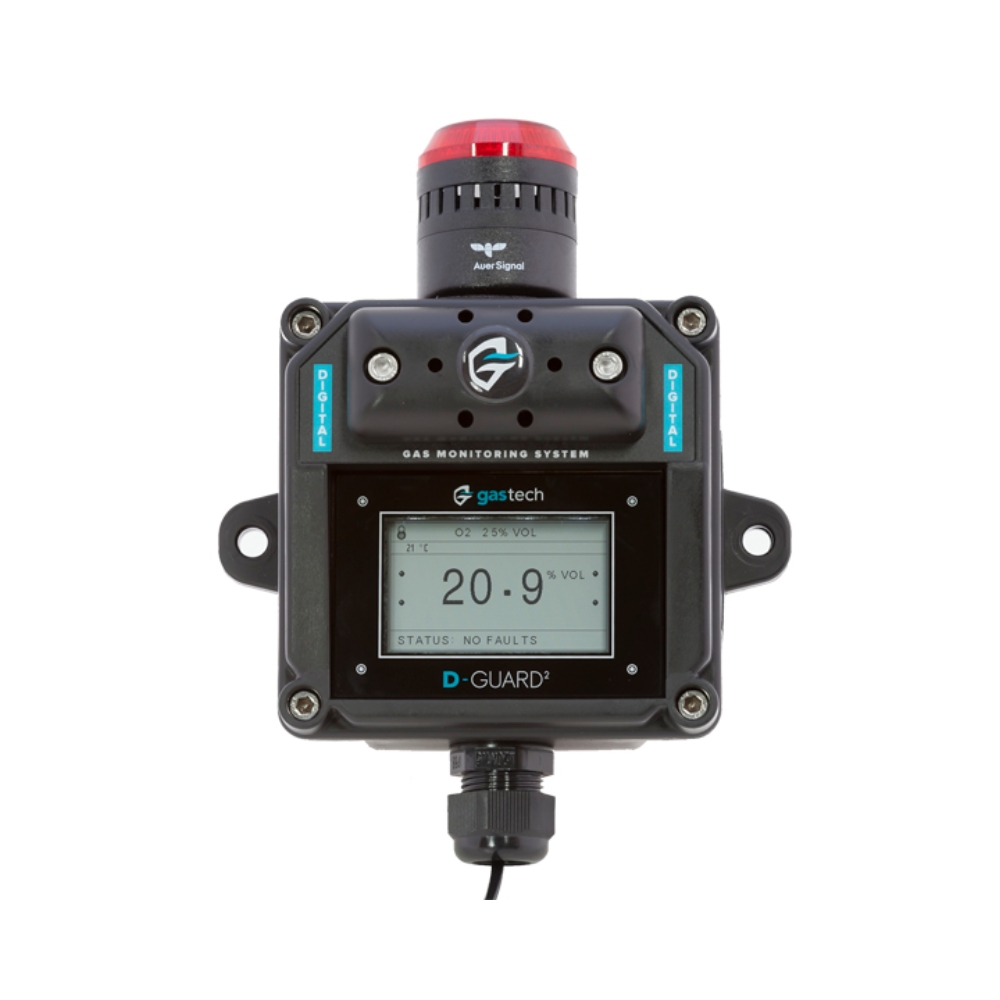
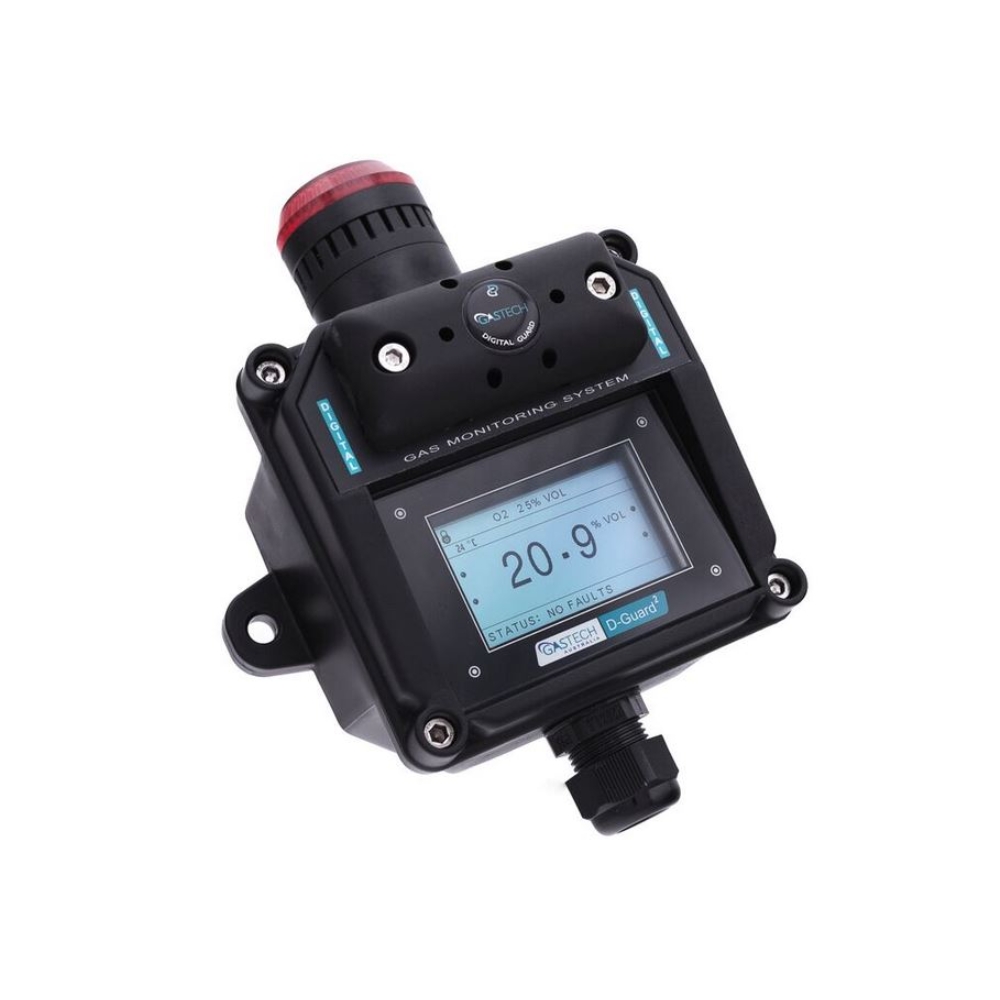
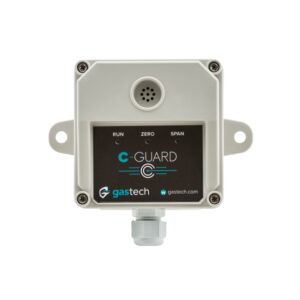
The D-Guard²S is Gastech’s own fixed gas detector with a built in relay board and sounder strobe. It detects and alarms in one enclosure, so a single point installation needs no cabling back to a controller. Three relays handle low alarm, high alarm and fault, and the 98 dB sounder with a flashing red strobe puts the warning where the hazard is. It’s a general purpose detector for non hazardous areas, covering 15 toxic gases and oxygen.
KEY BENEFITS
- Built in relay board and 98 dB sounder strobe alarm at the point of detection
- No cabling back to a controller, which cuts install cost on a single point installation
- Three relays cover low alarm, high alarm and fault
- Fault relay is normally energised, so a power failure shows up as a fault
- 15 gases from a single board, including hydrogen tolerant CO, configured on site
+ more in the Description tab below
Detection and Alarm in One Enclosure
Most fixed gas detection is a two part system: a detector at the hazard, a controller somewhere else, and cable between them.
That cable is often the biggest line in the install quote. Running armoured cable across a site, through a wall or up a duct can cost more than the detector at the end of it.
The D-Guard²S removes that. The relay board and sounder strobe are inside the detector, so it monitors, decides and alarms on its own.
For a single detection point, or a handful of points that don’t need a central panel, that changes the economics of the job.
What the Relays Do
Three relays, each with a defined job.
| Relay | Function | Type |
|---|---|---|
| 1 | Low alarm | Single pole double throw |
| 2 | High alarm | Single pole double throw |
| 3 | Fault | Normally energised |
The fault relay is normally energised, and that matters more than it sounds. Because it’s energised in normal operation, a power loss, broken wire or dead board drops the relay and registers as a fault. A normally open fault relay would stay silent in exactly the situation you most need to know about.
The low and high alarm relays are changeover contacts, which gives you options. Drive extraction on low and a shutdown on high. Trip a solenoid. Signal a BMS. Light a beacon at the door as well as the one on the detector. Both alarm relays can be set as energised or de-energised.
An Alarm People Will Notice
The sounder is rated 98 dB, with a flashing red strobe.
Both matter. A sounder alone fails in a plant room with machinery running, or where hearing protection is worn. A strobe alone fails for anyone facing the other way. Together, they cover both.
Putting the alarm on the detector, rather than at a remote panel, also means the warning is where the gas is. Someone about to walk into a cool room or pump station is warned before they go in, not after.
15 Gases, One Board
The D-Guard²S uses a single electronics board across toxic gases and oxygen, with 4 series plug in sensors and configuration through the interface. Hydrogen tolerant CO sensors are also available.
That covers hydrogen sulphide at a pump station, ammonia in a chiller room, ethylene oxide in a sterilisation area, phosphine in fumigation and chlorine at a dosing plant. One detector type, one spares line and one procedure to learn.
For carbon dioxide or methane with a relay board, use the D-Guard²R.
Calibrate It Without Opening It
Calibration and configuration use a magnetic stylus against the closed housing. Nothing is unscrewed or exposed.
On screen prompts walk the technician through it, which reduces mistakes by someone who calibrates a detector twice a year rather than twice a day. A detector isolate feature takes a point out of service for maintenance.
It Tells You When It Has Failed
A detector that has quietly failed is worse than no detector, because the site believes it’s protected.
A sensor self test runs on a timer, or on demand over HART, and operating conditions are monitored continuously. Response time testing is built in, giving a real measurement of dynamic performance rather than assuming a detector that worked last year still works today. As standards begin to require this, the detector is already equipped for it.
Drift is less than 3% signal loss per year, which keeps calibration intervals long and predictable.
HART If You Want It
Optional HART 7.0 runs alongside the 4-20 mA output. It carries real time readings, diagnostics, remote sensor testing and current loop rescaling.
For a standalone installation, you may never need it. For a remote site, it saves a trip.
Important: Not a Hazardous Area Detector
The D-Guard²S is a general purpose detector and carries no Ex certification. Gastech’s documentation states that it must not be used in applications that need certified equipment.
If your installation is in a classified hazardous area, you need the D-Guard², which carries IECEx, ATEX and ANZEx certification across Group I for underground coal and Group II for surface industry.
If you’re not sure how your area is classified, our engineering team can work through it with you. Getting this wrong isn’t a compliance technicality. It’s a genuine safety issue.
Choosing Across the Range
| Model | Use it when |
|---|---|
| D-Guard² | The area is classified and certified equipment is required |
| D-Guard²R | You want relays for control or interlock, without a local siren |
| D-Guard²S | You want a complete detect and alarm unit with no controller |
Where It’s Used
Cool rooms and cold stores, pump stations and wet wells, chemical dosing rooms, plant and boiler rooms, carparks and loading bays, workshops and battery charging areas, laboratories, sterilisation areas, fumigation and grain handling sheds, commercial kitchens, and mineral processing and surface plant in non classified areas.
Benefits
- Built in relay board and 98 dB sounder strobe alarm at the point of detection
- No cabling back to a controller, which cuts install cost on a single point installation
- Three relays cover low alarm, high alarm and fault
- Fault relay is normally energised, so a power failure shows up as a fault
- 15 gases from a single board, including hydrogen tolerant CO, configured on site
- Non-intrusive magnetic stylus calibration needs no enclosure opening
- Integrated response testing measures real performance, not assumed performance
- Sensor self test runs on a timer or over HART, so a failed cell reports itself
- Alarm relays can be set energised or de-energised to suit the control logic
- Backlit display shows the gas, range and reading clearly, with system alerts on the home screen
Analogue output
4-20 mA
Digital communication
HART 7.0 on selected models
Indication
2.7 inch (68.6 mm) monochrome LCD
Relay output 1 and 2
Low alarm and high alarm, single pole double throw. Energised or de-energised, user selectable
Relay output 3
Fault, normally energised
Sounder strobe
98 dB, flashing red
Input power
13 to 26 VDC, 250 mA
Wiring
3 wire connection when using the relay and sounder functions
Response time
T90 typically under 40 seconds for toxic gases, cell dependent
Operating temperature
-20°C to +55°C
Humidity range
15 to 90% non-condensing
Sensor style
4 series plug in sensors
Calibration
Non-intrusive, magnetic stylus
Sensor self test
Timed or HART triggered, with continuous operating condition monitoring
Response testing
Integrated dynamic response testing
Gland
20 mm nylon, IP68 rated
Drift
Less than 3% signal loss per year
Dimensions
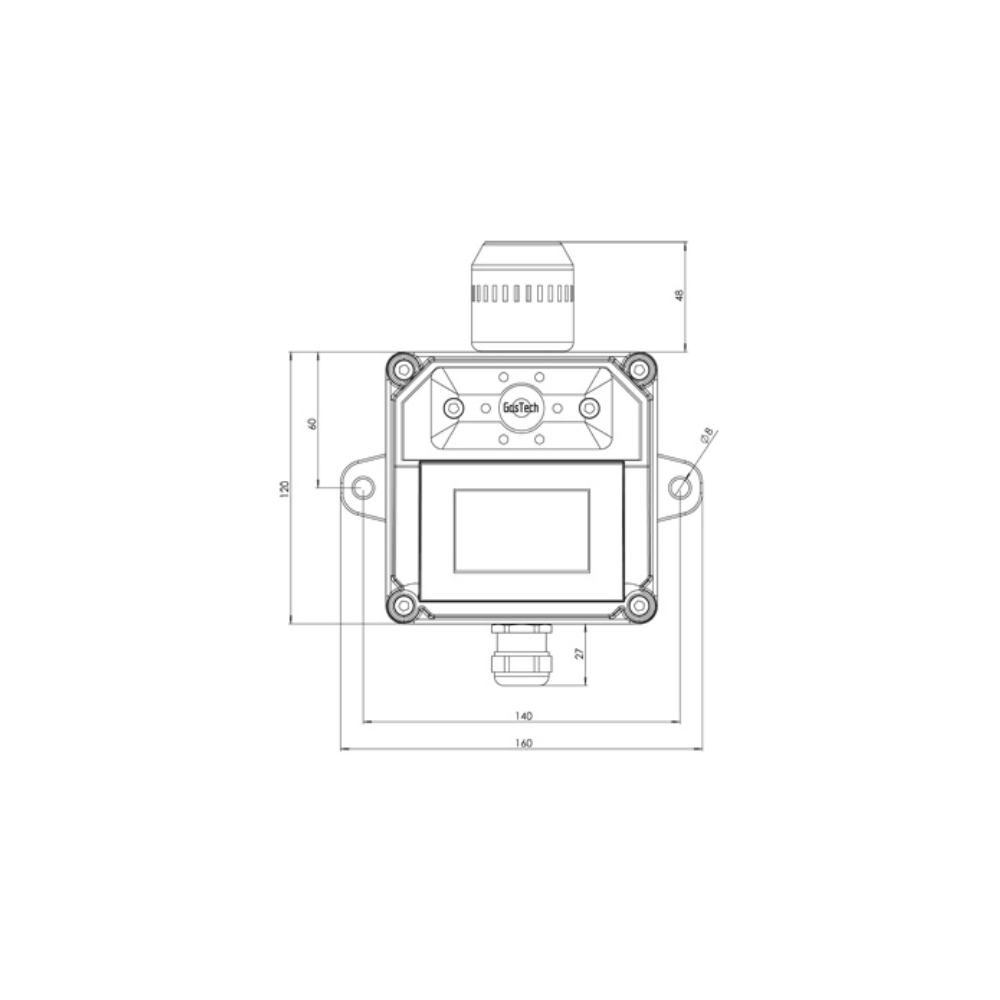
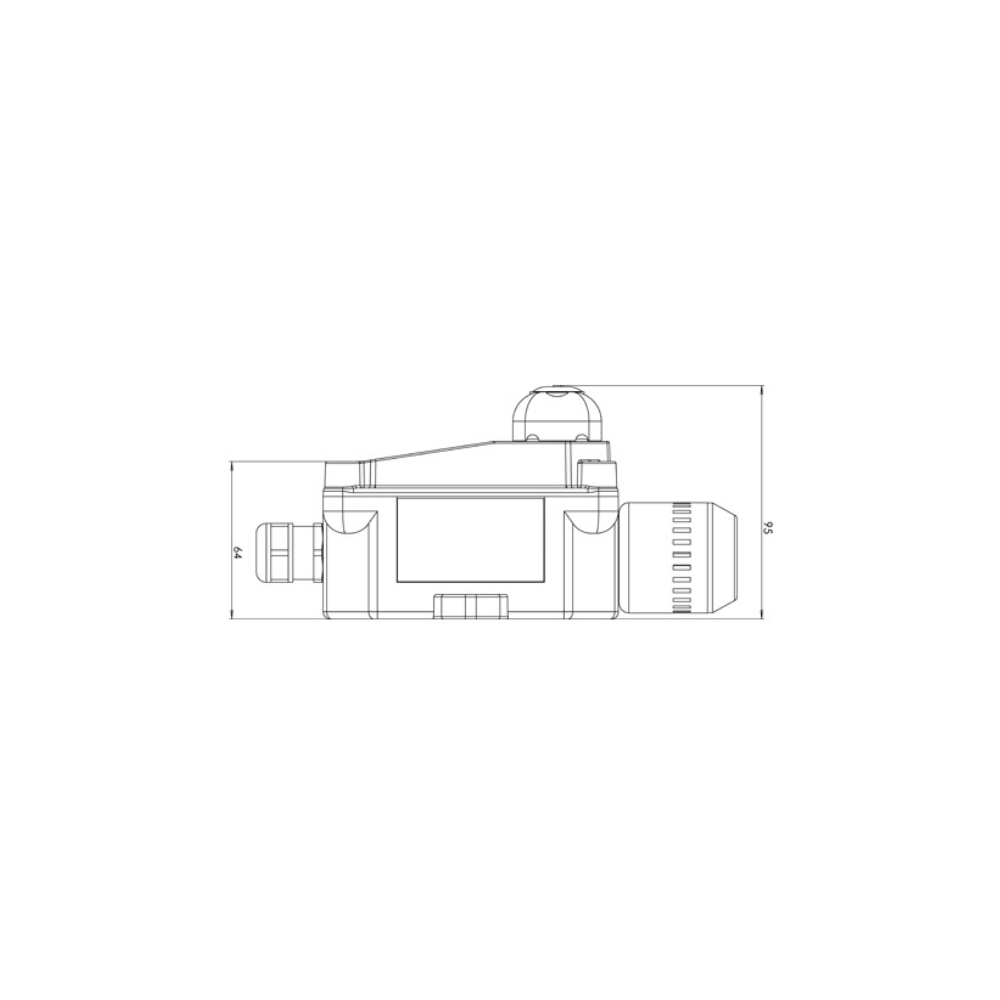
120 x 120 x 95 mm
Enclosure
Highly impact resistant, non conductive, anti static, UV stable, chemically resistant acetal plastic
IP rating
IP65
Certification
General purpose, non-certified. Not for use in hazardous areas
Warranty
2 years on the instrument. Sensor warranty varies by cell
Ethylene Oxide
C2H4O
Chlorine
Cl2
Carbon Monoxide
CO
Hydrogen Sulphide
H2S
Hydrogen Chloride
HCl
Hydrogen Cyanide
HCN
Hydrogen Fluoride
HF
Ammonia
NH3
Nitric Oxide
NO
Nitrogen Dioxide
NO2
Oxygen
O2
Ozone
O3
Phosphine
PH3
Sulphur Dioxide
SO2
- Aviation & Transportation
- Carpark & HVAC
- Chemical Manufacturing
- Confined Space & Compliance
- Energy (Oil & Gas)
- Food & Beverage
- Landfill & Remediation
- Marine & Maritime
- Medical & Healthcare
- Mining & Minerals
- Power Generation & BESS
- Technology & Semiconductor
- Water & Wastewater
No, the relay board and sounder strobe are built in, so it detects and alarms without any cabling back to a panel.
Relay one is low alarm and relay two is high alarm, both changeover contacts, while relay three is a normally energised fault relay.
So that a power failure or broken wire drops the relay and registers as a fault, rather than sitting silent when you most need to know.
No, it is a general purpose non-certified detector. Classified areas need the D-Guard², which carries IECEx, ATEX and ANZEx certification.
The sounder is 98 dB and pairs with a flashing red strobe, so it works where machinery is running or hearing protection is worn.
The S has both relays and a sounder strobe, while the R has the relay board without the local alarm.
No. The D-Guard²S covers toxic gases and oxygen. For carbon dioxide or methane with built in relays, use the D-Guard²R.
Trusted by









Contact Us
Can’t find what you’re looking for? Our team is happy to help.