
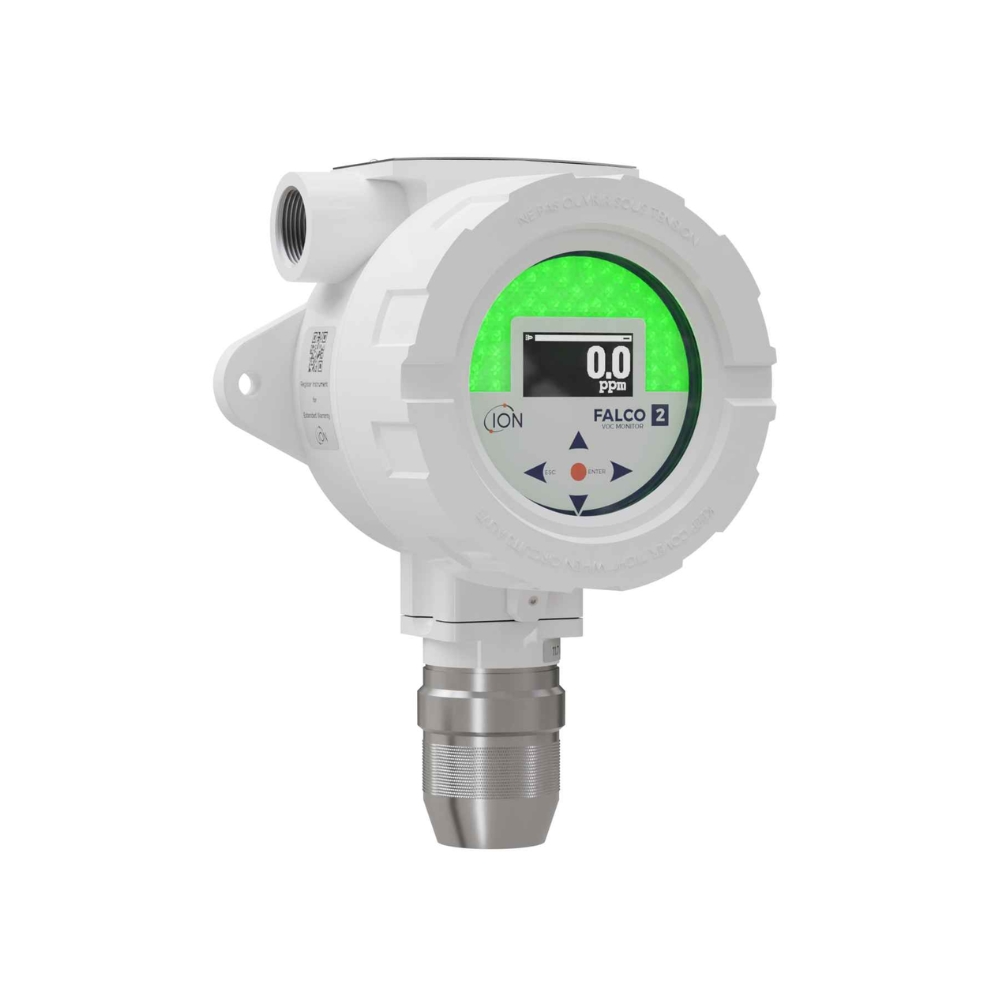
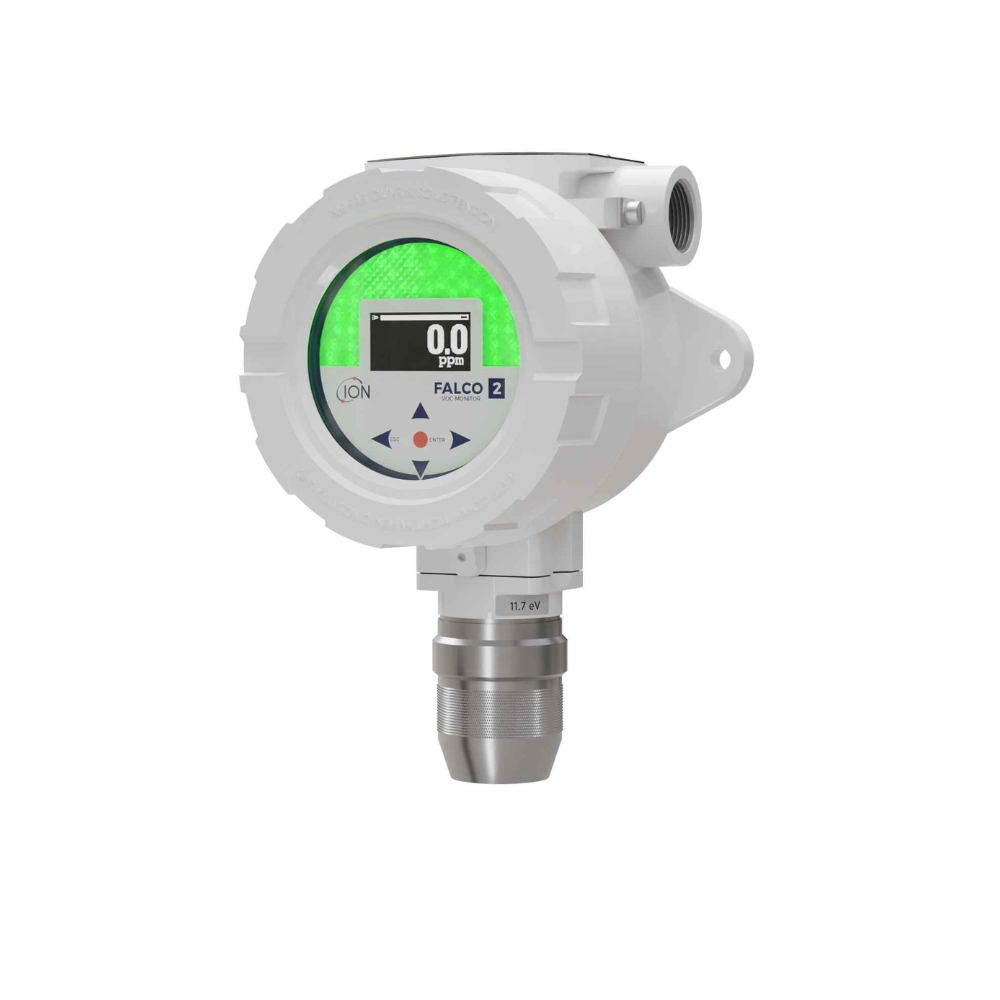
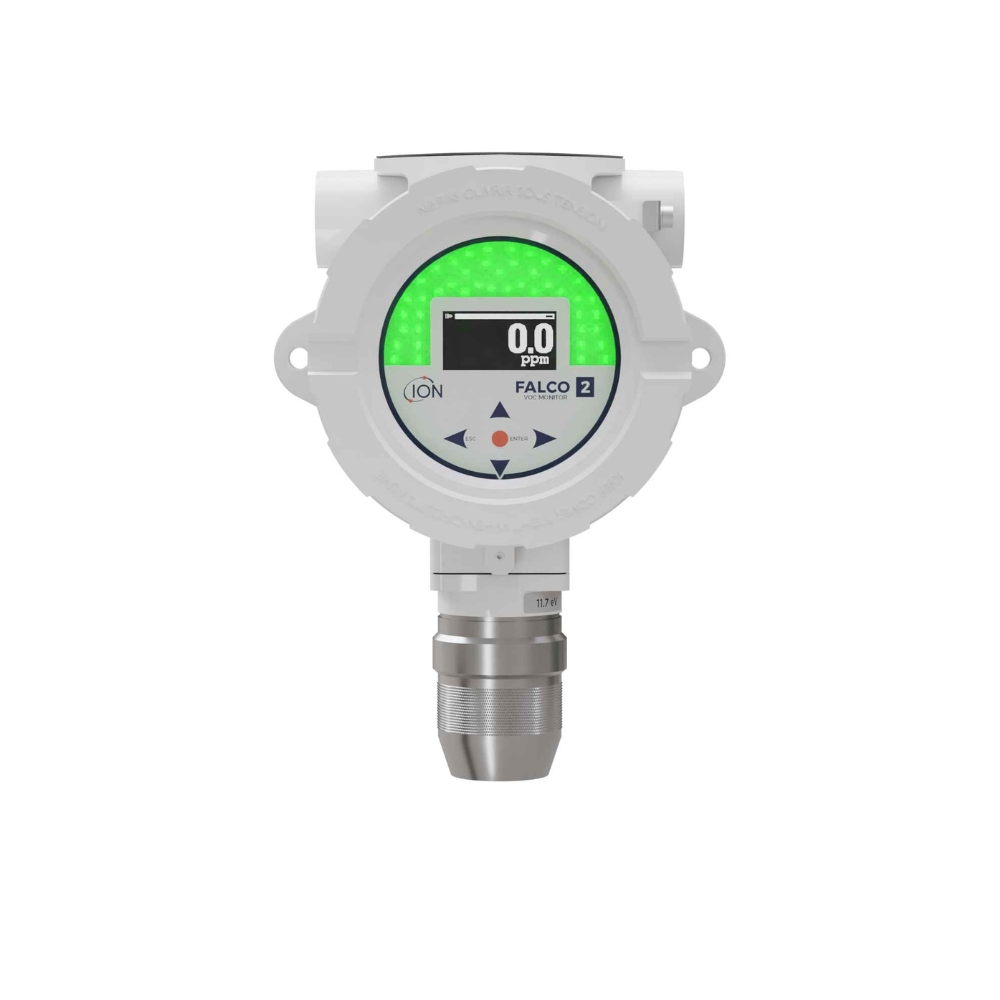
Falco 2
Fixed VOC Gas Detectors
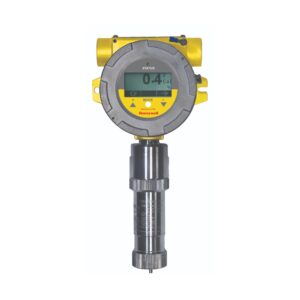
The Falco 2 by ION Science is a fixed photoionisation detector for continuous VOC monitoring in hazardous areas. The 10.6 eV lamp covers over 700 volatile organic compounds, and the 11.7 eV option reaches compounds with high ionisation energies, such as formaldehyde, methanol, dichloromethane and chlorinated solvents. Typhoon Technology stops condensation forming on the sensor, so readings hold up outdoors through a wet season. Dual IS and ExD certification means the sensor can be calibrated and serviced with the power on.
KEY BENEFITS
- Two lamp options on one platform, so the same instrument covers general VOC work or high energy compounds a standard PID misses
- Detects over 700 volatile organic compounds with the 10.6 eV lamp, enough for a mixed solvent site to standardise on one device
- Dual IS and ExD certification lets the sensor be calibrated and serviced in a hazardous area with the power on
- Typhoon Technology stops condensation forming on the sensor, holding readings stable through washdown, fog and tropical humidity
- Patented Fence Electrode Technology removes the humidity drift that makes competing PIDs unreliable outdoors
+ more in the Description tab below
Which Lamp You Need, and Why It Matters
This is the decision to get right, and it’s worth two minutes before you look at anything else.
Photoionisation works by knocking an electron off a molecule. If the lamp carries less energy than the compound’s ionisation energy, nothing happens and the instrument reads zero. Not a low reading. Zero.
So a 10.6 eV PID in a room full of formaldehyde reads clean, and the reading is worthless. The gas is there, but the lamp can’t see it.
| 10.6 eV | 11.7 eV | |
|---|---|---|
| Compounds covered | Over 700 VOCs | Adds formaldehyde, methanol, dichloromethane, acetylene, chloroform, acrylonitrile and most organics containing fluorine, chlorine or bromine |
| Monitoring | Continuous | Duty cycled, 20 seconds on and 40 seconds off |
| Response time | Seconds | 60 seconds, one full cycle |
| Detection ranges | 0 to 10, 0 to 50, 0 to 1,000, 0 to 3,000 ppm | 0 to 200 ppm |
| Sensitivity | 0.001 ppm on the lowest range | 0.1 ppm |
| Accuracy | Refer to datasheet by range | ±12% or 1 digit |
| Lamp life | 10,000 illuminated hours | Around 3 months in service |
| Calibration interval | Routine, per site schedule | Weekly, as recommended by ION Science |
| Sampling | Diffused or pumped | Diffused only |
The short version: choose 10.6 eV unless your target compound is beyond its reach. It monitors continuously, the lamp lasts years rather than months, and it costs far less to run. Choose 11.7 eV when the compound leaves you no option.
Over 700 Compounds From One Sensor
Most fixed gas detection is compound specific. You decide what you’re looking for, then buy a sensor for it.
Volatile organic compounds don’t work that way. A solvent store, tank farm or process line can release any of hundreds of compounds, and the mix changes with what’s running that day.
The 10.6 eV lamp responds to anything that ionises at or below 10.6 electron volts. That covers the aromatics, hydrocarbons, ketones and alcohols that make up most industrial solvent exposure. Calibrated to isobutylene, one instrument gives a total VOC reading across them all. Customisable response factors let the reading be set for a specific compound.
| Range | Typical use |
|---|---|
| 0 to 10 ppm | Fenceline, fugitive emissions, trace work at part per billion sensitivity |
| 0 to 50 ppm | Occupational exposure monitoring against workplace limits |
| 0 to 1,000 ppm | Process areas, solvent handling, tank farms |
| 0 to 3,000 ppm | High concentration process and storage areas |
Service It With the Power On
This feature saves money over the life of the instrument, and it’s easy to skim past on a datasheet.
The Falco 2 has dual certification. The main housing is ExD, and the sensor is intrinsically safe and mounted externally. Calibration and sensor servicing can be done in the hazardous area with the power on.
On a live plant, that makes routine calibration far simpler, with less shutdown planning and coordination. Across a fleet of detectors at a refinery, it changes the annual cost of ownership, not just the convenience. On the 11.7 eV lamp, which needs weekly calibration, it matters even more. Permit requirements are set by each site, so check yours.
Built for Weather, Not a Cabinet
PID sensors have a reputation for drifting in humidity. Condensation forms inside the sensor and the reading wanders.
Two ION Science technologies handle this. Typhoon Technology prevents condensation forming inside the PID sensor. Patented Fence Electrode Technology, with an anti contamination design, removes the effect of condensation on the response, so the instrument clears down properly instead of holding a false high reading.
The housing is rated IP65. In Australian terms, that means a Pilbara wet season, a coastal salt environment or a washdown area, without building a weatherproof cabinet around it.
Diffused or Pumped
The diffused model measures the air where it’s mounted. It’s simple, with no moving parts, and right when you know where the hazard will be.
The pumped model draws a sample through a line, covering pits, sumps, voids and confined spaces where mounting an instrument isn’t practical. Both share the same outputs and sensor technology. The 11.7 eV lamp comes in the diffused configuration only.
Understanding the Duty Cycle
An 11.7 eV lamp has a hard physical limit. Higher energy shortens lamp life, and on continuous operation, a high energy PID lamp lasts days rather than months.
ION Science’s answer is duty cycling. The lamp runs a fixed 60 second cycle, 20 seconds on and 40 seconds off, which stretches lamp life to about three months in service, or up to four months from delivery allowing for storage. The cycle is fixed and can’t be changed by the user.
A progress indicator shows where the unit is in its cycle, with an icon showing whether the lamp is on. That matters, because it tells an operator whether a zero reading means clean air or a lamp that happens to be off.
Maintenance on the 11.7 eV Lamp
Plan for this before you specify it, because a surprise six months in is worse than knowing up front.
ION Science recommends weekly calibration and weekly bump testing with a suitable span gas. Calibration is two point, thanks to the sensor’s linearity across the 0 to 200 ppm range. Lamps and filters can be replaced in the field. The lamp is warranted for three months from the date of sale, which reflects its working life rather than a defect window.
One practical point: the 11.7 eV lamp window must not be cleaned with the aluminium oxide polishing compound used on standard PID lamps, as it will damage the window. Only ION Science lamps fit the MiniPID 2 sensor, and anything else voids the warranty.
We can manage this under a scheduled service agreement and supply the span gas, which is the realistic way to keep a weekly cycle from slipping.
Integration
Outputs include 4-20 mA analogue, RS485 Modbus and two programmable relays. That covers a standalone install with local alarms, a connection to an existing fire and gas panel, or a site wide network reporting to a control room.
It runs on 8 to 40 VDC at typically 2 W, so it works on existing field power without a dedicated supply.
The interface is a high contrast OLED display with five tamper proof magnetic switches and LED confirmation, all operated without opening anything. A red, amber and green status display is visible from 20 metres in direct sunlight.
Where It’s Used
Refineries and petrochemical plants, tank farms and terminals, solvent and chemical stores, fenceline and fugitive emission monitoring, wastewater treatment works, contaminated land and remediation sites, lithium ion battery manufacturing and storage, pathology and mortuary formaldehyde monitoring, ethylene oxide sterilisation areas, methanol handling on gas processing plants, semiconductor and electronics cleaning, and marine terminals and cargo tank areas.
Benefits
- Two lamp options on one platform, so the same instrument covers general VOC work or high energy compounds a standard PID misses
- Detects over 700 volatile organic compounds with the 10.6 eV lamp, enough for a mixed solvent site to standardise on one device
- Dual IS and ExD certification lets the sensor be calibrated and serviced in a hazardous area with the power on
- Typhoon Technology stops condensation forming on the sensor, holding readings stable through washdown, fog and tropical humidity
- Patented Fence Electrode Technology removes the humidity drift that makes competing PIDs unreliable outdoors
- Four detection ranges on the 10.6 eV lamp, from 0 to 10 ppm for fenceline work up to 0 to 3,000 ppm in a process area
- Sensitivity to 0.001 ppm on the lowest range, low enough for fugitive emission programmes
- Pumped model draws a sample from up to 20 metres, reaching pits and voids without sending a person in
- Status display reads red, amber or green from 20 metres in direct sunlight, so alarm state is obvious across a plant
- ATEX and IECEx certified for the classified areas where solvents are handled
Sensor
MiniPID 2 photoionisation detector
Sensor protection
Typhoon Technology and patented Fence Electrode Technology
User interface
OLED high contrast white on black, 128 x 64 pixels, 35 x 17.5 mm, 5 magnetic switches with LED confirmation
Status indicator
Tri-colour red, amber and green, visible up to 20 metres in direct sunlight
Output
4 to 20 mA, RS485 Modbus, 2 programmable relays
Housing
ExD, with externally mounted intrinsically safe sensor
Certification
ATEX II 2G Ex db ib IIC T4 Gb. IECEx Ex db ib IIC T4 Gb. North American certification: confirm current status with Gastech (listed as TBA for the 11.7 eV version)
Servicing
Dual IS and ExD certification allows calibration and servicing in a hazardous area with the power on
Ingress protection
IP65
Operating temperature
Minus 20°C to plus 50°C
Storage temperature
Minus 40°C to plus 60°C
Electrical
8 to 40 V DC, typically 2 W, maximum 8 W
Cable entry
2 x M25 threaded entries, left and right
Mounting
2 x M8 points
Weight and dimensions
2.5 kg, 223 high x 192 wide x 115 deep mm, diffused housing
EMC
EMC Directive 2014/30/EU
Calibration basis
Isobutylene at 20°C and 1000 mBar
Warranty
Unit 1 year standard, 2 years on registration within one month of purchase
-
-
10.6 eV Lamp
Compounds detected
Over 700 volatile organic compounds
Detection ranges
0 to 10 ppm, 0 to 50 ppm, 0 to 1,000 ppm, 0 to 3,000 ppm
Sensitivity
0.001 ppm on the 0 to 10 ppm range
Monitoring
Continuous, no duty cycle
Lamp lifetime
10,000 hours of illumination
Sampling
Diffused or pumped, pumped drawing from up to 20 metres
Humidity
0 to 100% RH
-
-
11.7 eV Lamp
Compounds detected
Compounds ionising up to 11.7 eV, including formaldehyde, methanol, dichloromethane, acetylene, chloroform and acrylonitrile
Range and sensitivity
0 to 200 ppm, 0.1 ppm
Accuracy
Plus or minus 12% or plus or minus 1 digit
Response time (T90)
60 seconds, one full duty cycle
Duty cycle
60 seconds fixed, 20 seconds on and 40 seconds off, not user configurable
Lamp lifetime
Up to 4 months from delivery, based on 1 month storage and 3 months use
Lamp warranty
3 months from date of sale
Calibration interval
Weekly, as recommended by ION Science
Sampling
Diffused only
Humidity
0 to 99% RH
Acetylene (Ethyne)
C2H2
Ethylene Oxide
C2H4O
Acetic Acid
C2H4O2
Acrylonitrile
C3H3N
Acetone
C3H6O
Propane
C3H8
Isopropanol
C3H8O
Hexane
C6H14
Benzene
C6H6
Heptane
C7H16
Toluene (Methylbenzene)
C7H8
Octane
C8H18
Dichloromethane
CH2Cl2
Chloroform
CHCl3
- Chemical Manufacturing
- Aviation & Transportation
- Carpark & HVAC
- Confined Space & Compliance
- Energy (Oil & Gas)
- Food & Beverage
- Landfill & Remediation
- Marine & Maritime
- Medical & Healthcare
- Mining & Minerals
- Power Generation & BESS
- Technology & Semiconductor
- Water & Wastewater
Choose 10.6 eV for continuous monitoring of general VOCs, and 11.7 eV only when your target compound sits above its reach, such as formaldehyde, methanol or chlorinated solvents.
Because the lamp carries less energy than the compound needs to ionise, which is exactly why lamp selection matters more than any other specification on a PID.
Yes. Dual IS and ExD certification means the externally mounted sensor can be calibrated and serviced in a hazardous area with the power on. Check your site's permit requirements for the work.
The 10.6 eV lamp runs for 10,000 illuminated hours, while the 11.7 eV lamp lasts around three months in service even with duty cycling.
The diffused model reads air at the instrument, while the pumped model draws a sample through a line from up to 20 metres. The 11.7 eV lamp is diffused only.
Typhoon Technology and Fence Electrode Technology together prevent condensation forming on the sensor, so the instrument stays stable and clears down properly in humid air.
Trusted by









Contact Us
Can’t find what you’re looking for? Our team is happy to help.