

iNet Now
Live Monitoring Software
iNet Now tells you a worker is in trouble while it is happening, rather than when they fail to come back. Gas alarms, panic button presses and man down events generate a real time text or email alert with the readings, the worker and a map pin. It works through a smart device carrying data from a Ventis Pro or Radius BZ1 to the cloud, with no pairing and nothing for the worker to operate.
KEY BENEFITS
- Real time text and email alerts for gas, panic and man down events
- Live map pinpointing where each worker and instrument is
- No pairing required, and one smart device can carry unlimited Ventis Pro monitors
- Nothing for the worker to operate beyond checking the app is running
- Alerts escalate automatically if the first recipient does not acknowledge them
+ more in the Description tab below
During the Shift, Not After It
The clearest way to understand iNet Now is against its sibling.
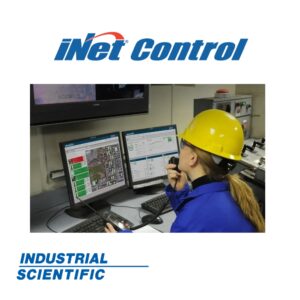
iNet Control+ works between shifts. It holds historical data and custom reports, and it reveals patterns, such as repeated alarms at one location, or a worker who turned an instrument off during an alarm.
iNet Now works during the shift. It carries what’s happening right now to someone who can act on it.
Both matter, and they answer different questions. One tells you what went wrong. The other lets you stop it going wrong.
How It Works
There are three steps, and no worker involvement beyond the first.
A worker carries a Ventis Pro Series monitor and a smart device, both with Bluetooth on. The smart device runs the iNet Now Sync app in the background, sending readings from the detector to the cloud over mobile data or WiFi. There’s no pairing, and any phone running the app works with any enabled Ventis Pro within about 30 metres.
When the detector alarms, the designated contact gets a text or email with the sensor readings, the location and the worker’s status. They then follow the established response procedure.
All the worker has to do is check the app is running.
What Triggers an Alert
There are six instrument events, and three real time alert events.
Gas alarms cover high alarm, low alarm, STEL and TWA. Panic alarm triggers when the worker presses and holds the panic button. Man down triggers when the instrument has been stationary for a set period.
Beyond those, short term lost and long term lost alerts trigger when an instrument is powered on, but has stopped sending data. That catches a worker who has gone somewhere without coverage, or a failure.
There’s also a separate real time alert setting for each gas, and it’s worth understanding, because it does something the instrument alone can’t.
You can set a threshold in iNet Now that’s different from the instrument’s own alarm setpoint. So on a site with a known history of sulphur dioxide, a worker’s instrument might go into high alarm and generate an alert. If the reading then climbs further and crosses the higher iNet Now threshold, a second alert is produced. That second alert says the situation is getting worse, not just present, which is a different message to send a supervisor.
Alerts That Don’t Get Missed
Subscriptions define who is told about what, and each has two recipients.
The primary recipient receives the alert. If they don’t acknowledge it within a set time, and the event is still in progress, it escalates automatically to a second person.
That last condition matters. If a worker presses the panic button and then turns it off before the escalation time is up, no escalation is sent, so the system doesn’t create noise from resolved events.
Subscriptions are set by equipment or by people, and alerts go by text, email or both.
Underground and in Confined Spaces
Bluetooth alone doesn’t get data out of a confined space or a tunnel, and this is where LENS Wireless does the work.
Instruments in a LENS group relay to each other. A detector deep in a space passes readings to one nearer the entrance, then to an instrument at the surface, which reaches a smart device by Bluetooth, and then the cloud. A group can hold six instruments, either Radius BZ1 area monitors or Ventis Pro monitors.
There’s one condition. A LENS group used for iNet Now has to include at least one Ventis Pro set up for iNet Now, within range of a smart device running the app. The Radius BZ1 can only take part through LENS, not directly.
For confined space entry teams and emergency response, that means someone at the surface sees conditions inside before anyone enters, and continuously while they’re in there.
The Lone Worker Problem
It’s worth setting out, because the usual answers don’t work, and Industrial Scientific is direct about why.
The buddy system is inefficient, and if there’s a gas hazard, both workers are affected by it. Check ins, manual or automated, take workers off their task, and tell a supervisor nothing in between. A gas detector alone doesn’t help if the worker is unconscious, because nothing reaches anyone else.
Lone worker pendants are useful, but they don’t detect gas, so the worker carries more equipment for partial coverage. And fleet management systems are sometimes used as a substitute, which is worse than it seems. They track a vehicle, not a person, and they don’t alert on gas, panic or man down at all.
What’s actually needed is real time awareness of the three things that need immediate action: gas, panic and man down. Everything else can be looked at later.
What You Need to Run It
There are four things, and the instrument requirements are specific.
A Ventis Pro Series monitor on firmware version 2.3 or later. A Radius BZ1 needs firmware 2.0 or later, and can only be used through LENS Wireless.
A supported smart device running iOS 9.0 or later, or Android 5.1 or later, with Bluetooth Low Energy 4.1 and GPS enabled.
The iNet Now Sync app, downloaded and logged into once. After that, there’s nothing to configure, and no need to log in again.
An active iNet Now account, with each instrument activated in it. An instrument that isn’t activated isn’t monitored, and its alerts don’t work.
Running costs on the smart device are modest: around 15 megabytes of mobile data a month, and between 10 and 25% of phone battery, depending on what else is running. The Ventis Pro loses about 10% of its standard run time.
For vehicles and remote teams, Gastech also supplies the RGX Gateway. Talk to our Technical Consultants about which connection suits your site.
Benefits
- Real time text and email alerts for gas, panic and man down events
- Live map pinpointing where each worker and instrument is
- No pairing required, and one smart device can carry unlimited Ventis Pro monitors
- Nothing for the worker to operate beyond checking the app is running
- Alerts escalate automatically if the first recipient does not acknowledge them
- Separate real time alert thresholds can be set per gas, independent of instrument alarms
- Lost alerts flag an instrument that is powered on but has stopped reporting
- Removes manual lone worker check ins, which take workers off task and prove little
- LENS Wireless carries data out of confined spaces and underground back to the surface
- Runs on roughly 15 megabytes of mobile data a month
Product type
Cloud based live monitoring software
Compatible instruments
Ventis Pro Series (firmware 2.3 or later). Radius BZ1 (firmware 2.0 or later, through LENS Wireless only)
Smart device
iOS 9.0 or later, or Android 5.1 or later. Bluetooth Low Energy 4.1. GPS
App
iNet Now Sync, runs in the background. No pairing needed
Range to smart device
About 30 m
Alert types
High alarm, low alarm, STEL, TWA, panic, man down, short term lost, long term lost. Optional real time alert threshold per gas
Alert delivery
SMS text, email or both. Automatic escalation to a second recipient
LENS Wireless groups
Up to 6 instruments (Ventis Pro or Radius BZ1), with at least one Ventis Pro set up for iNet Now
Data usage
About 15 MB per month
Battery impact
10 to 25% of smartphone battery. About 10% off Ventis Pro standard run time
- Aviation & Transportation
- Carpark & HVAC
- Chemical Manufacturing
- Confined Space & Compliance
- Energy (Oil & Gas)
- Food & Beverage
- Landfill & Remediation
- Marine & Maritime
- Medical & Healthcare
- Mining & Minerals
- Power Generation & BESS
- Technology & Semiconductor
- Water & Wastewater
iNet Now works during the shift, carrying live readings and alerts to someone who can act. iNet Control+ works between shifts, holding historical data and reports that reveal patterns.
Carry the instrument and a smart device, and check the app is running. There is no pairing and nothing to configure.
Ventis Pro Series on firmware 2.3 or above, and Radius BZ1 on firmware 2.0 or above through LENS Wireless.
It escalates to a second recipient after a set time, provided the event is still in progress. If the situation has resolved, no escalation is sent.
Yes, through LENS Wireless. Instruments relay to each other back to one at the surface that can reach a smart device. A group holds up to six instruments.
Around 15 megabytes of data a month, and 10 to 25 percent of phone battery depending on what else is running.

Trusted by









Contact Us
Can’t find what you’re looking for? Our team is happy to help.