
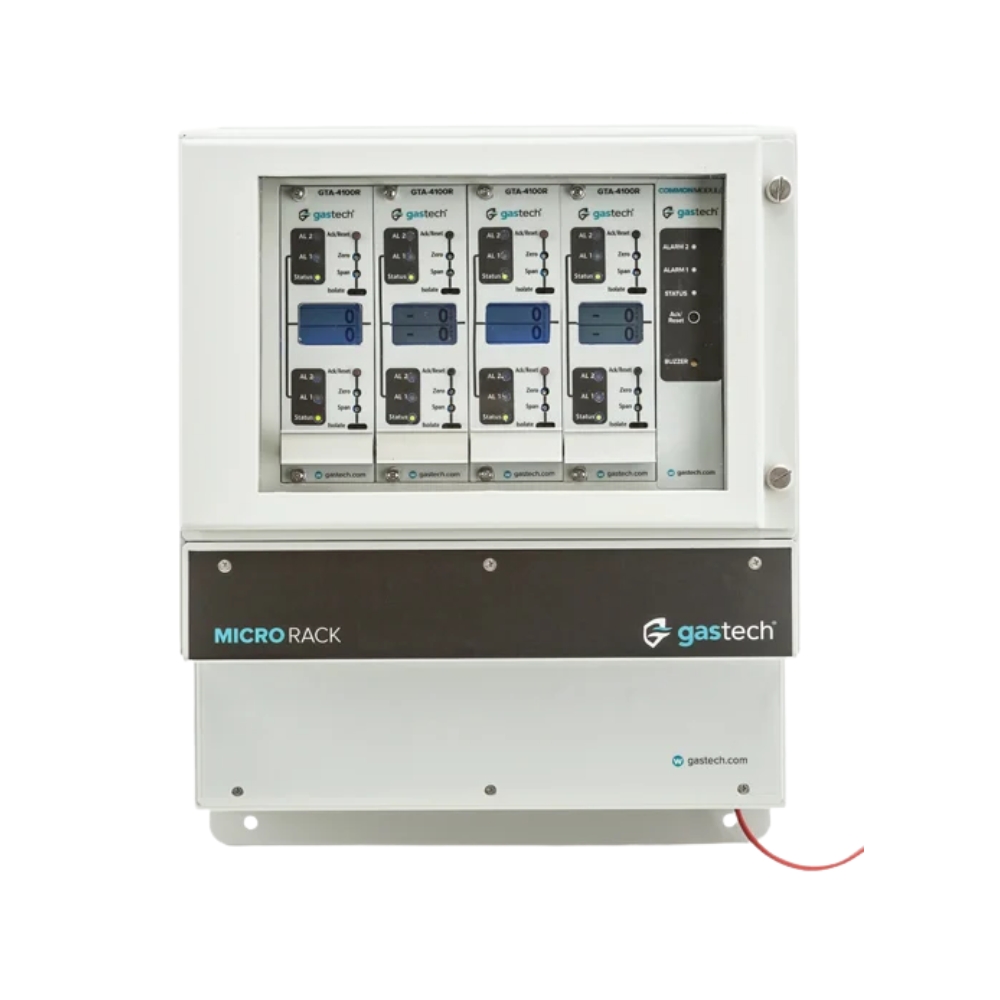
MicroRack
1 to 8 Channel Gas Detection Controller
The MicroRack is Gastech’s own packaged gas detection controller, covering one to eight channels in an IP65 housing with the mains power supply built in. It is built around the field proven 4100R card, with one processor per channel, so a processor failure costs one channel rather than the panel. Channels are added by fitting more cards, and the upgrade is user serviceable, so a system that starts at two channels grows to eight without replacing the panel.
KEY BENEFITS
- Starts at two channels and grows to eight by adding cards, so you buy what the site needs now
- User upgradeable, so expansion needs no panel replacement and no return to Gastech
- One processor per channel, so a processor failure costs one channel rather than the panel
- IP65 powder coated aluminium housing, so it does not need a switchroom cabinet
- 100 W mains power supply built in, so there is no separate 24 volt supply to specify
+ more in the Description tab below
Buy the Channels You Need Now, Not the Panel You Might Need Later
Most gas detection panels are sized once, at purchase. Add a detection point beyond that capacity, and the answer is a new panel.
The MicroRack works the other way round. Capacity comes from 4100R cards, each carrying two channels, and cards are added as requirements change. A site that needs two channels today buys two channels today, and grows to eight without touching the enclosure, power supply or existing wiring.
The upgrade is user serviceable. Nothing has to come back to Gastech, and a site with its own maintenance team can do it themselves.
For a plant that expands in stages, which is most of them, that removes the awkward choice between buying too much capacity now and replacing the panel in three years.
Channels Come in Pairs
Worth knowing before you specify: each 4100R card carries two channels, so capacity moves in twos.
Standard builds are two, four, six and eight channel. A site needing three detection points takes a four channel MicroRack and has a spare channel, which is usually welcome rather than wasted.
IP65, So It Doesn’t Need a Switchroom
The housing is powder coated aluminium, rated IP65.
Gas detection panels are often installed in a switchroom or comms cupboard, which isn’t always where you want them. The MicroRack’s IP65 rating opens up other positions: a plant room, a washdown area, a covered external wall or a pump station building. The panel goes where it’s useful, rather than where the environment allows.
At 270 x 350 x 209 mm and 4.2 kg with one card and the power supply fitted, it mounts on a wall without a fabricated frame.
Mains In, Nothing Else to Specify
The MicroRack includes a 100 W power supply, accepting 240 or 110 VAC. Internally, the system runs on 24 VDC nominal, with a range of 18 to 30 VDC.
That matters at the design stage. A bare controller card needs a 24 V supply specified, sized and installed alongside it, which is another item on the drawing and another thing to get wrong. Here, it’s one mains feed and the panel is complete.
The Card at the Heart of It
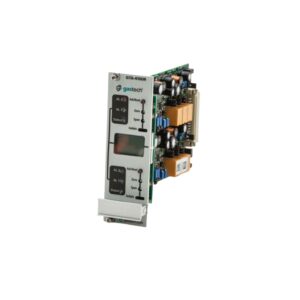
The MicroRack is built around the field proven 4100R controller card, and the engineering behind that card is why the panel is reliable.
Each channel runs its own processor on its own circuit, so a processor failure only affects one channel. The only shared component is the high resolution graphical display, which is non critical, so both channels keep operating correctly even if the display fails. Its dual write feature lets both processors write to the screen at once, top half and bottom half, so the display keeps showing whichever channel is still working.
The isolate feature deserves particular attention. It takes a channel offline for calibration without triggering alarms or a shutdown, drops the analogue output to 1.5 mA, and inverts that channel’s display while still showing the reading. There’s deliberately no timeout, because the system is built to drive critical actions including shutdowns and deluge, and a timeout releasing mid calibration could trigger the very incident it was meant to prevent.
Cards are hot swap compliant, so a card can be replaced without shutting down the panel. The full reasoning behind the card design is on the 4100R page.
Universal Inputs
Inputs accept 1.4 to 24 VDC and 4-20 mA, source or sink, two or three wire. An internal amplifier means 3 wire catalytic sensors connect directly, along with 0 to 1 V, 0 to 5 V, 0 to 10 V and 0 to 24 V inputs, 24 V digital and resistance inputs.
Range is adjustable to 2000, and the display reads in %LEL, ppm, % volume, PPMm, LELm or blank.
In practice, a MicroRack will take signals from most field devices, including detectors from other manufacturers. A staged replacement of ageing detection doesn’t have to start with replacing the panel.
Alarms, Relays and the Buzzer
Each channel has two alarms and a fault alarm. The low and high alarms are independently adjustable from below zero to full scale, give audible and visual indication, can be acknowledged, and can be set to activate on a rising or falling level.
Falling level activation is what lets oxygen depletion monitoring sit on the same panel as flammable gas detection.
Individual relays per channel cover low alarm, high alarm and fault, programmable as latching or non latching, and rated 1 A at 24 VDC. Common relays for low alarm, high alarm and fault are rated 5 A at 24 VDC. Accept and reset can be local to a channel or global across the panel.
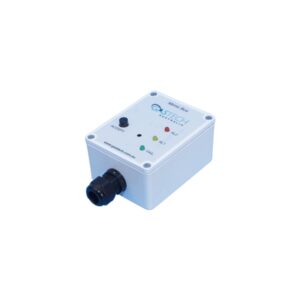
An internal buzzer gives an audible warning at the panel without an external sounder. Where indication is needed elsewhere in a building, the Mimic Box repeats panel status at as many remote locations as you need.
Two Housings, One Card
The 4100R card fits the MicroRack housing or a standard 19 inch rack.
That gives a simple path if a system outgrows eight channels. The cards move across, the field wiring logic stays the same, and the technicians already know the panel.
Where It’s Used
Plant and boiler rooms, cold stores and refrigeration plant, wastewater treatment works and pump stations, landfill gas systems, mineral processing and surface plant, chemical manufacturing and storage, breweries and beverage production, carpark and building ventilation control, workshops and battery charging areas, small to medium fixed detection systems, and sites replacing detectors in stages while keeping the panel.
Benefits
- Starts at two channels and grows to eight by adding cards, so you buy what the site needs now
- User upgradeable, so expansion needs no panel replacement and no return to Gastech
- One processor per channel, so a processor failure costs one channel rather than the panel
- IP65 powder coated aluminium housing, so it does not need a switchroom cabinet
- 100 W mains power supply built in, so there is no separate 24 volt supply to specify
- Universal inputs accept 4 to 20 mA, voltage, digital and resistance signals from most field devices
- Two alarms and a fault relay per channel, each programmable as latching or non-latching
- Channel isolate takes a point offline for calibration without triggering alarms or a shutdown
- Internal buzzer and a backlit graphical display per channel, so the panel stands alone
- The same card fits a standard 19 inch rack, so a system can change format later
Channel capacity
1 to 8 channels, user upgradeable by adding 4100R cards
Standard builds
2, 4, 6 and 8 channel
Processors
One per channel
Range
Adjustable to 2000. Reads percent LEL, ppm, percent volume, PPMm, LELm or blank
Inputs
1.4 to 24 V DC, 4 to 20 mA analogue signal inputs, source or sink, two or three wire. Also 3 wire catalytic, 0 to 1 V, 0 to 5 V, 0 to 10 V, 0 to 24 V, 24 V digital and resistance
Analogue outputs
One 4 to 20 mA source per channel, 1,000 ohm maximum impedance at 24 V DC input
Individual relay outputs
Low alarm, high alarm and fault per channel. Programmable latching or non-latching. Each rated 1 A at 24 V DC
Hot swap
Compliant
Internal amplifier
Yes. Allows direct connection of 3 wire catalytic sensors
Common relay outputs
Low alarm, high alarm and fault. Each rated 5 A at 24 V DC
Low alarm
Independently adjustable from below zero to full scale. Audible and visual indication. Can be acknowledged. Activates on a rising or falling level
High alarm
Independently adjustable from below zero to full scale. Audible and visual indication. Can be acknowledged. Activates on a rising or falling level
Accept and reset
Local to a channel or global across the panel
Channel isolate
Indicated by an inverted display, with 1.5 mA on the analogue output. No timeout
Display
Backlit graphical display per channel
Audible
Internal buzzer
Power supply
240 or 110 V AC, 100 W
Operating voltage
18 to 30 V DC, 24 V DC nominal
Operating temperature
Minus 20°C to plus 55°C
Operating humidity
0 to 95%, non-condensing
Housing
IP65 powder coated aluminium
Overall dimensions
270 x 350 x 209 mm
Weight
4.2 kg with one card and the 100 W power supply
Area classification
General purpose
Warranty
Two years, materials and workmanship
- Aviation & Transportation
- Carpark & HVAC
- Chemical Manufacturing
- Confined Space & Compliance
- Energy (Oil & Gas)
- Food & Beverage
- Landfill & Remediation
- Marine & Maritime
- Medical & Healthcare
- Mining & Minerals
- Power Generation & BESS
- Technology & Semiconductor
- Water & Wastewater
Up to eight, and it is user upgradeable, so a two channel system grows to eight by adding cards without replacing the panel.
Because each 4100R card carries two channels, so standard builds are two, four, six and eight channel.
No, a 100 watt supply accepting 240 or 110 volts AC is built in, so the installation is one mains feed.
Yes, the housing is IP65 powder coated aluminium, so plant rooms, wash down areas and covered external walls are all within scope.
Yes, inputs accept 4 to 20 mA source or sink, three wire catalytic, voltage inputs from 0 to 24 V, 24 volt digital and resistance.
The same 4100R cards fit a standard 19 inch rack, so the system changes format without changing the cards or the commissioning knowledge.
Trusted by









Contact Us
Can’t find what you’re looking for? Our team is happy to help.