
Touchpoint Plus
16 Channel Gas Detection Controller
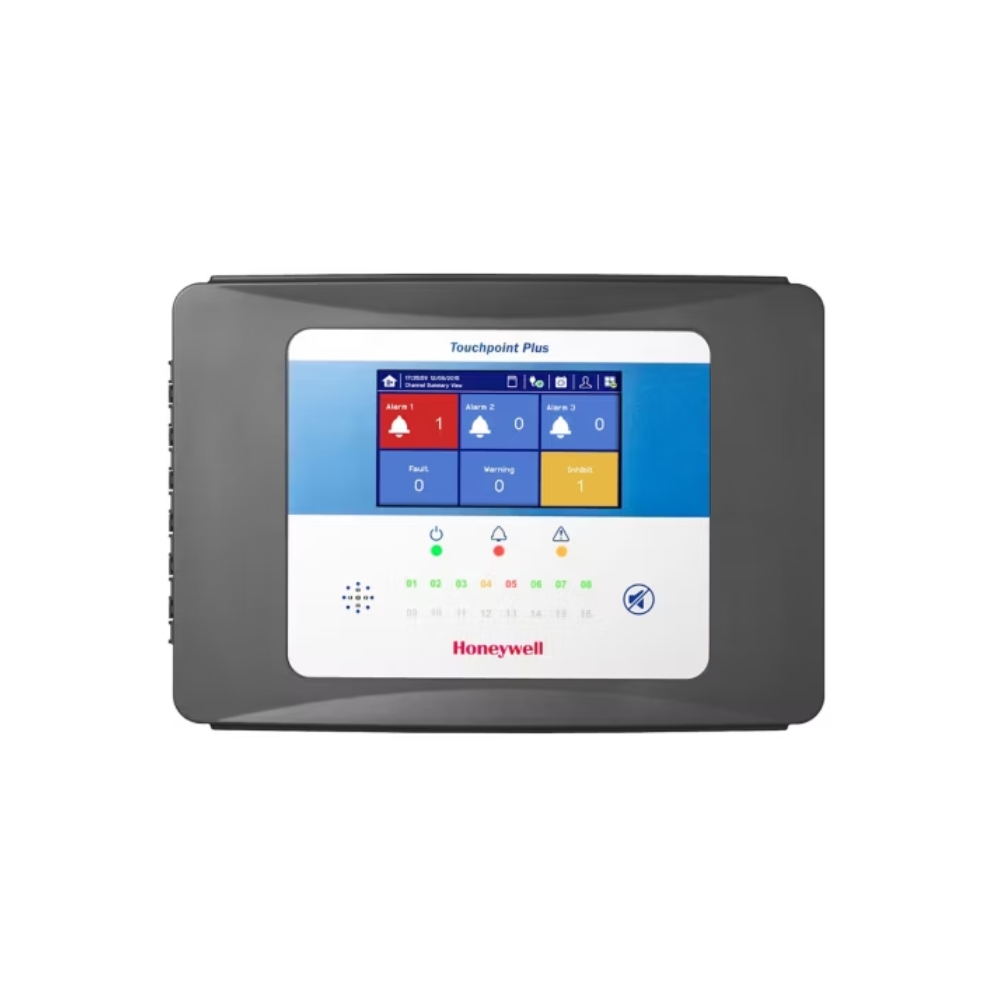
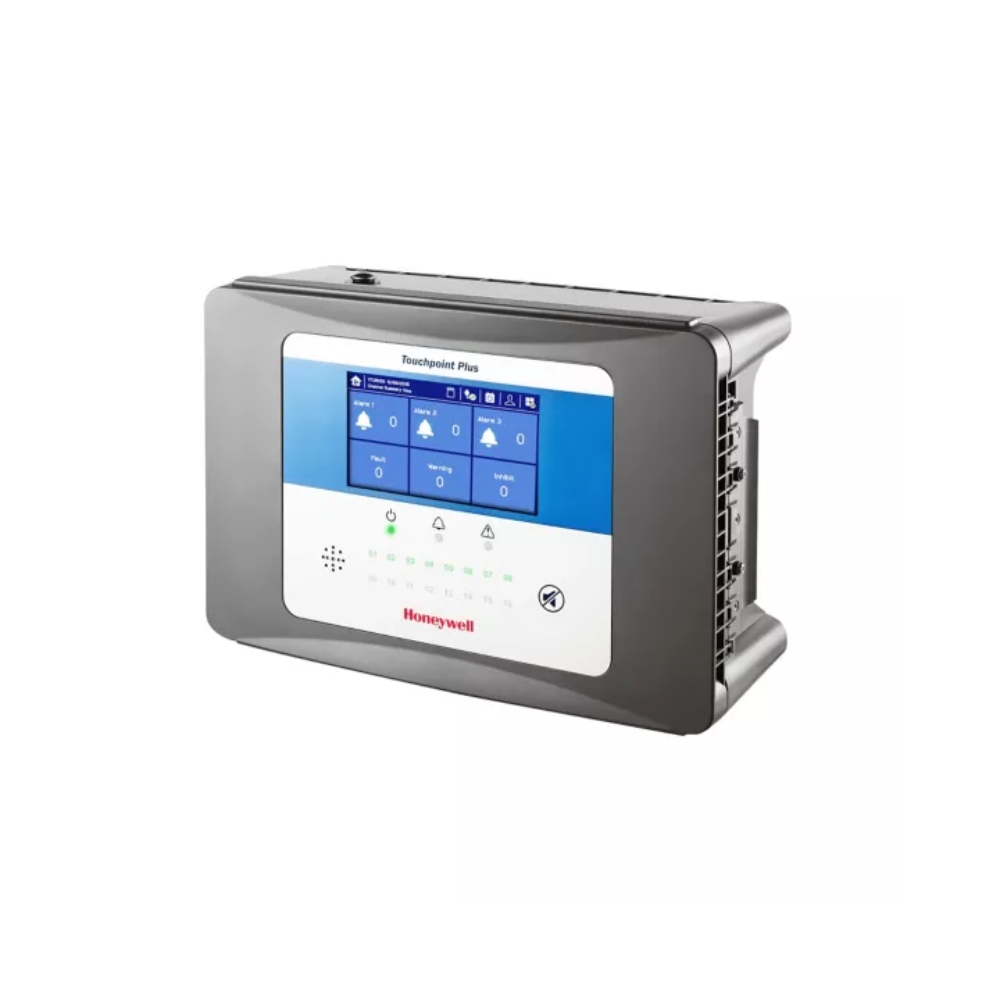
The Touchpoint Plus by Honeywell is a wall mounted gas detection controller for up to sixteen channels, built around a 7 inch colour touchscreen. Eight channels sit in the base unit and a further eight come from an expansion unit. It accepts both milliamp and millivolt inputs, so catalytic bridge sensors and 4 to 20 mA detectors share one panel. Historical data downloads for review, and the IP65 polymer housing is rated for a boiler room as well as a control room.
KEY BENEFITS
- Up to sixteen channels from one wall mounted unit, eight in the base and eight more with an expansion unit
- 7 inch colour touchscreen replaces menu keys, so configuration and calibration are done by touch
- Multilingual interface cuts training time and cost across a mixed workforce
- Historical data downloads, so a developing problem shows as a trend rather than a surprise
- Accepts 4-20 mA detectors and Honeywell mV bridge catalytic sensors on one panel
+ more in the Description tab below
The Panel Is the Part People Actually Use
A gas detection system is designed by engineers, then operated for fifteen years by whoever is on shift.
Many controllers make that hard: menu keys, numeric codes, a sequence someone learned once, and a manual in a drawer that nobody opens until something goes wrong. The result is a panel people are reluctant to touch, which means faults sit unacknowledged and calibrations get deferred.
Touchpoint Plus puts a 7 inch colour touchscreen on the front. Operators configure, operate and maintain the system by touching the screen, with readings in a menu structure designed to be navigated rather than memorised. The interface is available in nine languages, which removes a real training cost on a site with a mixed workforce. Green, yellow and red status lights for each channel and the whole system show the state at a glance, even from a distance.
The point isn’t that a touchscreen looks modern. It’s that a panel people are willing to use is a panel that gets maintained.
Eight Channels, or Sixteen
The base unit handles up to eight channels. An expansion unit adds eight more, taking the system to sixteen.
That covers most small and medium fixed installations without moving to a rack based system: a plant room, boiler house, laboratory building, workshop, or beverage cellar with several dispense points.
The design is modular, so the system is specified for what a site needs and expanded when it grows.
Two Input Types on One Panel
Touchpoint Plus accepts 2 and 3 wire 4-20 mA detectors, and 3 wire mV bridge catalytic sensors from Honeywell. Input modules come in 2, 4 or 8 channel mA or mV versions, or a dual module with mA and mV inputs together.
That gives flexibility on a mixed site. Honeywell catalytic sensors can connect directly without adding a transmitter at each head, while 4-20 mA detectors share the same panel.
It Takes Detectors You Already Have
Touchpoint Plus is designed to work with Honeywell’s detector range, including the Sensepoint XCD, XNX, Searchpoint Optima Plus, Searchline Excel and RAEGuard 2 PID. It also accepts 4-20 mA signals from other manufacturers’ fixed detectors.
That matters commercially. A site with a mixed installed base, built up over years, doesn’t have to standardise on one brand before it can standardise on one panel. Existing detection stays in service, and the control layer gets modernised.
Outputs and Alarm Logic
Powered audiovisual alarm drives are built in, with four powered outputs for alarms and fault. Common alarm outputs are standard: one for fault and two configurable. Remote reset and remote inhibit inputs are standard too, and there’s a built in sounder of at least 70 dB at 1 metre.
Relay modules give 12 or 24 changeover relays, rated 1.7 A at 30 VDC or 250 VAC. Each can be set as energised or de-energised, latching or non latching, with a time delay. Touchpoint Plus can drive actuators and solenoid valves directly, so a gas alarm can shut off a supply, start extraction or trip an interlock. Four or eight isolated mA outputs repeat the channel readings.
Alarm grouping and voting logic can be set up without specialist knowledge, so an alarm can depend on two detectors agreeing, or on a group of detectors in one area.
Data You Can Look Back Through
Real time readings are what a panel is for. Historical data tells you whether a problem has been building.
Touchpoint Plus logs configuration, events and data to an SD card, so a slow drift, a recurring low level release or a detector heading out of tolerance shows up as a pattern. For anyone who has to show that a system has been working, a downloadable record is far easier than a logbook.
For integration with a higher level system, Modbus RTU and Modbus TCP with web monitoring are available as options.
Built for Industrial Rooms
The enclosure is polycarbonate ABS, dust proof and water proof, rated IP65 and NEMA 4X. It’s designed for industrial environments from mechanical rooms to chemical plants, and operates from -10°C to +55°C at up to 95% RH.
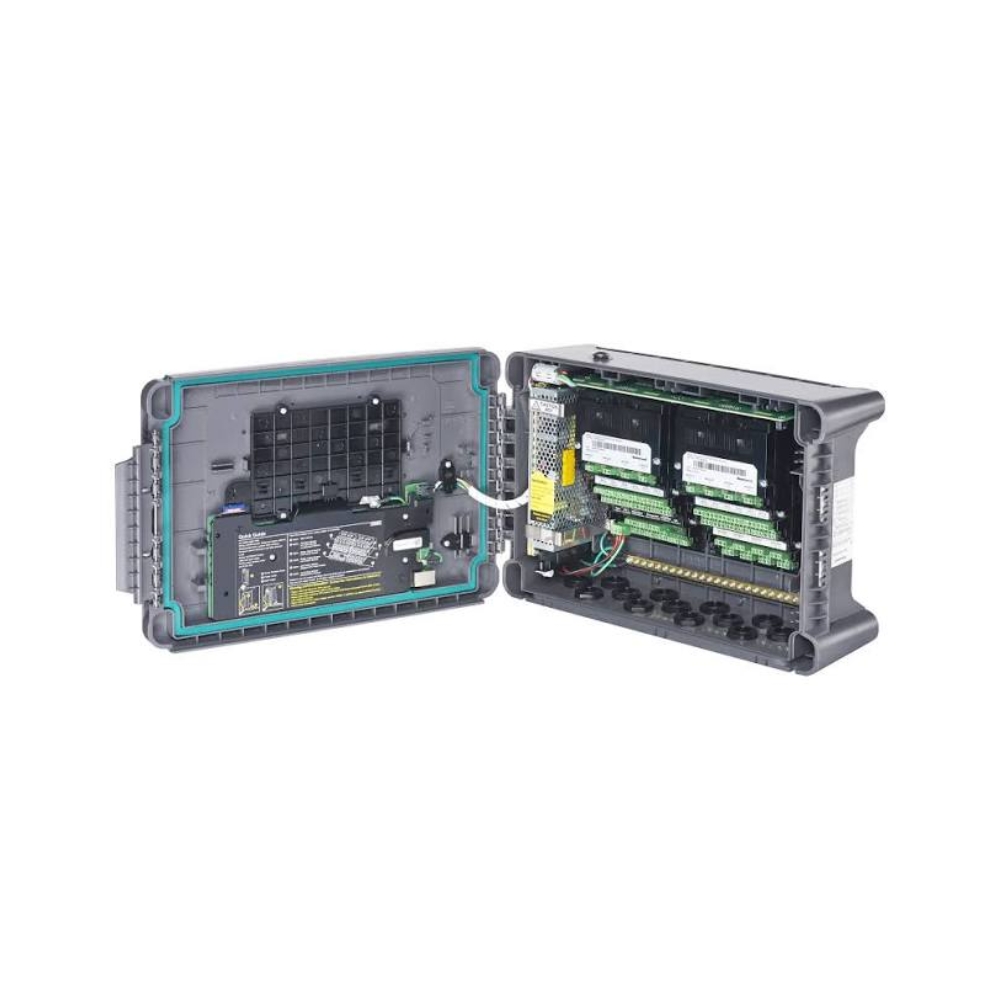
Cable entries come pre drilled and sealed, and the hinged front cover opens onto a tiered terminal arrangement with plenty of wiring space. It can mount directly on a wall, or on an optional mounting plate for an easier one person installation.
The base unit weighs up to 8.5 kg, or up to 17 kg with the expansion unit, so mounting needs a properly fixed vertical surface rather than a plasterboard wall.
Power and Backup
AC (110/220 VAC) and DC (18 to 32 VDC) power options are available, with an optional backup battery giving more than 30 minutes for a typical system. The base and expansion units each need their own power supply.
Maximum power consumption is 105 W including detectors and external devices, or 210 W with the expansion unit. That’s worth checking at design stage, as a sixteen channel system with power hungry infrared detectors needs the budget checked, not assumed.
Battery backup is worth specifying where the gas hazard doesn’t disappear when the power does. A refrigerant leak in a plant room carries on during an outage, and so does a fermentation cellar filling with carbon dioxide.
Approvals
Touchpoint Plus is assessed to IEC 61508 SIL 2, holds MED marine approval, and is approved for Class I, Division 2, Groups A to D or non hazardous locations. Performance approvals include EN 60079-29-1, EN 45544 and EN 50104.
Configured at Order
Touchpoint Plus is ordered as a configuration rather than off a shelf. You specify base or expansion unit, AC or DC power, the input modules, relay and mA output options, battery backup and communications.
That means a quote needs a short conversation rather than a part number, and the panel arrives set up for the job. Our engineering team can work through the configuration against your detector schedule.
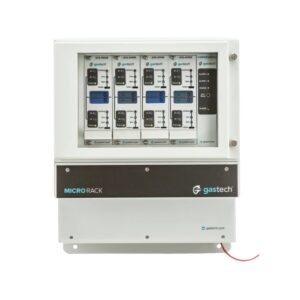
Where It Sits Against the MicroRack
Both are wall mounted controllers for small to medium systems, and the choice is straightforward.
| MicroRack | Touchpoint Plus | |
|---|---|---|
| Channels | 1 to 8 | 8, or 16 with expansion |
| Interface | Backlit graphical display per channel | 7 inch colour touchscreen |
| Data logging | Not stated | SD card, with optional Modbus TCP and web monitoring |
| Power | 240 or 110 V AC built in | 110/220 VAC or 18 to 32 VDC, optional backup battery |
| Housing | IP65 powder coated aluminium | IP65 and NEMA 4X polycarbonate ABS |
| Expansion | Add cards, user upgradeable | Add an expansion unit |
The MicroRack suits one to eight channels where reliability engineering and simple growth matter most. Touchpoint Plus suits systems above eight channels, or any system where the operator interface, alarm logic and data record are worth paying for.
Where It’s Used
Plant and boiler rooms, laboratory buildings, beverage cellars and dispense areas, cold stores and refrigeration plant, workshops and vehicle bays, wastewater treatment buildings, water treatment and chemical dosing rooms, small chemical manufacturing sites, building services and mechanical plant, marine installations, and sites upgrading a panel while keeping existing detectors.
Benefits
- Up to sixteen channels from one wall mounted unit, eight in the base and eight more with an expansion unit
- 7 inch colour touchscreen replaces menu keys, so configuration and calibration are done by touch
- Multilingual interface cuts training time and cost across a mixed workforce
- Historical data downloads, so a developing problem shows as a trend rather than a surprise
- Accepts 4-20 mA detectors and Honeywell mV bridge catalytic sensors on one panel
- Works with 4 to 20 mA detectors from other manufacturers, so existing detection is not stranded
- Powered alarm relays built in, plus dedicated outputs for remote audio and visual indicators
- Voting and grouping alarm logic set up without specialist knowledge
- IP65 and NEMA 4X rated, SIL 2 assessed to IEC 61508, with MED marine approval
- Optional Modbus RTU and Modbus TCP with web monitoring for higher level systems
Operating temperature
-10°C to +55°C, up to 95% RH non condensing
Dimensions
426 x 300 x 156 mm
Channel capacity
8 in the base unit, up to 16 with an expansion unit
Architecture
Modular, wall mounted
Display
7 inch colour LCD touchscreen. 3 master LEDs and an LED for each channel (green normal, yellow fault or inhibit, red alarm). Sounder at least 70 dB at 1 m
Interface
Multilingual: English, French, German, Italian, Dutch, Spanish, Portuguese, Russian, Chinese
Data
Datalogging to SD card: configuration, logged events and data
Inputs
2 or 3 wire 4-20 mA (2, 4 or 8 channel modules). 3 wire mV bridge for Honeywell catalytic detectors (2, 4 or 8 channel modules). Dual mA and mV modules. Max 15 W per channel
Detector compatibility
Honeywell fixed detectors, plus 4 to 20 mA detectors from other manufacturers
Relay outputs
12 or 24 changeover relays, 1.7 A at 30 VDC or 250 VAC. Energised or de-energised, latching or non latching, time delay
Actuator control
Drives audible and visible signals and solenoid valves
Base unit signals
Master 1, Master 2 and Master Fault
Power options
110/220 VAC or 18 to 32 VDC. Optional 22.2 V lithium ion backup battery (more than 30 minutes for a typical system)
Maximum power consumption
105 W including detectors and external devices. 210 W with expansion unit
Enclosure material
Polycarbonate ABS
Ingress protection
IP65 and NEMA 4X
Electrical safety
CSA C22.2 No. 61010-1-04. UL 61010-1 and 508. LVD EN 61010-1
Weight
Up to 8.5 kg base unit. Up to 17 kg with expansion unit
Approvals
IEC 61508 SIL 2. MED marine. Class I, Division 2, Groups A, B, C and D, or non hazardous only. EMC EN 50270:2015. Performance: EN 60079-29-1, EN 45544-1/-2/-3, EN 50104, EN 50271
- Aviation & Transportation
- Carpark & HVAC
- Chemical Manufacturing
- Confined Space & Compliance
- Energy (Oil & Gas)
- Food & Beverage
- Landfill & Remediation
- Marine & Maritime
- Medical & Healthcare
- Mining & Minerals
- Power Generation & BESS
- Technology & Semiconductor
- Water & Wastewater
Eight in the base unit, and up to sixteen when an expansion unit is fitted.
Yes, if they're Honeywell catalytic detectors. Touchpoint Plus has mV bridge input modules for Honeywell catalytic sensors, so they connect directly. Catalytic sensors from other manufacturers need checking, so talk to our Technical Consultants.
Yes, it accepts 4 to 20 mA signals from other manufacturers' fixed detectors alongside Honeywell's own range.
Yes, it drives solenoid valves and actuators directly, as well as audible and visual alarm devices.
Yes. The polycarbonate ABS enclosure is rated IP65 and NEMA 4X, and operates from -10°C to +55°C, so it suits mechanical rooms and chemical plants as well as control rooms.
With the optional battery backup fitted, yes. Worth specifying where the hazard continues during an outage.
Trusted by









Contact Us
Can’t find what you’re looking for? Our team is happy to help.